Replica Tensor Train
Pith reviewed 2026-05-08 09:46 UTC · model grok-4.3
The pith
A replica tensor train variational ansatz finds ground states of local Hamiltonians algebraically without gradient descent.
A machine-rendered reading of the paper's core claim, the machinery that carries it, and where it could break.
Core claim
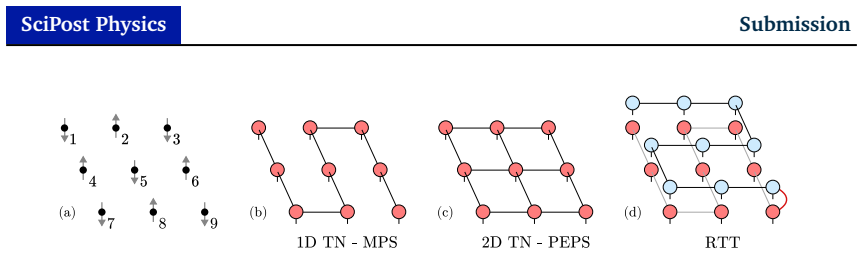
The replica tensor train is built by taking a tensor train and applying a set of non-local operators that identify several indices with the same physical index. The resulting manifold inherits the ability to form linear combinations of states and to apply a restricted class of operators, so the ground state of any local Hamiltonian can be found by purely algebraic operations identical to those used in standard tensor-network algorithms. Because the states obey a volume law, physical observables are inaccessible by direct contraction and must be sampled with Markov Chain Monte Carlo; the same algebraic structure further allows Krylov-subspace ground-state methods to be constructed inside the
What carries the argument
The replica tensor train (RTT) ansatz obtained by applying non-local operators to a tensor train so that multiple indices become identical physical indices, which supplies both volume-law entanglement and the algebraic closure needed for ground-state search.
Load-bearing premise
The replica tensor train manifold must be expressive enough to represent the target ground state and the Markov Chain Monte Carlo sampling must converge without prohibitive autocorrelation or sign problems.
What would settle it
Apply the algebraic procedure to a small two-dimensional spin system whose exact ground-state energy is known by full diagonalization; a variational energy appreciably above the exact value would show that the manifold fails to reach the true ground state.
Figures
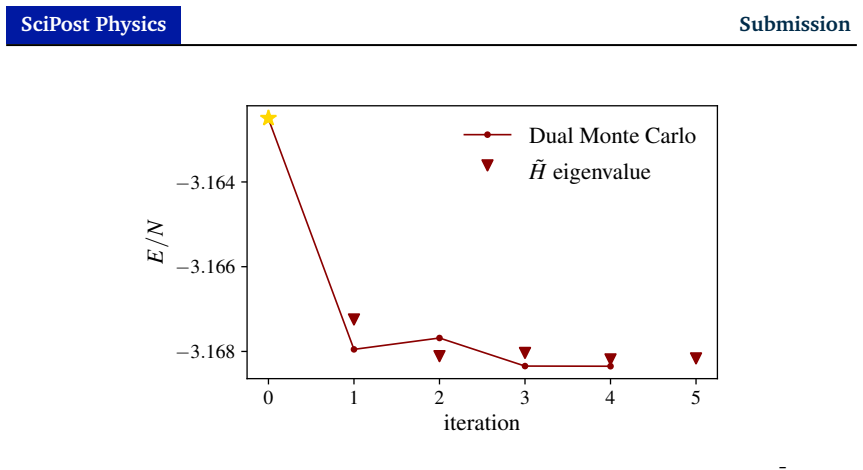
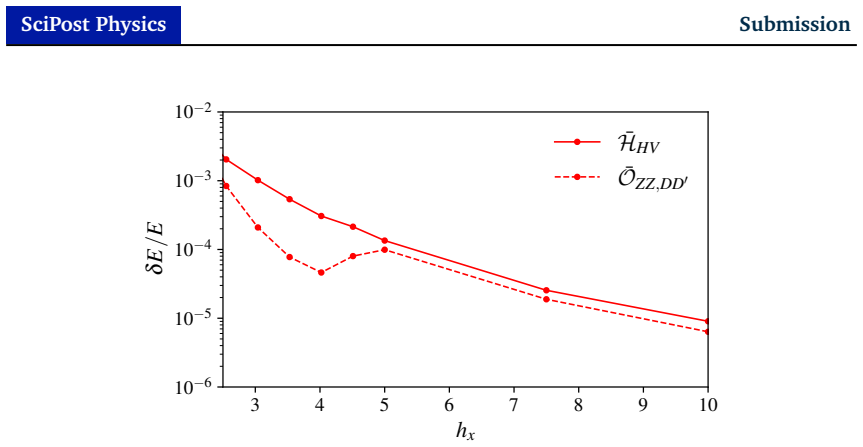
read the original abstract
We describe a numerical many-body technique that is based on both tensor networks and quantum Monte Carlo. The variational ansatz is a tensor network that can harvest volume-law entanglement. It is constructed from a tensor train to which one applies a set of non-local operators that force several indices of the tensor train to represent the same physical index, hence its name -- replica tensor train (RTT). From the tensor network toolbox, it inherits the possibility to make linear combinations of these states and apply a certain class of operators. We can therefore find the ground-state of a local Hamiltonian in a purely algebraic way as in standard tensor network algorithms -- i.e. without using gradient descent methods. On the other hand, the volume-law structure forbids calculating physical observables directly. In much the same way as on a quantum computer where one can prepare a state but can only sample it at the end, here we have to use Markov Chain Monte Carlo to compute the observables. We further show that the approach can be extended to build Krylov-subspace ground-state methods within the variational manifold. We illustrate the different algorithms on a two-dimensional spin model with a transverse magnetic field, which can be solved by this approach at low computational cost.
Editorial analysis
A structured set of objections, weighed in public.
Referee Report
Summary. The manuscript introduces the Replica Tensor Train (RTT) ansatz, a tensor-network variational wavefunction constructed from a tensor train with replicated indices to represent volume-law entanglement. It leverages standard tensor-network operations for linear combinations and application of a class of operators, enabling algebraic ground-state searches for local Hamiltonians without gradient descent. Due to the volume-law structure, physical observables cannot be computed directly and require Markov Chain Monte Carlo sampling instead. The approach is extended to Krylov-subspace methods, and the algorithms are illustrated on the two-dimensional transverse-field Ising model.
Significance. If the central claims hold, the RTT provides a hybrid tensor-network/QMC framework that can variationally optimize states with volume-law entanglement using algebraic operations while delegating measurements to sampling. This could extend tensor-network techniques beyond area-law limited regimes and offer an alternative to gradient-based variational methods for certain quantum many-body problems.
major comments (2)
- [Abstract] Abstract: the claim that the ground state can be found 'in a purely algebraic way as in standard tensor network algorithms -- i.e. without using gradient descent methods' is load-bearing for the central contribution, yet the manuscript states that volume-law entanglement 'forbids calculating physical observables directly' and requires MCMC. It is unclear how the algebraic procedure (including the mentioned Krylov-subspace extension) identifies the lowest-energy state without evaluating energy expectation values or overlaps, which would appear to necessitate sampling.
- [Krylov-subspace methods] Krylov-subspace extension (described after the basic RTT construction): repeated Hamiltonian applications and subspace orthogonalization in Krylov methods typically require computing inner products and norms. The manuscript does not specify whether these can be performed purely algebraically within the RTT manifold or whether they invoke MCMC sampling, which would undermine the 'purely algebraic' distinction from gradient-based methods.
minor comments (2)
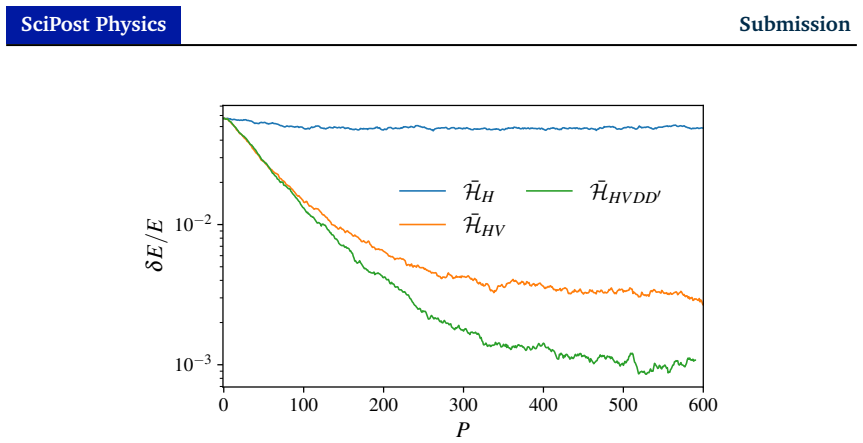
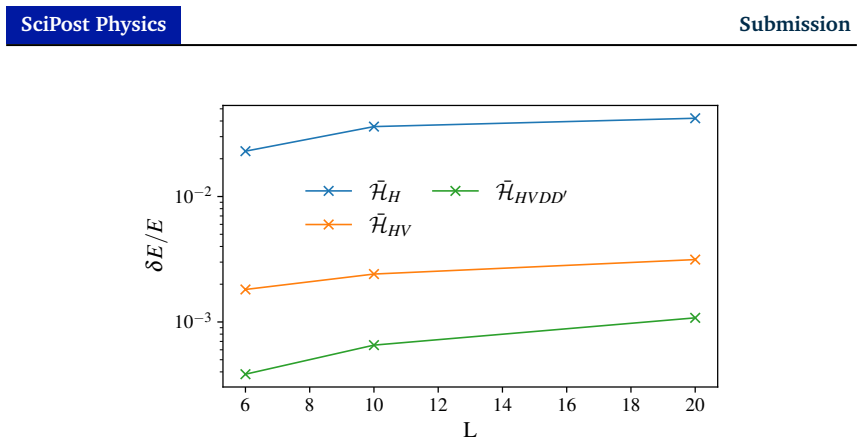
- [Numerical illustration] The illustration on the 2D transverse-field Ising model would benefit from explicit error bars, comparison to established methods (e.g., DMRG or QMC), and details on the chosen replica number and bond dimension to assess the claimed low computational cost.
- [RTT construction] Notation for the replica indices and the precise class of operators that can be applied algebraically is introduced only briefly; a short appendix with the explicit tensor diagram or pseudocode would improve reproducibility.
Simulated Author's Rebuttal
We thank the referee for their constructive comments on our manuscript introducing the Replica Tensor Train (RTT) method. We appreciate the opportunity to clarify the aspects of our approach regarding the algebraic optimization and its distinction from sampling-based computations. Below, we provide point-by-point responses to the major comments.
read point-by-point responses
-
Referee: [Abstract] Abstract: the claim that the ground state can be found 'in a purely algebraic way as in standard tensor network algorithms -- i.e. without using gradient descent methods' is load-bearing for the central contribution, yet the manuscript states that volume-law entanglement 'forbids calculating physical observables directly' and requires MCMC. It is unclear how the algebraic procedure (including the mentioned Krylov-subspace extension) identifies the lowest-energy state without evaluating energy expectation values or overlaps, which would appear to necessitate sampling.
Authors: We agree that this point requires clarification in the manuscript. The purely algebraic ground-state search is enabled by the RTT's inheritance of tensor-network operations, specifically the ability to form linear combinations of states and to apply local operators (such as the Hamiltonian) exactly via tensor contractions. This permits us to optimize the variational parameters or identify the optimal state in the manifold through algebraic manipulations, analogous to standard TN algorithms like DMRG, without the need for gradient descent. While general physical observables must be sampled via MCMC due to the volume-law entanglement, the energy minimization during the search leverages the local nature of the Hamiltonian and the algebraic structure to avoid sampling. We will revise the abstract and add a dedicated subsection explaining the optimization algorithm in detail, including how energy and overlaps are handled algebraically in this context. revision: yes
-
Referee: [Krylov-subspace methods] Krylov-subspace extension (described after the basic RTT construction): repeated Hamiltonian applications and subspace orthogonalization in Krylov methods typically require computing inner products and norms. The manuscript does not specify whether these can be performed purely algebraically within the RTT manifold or whether they invoke MCMC sampling, which would undermine the 'purely algebraic' distinction from gradient-based methods.
Authors: The inner products and norms in the Krylov-subspace construction are computed algebraically using the tensor operations available within the RTT ansatz. Since the method allows exact linear combinations and operator applications, the Gram matrix elements and other quantities needed for orthogonalization and diagonalization can be obtained without sampling. This maintains the algebraic character of the procedure. We will update the manuscript to explicitly state this and provide pseudocode or a step-by-step description of the Krylov implementation to address this concern. revision: yes
Circularity Check
No circularity: RTT ground-state search is an independent algebraic construction from tensor-network operations.
full rationale
The paper constructs the replica tensor train ansatz explicitly from a tensor train by applying non-local operators that identify indices, then inherits linear-combination and operator-application rules directly from the tensor-network toolbox. The claim of finding the ground state 'in a purely algebraic way ... without using gradient descent methods' follows from those inherited operations and is presented as a direct consequence of the construction rather than a fitted parameter or self-referential definition. Observables are handled separately via MCMC because of volume-law entanglement, but this separation is stated explicitly and does not reduce the algebraic-search claim to the MCMC step. No equations or steps in the provided description equate the target result to its inputs by construction, and no load-bearing self-citations or uniqueness theorems are invoked. The derivation therefore remains self-contained.
Axiom & Free-Parameter Ledger
axioms (2)
- domain assumption The RTT manifold supports exact algebraic ground-state optimization via linear algebra operations on the tensor network.
- domain assumption Markov Chain Monte Carlo sampling on the RTT state converges to accurate observables at acceptable cost.
invented entities (1)
-
Replica Tensor Train (RTT) ansatz
no independent evidence
Reference graph
Works this paper leans on
-
[1]
, " * write output.state after.block =
ENTRY address archive author booktitle chapter doi edition editor eid eprint howpublished institution isbn journal key month note number organization pages publisher school series title type url volume year label INTEGERS output.state before.all mid.sentence after.sentence after.block FUNCTION init.state.consts #0 'before.all := #1 'mid.sentence := #2 'af...
-
[2]
" write newline "" before.all 'output.state := FUNCTION n.dashify 't := "" t empty not t #1 #1 substring "-" = t #1 #2 substring "--" = not "--" * t #2 global.max substring 't := t #1 #1 substring "-" = "-" * t #2 global.max substring 't := while if t #1 #1 substring * t #2 global.max substring 't := if while FUNCTION word.in bbl.in capitalize " " * FUNCT...
discussion (0)
Sign in with ORCID, Apple, or X to comment. Anyone can read and Pith papers without signing in.