Dalitz Plot Kinematics for a Lorentz-Violating Three-Body Decay
Pith reviewed 2026-05-09 20:42 UTC · model grok-4.3
The pith
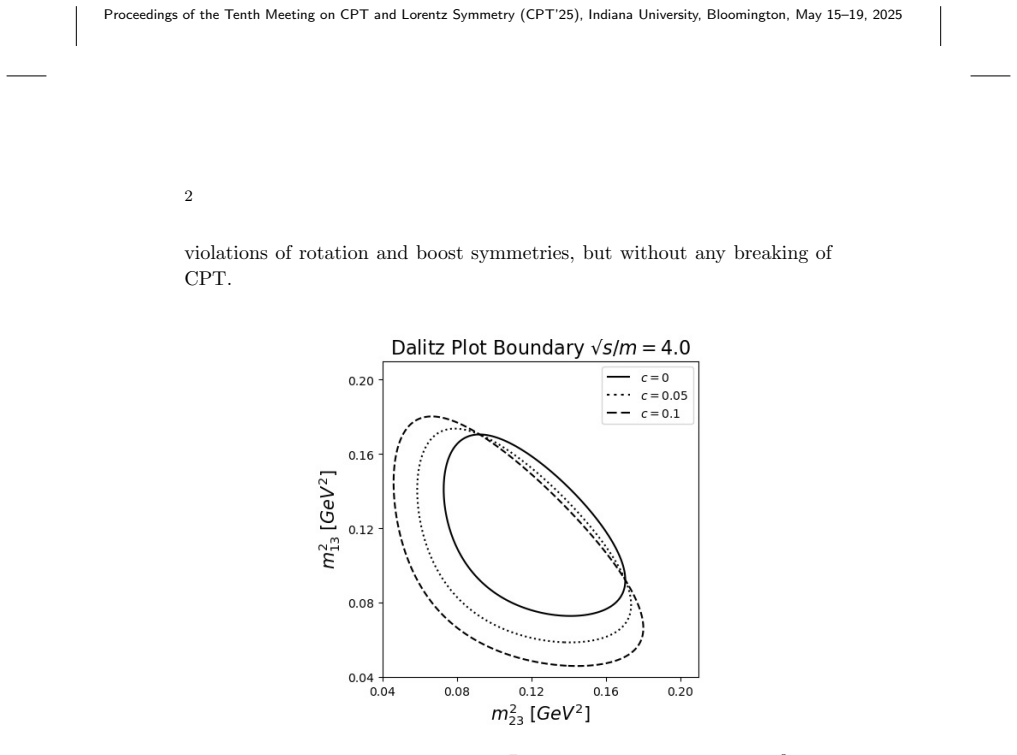
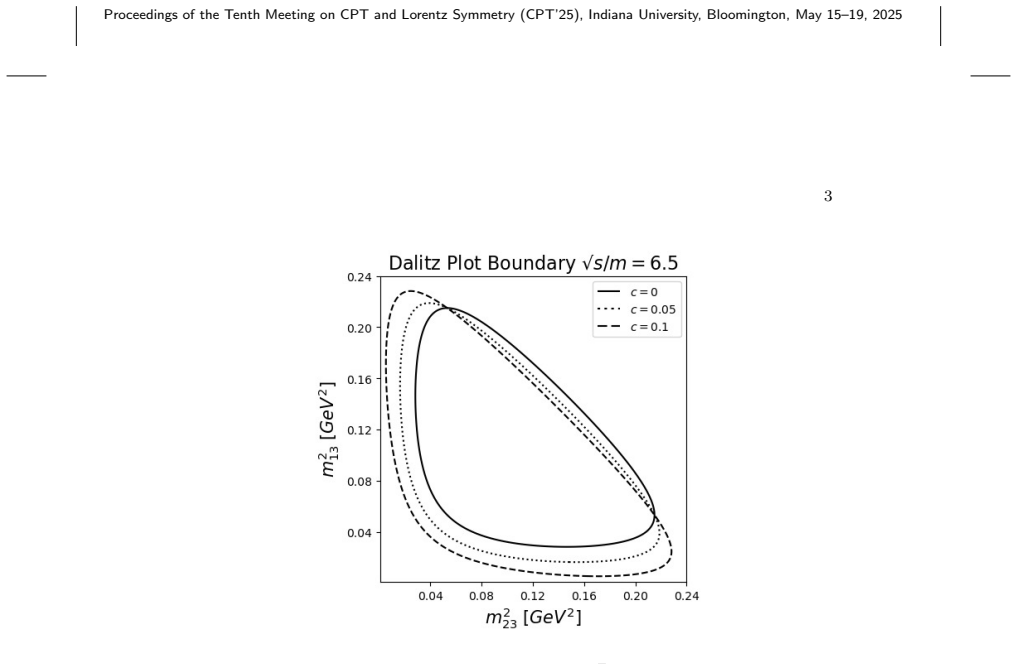
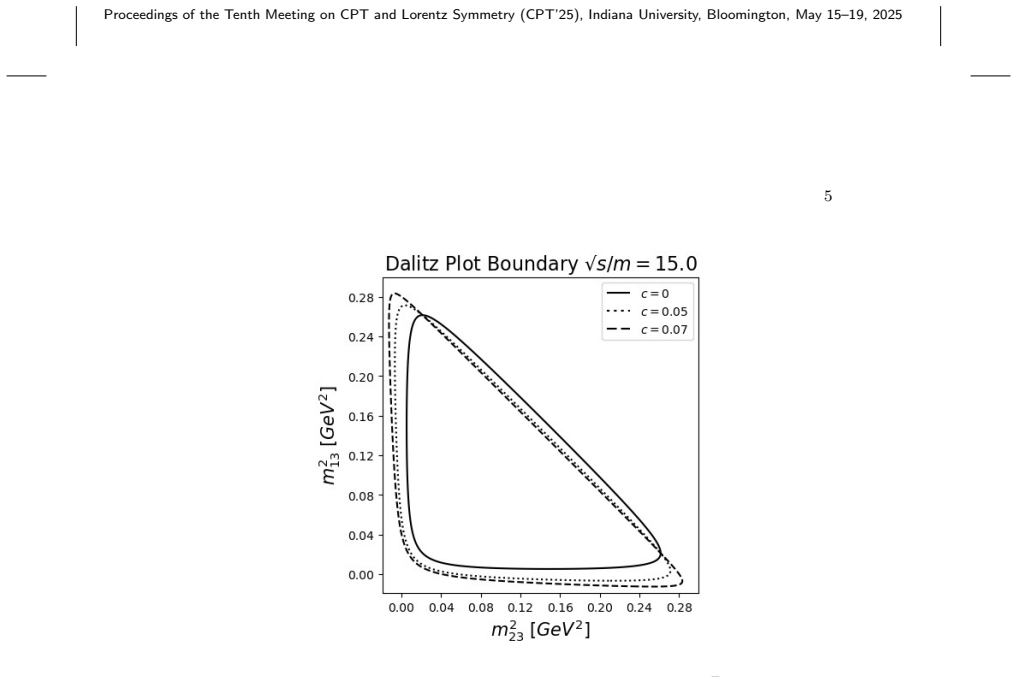
The kinematics of three-body decays can be analyzed using Dalitz plots modified by leading-order Lorentz violation in quantum field theory.
A machine-rendered reading of the paper's core claim, the machinery that carries it, and where it could break.
Core claim
The paper outlines the analysis of three-particle interactions and decay processes for leading-order modifications in a Lorentz-violating quantum field theory, specifically through the kinematics of Dalitz plots for three-body decays.
What carries the argument
Modified Dalitz plot variables that encode the leading-order effects of Lorentz violation on the momenta and energies in three-body decays.
If this is right
- Dalitz plots become sensitive to leading-order Lorentz-violating corrections in the decay kinematics.
- Three-particle interaction analyses must include modified energy-momentum relations at the lowest order in the violation parameters.
- Decay rates and distributions can be recalculated with these kinematic shifts to compare against data.
- The method applies directly to any three-body process where Lorentz violation is considered perturbatively.
Where Pith is reading between the lines
- The outlined method could be applied to specific Lorentz-violating models to derive bounds from existing decay data.
- Similar kinematic adjustments might extend to four-body decays or scattering processes if the leading-order approximation remains valid.
- This framework connects to tests of Lorentz invariance in other high-energy contexts like neutrino oscillations or cosmic rays.
Load-bearing premise
Leading-order modifications in a Lorentz-violating QFT are sufficient to capture the dominant kinematic effects in three-body decays without higher-order terms or inconsistencies in the underlying theory.
What would settle it
A high-precision measurement of the Dalitz plot for a known three-body decay such as eta to three pions that shows deviations neither explained by standard kinematics nor by the leading-order Lorentz-violating corrections.
Figures
read the original abstract
We outline the analysis of three-particle interactions and decay processes for leading-order modifications in a Lorentz-violating quantum field theory.
Editorial analysis
A structured set of objections, weighed in public.
Referee Report
Summary. The manuscript outlines an analysis of three-particle interactions and decay processes incorporating leading-order Lorentz-violating modifications in quantum field theory, with emphasis on the resulting Dalitz plot kinematics for three-body decays.
Significance. Lorentz violation effects in decay kinematics could provide testable signatures in high-energy physics if concrete modifications to dispersion relations or phase space are derived. As an outline without explicit results or derivations, the work has limited immediate impact but could serve as a starting point if expanded.
major comments (1)
- The manuscript provides no equations, derivations, or sections detailing how leading-order LV modifications alter the dispersion relations, energy-momentum conservation, or Dalitz plot boundaries for the three-body decay. This absence makes it impossible to assess whether the approach yields consistent kinematics or avoids known LV pitfalls such as frame dependence.
Simulated Author's Rebuttal
We thank the referee for their review of our manuscript. We respond point by point to the major comment below.
read point-by-point responses
-
Referee: The manuscript provides no equations, derivations, or sections detailing how leading-order LV modifications alter the dispersion relations, energy-momentum conservation, or Dalitz plot boundaries for the three-body decay. This absence makes it impossible to assess whether the approach yields consistent kinematics or avoids known LV pitfalls such as frame dependence.
Authors: The manuscript is explicitly framed as an outline of the methodological approach for incorporating leading-order Lorentz-violating modifications into the kinematics of three-body decays using Dalitz plots. We acknowledge that the lack of explicit equations and derivations prevents a full evaluation of the resulting kinematics and any potential inconsistencies, such as frame dependence. To address this concern, we will prepare a revised version that includes the leading-order corrections to the dispersion relations, the adjusted four-momentum conservation conditions for the decay, the modified Dalitz plot boundaries, and a discussion of reference-frame choices to mitigate frame-dependence issues. revision: yes
Circularity Check
No derivation chain or equations present; paper is purely an outline statement
full rationale
The provided text consists solely of a one-sentence abstract stating an intent to outline analysis of three-particle decays under leading-order Lorentz violation. No equations, dispersion relations, phase-space modifications, Dalitz-plot expressions, or any derivation steps appear. No parameters are fitted, no self-citations are invoked as load-bearing premises, and no predictions are claimed that could reduce to inputs by construction. The absence of any mathematical content means there are no load-bearing steps to inspect for circularity of any enumerated kind. The work is self-contained as a high-level statement of intent and requires no external verification of hidden equivalences.
Axiom & Free-Parameter Ledger
Reference graph
Works this paper leans on
-
[1]
R. Lehnert, R. Potting, Phys. Rev. D70, 125010 (2004); erratumibid.70, 129906 (2004)
work page 2004
- [2]
- [3]
- [4]
- [5]
-
[6]
A. Alonso Izquierdo, W. Garcia Fuertes, M. A. Gonzalez Leon, J. Mateos Guilarte, Nucl. Phys. B635, 525 (2002)
work page 2002
-
[7]
A. V. Anisovich, H. Leutwyler, Phys. Lett. B375, 335 (1996)
work page 1996
- [8]
- [9]
-
[10]
K. K. Vos, H. W. Wilschut, R. G. E. Timmermans, Rev. Mod. Phys.87, 1483 (2015)
work page 2015
- [11]
- [12]
- [13]
discussion (0)
Sign in with ORCID, Apple, or X to comment. Anyone can read and Pith papers without signing in.