On the Existence of an Inverse Solution for Preference-Based Reductions in Argumentation
Pith reviewed 2026-05-08 11:42 UTC · model grok-4.3
The pith
Determining if some preference relation can produce a given labelling under standard reductions from preference-based to abstract argumentation is possible in polynomial time for most cases.
A machine-rendered reading of the paper's core claim, the machinery that carries it, and where it could break.
Core claim
Under the complete semantics, for each of the four widely-used reductions that map a preference relation over arguments into a set of defeats, the problem of deciding whether there exists a preference relation capable of yielding a prescribed labelling on a given argumentation graph is solvable in polynomial time except in a small number of residual cases.
What carries the argument
The inverse decision problem that takes a graph, a labelling and a semantics and returns whether a preference relation exists that produces the labelling via one of the four standard reductions.
If this is right
- Preference elicitation from observed labellings becomes computationally feasible for these frameworks.
- Explanations of argument acceptance can be produced by recovering the preferences that justify the labelling.
- Verification that a given outcome is consistent with some preference ordering can be done efficiently.
- The same polynomial-time procedures apply directly whenever the complete semantics and one of the four reductions are used.
Where Pith is reading between the lines
- The technique could be lifted to other semantics such as preferred or stable if analogous reductions are shown to preserve the polynomial bound.
- In multi-agent settings the same decision procedure might be used to infer collective preferences from collective labellings.
- Implementation in existing argumentation toolkits would allow users to test consistency of proposed preferences against observed behaviour.
Load-bearing premise
The four standard preference-based reductions and the complete semantics are assumed to work exactly as previously defined in the literature.
What would settle it
A concrete graph together with a labelling for which, under one of the four reductions, no polynomial-time procedure can correctly decide whether a suitable preference relation exists.
Figures
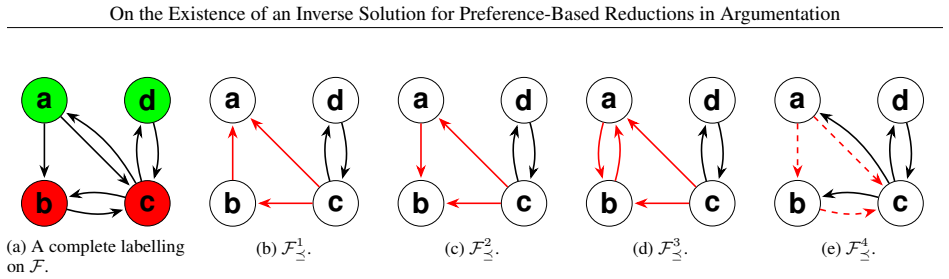

read the original abstract
Preference-based argumentation frameworks (PAFs) extend Dung's approach to abstract argumentation (AAFs) by encoding preferences over arguments. Such preferences control the transformation of attacks into defeats, and different approaches to doing so result in different reductions from a PAF to an AAF. In this paper we consider a PAF inverse problem which takes an argumentation graph, a labelling and a semantics as an input, and outputs a ``yes" or ``no" as to whether there is a preference relation between the arguments which can yield the desired labelling. This inverse problem has applications in areas including preference elicitation and explainability. We consider this problem in the context of the four most widely-used preference based reductions under the complete semantics. We show that in most cases, the problem can be answered in polynomial time.
Editorial analysis
A structured set of objections, weighed in public.
Referee Report
Summary. The paper considers the inverse problem for preference-based argumentation frameworks (PAFs) under complete semantics. It takes as input an argumentation graph, a labelling, and a semantics, and determines whether there exists a preference relation that, via one of the four widely-used reductions, produces the desired labelling. The main contribution is showing that this decision problem is solvable in polynomial time in most cases, by reducing it to acyclicity checks or 2-SAT instances.
Significance. This work offers efficient algorithms for an inverse problem with applications in preference elicitation and explainability in argumentation systems. By grounding the solutions in standard polynomial-time problems like graph acyclicity and 2-SAT, the results are both theoretically sound and practically implementable. The explicit constraint-based algorithms provide a clear path for verification and extension.
minor comments (2)
- Consider adding a summary table in the conclusion or results section that lists the four reductions and their respective complexity results for the inverse problem.
- The abstract mentions 'most cases' but does not specify which reductions fall into the polynomial category; a brief clarification would improve readability.
Simulated Author's Rebuttal
We thank the referee for their positive evaluation of our manuscript and for recommending minor revision. We are pleased that the significance of our polynomial-time results for the inverse problem in preference-based argumentation frameworks under complete semantics has been recognized, particularly the grounding in acyclicity checks and 2-SAT.
Circularity Check
No significant circularity in the derivation chain
full rationale
The paper establishes polynomial-time solvability for the inverse preference problem by providing explicit constraint-based algorithms that reduce the existence of a suitable preference relation directly to acyclicity checks on a derived graph or to 2-SAT instances constructed from the input attack graph and labelling. These constructions use only the standard definitions of the four preference-based reductions and complete semantics taken from the prior literature. No equations or steps in the derivation are self-definitional, no fitted parameters are relabeled as predictions, and no load-bearing claims rest on self-citations or imported uniqueness results. The result is therefore self-contained against external graph-theoretic and complexity benchmarks.
Axiom & Free-Parameter Ledger
axioms (2)
- domain assumption Standard definitions of the four preference-based reductions from PAFs to AAFs
- standard math Complete semantics for abstract argumentation frameworks
Reference graph
Works this paper leans on
-
[1]
URL https://dslpitt.org/uai/displayArticleDetails.jsp?mmnu=1&smnu=2&article_id=226& proceeding_id=14. L. Amgoud and C. Cayrol. Inferring from inconsistency in preference-based argumentation frameworks.Journal of Automated Reasoning, 29(2):125–169, 2002. L. Amgoud and S. Vesic. Handling inconsistency with preference-based argumentation. In A. Deshpande and...
-
[2]
URLhttps://doi.org/10.3233/978-1-61499-906-5-405
doi:10.3233/978-1-61499-906-5-405. URLhttps://doi.org/10.3233/978-1-61499-906-5-405. H. Kido and B. Liao. A bayesian approach to forward and inverse abstract argumentation problems.Journal of Applied Non-Classical Logics, 32(4):273–304, 2022. A. Libman, N. Oren, and B. Yun. Bases for weighted gradual semantics and inverse problems in argumentation theory....
discussion (0)
Sign in with ORCID, Apple, or X to comment. Anyone can read and Pith papers without signing in.