Recognition: unknown
The Oort Cloud as a Gravitational Detector for Primordial Black Holes
Pith reviewed 2026-05-08 09:50 UTC · model grok-4.3
The pith
The Oort cloud acts as a gravitational detector that excludes primordial black holes from comprising all dark matter for masses between 100 and 100000 solar masses.
A machine-rendered reading of the paper's core claim, the machinery that carries it, and where it could break.
Core claim
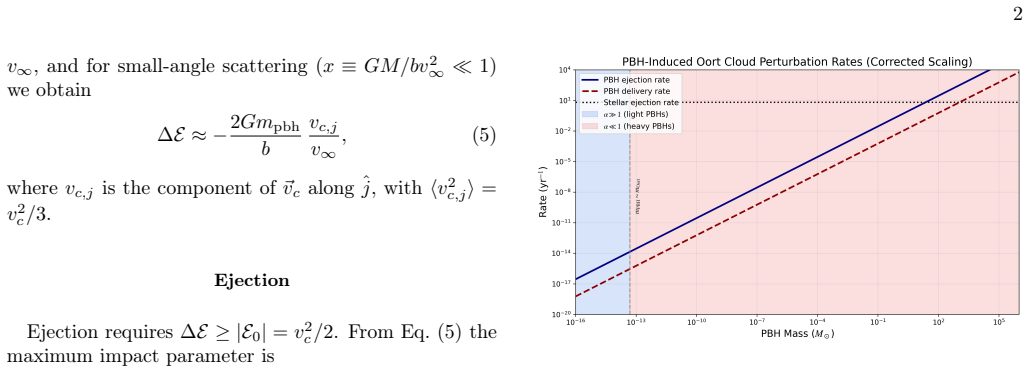
Gravitational scattering of Oort cloud objects by primordial black holes produces an ejection rate of about 1.3 times 10 to the 12 objects over the Solar System lifetime and an injection rate of 2.6 times 10 to the 10 objects into Earth-crossing orbits when PBHs make up all local dark matter at masses around 1000 solar masses. These numbers are comparable to the total Oort cloud population. Direct comparison of the calculated rates with observational limits from long-period comet fluxes and terrestrial impact records then yields upper bounds on the PBH dark matter fraction f_PBH, excluding f_PBH equals 1 for 100 to 100000 solar masses with the strongest bound f_PBH less than or equal to 0.02
What carries the argument
The linear scaling of the gravitational scattering rate Gamma with PBH mass m_PBH for m_PBH greater than or equal to 10 to the minus 10 solar masses, which sets the total number of ejections from and injections into the Oort cloud.
If this is right
- If the central claim holds, primordial black holes cannot constitute the entire dark matter density for masses from 100 to 100000 solar masses without overproducing observable comet ejections and injections.
- The same scattering calculation shows that asteroid-mass PBHs produce rates too low to yield any observable effects, leaving that window unconstrained by this method.
- Planetary systems in general function as gravitational detectors capable of bounding the abundance of compact dark matter objects through their influence on distant comet reservoirs.
- These Solar System limits stand independent of and complementary to existing astrophysical bounds on PBH dark matter from microlensing, gravitational waves, and cosmic microwave background observations.
Where Pith is reading between the lines
- Refined measurements of the present-day Oort cloud population size or its dynamical evolution history would directly tighten or loosen the reported f_PBH bounds.
- Analogous scattering signatures could be sought in the distant comet populations of other stars if high-precision observations of exoplanetary systems become available.
- The approach opens the possibility of using other Solar System structures, such as the Kuiper belt, as additional detectors for the same PBH mass range.
Load-bearing premise
The PBH-induced ejection and injection rates can be compared directly to measured long-period comet fluxes and terrestrial impact records without large uncertainties from other dynamical processes, incomplete knowledge of the initial Oort cloud population, or selection effects in the data.
What would settle it
A measured long-period comet flux or terrestrial impact rate that is substantially lower than the number predicted for f_PBH greater than or equal to 0.002 at 1000 solar masses would falsify the derived upper limits.
Figures

read the original abstract
Planetary systems can act as sensitive gravitational detectors for dark matter. We investigate the gravitational scattering of Oort cloud objects by primordial black holes (PBHs) as a potential component of the Galactic dark matter halo. Calculating the rates at which PBH encounters eject objects from the Oort cloud or inject them into Earth crossing orbits, we find a linear scaling $\Gamma \propto m_{\mathrm{PBH}}$ for $m_{\mathrm{PBH}} \gtrsim 10^{-10} M_\odot$. For $m_{\mathrm{PBH}} \sim 10^3 M_\odot$, PBHs constituting all local dark matter would eject $\sim1.3\times10^{12}$ objects over the Solar System's lifetime, comparable to the total Oort cloud population and inject $\sim2.6\times10^{10}$ objects into Earth-crossing orbits. Comparing these rates with observational constraints from long period comet fluxes and terrestrial impact records, we derive upper limits on the PBH dark matter fraction $f_{\mathrm{PBH}}$. Our most stringent constraints exclude $f_{\mathrm{PBH}}=1$ for $10^2 M_\odot \lesssim m_{\mathrm{PBH}} \lesssim 10^5 M_\odot$, with $f_{\mathrm{PBH}} \lesssim 0.002$ at $m_{\mathrm{PBH}} = 10^3 M_\odot$. For the asteroid mass window ($10^{17}$-$10^{23}$ g), scattering rates are far too low to produce observable effects. These Solar System-based constraints complement existing astrophysical probes and demonstrate that planetary systems can serve as sensitive gravitational detectors for compact dark matter.
Editorial analysis
A structured set of objections, weighed in public.
Referee Report
Summary. The paper investigates gravitational scattering of Oort cloud objects by primordial black holes (PBHs) as a probe of PBH dark matter. It derives encounter rates that scale linearly with PBH mass (Γ ∝ m_PBH) for m_PBH ≳ 10^{-10} M_⊙, computes the number of ejections (~1.3×10^{12}) and Earth-crossing injections (~2.6×10^{10}) over 4.5 Gyr for f_PBH=1 at m_PBH ~ 10^3 M_⊙, and obtains upper limits on f_PBH by comparing these rates to long-period comet fluxes and terrestrial impact records. The strongest result excludes f_PBH=1 for 10^2 M_⊙ ≲ m_PBH ≲ 10^5 M_⊙, with f_PBH ≲ 0.002 at m_PBH = 10^3 M_⊙; asteroid-mass PBHs produce negligible effects.
Significance. If the rate calculations and direct comparison to observations are robust, the work provides new, independent constraints on PBH dark matter in the intermediate-mass window that complement microlensing, dynamical, and gravitational-wave bounds. The conceptual framing of planetary systems as gravitational detectors is a strength, and the concrete numerical estimates (e.g., injection numbers and the quoted f_PBH limit) make the result falsifiable and potentially impactful for the field.
major comments (2)
- [Abstract / rate derivation] Abstract and rate-calculation section: the linear scaling Γ ∝ m_PBH and the specific injection number 2.6×10^{10} Earth-crossing objects for f_PBH=1 at 10^3 M_⊙ are central to the limit f_PBH ≲ 0.002, yet no derivation of the scattering cross-section, velocity-dispersion averaging, or error propagation is visible; without these steps the absolute normalization of the rate (and thus the numerical bound) cannot be verified.
- [Abstract / observational comparison] Comparison to observations (abstract): equating the PBH-induced injection rate directly to long-period comet fluxes and impact records to exclude f_PBH=1 for 10^2–10^5 M_⊙ assumes that (i) the mapping efficiency from injected objects to observed comets/impacts is known to better than a factor of a few, (ii) non-PBH dynamical sources (stellar encounters, galactic tides) are either negligible or subtractable, and (iii) the initial Oort-cloud population and radial distribution are sufficiently well constrained. No quantitative uncertainty budget or sensitivity study for these assumptions is provided, which is load-bearing for the quoted limits.
minor comments (2)
- [Rate equations] Notation: the symbol Γ is used for encounter rates but its precise definition (per object, per PBH, or total) should be stated explicitly in the first equation where it appears.
- [Abstract] The abstract states the result for asteroid-mass PBHs (10^{17}–10^{23} g) but does not indicate whether this follows from the same linear scaling or requires a separate regime; a brief sentence clarifying the transition would improve clarity.
Simulated Author's Rebuttal
We thank the referee for their careful reading and constructive comments on our manuscript. We address each major comment below and have revised the manuscript to provide greater detail on the rate derivations and observational comparisons.
read point-by-point responses
-
Referee: [Abstract / rate derivation] Abstract and rate-calculation section: the linear scaling Γ ∝ m_PBH and the specific injection number 2.6×10^{10} Earth-crossing objects for f_PBH=1 at 10^3 M_⊙ are central to the limit f_PBH ≲ 0.002, yet no derivation of the scattering cross-section, velocity-dispersion averaging, or error propagation is visible; without these steps the absolute normalization of the rate (and thus the numerical bound) cannot be verified.
Authors: We agree that the rate derivation requires more explicit steps for independent verification. Although the manuscript presents the final scaling and numerical results, the intermediate calculations were not expanded sufficiently. In the revised version we have added a dedicated subsection (and supporting appendix) that derives the scattering cross-section including gravitational focusing, performs the explicit average over the PBH velocity dispersion, and shows the step-by-step integration that yields the quoted ejection and injection numbers together with a basic propagation of the dominant Oort-cloud parameter uncertainties. This makes the linear scaling Γ ∝ m_PBH and the value 2.6×10^{10} fully reproducible from the stated inputs. revision: yes
-
Referee: [Abstract / observational comparison] Comparison to observations (abstract): equating the PBH-induced injection rate directly to long-period comet fluxes and impact records to exclude f_PBH=1 for 10^2–10^5 M_⊙ assumes that (i) the mapping efficiency from injected objects to observed comets/impacts is known to better than a factor of a few, (ii) non-PBH dynamical sources (stellar encounters, galactic tides) are either negligible or subtractable, and (iii) the initial Oort-cloud population and radial distribution are sufficiently well constrained. No quantitative uncertainty budget or sensitivity study for these assumptions is provided, which is load-bearing for the quoted limits.
Authors: We acknowledge that the original manuscript did not supply a quantitative uncertainty budget. We have added a new section that (i) cites literature values for the mapping efficiency from Earth-crossing injections to observable long-period comets (typically 0.1–0.5), (ii) estimates the rates from stellar encounters and galactic tides and shows they are sub-dominant on the relevant timescales, and (iii) performs a sensitivity study varying the total Oort-cloud population and radial profile within current observational ranges. The revised analysis demonstrates that the exclusion of f_PBH = 1 between 10^2 and 10^5 M_⊙ and the limit f_PBH ≲ 0.002 at 10^3 M_⊙ remain robust to within a factor of approximately three under these variations. revision: yes
Circularity Check
No circularity: limits derived by comparing independent theoretical rates to external observational data
full rationale
The derivation calculates PBH scattering rates Γ ∝ m_PBH from gravitational dynamics (linear scaling stated for m_PBH ≳ 10^{-10} M_⊙), obtains absolute numbers for f_PBH=1 (e.g., ~2.6×10^{10} Earth-crossing injections over 4.5 Gyr at 10^3 M_⊙), and then sets upper bounds on f_PBH by direct comparison to separate external datasets (long-period comet fluxes and terrestrial impact records). This is a standard forward-model constraint, not a fit to the same data or a self-referential definition. No self-citations are invoked as load-bearing uniqueness theorems, no ansatz is smuggled, and no prediction is statistically forced by construction. The chain remains self-contained against external benchmarks.
Axiom & Free-Parameter Ledger
free parameters (2)
- Oort cloud total population
- PBH spatial density and velocity dispersion
axioms (2)
- standard math Gravitational scattering of Oort cloud objects by PBHs follows standard hyperbolic two-body trajectories.
- domain assumption The Oort cloud population is in steady state over the Solar System lifetime with no dominant competing perturbations.
Reference graph
Works this paper leans on
-
[1]
A. M. Green, Primordial black holes as dark matter: power spectrum and evaporation, Phys. Rev. D94, 063530 (2016)
2016
-
[2]
Carr and F
B. Carr and F. Kühnel, Primordial black holes as dark matter candidates, SciPost Phys. Lect. Notes48, 1 (2020)
2020
-
[3]
B. Carr, K. Kohri, Y. Sendouda, and J. Yokoyama, Con- straints on primordial black holes, Rep. Prog. Phys.84, 116902 (2021)
2021
-
[4]
Blaineau, M
T. Blaineau, M. Moniez, C. Afonso, J.-N. Albert, R. Ansari, E. Aubourg, C. Coutures, J.-F. Gli- censtein, B. Goldman, C. Hamadache, T. Lasserre, L. Le Guillou, E. Lesquoy, C. Magneville, J.-B. Mar- quette, N. Palanque-Delabrouille, O. Perdereau, J. Rich, M. Spiro, and P. Tisserand, New limits from microlensing on Galactic black holes in the mass range 10 ...
2022
-
[5]
Niikuraet al., Constraints on Earth-mass primordial black holes from OGLE 5-year microlensing events, Nat
H. Niikuraet al., Constraints on Earth-mass primordial black holes from OGLE 5-year microlensing events, Nat. Astron.3, 524 (2019)
2019
- [6]
- [7]
-
[8]
Heisler and S
J. Heisler and S. Tremaine, The influence of the Galactic tidal field on the Oort comet cloud, Icarus65, 13 (1986)
1986
-
[9]
Binney and S
J. Binney and S. Tremaine,Galactic Dynamics, 2nd ed. (Princeton University Press, Princeton, NJ, 2008)
2008
-
[10]
LSST Science Collaboration, P. Marshall, T. Anguita, F. B. Bianco, E. C. Bellm, N. Brandt, W. Clarkson, A. Connolly, E. Gawiser, Z. Ivezic, L. Jones, M. Lochner, M. B. Lund, A. Mahabal, D. Nidever, K. Olsen, S. Ridg- way, J. Rhodes, O. Shemmer, D. Trilling, K. Vivas, L. Walkowicz, B. Willman, P. Yoachim, S. Anderson, P. Antilogus, R. Angus, I. Arcavi, H. ...
-
[11]
Moore, Long-period comets, inEncyclopedia of Ge- ology, edited by D
P. Moore, Long-period comets, inEncyclopedia of Ge- ology, edited by D. Schleicher, L.-A. McFadden,et al. (Elsevier, 2005) Chap. SOLAR SYSTEM | Asteroids, Comets and Space Dust, long-period comets recede to great distances and have orbital periods of many cen- turies
2005
-
[12]
Morrison, C
D. Morrison, C. R. Chapman, and P. Slovic, The impact hazard, inHazards due to Comets and Asteroids, edited by T. Gehrels (University of Arizona Press, Tucson, AZ,
-
[13]
59–91, chapter discussing the risk assessment of asteroid and comet impacts on Earth
pp. 59–91, chapter discussing the risk assessment of asteroid and comet impacts on Earth
-
[14]
Griest, A
K. Griest, A. M. Cieplak, and M. J. Lehner, Microlensing of stars by black holes in galactic halos, Phys. Rev. Lett. 111, 181302 (2013)
2013
-
[15]
Massive Primordial Black Holes from Hybrid Inflation as Dark Matter and the seeds of Galaxies
S. Clesse and J. García-Bellido, Massive primordial black holes from hybrid inflation as dark matter and the seeds of galaxies, Phys. Rev. D92, 023524 (2015), arXiv:1501.07565 [astro-ph.CO]. Geometry of PBH-Induced Injection into the Inner Solar System In this Appendix we estimate the probabilitypdel that a PBH encounter delivers an Oort object toq <1 AU....
work page Pith review arXiv 2015
discussion (0)
Sign in with ORCID, Apple, or X to comment. Anyone can read and Pith papers without signing in.