Cosmological evolution of interacting dark energy with a CPL equation of state
Pith reviewed 2026-05-08 09:51 UTC · model grok-4.3
The pith
An interacting dark energy model with CPL parametrization and Q proportional to dark energy density yields exact analytic solutions and a modestly better AIC fit to data than the non-interacting case, while showing a phantom-to-quintessence
A machine-rendered reading of the paper's core claim, the machinery that carries it, and where it could break.
Core claim
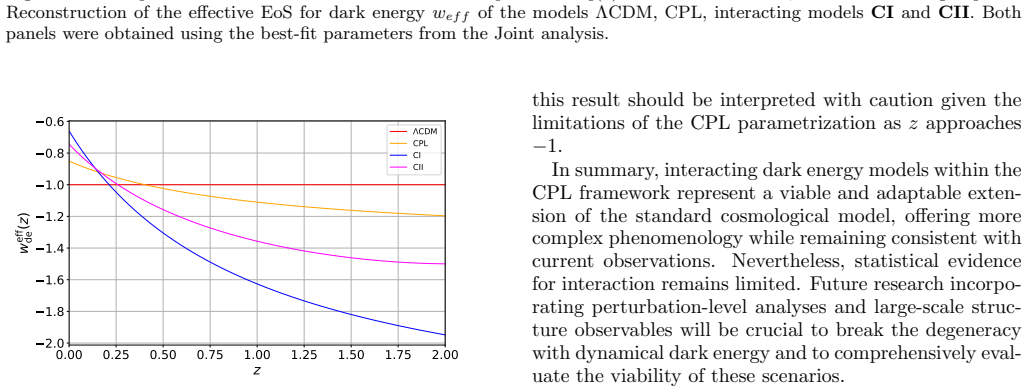
Exact analytic solutions involving incomplete gamma functions are obtained for the scale-factor dependence of the dark-sector densities when the interaction takes the form Q = beta H rho_de or Q = beta H rho_c. Bayesian analysis of the combined observational data sets shows that the first interaction form improves the fit relative to non-interacting CPL according to the Akaike criterion, yet the Bayesian information criterion continues to favor Lambda CDM. The best-fit parameters indicate that the dark energy equation of state evolves from an effective phantom regime at early times to a quintessence regime at late times, with the possibility that cosmic acceleration is only transient.
What carries the argument
The interaction term Q = beta H rho_de inserted into the continuity equations together with the CPL form w_de(a) = w0 + wa (1 - a), which permits exact integration in terms of incomplete gamma functions.
If this is right
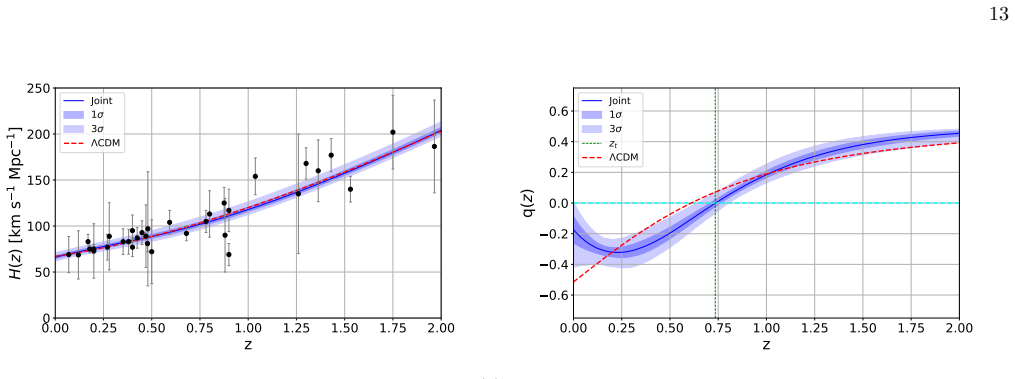
- The dark energy equation of state transitions from phantom values at high redshift to quintessence values at low redshift.
- Cosmic acceleration may be only transient rather than a permanent feature of the future universe.
- The interacting model remains consistent with all current observations despite its extra parameter.
- The alternative interaction proportional to dark matter density receives no observational support.
Where Pith is reading between the lines
- The existence of closed-form solutions allows direct study of how interaction strength affects the timing of the phantom-quintessence crossing without relying on numerical integration.
- If the transition is confirmed, it would imply that the acceleration we observe today is not the final state but could end at some finite future time.
- Such models enlarge the range of possible expansion histories that still match existing data, suggesting that next-generation surveys sensitive to the expansion rate at intermediate redshifts could detect or exclude the interaction.
Load-bearing premise
The assumption that the interaction between dark energy and dark matter must take one of the two specific linear forms proportional to the Hubble rate times one density, and that the CPL parametrization is an adequate description of dark energy evolution.
What would settle it
A future data set that constrains the dark energy equation of state to remain either always phantom or always quintessence without a crossing, or that eliminates any transient acceleration phase, would rule out the preferred interacting solution.
Figures
read the original abstract
This paper examines interacting dark energy models within the Chevallier-Polarski-Linder (CPL) parametrization, emphasizing both theoretical structure and observational viability. Two commonly adopted interaction terms are considered: $Q = \beta H \rho_{de}$ and $Q = \beta H \rho_c$. We derive exact analytic solutions that describe how the dark sector evolves. These solutions involve incomplete gamma functions and reveal a non-trivial mathematical structure that is often missed in numerical analyses. We perform a Bayesian analysis using current cosmological observations, including the Hubble parameter (OHD), Type Ia supernovae (SNIa), baryon acoustic oscillations (BAO), and cosmic microwave background (CMB) data. Relative to the non-interacting CPL scenario, the interacting model with $Q = \beta H \rho_{de}$ yields a modestly improved fit, as indicated by the Akaike Information Criterion (AIC). However, the Bayesian Information Criterion (BIC) penalizes increased model complexity, leading to a continued preference for $\Lambda$CDM. In contrast, the interaction model that depends on dark matter density does not provide observational support. The preferred interacting scenario indicates that the dark energy equation of state evolves dynamically, transitioning from an effective phantom regime at high redshift to quintessence-like behavior at late times. Further analysis indicates the potential for a transient phase of cosmic acceleration in the future. These findings suggest that interacting dark energy models within the CPL framework enrich the standard cosmological model by introducing more diverse phenomenology while maintaining consistency with current observations.
Editorial analysis
A structured set of objections, weighed in public.
Referee Report
Summary. The paper examines interacting dark energy models with the CPL parametrization w(a) = w0 + wa(1-a), considering two ad-hoc interaction forms Q = β H ρ_de and Q = β H ρ_c. It derives closed-form analytic solutions for the dark-sector energy densities (involving incomplete gamma functions), performs Bayesian parameter estimation and model comparison (AIC/BIC) against OHD + SNIa + BAO + CMB data, and reports that the Q ∝ ρ_de case yields a modest AIC improvement over non-interacting CPL while BIC continues to favor ΛCDM; the best-fit evolution shows w_de transitioning from phantom-like at high redshift to quintessence-like at late times, with possible future transient acceleration.
Significance. If the statistical results hold, the work supplies a useful analytic treatment of the interacting CPL system that avoids purely numerical integration and yields exact expressions for ρ_de(a) and ρ_c(a). The observational conclusion is appropriately modest: the interacting model is viable and slightly preferred by AIC but does not displace ΛCDM under BIC, thereby adding a controlled phenomenological extension without overclaiming dynamical predictions.
major comments (1)
- [Bayesian analysis section] Bayesian analysis section: the reported AIC improvement for the Q = β H ρ_de model is presented without the numerical ΔAIC value, the minimum χ² for each model, the explicit priors on β, w0, wa, or MCMC convergence diagnostics (e.g., Gelman-Rubin R̂ or effective sample size). These omissions make it impossible to verify the robustness of the model-comparison claim that underpins the central observational result.
minor comments (3)
- [Analytic solutions] The abstract states that the solutions 'involve incomplete gamma functions' but does not indicate which specific integral (the modified continuity equation for ρ_de) produces the gamma function; a brief reference to the relevant equation in the analytic section would clarify the derivation.
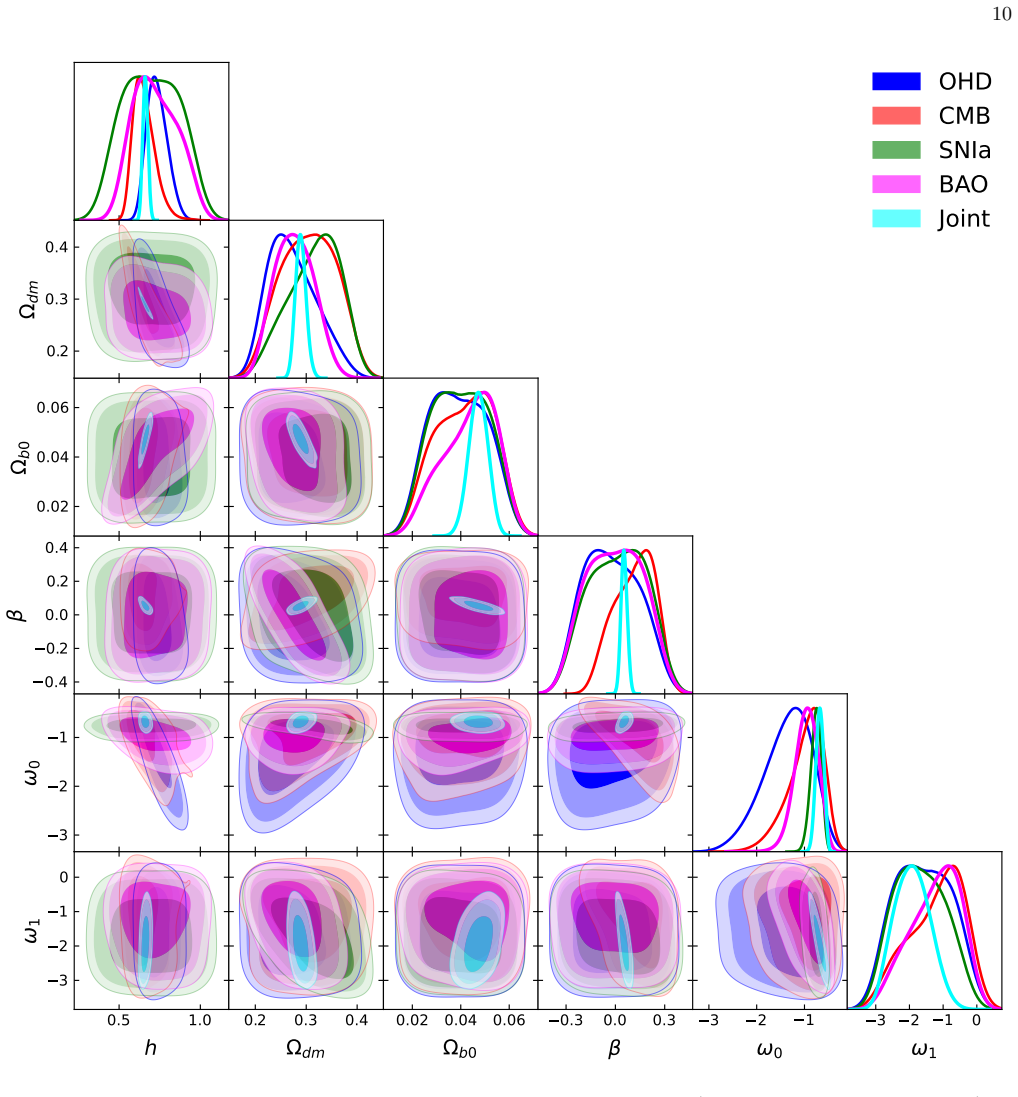
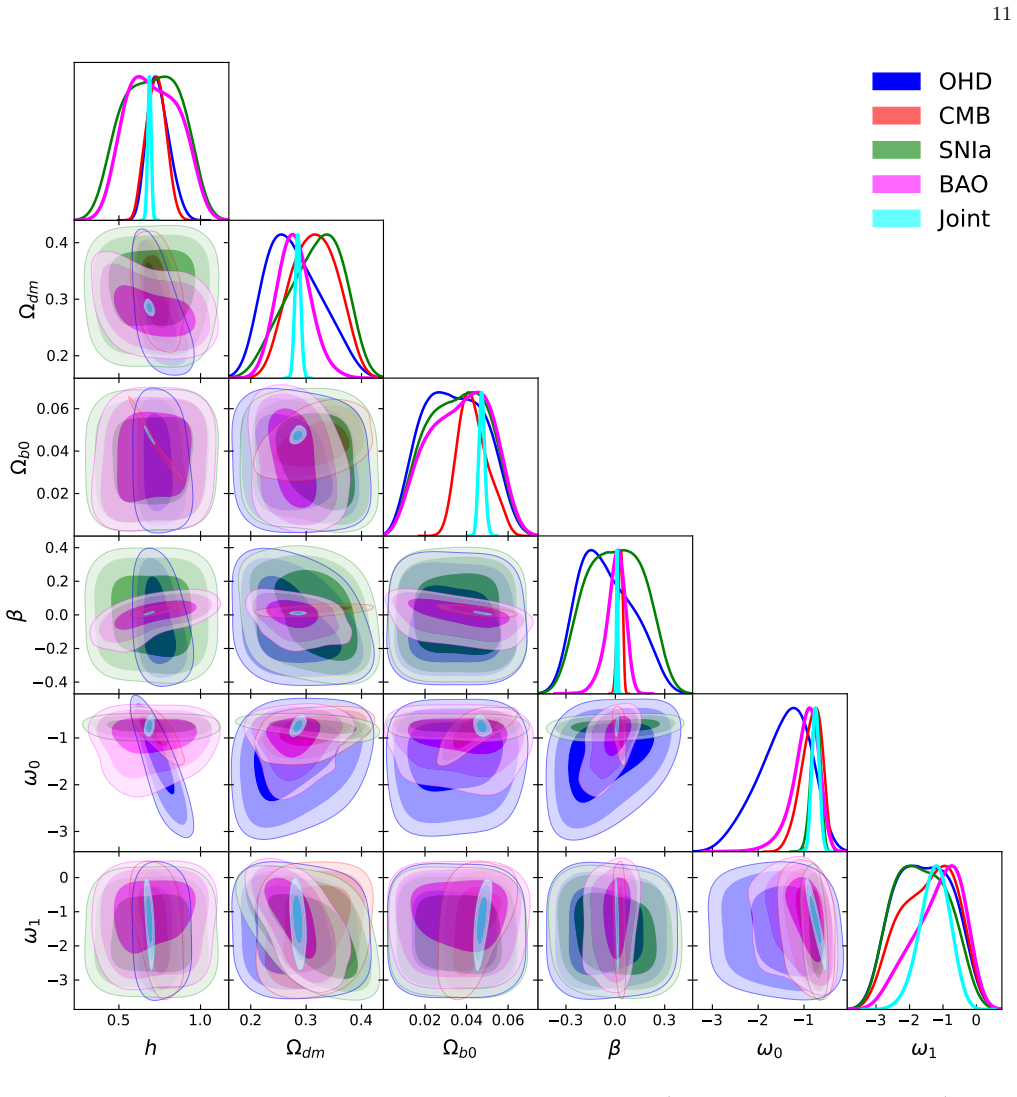
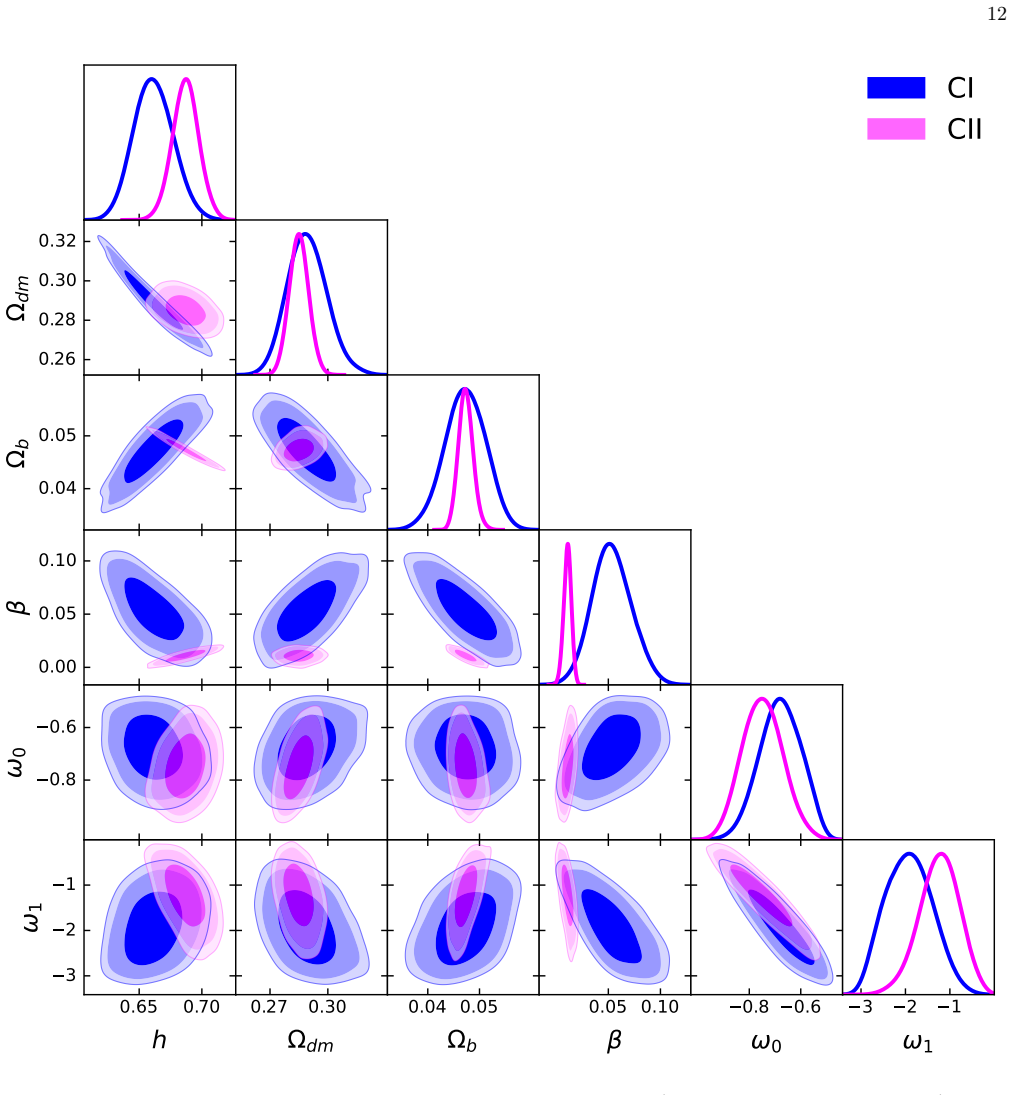
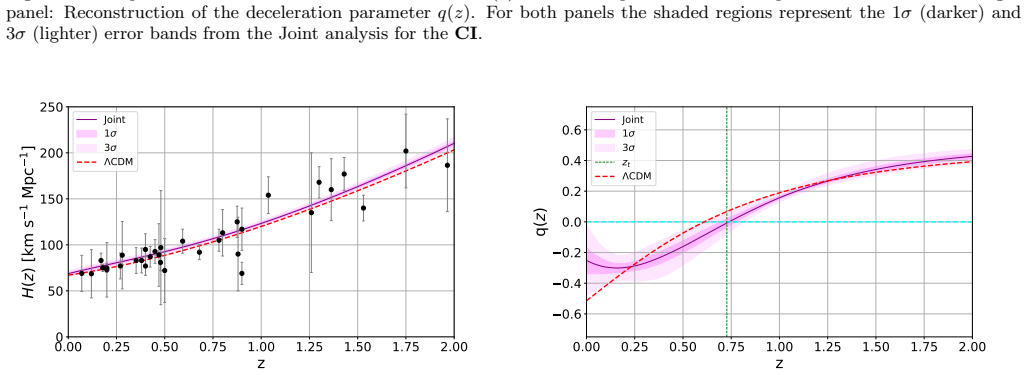
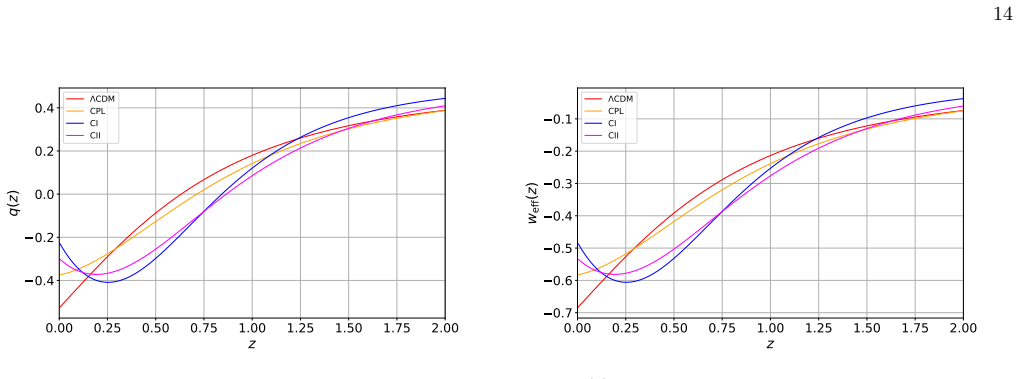
- [Results figures] Figure captions for the w_de(z) and q(z) evolution plots should explicitly state whether the curves are evaluated at the best-fit point or include 1σ/2σ bands; without this, the claimed 'transition from phantom to quintessence' and 'transient acceleration' are difficult to assess for robustness.
- [Model comparison] The manuscript uses 'modestly improved fit' for the AIC result; quoting the actual ΔAIC (and the corresponding evidence ratio) would make the strength of the improvement quantitative rather than qualitative.
Simulated Author's Rebuttal
We thank the referee for the careful reading of our manuscript and for the constructive comments. We address the major comment below and will make the necessary revisions to improve the presentation of our Bayesian analysis.
read point-by-point responses
-
Referee: [Bayesian analysis section] Bayesian analysis section: the reported AIC improvement for the Q = β H ρ_de model is presented without the numerical ΔAIC value, the minimum χ² for each model, the explicit priors on β, w0, wa, or MCMC convergence diagnostics (e.g., Gelman-Rubin R̂ or effective sample size). These omissions make it impossible to verify the robustness of the model-comparison claim that underpins the central observational result.
Authors: We agree that these details are important for verifying the robustness of our model-comparison results. In the revised manuscript, we will explicitly report the numerical ΔAIC value for the Q = β H ρ_de model (relative to both the non-interacting CPL and ΛCDM cases), the minimum χ² values for all models, the explicit prior ranges adopted for β, w0, and wa, and the MCMC convergence diagnostics (including Gelman-Rubin R̂ and effective sample sizes). revision: yes
Circularity Check
No significant circularity in derivation chain
full rationale
The paper adopts two standard phenomenological interaction forms Q = β H ρ_de and Q = β H ρ_c (not derived from first principles), assumes the CPL parametrization w(a) = w0 + wa(1-a), and derives closed-form solutions for the dark-sector densities via integration of the continuity equations, yielding expressions involving incomplete gamma functions. These solutions are mathematically obtained from the input differential equations and do not reduce to the target observables by construction. Bayesian constraints are then obtained from independent datasets (OHD, SNIa, BAO, CMB). The reported features—dynamical transition in w_de and possible future transient acceleration—are direct descriptions of the posterior best-fit parameter values rather than independent predictions or self-referential derivations. No self-definitional loops, load-bearing self-citations, ansatz smuggling, or renaming of known results occur. The analysis is a conventional model-building and fitting exercise that remains self-contained against external data.
Axiom & Free-Parameter Ledger
free parameters (2)
- β
- w0, wa
axioms (2)
- domain assumption Dark energy equation of state follows the CPL parametrization w(a) = w0 + wa(1-a).
- domain assumption Interaction rate takes the form Q = β H times one of the dark-sector densities.
Reference graph
Works this paper leans on
-
[1]
General system of equations We consider the conservation equations ˙ρc + 3Hρc =−Q,(A1) ˙ρde + 3Hρde(1 +ω de) =Q,(A2) 15 together with the CPL parametrization ωde(z) =w 0 +w a z 1 +z .(A3) Using the relation d dt =−H(1 +z) d dz , the system becomes (1 +z) dρc dz −3ρ c = Q H ,(A4) dρde dz = 3(1 +w 0) 1 +z + 3waz (1 +z) 2 ρde − Q H(1 +z) .(A5)
-
[2]
Model CI:Q=βHρ de The system reduces to (1 +z) dρc dz −3ρ c =βρ de,(A6) dρde dz = 3(1 +w 0)−β 1 +z + 3waz (1 +z) 2 ρde. (A7) a. Solution forρ de The equation forρ de can be written as 1 ρde dρde dz = 3(1 +w 0)−β 1 +z + 3waz (1 +z) 2 .(A8) Integrating, lnρ de = (3(1 +w0)−β) ln(1 +z) + Z 3waz (1 +z) 2 dz.(A9) Using the change of variableu= 1 +z, Z 3waz (1 +...
-
[3]
Model CII:Q=βHρ c The system becomes (1 +z) dρc dz −3ρ c =βρ c,(A19) dρde dz = 3(1 +w 0) 1 +z + 3waz (1 +z) 2 ρde − βρc 1 +z . (A20) a. Solution forρ c This equation integrates directly, ρc(z) =ρ c,0(1 +z) 3+β.(A21) b. Solution forρ de Substituting into the dark energy equation leads to a first-order linear equation that can be solved using an integrating...
-
[4]
Observational evidence from super- novae for an accelerating universe and a cosmological constant,
A. G. Riesset al., “Observational evidence from super- novae for an accelerating universe and a cosmological constant,”Astron. J., vol. 116, pp. 1009–1038, 1998
work page 1998
-
[5]
Measurements of Ω and Λ from 42 High Redshift Supernovae,
S. Perlmutteret al., “Measurements of Ω and Λ from 42 High Redshift Supernovae,”Astrophys. J., vol. 517, pp. 565–586, 1999
work page 1999
-
[6]
D. M. Scolnicet al., “The Complete Light-curve Sam- ple of Spectroscopically Confirmed SNe Ia from Pan- STARRS1 and Cosmological Constraints from the Com- bined Pantheon Sample,”Astrophys. J., vol. 859, no. 2, p. 101, 2018
work page 2018
-
[7]
Planck 2018 results. VI. Cosmolog- ical parameters,
N. Aghanimet al., “Planck 2018 results. VI. Cosmolog- ical parameters,”Astron. Astrophys., vol. 641, p. A6,
work page 2018
- [8]
-
[9]
D. J. Eisensteinet al., “Detection of the Baryon Acous- tic Peak in the Large-Scale Correlation Function of SDSS Luminous Red Galaxies,”Astrophys. J., vol. 633, pp. 560–574, 2005
work page 2005
-
[10]
S. Alamet al., “Completed SDSS-IV extended Baryon Oscillation Spectroscopic Survey: Cosmological impli- cations from two decades of spectroscopic surveys at the Apache Point Observatory,”Phys. Rev. D, vol. 103, no. 8, p. 083533, 2021
work page 2021
-
[11]
DESI 2024 VI: cosmological con- straints from the measurements of baryon acoustic os- cillations,
A. G. Adameet al., “DESI 2024 VI: cosmological con- straints from the measurements of baryon acoustic os- cillations,”JCAP, vol. 02, p. 021, 2025
work page 2024
-
[12]
E. J. Copeland, M. Sami, and S. Tsujikawa, “Dynamics of dark energy,”Int. J. Mod. Phys. D, vol. 15, pp. 1753– 1936, 2006
work page 1936
-
[13]
The Cosmological Constant Problem,
S. Weinberg, “The Cosmological Constant Problem,” Rev. Mod. Phys., vol. 61, pp. 1–23, 1989
work page 1989
-
[14]
J. Martin, “Everything You Always Wanted To Know About The Cosmological Constant Problem (But Were Afraid To Ask),”Comptes Rendus Physique, vol. 13, pp. 566–665, 2012
work page 2012
-
[15]
A. G. Riess, S. Casertano, W. Yuan, L. M. Macri, and D. Scolnic, “Large Magellanic Cloud Cepheid Standards Provide a 1% Foundation for the Determination of the Hubble Constant and Stronger Evidence for Physics be- yond ΛCDM,”Astrophys. J., vol. 876, no. 1, p. 85, 2019
work page 2019
-
[16]
A. G. Riesset al., “A Comprehensive Measurement of the Local Value of the Hubble Constant with 1 km s −1 Mpc−1 Uncertainty from the Hubble Space Telescope and the SH0ES Team,”Astrophys. J. Lett., vol. 934, no. 1, p. L7, 2022
work page 2022
-
[17]
T. M. C. Abbottet al., “Dark Energy Survey year 1 results: Cosmological constraints from galaxy cluster- ing and weak lensing,”Phys. Rev. D, vol. 98, no. 4, p. 043526, 2018
work page 2018
-
[18]
C. Heymanset al., “KiDS-1000 Cosmology: Multi- probe weak gravitational lensing and spectroscopic galaxy clustering constraints,”Astron. Astrophys., vol. 646, p. A140, 2021
work page 2021
-
[19]
Tensions be- tween the Early and the Late Universe,
L. Verde, T. Treu, and A. G. Riess, “Tensions be- tween the Early and the Late Universe,”Nature Astron., vol. 3, p. 891, 2019
work page 2019
-
[20]
Snowmass2021 - Letter of in- terest cosmology intertwined II: The hubble constant tension,
E. Di Valentinoet al., “Snowmass2021 - Letter of in- terest cosmology intertwined II: The hubble constant tension,”Astropart. Phys., vol. 131, p. 102605, 2021
work page 2021
-
[21]
Cosmology Intertwined III:f σ 8 andS 8,
E. Di Valentinoet al., “Cosmology Intertwined III:f σ 8 andS 8,”Astropart. Phys., vol. 131, p. 102604, 2021
work page 2021
-
[22]
In the realm of the Hubble tension—a review of solutions,
E. Di Valentino, O. Mena, S. Pan, L. Visinelli, W. Yang, A. Melchiorri, D. F. Mota, A. G. Riess, and J. Silk, “In the realm of the Hubble tension—a review of solutions,” Class. Quant. Grav., vol. 38, no. 15, p. 153001, 2021
work page 2021
-
[23]
Challenges for ΛCDM: An update,
L. Perivolaropoulos and F. Skara, “Challenges for ΛCDM: An update,”New Astron. Rev., vol. 95, p. 101659, 2022
work page 2022
-
[24]
Introduction to modified gravity and gravitational alternative for dark energy,
S. Nojiri and S. D. Odintsov, “Introduction to modified gravity and gravitational alternative for dark energy,” eConf, vol. C0602061, p. 06, 2006
work page 2006
-
[25]
Modified Gravity and Cosmology,
T. Clifton, P. G. Ferreira, A. Padilla, and C. Sko- rdis, “Modified Gravity and Cosmology,”Phys. Rept., vol. 513, pp. 1–189, 2012
work page 2012
-
[26]
K. Bamba, S. Capozziello, S. Nojiri, and S. D. Odintsov, “Dark energy cosmology: the equivalent description via different theoretical models and cosmography tests,” Astrophys. Space Sci., vol. 342, pp. 155–228, 2012
work page 2012
-
[27]
Dark Energy Versus Modified Gravity,
A. Joyce, L. Lombriser, and F. Schmidt, “Dark Energy Versus Modified Gravity,”Ann. Rev. Nucl. Part. Sci., vol. 66, pp. 95–122, 2016
work page 2016
-
[28]
Accelerating universes with scaling dark matter,
M. Chevallier and D. Polarski, “Accelerating universes with scaling dark matter,”Int. J. Mod. Phys. D, vol. 10, pp. 213–224, 2001
work page 2001
-
[29]
Exploring the expansion history of the universe,
E. V. Linder, “Exploring the expansion history of the universe,”Phys. Rev. Lett., vol. 90, p. 091301, 2003
work page 2003
-
[30]
DESI DR2 results. II. Measure- ments of baryon acoustic oscillations and cosmological constraints,
M. Abdul Karimet al., “DESI DR2 results. II. Measure- ments of baryon acoustic oscillations and cosmological constraints,”Phys. Rev. D, vol. 112, no. 8, p. 083515, 2025
work page 2025
-
[31]
DESI 2024: reconstructing dark energy using crossing statistics with DESI DR1 BAO data,
R. Calderonet al., “DESI 2024: reconstructing dark energy using crossing statistics with DESI DR1 BAO data,”JCAP, vol. 10, p. 048, 2024
work page 2024
-
[32]
M. Malekjani, Z. Davari, and S. Pourojaghi, “Cosmolog- ical constraints on dark energy parametrizations after DESI 2024: Persistent deviation from standard ΛCDM cosmology,”Phys. Rev. D, vol. 111, no. 8, p. 083547, 2025
work page 2024
-
[33]
Impacts of dark energy on weighing neutrinos after DESI BAO,
G.-H. Du, P.-J. Wu, T.-N. Li, and X. Zhang, “Impacts of dark energy on weighing neutrinos after DESI BAO,” Eur. Phys. J. C, vol. 85, no. 4, p. 392, 2025
work page 2025
-
[34]
W. Giar` e, “Dynamical dark energy beyond Planck? Constraints from multiple CMB probes, DESI BAO, and type-Ia supernovae,”Phys. Rev. D, vol. 112, no. 2, p. 023508, 2025
work page 2025
-
[35]
Cosmological constraints on dark energy models using DESI BAO 2024,
J. Zheng, D.-C. Qiang, and Z.-Q. You, “Cosmological constraints on dark energy models using DESI BAO 2024,”JCAP, vol. 08, p. 056, 2025
work page 2024
-
[36]
Comparison of dynamical dark energy with ΛCDM in light of DESI DR2,
A. N. Ormondroyd, W. J. Handley, M. P. Hobson, and A. N. Lasenby, “Comparison of dynamical dark energy with ΛCDM in light of DESI DR2,” 3 2025
work page 2025
-
[37]
To CPL, or not to CPL? What we have not learned about the dark energy equation of state,
S. Nesseris, Y. Akrami, and G. D. Starkman, “To CPL, or not to CPL? What we have not learned about the dark energy equation of state,” 3 2025. 17
work page 2025
-
[38]
Dynamical dark energy in light of the DESI DR2 baryonic acoustic oscillations measure- ments,
G. Guet al., “Dynamical dark energy in light of the DESI DR2 baryonic acoustic oscillations measure- ments,”Nature Astron., vol. 9, no. 12, pp. 1879–1889,
- [39]
-
[40]
Challenging the ΛCDM model: 5σevidence for a dynamical dark energy late-time transition,
M. Scherer, M. A. Sabogal, R. C. Nunes, and A. De Fe- lice, “Challenging the ΛCDM model: 5σevidence for a dynamical dark energy late-time transition,”Phys. Rev. D, vol. 112, no. 4, p. 043513, 2025
work page 2025
-
[41]
Is dark energy dynamical in the DESI era? A critical review,
S. Capozziello, H. Chaudhary, T. Harko, and G. Mustafa, “Is dark energy dynamical in the DESI era? A critical review,”Phys. Dark Univ., vol. 51, p. 102196, 2026
work page 2026
-
[42]
Phantom crossing or dark interaction?,
S. L. Guedezounme, B. R. Dinda, and R. Maartens, “Phantom crossing or dark interaction?,”JCAP, vol. 01, p. 062, 2026
work page 2026
-
[43]
The Cosmon model for an asymp- totically vanishing time dependent cosmological ’con- stant’,
C. Wetterich, “The Cosmon model for an asymp- totically vanishing time dependent cosmological ’con- stant’,”Astron. Astrophys., vol. 301, pp. 321–328, 1995
work page 1995
-
[44]
L. Amendola, “Coupled quintessence,”Phys. Rev. D, vol. 62, p. 043511, 2000
work page 2000
-
[45]
W. Zimdahl and D. Pavon, “Interacting quintessence,” Phys. Lett. B, vol. 521, pp. 133–138, 2001
work page 2001
-
[46]
Interacting quintessence solution to the coinci- dence problem,
L. P. Chimento, A. S. Jakubi, D. Pavon, and W. Zim- dahl, “Interacting quintessence solution to the coinci- dence problem,”Phys. Rev. D, vol. 67, p. 083513, 2003
work page 2003
-
[47]
Interacting dark matter and dark energy,
G. R. Farrar and P. J. E. Peebles, “Interacting dark matter and dark energy,”Astrophys. J., vol. 604, pp. 1– 11, 2004
work page 2004
-
[48]
Instabil- ity in interacting dark energy and dark matter fluids,
J. Valiviita, E. Majerotto, and R. Maartens, “Instabil- ity in interacting dark energy and dark matter fluids,” JCAP, vol. 07, p. 020, 2008
work page 2008
-
[49]
Stability of the curvature perturbation in dark sectors’ mutual inter- acting models,
J.-H. He, B. Wang, and E. Abdalla, “Stability of the curvature perturbation in dark sectors’ mutual inter- acting models,”Phys. Lett. B, vol. 671, pp. 139–145, 2009
work page 2009
-
[50]
Effects of the interaction be- tween dark energy and dark matter on cosmological pa- rameters,
J.-H. He and B. Wang, “Effects of the interaction be- tween dark energy and dark matter on cosmological pa- rameters,”JCAP, vol. 06, p. 010, 2008
work page 2008
-
[51]
On the large- scale instability in interacting dark energy and dark matter fluids,
B. M. Jackson, A. Taylor, and A. Berera, “On the large- scale instability in interacting dark energy and dark matter fluids,”Phys. Rev. D, vol. 79, p. 043526, 2009
work page 2009
-
[52]
Cosmological evolution with interac- tion between dark energy and dark matter,
Y. L. Bolotin, A. Kostenko, O. A. Lemets, and D. A. Yerokhin, “Cosmological evolution with interac- tion between dark energy and dark matter,”Interna- tional Journal of Modern Physics D, vol. 24, no. 03, p. 1530007, 2015
work page 2015
-
[53]
B. Wang, E. Abdalla, F. Atrio-Barandela, and D. Pav´ on, “Dark matter and dark energy interac- tions: Theoretical challenges, cosmological implications and observational signatures,”Reports on Progress in Physics, vol. 79, no. 9, p. 096901, 2016
work page 2016
-
[54]
Can in- teracting dark energy solve theH0 tension?,
E. Di Valentino, A. Melchiorri, and O. Mena, “Can in- teracting dark energy solve theH0 tension?,”Phys. Rev. D, vol. 96, no. 4, p. 043503, 2017
work page 2017
-
[55]
Interacting dark energy with time varying equation of state and theH 0 tension,
W. Yang, A. Mukherjee, E. Di Valentino, and S. Pan, “Interacting dark energy with time varying equation of state and theH 0 tension,”Phys. Rev. D, vol. 98, no. 12, p. 123527, 2018
work page 2018
-
[56]
Tale of stable interact- ing dark energy, observational signatures, and theH 0 tension,
W. Yang, S. Pan, E. Di Valentino, R. C. Nunes, S. Vagnozzi, and D. F. Mota, “Tale of stable interact- ing dark energy, observational signatures, and theH 0 tension,”JCAP, vol. 09, p. 019, 2018
work page 2018
-
[57]
S. Pan, W. Yang, E. Di Valentino, E. N. Saridakis, and S. Chakraborty, “Interacting scenarios with dynamical dark energy: Observational constraints and alleviation of theH 0 tension,”Phys. Rev. D, vol. 100, no. 10, p. 103520, 2019
work page 2019
-
[58]
E. Di Valentino, A. Melchiorri, O. Mena, and S. Vagnozzi, “Interacting dark energy in the early 2020s: A promising solution to theH 0 and cosmic shear ten- sions,”Phys. Dark Univ., vol. 30, p. 100666, 2020
work page 2020
-
[59]
B. Wang, E. Abdalla, F. Atrio-Barandela, and D. Pav´ on, “Further understanding the interaction be- tween dark energy and dark matter: current status and future directions,”Rept. Prog. Phys., vol. 87, no. 3, p. 036901, 2024
work page 2024
-
[60]
I. Linear interacting dark energy: Analytical solutions and theoretical pathologies,
M. van der Westhuizen, A. Abebe, and E. Di Valentino, “I. Linear interacting dark energy: Analytical solutions and theoretical pathologies,”Phys. Dark Univ., vol. 50, p. 102119, 2025
work page 2025
-
[61]
M. B. Gavela, D. Hernandez, L. Lopez Honorez, O. Mena, and S. Rigolin, “Dark coupling,”JCAP, vol. 07, p. 034, 2009. [Erratum: JCAP 05, E01 (2010)]
work page 2009
-
[62]
Testing the Interaction between Dark Energy and Dark Matter with Planck Data,
A. A. Costa, X.-D. Xu, B. Wang, E. G. M. Ferreira, and E. Abdalla, “Testing the Interaction between Dark Energy and Dark Matter with Planck Data,”Phys. Rev. D, vol. 89, no. 10, p. 103531, 2014
work page 2014
-
[63]
An an- alytic model for interacting dark energy and its ob- servational constraints,
S. Pan, S. Bhattacharya, and S. Chakraborty, “An an- alytic model for interacting dark energy and its ob- servational constraints,”Mon. Not. Roy. Astron. Soc., vol. 452, no. 3, pp. 3038–3046, 2015
work page 2015
-
[64]
II. Non-linear interacting dark energy: Analytical so- lutions and theoretical pathologies,
M. van der Westhuizen, A. Abebe, and E. Di Valentino, “II. Non-linear interacting dark energy: Analytical so- lutions and theoretical pathologies,”Phys. Dark Univ., vol. 50, p. 102120, 2025
work page 2025
-
[65]
III. Interacting Dark Energy: Summary of mod- els, Pathologies, and Constraints,
M. van der Westhuizen, A. Abebe, and E. Di Valentino, “III. Interacting Dark Energy: Summary of mod- els, Pathologies, and Constraints,”Phys. Dark Univ., vol. 50, p. 102121, 2025
work page 2025
-
[66]
Interacting Dark Energy – constraints and degeneracies,
T. Clemson, K. Koyama, G.-B. Zhao, R. Maartens, and J. Valiviita, “Interacting Dark Energy – constraints and degeneracies,”Phys. Rev. D, vol. 85, p. 043007, 2012
work page 2012
-
[67]
Parametrized Post-Friedmann Framework for Interacting Dark En- ergy,
Y.-H. Li, J.-F. Zhang, and X. Zhang, “Parametrized Post-Friedmann Framework for Interacting Dark En- ergy,”Phys. Rev. D, vol. 90, no. 6, p. 063005, 2014
work page 2014
-
[68]
Interacting dark energy: clarifying the cosmological implications and viability conditions,
M. A. van der Westhuizen and A. Abebe, “Interacting dark energy: clarifying the cosmological implications and viability conditions,”JCAP, vol. 01, p. 048, 2024
work page 2024
-
[69]
Constraints on interacting dark energy revisited: Implications for the Hubble tension,
G. A. Hoerning, R. G. Landim, L. O. Ponte, R. P. Rolim, F. B. Abdalla, and E. Abdalla, “Constraints on interacting dark energy revisited: Implications for the Hubble tension,”Phys. Rev. D, vol. 112, no. 2, p. 023523, 2025
work page 2025
-
[70]
Interacting Dark Energy after DESI Baryon Acoustic Oscillation Measurements,
W. Giar` e, M. A. Sabogal, R. C. Nunes, and E. Di Valentino, “Interacting Dark Energy after DESI Baryon Acoustic Oscillation Measurements,”Phys. Rev. Lett., vol. 133, no. 25, p. 251003, 2024
work page 2024
-
[71]
Late-time constraints on interacting dark energy: Analysis independent of H0, rd, and MB,
D. Benisty, S. Pan, D. Staicova, E. Di Valentino, and R. C. Nunes, “Late-time constraints on interacting dark energy: Analysis independent of H0, rd, and MB,”As- tron. Astrophys., vol. 688, p. A156, 2024
work page 2024
-
[72]
Redshift-space distortions corner interacting dark energy,
P. Ghedini, R. Hajjar, and O. Mena, “Redshift-space distortions corner interacting dark energy,”Phys. Dark Univ., vol. 46, p. 101671, 2024
work page 2024
-
[73]
Z. Zhu, Q. Jiang, Y. Liu, P. Wu, and N. Liang, “Cosmo- logical constraints on the phenomenological interacting dark energy model with Fermi gamma-ray bursts and DESI DR2,”JHEAp, vol. 51, p. 100534, 2026. 18
work page 2026
-
[74]
M. Tsedrik and B. Bose, “Evolving and interacting dark energy: photometric and spectroscopic synergy with DES Y3 and DESI DR2,” 12 2025
work page 2025
-
[75]
Dark degen- eracy in DESI DR2 data: Interacting or evolving dark energy?,
V. Petri, V. Marra, and R. von Marttens, “Dark degen- eracy in DESI DR2 data: Interacting or evolving dark energy?,”Phys. Rev. D, vol. 113, no. 2, p. 023504, 2026
work page 2026
-
[76]
Late-time background constraints on linear and non-linear interacting dark energy after DESI DR2,
D. Figueruelo, M. van der Westhuizen, A. Abebe, and E. Di Valentino, “Late-time background constraints on linear and non-linear interacting dark energy after DESI DR2,”Phys. Dark Univ., vol. 52, p. 102238, 2026
work page 2026
-
[77]
Strong Evidence for Dark Sector Interactions,
T.-N. Li, W. Giar` e, G.-H. Du, Y.-H. Li, E. Di Valentino, J.-F. Zhang, and X. Zhang, “Strong Evidence for Dark Sector Interactions,” 1 2026
work page 2026
-
[78]
Breaking parameter degen- eracy in interacting dark energy models from observa- tions,
X.-D. Xu and B. Wang, “Breaking parameter degen- eracy in interacting dark energy models from observa- tions,”Phys. Lett. B, vol. 701, pp. 513–519, 2011
work page 2011
-
[79]
On dark degeneracy and interacting models,
S. Carneiro and H. A. Borges, “On dark degeneracy and interacting models,”JCAP, vol. 06, p. 010, 2014
work page 2014
-
[80]
F. Schmidt and S. Dodelson,Modern cosmology. Lon- don: Academic Press., 2021
work page 2021
discussion (0)
Sign in with ORCID, Apple, or X to comment. Anyone can read and Pith papers without signing in.