Sustainability-informed materials design
Pith reviewed 2026-05-08 11:04 UTC · model grok-4.3
The pith
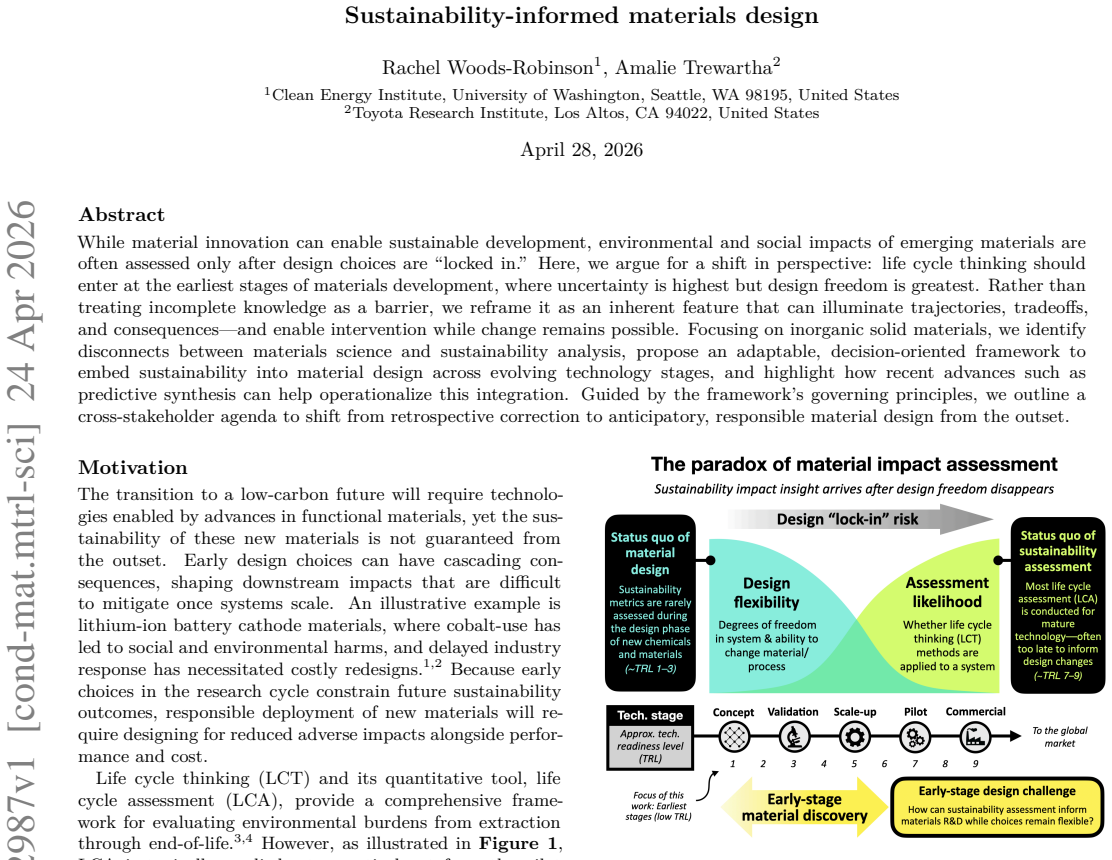
Sustainability assessments must enter materials design at the earliest stages, when uncertainty is high but design freedom remains greatest.
A machine-rendered reading of the paper's core claim, the machinery that carries it, and where it could break.
Core claim
Life cycle thinking should be introduced at the earliest stages of materials development for inorganic solids, where uncertainty is reframed as a feature that illuminates trajectories, tradeoffs, and consequences, thereby enabling intervention before design choices become fixed and limit sustainable outcomes. This integration is operationalized through an adaptable, decision-oriented framework that spans evolving technology stages and draws on advances such as predictive synthesis to make early-stage sustainability data actionable.
What carries the argument
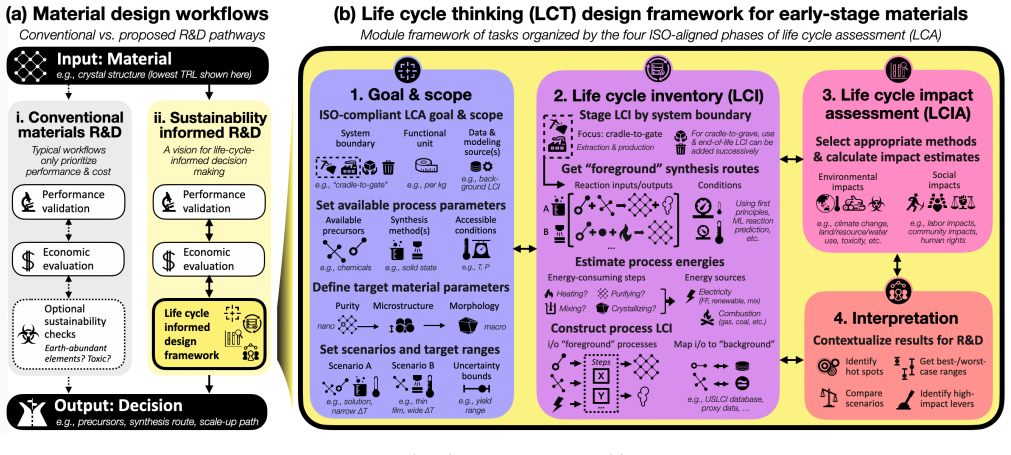
The adaptable, decision-oriented framework that embeds sustainability into material design across evolving technology stages by treating incomplete knowledge as a means to identify trajectories and tradeoffs.
If this is right
- Design choices can be altered while freedom remains high rather than corrected after impacts are locked in.
- Predictive synthesis methods can supply the data needed to evaluate sustainability tradeoffs at early stages.
- Disconnects between materials science and life cycle analysis are reduced by making sustainability a design input rather than an after-the-fact check.
- Stakeholder collaboration can establish shared principles for anticipatory rather than retrospective material development.
Where Pith is reading between the lines
- The same early-integration logic could be tested on classes of materials beyond inorganic solids, such as polymers or composites.
- Funding agencies might require preliminary sustainability trajectory maps as part of early-stage materials research proposals.
- The framework could be extended to include social equity metrics alongside environmental ones in the same early decision process.
Load-bearing premise
An adaptable framework can successfully turn early uncertainty into actionable guidance for sustainability across different stages of material development.
What would settle it
A controlled test on a specific emerging material, such as a new solid-state battery component, in which the framework is applied from the start yet produces no measurable change in final design choices or projected impacts compared with conventional late-stage assessment.
Figures
read the original abstract
While material innovation can enable sustainable development, environmental and social impacts of emerging materials are often assessed only after design choices are "locked in." Here, we argue for a shift in perspective: life cycle thinking should enter at the earliest stages of materials development, where uncertainty is highest but design freedom is greatest. Rather than treating incomplete knowledge as a barrier, we reframe it as an inherent feature that can illuminate trajectories, tradeoffs, and consequences -- and enable intervention while change remains possible. Focusing on inorganic solid materials, we identify disconnects between materials science and sustainability analysis, propose an adaptable, decision-oriented framework to embed sustainability into material design across evolving technology stages, and highlight how recent advances such as predictive synthesis can help operationalize this integration. Guided by the framework's governing principles, we outline a cross-stakeholder agenda to shift from retrospective correction to anticipatory, responsible material design from the outset.
Editorial analysis
A structured set of objections, weighed in public.
Referee Report
Summary. The paper is a perspective arguing that life-cycle thinking should be integrated into the earliest stages of inorganic materials design, where uncertainty is highest but design freedom is greatest. It reframes incomplete knowledge as an opportunity to illuminate trajectories and tradeoffs, identifies disconnects between materials science and sustainability analysis, proposes an adaptable decision-oriented framework to embed sustainability across technology stages, highlights how advances such as predictive synthesis can operationalize this integration, and outlines a cross-stakeholder agenda for anticipatory rather than retrospective material design.
Significance. If the framework can be made operational, the perspective could meaningfully shift materials development practice toward proactive sustainability integration, reducing locked-in impacts. It usefully synthesizes established concepts from the two fields and offers a constructive reframing of uncertainty, though its impact will depend on whether the proposed operationalization is developed further.
major comments (1)
- [section on advances such as predictive synthesis] The discussion of predictive synthesis as a means to operationalize early-stage sustainability integration lacks an explicit mapping or uncertainty-propagation mechanism. Predictive synthesis models output quantities such as formation energies, phase stability, or synthesizability, but sustainability indicators (embodied energy, resource criticality, process emissions) require process-scale parameters, supply-chain data, and end-of-life assumptions that are not generated by current predictors. Without this bridge, the central claim that the framework can illuminate trajectories and enable intervention rests on an unstated assumption of commensurability between the domains.
minor comments (2)
- [Abstract] The abstract is clear but could briefly define or exemplify the 'governing principles' of the proposed framework to help readers anticipate the later sections.
- [framework proposal] A short table or schematic illustrating the adaptable framework across technology stages would improve clarity and make the proposal more concrete for readers.
Simulated Author's Rebuttal
We thank the referee for their positive evaluation of our perspective and for the constructive major comment, which identifies a valuable opportunity to strengthen the operationalization discussion. We have prepared a targeted revision to address the concern directly while preserving the high-level, forward-looking character of the manuscript.
read point-by-point responses
-
Referee: [section on advances such as predictive synthesis] The discussion of predictive synthesis as a means to operationalize early-stage sustainability integration lacks an explicit mapping or uncertainty-propagation mechanism. Predictive synthesis models output quantities such as formation energies, phase stability, or synthesizability, but sustainability indicators (embodied energy, resource criticality, process emissions) require process-scale parameters, supply-chain data, and end-of-life assumptions that are not generated by current predictors. Without this bridge, the central claim that the framework can illuminate trajectories and enable intervention rests on an unstated assumption of commensurability between the domains.
Authors: We agree that an explicit mapping and uncertainty-propagation mechanism would make the discussion more concrete and strengthen the central claim. The manuscript is a perspective that proposes a decision-oriented framework at a conceptual level rather than a fully specified technical implementation. In the revised version we will add a new paragraph and accompanying schematic in the predictive-synthesis section. The schematic will illustrate a stepwise linkage: (i) synthesis predictors (formation energies, phase stability) feed into material-property filters; (ii) these are connected to sustainability indicators via proxy models (e.g., literature-derived scaling relations for embodied energy or criticality scores) and scenario assumptions for process parameters and supply chains; (iii) uncertainty is propagated through sensitivity analysis or bounding scenarios that align with the framework’s reframing of incomplete knowledge. This addition will demonstrate a practical pathway for commensurability without claiming that current predictors alone generate full life-cycle data. We believe the revision directly resolves the referee’s concern while remaining consistent with the perspective format. revision: yes
Circularity Check
No circularity: purely conceptual proposal with no derivations or self-referential reductions
full rationale
The paper is a perspective piece advocating a shift toward early-stage life-cycle thinking in materials design. It contains no equations, no fitted parameters, no derivations, and no mathematical claims that could reduce to inputs by construction. The central elements are a reframing of uncertainty as an opportunity and a high-level adaptable framework, both presented as normative proposals rather than derived results. Mentions of 'predictive synthesis' and similar advances are cited as external enablers, not as self-generated outputs renamed as predictions. No self-citation chains or uniqueness theorems are invoked to justify core premises. The argument is therefore self-contained against external benchmarks and exhibits no load-bearing circular steps.
Axiom & Free-Parameter Ledger
axioms (1)
- domain assumption Life cycle thinking can be effectively integrated into early materials design despite high uncertainty by reframing incomplete knowledge as a feature.
Reference graph
Works this paper leans on
-
[1]
Li, M. & Lu, J. Cobalt in lithium-ion batteries.Science 367, 979–980 (2020)
work page 2020
-
[2]
Global Critical Minerals Outlook 2025 en
IEA. Global Critical Minerals Outlook 2025 en. Tech. rep. (International Energy Agency (IEA), 2025)
work page 2025
-
[3]
ISO 14040: Environmental Management - Life Cycle Assessment - Principles and Framework en
ISO. ISO 14040: Environmental Management - Life Cycle Assessment - Principles and Framework en. International Standard. 2006
work page 2006
-
[4]
ISO 14044: Environmental Management-Life Cycle Assessment-Requirements and Guidelines en
ISO. ISO 14044: Environmental Management-Life Cycle Assessment-Requirements and Guidelines en. International Standard. 2006
work page 2006
-
[5]
Arvidsson, R. et al. Environmental Assessment of Emerging Technologies: Recommendations for Prospective LCA. en. Journal of Industrial Ecology 22, 1286–1294. issn: 1530- 9290 (2018)
work page 2018
-
[6]
Otyepka, M., Pykal, M. & Otyepka, M. Advancing materi- als discovery through artificial intelligence. en.Applied Ma- terials Today 47, 102981. issn: 23529407 (2025)
work page 2025
-
[7]
Tom, G. et al. Self-Driving Laboratories for Chemistry and Materials Science. en. Chemical Reviews 124, 9633–9732. issn: 0009-2665, 1520-6890 (2024)
work page 2024
-
[8]
Tobias, A. V. & Wahab, A. Autonomous ‘self-driving’ labo- ratories: a review of technology and policy implications. en. Royal Society Open Science 12, 250646. issn: 2054-5703 (2025)
work page 2054
-
[9]
Mikolajczyk, A. et al. Retrosynthesis from transforms to predictive sustainable chemistry and nanotechnology: a brief tutorial review. en. Green Chemistry 25, 2971–2991. issn: 1463-9270 (2023)
work page 2023
-
[10]
Blanco, C., Pauliks, N., Donati, F., Engberg, N. & Weber, J. Machine learning to support prospective life cycle assess- ment of emerging chemical technologies. en. Current Opin- ion in Green and Sustainable Chemistry 50, 100979. issn: 24522236 (2024)
work page 2024
-
[11]
Chen, S. et al. Life cycle assessment for all organic chem- icals 2026
work page 2026
-
[12]
Szczypiński, F. T., Bennett, S. & Jelfs, K. E. Can we predict materials that can be synthesised? en.Chemical Science 12, 830–840. issn: 2041-6520, 2041-6539 (2021)
work page 2041
-
[13]
Kovnir, K. Predictive Synthesis. en.Chemistry of Materials 33, 4835–4841. issn: 0897-4756, 1520-5002 (2021)
work page 2021
-
[14]
Aziz, A. & Carrasco, J. Towards Predictive Synthesis of Inorganic Materials Using Network Science. en. Frontiers in Chemistry 9, 798838. issn: 2296-2646 (2021). 5
work page 2021
-
[15]
Leeman, J. et al. Challenges in High-Throughput Inorganic Materials Prediction and Autonomous Synthesis. en. PRX Energy 3, 011002. issn: 2768-5608 (2024)
work page 2024
-
[16]
Aykol, M. et al. Network analysis of synthesizable materials discovery. en.Nature Communications 10, 2018. issn: 2041- 1723 (2019)
work page 2018
-
[17]
Aykol, M., Montoya, J. H. & Hummelshøj, J. Rational Solid- State Synthesis Routes for Inorganic Materials. en.Journal of the American Chemical Society 143, 9244–9259. issn: 0002-7863, 1520-5126 (2021)
work page 2021
-
[18]
McDermott, M. J., Dwaraknath, S. S. & Persson, K. A. A graph-based network for predicting chemical reaction path- ways in solid-state materials synthesis. en. Nature Commu- nications 12, 3097. issn: 2041-1723 (2021)
work page 2041
-
[19]
Gallant, M. C., McDermott, M. J., Li, B. & Persson, K. A. ReactCA: A Cellular Automaton for Predicting Phase Evo- lution in Solid-State Reactions en. 2024
work page 2024
-
[20]
Malik, S. A., Goodall, R. E. A. & Lee, A. A. Predicting the Outcomes of Material Syntheses with Deep Learning. en. Chemistry of Materials 33, 616–624. issn: 0897-4756, 1520-5002 (2021)
work page 2021
-
[21]
Huo, H. et al. Machine-Learning Rationalization and Predic- tion of Solid-State Synthesis Conditions. en. Chemistry of Materials 34, 7323–7336. issn: 0897-4756, 1520-5002 (2022)
work page 2022
-
[22]
Szymanski, N. J., Nevatia, P., Bartel, C. J., Zeng, Y. & Ceder, G. Autonomous and dynamic precursor selection for solid-state materials synthesis. en.Nature Communications 14, 6956. issn: 2041-1723 (2023)
work page 2041
-
[23]
Szymanski, N. J. et al. An autonomous laboratory for the accelerated synthesis of novel materials. en.Nature 624, 86–
-
[24]
issn: 0028-0836, 1476-4687 (2023)
work page 2023
-
[25]
Williamson, E. M. & Brutchey, R. L. Using Data-Driven Learning to Predict and Control the Outcomes of Inorganic Materials Synthesis. Inorganic Chemistry 62, 16251–16262. issn: 0020-1669 (2023)
work page 2023
-
[26]
Kim, S., Noh, J., Gu, G. H., Chen, S. & Jung, Y. Predict- ing synthesis recipes of inorganic crystal materials using el- ementwise template formulation. en. Chemical Science 15, 1039–1045. issn: 2041-6520, 2041-6539 (2024)
work page 2041
-
[27]
Kim, S., Jung, Y. & Schrier, J. Large Language Models for Inorganic Synthesis Predictions. en. Journal of the Amer- ican Chemical Society 146, 19654–19659. issn: 0002-7863, 1520-5126 (2024)
work page 2024
-
[28]
Chen, Z. et al. Data-driven prediction of solid state reaction pathways in the synthesis of ferrites. en. Journal of Solid State Chemistry 359, 125914. issn: 00224596 (2026)
work page 2026
-
[29]
Pan, E. et al. DiffSyn: a generative diffusion approach to ma- terials synthesis planning. en. Nature Computational Sci- ence, 1–13. issn: 2662-8457 (2026)
work page 2026
-
[30]
Kononova, O. et al. Text-mined dataset of inorganic ma- terials synthesis recipes. en. Scientific Data 6, 203. issn: 2052-4463 (2019)
work page 2052
-
[31]
Kim, E. et al. Inorganic Materials Synthesis Planning with Literature-Trained Neural Networks. en. Journal of Chem- ical Information and Modeling 60, 1194–1201. issn: 1549- 9596, 1549-960X (2020)
work page 2020
- [32]
-
[33]
Wang, Z. et al. Dataset of solution-based inorganic materi- als synthesis procedures extracted from the scientific litera- ture. en. Scientific Data 9, 231. issn: 2052-4463 (2022)
work page 2052
-
[34]
Chung, V., Walsh, A. & J. Payne, D. Solid-state synthesiz- ability predictions using positive-unlabeled learning from human-curated literature data. en. Digital Discovery 4, 2439–2453. issn: 2635-098X (2025)
work page 2025
-
[35]
Wang, Z. et al. ULSA: unified language of synthesis actions for the representation of inorganic synthesis protocols. en. Digital Discovery 1, 313–324. issn: 2635-098X (2022)
work page 2022
-
[36]
SEMI. SEMI PV17-1012 (Reapproved 0419): Specification for Polysilicon Materials Used in Photovoltaic Applications. en. Photovoltaic. 2019
work page 2019
-
[37]
Frischknecht, R. et al. Life Cycle Inventories and Life Cycle Assessments of Photovoltaic Systems en. Tech. rep. NREL/TP-6A20-73853, 1561526 (2020), NREL/TP–6A20– 73853, 1561526
work page 2020
-
[38]
Parvatker, A. G. & Eckelman, M. J. Simulation-Based Es- timates of Life Cycle Inventory Gate-to-Gate Process En- ergy Use for 151 Organic Chemical Syntheses. en.ACS Sus- tainable Chemistry & Engineering 8, 8519–8536. issn: 2168- 0485, 2168-0485 (2020)
work page 2020
-
[39]
Lee, A. et al. The IDAES process modeling framework and model library—Flexibility for process simulation and opti- mization. en. Journal of Advanced Manufacturing and Pro- cessing 3, e10095. issn: 2637-403X (2021)
work page 2021
-
[40]
Alizadeh, R., Allen, J. K. & Mistree, F. Managing computa- tional complexity using surrogate models: a critical review. en. Research in Engineering Design 31, 275–298. issn: 1435- 6066 (2020)
work page 2020
-
[41]
Misener, R. & Biegler, L. Formulating data-driven surrogate models for process optimization. Computers & Chemical Engineering 179, 108411. issn: 0098-1354 (2023)
work page 2023
-
[42]
Brumen, B., Černezel, A. & Bošnjak, L. Overview of Ma- chine Learning Process Modelling. en. Entropy 23. issn: 1099-4300 (2021)
work page 2021
-
[43]
Schweidtmann, A. M. et al. Machine Learning in Chemical Engineering: A Perspective. en. Chemie Ingenieur Technik 93, 2029–2039. issn: 1522-2640 (2021)
work page 2029
-
[44]
Schweidtmann, A. M. Mining Chemical Process Informa- tion from Literature for Generative Process Design: A Per- spective en. in (Breckenridge, Colorado, USA, 2024), 84–91
work page 2024
-
[45]
Medeiros, D. W. d. DWSIM: Open-Source Process Simula- tor 2025
work page 2025
-
[46]
Cortes-Peña, Y., Kumar, D., Singh, V. & Guest, J. S. BioSTEAM: A Fast and Flexible Platform for the Design, Simulation, and Techno-Economic Analysis of Biorefiner- ies under Uncertainty. ACS Sustainable Chemistry & En- gineering 8, 3302–3310 (2020)
work page 2020
-
[47]
Shields, B. J. et al. Bayesian reaction optimization as a tool for chemical synthesis. en. Nature 590, 89–96. issn: 1476- 4687 (2021)
work page 2021
- [48]
-
[49]
Langkau, S. et al. A stepwise approach for Scenario-based Inventory Modelling for Prospective LCA (SIMPL). en.The International Journal of Life Cycle Assessment 28, 1169–
-
[50]
issn: 1614-7502 (2023)
work page 2023
-
[51]
Olivetti, E., Patanavanich, S. & Kirchain, R. Exploring the Viability of Probabilistic Under-Specification To Streamline Life Cycle Assessment. Environmental Science & Technol- ogy 47, 5208–5216. issn: 0013-936X (2013)
work page 2013
- [52]
-
[53]
Nurdiawati, A., Mir, B. A. & Al-Ghamdi, S. G. Recent advancements in prospective life cycle assessment: Current practices, trends, and implications for future research. Re- sources, Environment and Sustainability 20, 100203. issn: 2666-9161 (2025). 6
work page 2025
-
[54]
Hauschild, M. Z. et al. Identifying best existing practice for characterization modeling in life cycle impact assessment. en. The International Journal of Life Cycle Assessment 18, 683–697. issn: 1614-7502 (2013)
work page 2013
-
[55]
Cucurachi, S., van der Giesen, C. & Guinée, J. Ex-ante LCA of Emerging Technologies. Procedia CIRP. 25th CIRP Life Cycle Engineering (LCE) Conference, 30 April – 2 May 2018, Copenhagen, Denmark 69, 463–468. issn: 2212-8271 (2018)
work page 2018
-
[56]
Cucurachi, S. & Blanco Rocha, C. F. en. inNanotechnology in Eco-efficient Construction 815–846 (Elsevier, 2019).isbn: 978-0-08-102641-0
work page 2019
-
[57]
Wender, B. A. et al. Anticipatory life-cycle assessment for responsible research and innovation. en. Journal of Re- sponsible Innovation 1, 200–207. issn: 2329-9460, 2329-9037 (2014)
work page 2014
-
[58]
Blanco, C. F. et al. Assessing the sustainability of emerg- ing technologies: A probabilistic LCA method applied to advanced photovoltaics. en. Journal of Cleaner Production 259, 120968. issn: 09596526 (2020)
work page 2020
-
[59]
Prado, V., Seager, T. P. & Guglielmi, G. Challenges and risks when communicating comparative LCA results to man- agement. en. The International Journal of Life Cycle As- sessment 27, 1164–1169. issn: 1614-7502 (2022)
work page 2022
-
[60]
Quantified Uncertainties in Com- parative Life Cycle Assessment: What Can Be Concluded? en
Mendoza Beltran, A.et al. Quantified Uncertainties in Com- parative Life Cycle Assessment: What Can Be Concluded? en. Environmental Science & Technology 52, 2152–2161. issn: 0013-936X, 1520-5851 (2018)
work page 2018
-
[61]
Huijbregts, M. A. J. Part I: Application of uncertainty and variability in LCA. en. The International Journal of Life Cycle Assessment 3, 273–280. issn: 1614-7502 (1998)
work page 1998
-
[62]
Igos, E., Benetto, E., Meyer, R., Baustert, P. & Othoniel, B. How to treat uncertainties in life cycle assessment studies? en. The International Journal of Life Cycle Assessment 24, 794–807. issn: 1614-7502 (2019)
work page 2019
-
[63]
Heijungs, R. Probability, Statistics and Life Cycle Assess- ment: Guidance for Dealing with Uncertainty and Sensitiv- ity en. isbn: 978-3-031-49317-1 (Springer Nature, 2024)
work page 2024
-
[64]
Lacirignola, M., Blanc, P., Girard, R., Pérez-López, P. & Blanc, I. LCA of emerging technologies: addressing high uncertainty on inputs’ variability when performing global sensitivity analysis. en. Science of The Total Environment 578, 268–280. issn: 00489697 (2017)
work page 2017
-
[65]
Mendoza Beltran, A. et al. When the Background Mat- ters: Using Scenarios from Integrated Assessment Models in Prospective Life Cycle Assessment. en.Journal of Indus- trial Ecology 24, 64–79. issn: 1088-1980, 1530-9290 (2018)
work page 1980
-
[66]
Ravikumar, D., Seager, T. P., Cucurachi, S., Prado, V. & Mutel, C. L. Novel Method of Sensitivity Analysis Improves the Prioritization of Research in Anticipatory Life Cycle Assessment of Emerging Technologies. en. Environmental Science (2018)
work page 2018
-
[67]
Sacchi, R. et al. PRospective EnvironMental Impact asSE- ment (premise): A streamlined approach to producing databases for prospective life cycle assessment using inte- grated assessment models. en. Renewable and Sustainable Energy Reviews 160, 112311. issn: 13640321 (2022)
work page 2022
-
[68]
Douziech, M. et al. Life cycle assessment of prospective tra- jectories: A parametric approach for tailor‐made invento- ries and its computational implementation. en. Journal of Industrial Ecology, jiec.13432. issn: 1088-1980, 1530-9290 (2023)
work page 1980
-
[69]
Jouannais, P., Blanco, C. F. & Pizzol, M. ENvironmental Success under Uncertainty and Risk (ENSURe): A proce- dure for probability evaluation in ex-ante LCA. Techno- logical Forecasting and Social Change 201, 123265. issn: 0040-1625 (2024)
work page 2024
-
[70]
Woods-Robinson, R. et al. Controversy and consensus: common ground and best practices for life cycle assessment of emerging technologies 2025
work page 2025
-
[71]
A., Koehler, A., Althaus, H.-J
Caduff, M., Huijbregts, M. A., Koehler, A., Althaus, H.-J. & Hellweg, S. Scaling Relationships in Life Cycle Assessment. en. Journal of Industrial Ecology 18, 393–406. issn: 1530- 9290 (2014)
work page 2014
- [72]
-
[73]
Weyand, S., Kawajiri, K., Mortan, C. & Schebek, L. Scheme for generating upscaling scenarios of emerging functional materials based energy technologies in prospective LCA (UpFunMatLCA). en. Journal of Industrial Ecology 27, 676–692. issn: 1088-1980, 1530-9290 (2023)
work page 1980
-
[74]
Prado, V. et al. Sensitivity to weighting in life cycle impact assessment (LCIA). en. The International Journal of Life Cycle Assessment 25, 2393–2406. issn: 1614-7502 (2020)
work page 2020
-
[75]
Wilkinson, M. D. et al. The FAIR Guiding Principles for scientific data management and stewardship. en. Scientific Data 3, 160018. issn: 2052-4463 (2016)
work page 2052
-
[76]
Curtarolo, S. et al. AFLOWLIB.ORG: A distributed mate- rials properties repository from high-throughput ab initio calculations. Comput. Mater. Sci. 58, 227–235 (2012)
work page 2012
-
[77]
Jain, A. et al. The Materials Project: A materials genome approach to accelerating materials innovation. APL Mate- rials 1, 011002. issn: 2166532X (2013)
work page 2013
-
[78]
E., Kirklin, S., Aykol, M., Meredig, B
Saal, J. E., Kirklin, S., Aykol, M., Meredig, B. & Wolverton, C. Materials design and discovery with high-throughput density functional theory: the open quantum materials database (OQMD). Jom 65, 1501–1509 (2013)
work page 2013
-
[79]
Draxl, C. & Scheffler, M. The NOMAD laboratory: from data sharing to artificial intelligence. en.Journal of Physics: Materials 2, 036001. issn: 2515-7639 (2019)
work page 2019
-
[80]
Horton, M. K. et al. Accelerated data-driven materials sci- ence with the Materials Project. en. Nature Materials 24, 1522–1532. issn: 1476-1122, 1476-4660 (2025)
work page 2025
discussion (0)
Sign in with ORCID, Apple, or X to comment. Anyone can read and Pith papers without signing in.