Recognition: unknown
Crystalline metal flakes: Platforms for advanced plasmonics and hybrid 2D material architectures
Pith reviewed 2026-05-08 10:27 UTC · model grok-4.3
The pith
Crystalline noble metal flakes reduce optical scattering and enable precise nanostructuring for plasmonics and 2D material hybrids.
A machine-rendered reading of the paper's core claim, the machinery that carries it, and where it could break.
Core claim
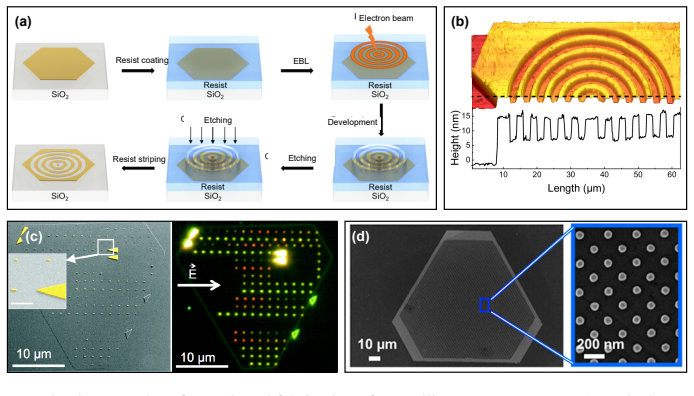
Crystalline noble metal flakes are emerging as versatile platforms in nanophotonics. Their atomically flat surfaces, high crystallinity, and superior optical quality open new avenues in advanced plasmonics, quantum light generation, and hybrid photonic systems. In contrast to conventional polycrystalline metal films, which suffer from higher optical losses due to grain boundaries, surface roughness, and structural disorder, these monocrystalline flakes provide minimal scattering and enhanced performance. They serve as templates for precise nanostructuring through focused-ion beam milling and facilitate frontier research in quantum plasmonics and hybrid 2D architectures, with their {111} facu
What carries the argument
The atomically flat {111} facets of monocrystalline noble metal flakes that support Tamm-Shockley surface states, host 2D plasmons coexisting with bulk modes, and function as near-ideal mirrors with roughness limited to atomic terrace steps.
If this is right
- Precise nanostructuring via focused-ion beam milling becomes feasible with reduced unwanted scattering.
- Fundamental studies of nonlocal optical effects and generation of nonclassical light are supported in quantum plasmonics.
- Hybrid photonic architectures benefit from nearly ideal metallic mirrors at near-infrared and longer wavelengths.
- Well-defined facets enable coexistence of 2D plasmons with bulk modes for new device designs.
Where Pith is reading between the lines
- If growth methods for these flakes become more reproducible, integration into larger-scale photonic circuits could follow directly from the low-loss and flatness properties.
- The same atomic-flat mirror behavior may extend advantages to other wavelengths or material combinations not yet tested in the reviewed studies.
- Direct comparison of loss metrics between different noble metals in crystalline form could guide material selection for specific hybrid 2D applications.
Load-bearing premise
The superior optical quality, atomic flatness, and low-loss properties of these flakes are reliably achieved and consistently superior across the cited experimental works without significant variability or unaddressed limitations.
What would settle it
A side-by-side optical measurement at near-infrared wavelengths showing that a well-prepared polycrystalline film exhibits scattering losses or surface roughness equal to or lower than a crystalline flake would directly challenge the claimed advantage.
Figures




read the original abstract
Crystalline noble metal flakes are emerging as versatile platforms in nanophotonics, enabling a broad range of optical phenomena and applications. Their atomically flat surfaces, high crystallinity, and superior optical quality open new avenues in advanced plasmonics, quantum light generation, and hybrid photonic systems. In contrast to conventional polycrystalline metal films, which typically suffer from higher optical losses due to grain boundaries, surface roughness, and structural disorder, these monocrystalline flakes provide minimal scattering and enhanced performance. They serve as templates for precise nanostructuring through techniques like focused-ion beam (FIB) milling and are crucial for advanced applications in sensing and optoelectronics. Additionally, they facilitate frontier research in quantum plasmonics, enabling fundamental studies of nonlocal optical effects and the generation of nonclassical light. Furthermore, the well-defined $\{111\}$ facets of these flakes host Tamm--Shockley surface states that support 2D plasmons coexisting with bulk modes. At near-infrared wavelengths and beyond, crystalline flakes act as nearly ideal metallic mirrors, featuring surface roughness limited only to atomic terrace steps, making them highly suitable for integration with 2D materials in hybrid photonic architectures. This review surveys the key roles these flakes play, highlighting recent developments and discussing future prospects while emphasizing their unique benefits in addressing fundamental and applied challenges in modern nanophotonics.
Editorial analysis
A structured set of objections, weighed in public.
Referee Report
Summary. The manuscript is a review surveying crystalline noble metal flakes as versatile platforms in nanophotonics. It claims that their atomically flat surfaces, high crystallinity, and superior optical quality enable advanced plasmonics, quantum light generation, and hybrid photonic systems with 2D materials. In contrast to polycrystalline films with higher losses from grain boundaries and roughness, these monocrystalline flakes offer minimal scattering. They are used for precise nanostructuring via FIB milling, support studies of nonlocal effects and nonclassical light in quantum plasmonics, host 2D plasmons on {111} facets, and serve as nearly ideal mirrors at near-IR wavelengths for 2D material integration. The review discusses recent developments and future prospects.
Significance. This review holds significance by providing a consolidated overview of the advantages of crystalline metal flakes, crediting the experimental literature on their low-loss properties and applications. It could guide researchers toward using these platforms for quantum plasmonics and hybrid architectures, emphasizing their role in addressing fundamental challenges in nanophotonics.
major comments (1)
- The assertion that crystalline flakes 'reliably' achieve superior optical quality and atomic flatness (as summarized in the abstract) is load-bearing for the review's central advocacy but lacks a dedicated critical assessment of variability or limitations in the cited experimental works, potentially overstating consistency.
minor comments (2)
- The abstract mentions specific techniques like focused-ion beam (FIB) milling but the full manuscript should ensure all acronyms are defined on first use.
- The discussion of future prospects could include more concrete examples or open questions to make it more actionable for readers.
Simulated Author's Rebuttal
We thank the referee for their positive evaluation of the manuscript and for the constructive comment, which helps improve the balance of the review. We have revised the text accordingly.
read point-by-point responses
-
Referee: The assertion that crystalline flakes 'reliably' achieve superior optical quality and atomic flatness (as summarized in the abstract) is load-bearing for the review's central advocacy but lacks a dedicated critical assessment of variability or limitations in the cited experimental works, potentially overstating consistency.
Authors: We agree that the review would benefit from an explicit discussion of variability. While the cited experimental literature consistently demonstrates lower losses and flatter surfaces relative to polycrystalline films, reported values do show some spread depending on growth conditions, substrate choice, and characterization methods. In the revised manuscript we have added a dedicated paragraph (new Section 2.3) that surveys the range of RMS roughness and plasmonic loss figures reported across key works, notes factors that can introduce variability (e.g., residual strain, terrace-step density, and FIB-induced damage), and qualifies the term 'reliably' to reflect these nuances without altering the central conclusion that crystalline flakes remain superior platforms for the applications discussed. revision: yes
Circularity Check
No circularity: review paper with no derivations or self-referential predictions
full rationale
This is a survey/review manuscript that summarizes existing literature on crystalline noble metal flakes. The abstract and framing present contrasts with polycrystalline films and applications as drawn from cited experimental works rather than introducing new equations, fitted parameters, or quantitative predictions. No load-bearing steps reduce to self-definition, fitted inputs renamed as predictions, or self-citation chains that substitute for independent justification. All central claims are explicitly attributed to the referenced body of prior research, making the paper self-contained as a descriptive overview without internal circularity.
Axiom & Free-Parameter Ledger
Reference graph
Works this paper leans on
-
[1]
Nano-optics from sensing to waveguiding,
S. Lal, S. Link, and N. J. Halas, “Nano-optics from sensing to waveguiding,” Nat. Photonics1, 641–648 (2007)
2007
-
[2]
Nanoplasmonics: The physics behind the applications,
M. I. Stockman, “Nanoplasmonics: The physics behind the applications,” Phys. Today64(2), 39 (2011)
2011
-
[3]
Unrelenting plasmons,
A. I. Fernández-Domínguez, F. J. García-Vidal, and L. Martín-Moreno, “Unrelenting plasmons,” Nat. Photonics11, 8–10 (2017)
2017
-
[4]
Nanofabrication of plasmonic structures,
J. Henzie, J. Lee, M. H. Lee,et al., “Nanofabrication of plasmonic structures,” Annu. Rev. Phys. Chem.60, 147–165 (2009)
2009
-
[5]
Optical constants of the noble metals,
P. B. Johnson and R. W. Christy, “Optical constants of the noble metals,” Phys. Rev. B6, 4370–4379 (1972)
1972
-
[6]
How to deal with the loss in plasmonics and metamaterials,
J. B. Khurgin, “How to deal with the loss in plasmonics and metamaterials,” Nat. Nanotechnol.10, 2–6 (2015)
2015
-
[7]
Plasmonic and new plasmonic materials: general discussion,
F. J. García de Abajo, R. Sapienza, M. Noginov,et al., “Plasmonic and new plasmonic materials: general discussion,” Faraday Discuss.178, 123–149 (2015)
2015
-
[8]
Plasmonics–turning loss into gain,
J. C. Ndukaife, V. M. Shalaev, and A. Boltasseva, “Plasmonics–turning loss into gain,” Science351, 334–335 (2016)
2016
-
[9]
Lossesinplasmonics: frommitigatingenergydissipationtoembracing loss-enabled functionalities,
S.V.Boriskina,T.A.Cooper,L.Zeng,etal.,“Lossesinplasmonics: frommitigatingenergydissipationtoembracing loss-enabled functionalities,” Adv. Opt. Photonics9, 775–827 (2017)
2017
-
[10]
Plasmonic films can easily be better: Rules and recipes,
K. M. McPeak, S. V. Jayanti, S. J. P. Kress,et al., “Plasmonic films can easily be better: Rules and recipes,” ACS Photonics2, 326–333 (2015)
2015
-
[11]
Atomically flat single-crystalline gold nanostructures for plasmonic nanocircuitry,
J.-S. Huang, V. Callegari, P. Geisler,et al., “Atomically flat single-crystalline gold nanostructures for plasmonic nanocircuitry,” Nat. Commun.1, 150 (2010)
2010
-
[12]
Adiabatic nanofocusing on ultrasmooth single-crystalline gold tapers creates a 10-nm-sized light source with few-cycle time resolution,
S. Schmidt, B. Piglosiewicz, D. Sadiq,et al., “Adiabatic nanofocusing on ultrasmooth single-crystalline gold tapers creates a 10-nm-sized light source with few-cycle time resolution,” ACS Nano6, 6040–6048 (2012)
2012
-
[13]
Cavity-assisted ultrafast long-range periodic energy transfer between plasmonic nanoantennas,
M. Aeschlimann, T. Brixner, M. Cinchetti,et al., “Cavity-assisted ultrafast long-range periodic energy transfer between plasmonic nanoantennas,” Light. Sci. & Appl.6, e17111 (2017)
2017
-
[14]
Revealing the subfemtosecond dynamics of orbital angular momentum in nanoplasmonic vortices,
G. Spektor, D. Kilbane, A. K. Mahro,et al., “Revealing the subfemtosecond dynamics of orbital angular momentum in nanoplasmonic vortices,” Science355, 1187–1191 (2017)
2017
-
[15]
Short-range surface plasmonics: Localized electron emission dynamics from a 60-nm spot on an atomically flat single-crystalline gold surface,
B. Frank, P. Kahl, D. Podbiel,et al., “Short-range surface plasmonics: Localized electron emission dynamics from a 60-nm spot on an atomically flat single-crystalline gold surface,” Sci. Adv.3, e1700721 (2017)
2017
-
[16]
Tunable self-assembled Casimir microcavities and polaritons,
B. Munkhbat, A. Canales, B. Küçüköz,et al., “Tunable self-assembled Casimir microcavities and polaritons,” Nature 597, 214–219 (2021)
2021
-
[17]
Light-driven microdrones,
X. Wu, R. Ehehalt, G. Razinskas,et al., “Light-driven microdrones,” Nat. Nanotechnol.17, 477–484 (2022)
2022
-
[18]
Modulation of surface response in a single plasmonic nanoresonator,
L. Zurak, C. Wolff, J. Meier,et al., “Modulation of surface response in a single plasmonic nanoresonator,” Sci. Adv. 10, eadn5227 (2024)
2024
-
[19]
Light-driven plasmonic microrobot for nanoparticle manipulation,
J. Qin, X. Wu, A. Krueger, and B. Hecht, “Light-driven plasmonic microrobot for nanoparticle manipulation,” Nat. Commun.16, 2570 (2025)
2025
-
[20]
Evolutionary optimized, monocrystalline gold double wire gratings as a novel SERS sensing platform,
A. O. Sweedan, M. J. Pavan, E. Schatz,et al., “Evolutionary optimized, monocrystalline gold double wire gratings as a novel SERS sensing platform,” Small20, 2311937 (2024)
2024
-
[21]
Plasmonics for emerging quantum technologies,
S. I. Bozhevolnyi and N. A. Mortensen, “Plasmonics for emerging quantum technologies,” Nanophotonics6, 1185–1188 (2017). 33
2017
-
[22]
The case for quantum plasmonics,
S. I. Bozhevolnyi and J. B. Khurgin, “The case for quantum plasmonics,” Nat. Photonics11, 398–400 (2017)
2017
-
[23]
Plasmon-enhanced generation of nonclassical light,
A. I. Fernández-Domínguez, S. I. Bozhevolnyi, and N. A. Mortensen, “Plasmon-enhanced generation of nonclassical light,” ACS Photonics5, 3447–3451 (2018)
2018
-
[24]
Tailoring and imaging the plasmonic local density of states in crystalline nanoprisms,
S. Viarbitskaya, A. Teulle, R. Marty,et al., “Tailoring and imaging the plasmonic local density of states in crystalline nanoprisms,” Nat. Mater.12, 426–432 (2013)
2013
-
[25]
Extremely confined gap plasmon modes: when nonlocality matters,
S. Boroviks, Z.-H. Lin, V. A. Zenin,et al., “Extremely confined gap plasmon modes: when nonlocality matters,” Nat. Commun.13, 3105 (2022)
2022
-
[26]
Image polaritons in van der Waals crystals,
S. G. Menabde, J. T. Heiden, J. D. Cox,et al., “Image polaritons in van der Waals crystals,” Nanophotonics11, 2433–2452 (2022)
2022
-
[27]
Anisotropicsecond-harmonicgenerationfrommonocrystalline gold flakes,
S.Boroviks,T.Yezekyan,À.RodríguezEcharri,etal.,“Anisotropicsecond-harmonicgenerationfrommonocrystalline gold flakes,” Opt. Lett.46, 833–836 (2021)
2021
-
[28]
Monocrystalline gold metasurface to control anisotropic second-harmonic generation,
S. Boroviks and O. J. F. Martin, “Monocrystalline gold metasurface to control anisotropic second-harmonic generation,” Adv. Opt. Mater.13, 2402525 (2025)
2025
-
[29]
Surface electronic structure,
J. E. Inglesfield, “Surface electronic structure,” Reports on Prog. Phys.45, 223–284 (1982)
1982
-
[30]
Confinement of electrons to quantum corrals on a metal surface,
M. F. Crommie, C. P. Lutz, and D. M. Eigler, “Confinement of electrons to quantum corrals on a metal surface,” Science262, 218–220 (1993)
1993
-
[31]
On the possible bound states of electrons on a crystal surface,
I. Tamm, “On the possible bound states of electrons on a crystal surface,” Phys. Z. Sov. Union1, 733 (1932)
1932
-
[32]
On the surface states associated with a periodic potential,
W. Shockley, “On the surface states associated with a periodic potential,” Phys. Rev.56, 317–323 (1939)
1939
-
[33]
Theory of surface plasmons and surface plasmon polaritons,
J. M. Pitarke, V. M. Silkin, E. V. Chulkov, and P. M. Echenique, “Theory of surface plasmons and surface plasmon polaritons,” Reports on Prog. Phys.70, 1–87 (2007)
2007
-
[34]
Mesoscopic electrodynamics at metal surfaces,
N. A. Mortensen, “Mesoscopic electrodynamics at metal surfaces,” Nanophotonics10, 2563–2616 (2021)
2021
-
[35]
Surface-plasmonenergyanddispersiononAgsinglecrystals,
S.Suto,K.-D.Tsuei,E.W.Plummer,andE.Burstein,“Surface-plasmonenergyanddispersiononAgsinglecrystals,” Phys. Rev. Lett.63, 2590–2593 (1989)
1989
-
[36]
Surface-state electron dynamics in noble metals,
P. M. Echenique, J. Osma, M. Machado,et al., “Surface-state electron dynamics in noble metals,” Prog. Surf. Sci.67, 271–283 (2001)
2001
-
[37]
Quantum effects in the acoustic plasmons of atomically thin heterostructures,
À. Rodríguez Echarri, J. D. Cox, and F. J. García de Abajo, “Quantum effects in the acoustic plasmons of atomically thin heterostructures,” Optica6, 630–641 (2019)
2019
-
[38]
Optical response of noble metal nanostructures: quantum surface effects in crystallographic facets,
À. Rodríguez Echarri, P. A. D. Gonçalves, C. Tserkezis,et al., “Optical response of noble metal nanostructures: quantum surface effects in crystallographic facets,” Optica8, 710–721 (2021)
2021
-
[39]
Effect of Tamm surface states on Landau damping in metal–semiconductor nanostructures,
A. V. Uskov, I. V. Smetanin, I. E. Protsenko,et al., “Effect of Tamm surface states on Landau damping in metal–semiconductor nanostructures,” Adv. Opt. Mater.11, 2201388 (2023)
2023
-
[40]
Nonlocality in photonic materials and metamaterials: roadmap,
F. Monticone, N. A. Mortensen, A. I. Fernández-Domínguez,et al., “Nonlocality in photonic materials and metamaterials: roadmap,” Opt. Mater. Express15, 1544–1709 (2025)
2025
-
[41]
High-index faceted noble metal nanocrystals,
Z. Quan, Y. Wang, and J. Fang, “High-index faceted noble metal nanocrystals,” Accounts Chem. Res.46, 191–202 (2013)
2013
-
[42]
Modeling the optical response of highly faceted metal nanoparticles with a fully 3D boundary element method,
V. Myroshnychenko, E. Carbó-Argibay, I. Pastoriza-Santos,et al., “Modeling the optical response of highly faceted metal nanoparticles with a fully 3D boundary element method,” Adv. Mater.20, 4288–4293 (2008)
2008
-
[43]
Surfaceplasmoncouplingindimersofgoldnanoparticles: Experiment and theory for ideal (spherical) and nonideal (faceted) building blocks,
J.H.Yoon,F.Selbach,L.Schumacher,etal.,“Surfaceplasmoncouplingindimersofgoldnanoparticles: Experiment and theory for ideal (spherical) and nonideal (faceted) building blocks,” ACS Photonics6, 642–648 (2019)
2019
-
[44]
Shape-controlled synthesis of metal nanocrystals: Simple chemistry meets complex physics?
Y. Xia, Y. Xiong, B. Lim, and S. E. Skrabalak, “Shape-controlled synthesis of metal nanocrystals: Simple chemistry meets complex physics?” Angewandte Chemie Int. Ed.48, 60–103 (2009)
2009
-
[45]
Anisotropic gold nanoparticles: Synthesis, properties, applications, and toxicity,
N. Li, P. Zhao, and D. Astruc, “Anisotropic gold nanoparticles: Synthesis, properties, applications, and toxicity,” Angewandte Chemie Int. Ed.53, 1756–1789 (2014)
2014
-
[46]
Two-dimensional Au nanocrystals: Shape/size controlling synthesis, morphologies, and applications,
H. Hu, J. Zhou, Q. Kong, and C. Li, “Two-dimensional Au nanocrystals: Shape/size controlling synthesis, morphologies, and applications,” Part. & Part. Syst. Charact.32, 796–808 (2015)
2015
-
[47]
New insights into colloidal gold flakes: structural investigation, micro-ellipsometry and thinning procedure towards ultrathin monocrystalline layers,
B. Hoffmann, M. Y. Bashouti, T. Feichtner,et al., “New insights into colloidal gold flakes: structural investigation, micro-ellipsometry and thinning procedure towards ultrathin monocrystalline layers,” Nanoscale8, 4529–4536 (2016)
2016
-
[48]
Shape control in gold nanoparticle synthesis,
M. Grzelczak, J. Pérez-Juste, P. Mulvaney, and L. M. Liz-Marzán, “Shape control in gold nanoparticle synthesis,” Chem. Soc. Rev.37, 1783–1791 (2008)
2008
-
[49]
Shape control in gold nanoparticle synthesis,
M. Grzelczak, J. Pérez-Juste, P. Mulvaney, and L. M. Liz-Marzán, “Shape control in gold nanoparticle synthesis,” in Colloidal Synthesis of Plasmonic Nanometals,L. M. Liz-Marzán, ed. (Jenny Stanford Publishing, 2020), chap. 6, pp. 197–220
2020
-
[50]
Substrate-immobilized noble metal nanoplates: a review of their synthesis, assembly, and application,
R. D. Neal, R. A. Hughes, A. S. Preston,et al., “Substrate-immobilized noble metal nanoplates: a review of their synthesis, assembly, and application,” J. Mater. Chem. C9, 12974–13012 (2021)
2021
-
[51]
Two-dimensionalmetalnanostructures: Fromtheoreticalunderstandingtoexperiment,
S.Yu,C.Zhang,andH.Yang,“Two-dimensionalmetalnanostructures: Fromtheoreticalunderstandingtoexperiment,” Chem. Rev.123, 3443–3492 (2023)
2023
-
[52]
Plate-like colloidal metal nanoparticles,
L. Scarabelli, M. Sun, X. Zhuo,et al., “Plate-like colloidal metal nanoparticles,” Chem. Rev.123, 3493–3542 (2023)
2023
-
[53]
A. O. Sweedan, K. Zhang, M. Y. Bashouti, and T. Feichtner, “Large-area atomically flat monocrystalline gold flakes: Recent advances, applications, and future potential,” arXiv:2511.01327 (2025)
-
[54]
Experimental relations of gold (and other metals) to light,
M. Faraday, “Experimental relations of gold (and other metals) to light,” Philos. Trans. Royal Soc. Lond.147, 145–181 (1857)
-
[55]
A study of the nucleation and growth processes in the synthesis of 34 colloidal gold,
J. Turkevich, P. C. Stevenson, and J. Hillier, “A study of the nucleation and growth processes in the synthesis of 34 colloidal gold,” Discuss. Faraday Soc.11, 55–75 (1951)
1951
-
[56]
Theory, production and mechanism of formation of monodispersed hydrosols,
V. K. LaMer and R. H. Dinegar, “Theory, production and mechanism of formation of monodispersed hydrosols,” J. Am. Chem. Soc.72, 4847–4854 (1950)
1950
-
[57]
Synthesisofthiol-derivatisedgoldnanoparticlesinatwo-phaseliquid–liquid system,
M.Brust,M.Walker,D.Bethell,etal.,“Synthesisofthiol-derivatisedgoldnanoparticlesinatwo-phaseliquid–liquid system,” J. Chem. Soc. Chem. Commun.7, 801–802 (1994)
1994
-
[58]
A real time microscopy study of the growth of giant Au microplates,
B. Radha and G. U. Kulkarni, “A real time microscopy study of the growth of giant Au microplates,” Cryst. Growth & Des.11, 320–327 (2011)
2011
-
[59]
Giant single crystalline Au microplates,
B. Radha and G. U. Kulkarni, “Giant single crystalline Au microplates,” Curr. Sci.102, 70–77 (2012)
2012
-
[60]
Synthesis of single-crystal gold nanosheets of large size in ionic liquids,
Z. Li, Z. Liu, J. Zhang,et al., “Synthesis of single-crystal gold nanosheets of large size in ionic liquids,” J. Phys. Chem. B109, 14445–14448 (2005)
2005
-
[61]
Facilesynthesisofmicrometer-sizedgoldnanoplatesthroughananiline-assisted route in ethylene glycol solution,
Z.Guo,Y.Zhang,Y.DuanMu,etal.,“Facilesynthesisofmicrometer-sizedgoldnanoplatesthroughananiline-assisted route in ethylene glycol solution,” Colloids Surfaces A: Physicochem. Eng. Aspects278, 33–38 (2006)
2006
-
[62]
Single-crystallinegoldmicroplates: Synthesis,characterization,andthermalstability,
C.Kan,X.Zhu,andG.Wang,“Single-crystallinegoldmicroplates: Synthesis,characterization,andthermalstability,” J. Phys. Chem. B110, 4651–4656 (2006)
2006
-
[63]
Single-crystallinegoldmicroplatesgrownonsubstratesbysolution-phase synthesis,
X.Wu,R.Kullock,E.Krauss,andB.Hecht,“Single-crystallinegoldmicroplatesgrownonsubstratesbysolution-phase synthesis,” Cryst. Res. & Technol.50, 595–602 (2015)
2015
-
[64]
One-steppreparationofbiocompatiblegoldnanoplateswithcontrolled thickness and adjustable optical properties for plasmon-based applications,
S.Ye,S.D.Connell,J.R.McLaughlan,etal.,“One-steppreparationofbiocompatiblegoldnanoplateswithcontrolled thickness and adjustable optical properties for plasmon-based applications,” Adv. Funct. Mater.30, 2003512 (2020)
2020
-
[65]
Controlled growth of high-aspect-ratio single-crystalline gold platelets,
E. Krauss, R. Kullock, X. Wu,et al., “Controlled growth of high-aspect-ratio single-crystalline gold platelets,” Cryst. Growth & Des.18, 1297–1302 (2018)
2018
-
[66]
Recrystallization-enabled fabrication of single-crystalline gold flakes for plasmonic applications,
C. Wu, C. Pan, J. Zheng,et al., “Recrystallization-enabled fabrication of single-crystalline gold flakes for plasmonic applications,” ACS Appl. Mater. & Interfaces16, 68204–68210 (2024)
2024
-
[67]
Naturally occurring gold nanoparticles and nanoplates,
R. M. Hough, R. R. P. Noble, G. J. Hitchen,et al., “Naturally occurring gold nanoparticles and nanoplates,” Geology 36, 571–574 (2008)
2008
-
[68]
Interference in edge-scattering from monocrystalline gold flakes [Invited],
S. Boroviks, C. Wolff, J. Linnet,et al., “Interference in edge-scattering from monocrystalline gold flakes [Invited],” Opt. Mater. Express8, 3688–3697 (2018)
2018
-
[69]
The role of twinning in shape evolution of anisotropic noble metal nanostructures,
J. L. Elechiguerra, J. Reyes-Gasga, and M. J. Yacaman, “The role of twinning in shape evolution of anisotropic noble metal nanostructures,” J. Mater. Chem.16, 3906–3919 (2006)
2006
-
[70]
Colloidal gold and silver triangular nanoprisms,
J. E. Millstone, S. J. Hurst, G. S. Métraux,et al., “Colloidal gold and silver triangular nanoprisms,” Small5, 646–664 (2009)
2009
-
[71]
Mechanisms controlling crystal habits of gold and silver colloids,
C. Lofton and W. Sigmund, “Mechanisms controlling crystal habits of gold and silver colloids,” Adv. Funct. Mater. 15, 1197–1208 (2005)
2005
-
[72]
On the mechanism of metal nanoparticle synthesis in the Brust–Schiffrin method,
S. R. K. Perala and S. Kumar, “On the mechanism of metal nanoparticle synthesis in the Brust–Schiffrin method,” Langmuir29, 9863–9873 (2013)
2013
-
[73]
Making sense of the mayhem behind shape control in the synthesis of gold nanoparticles,
M. L. Personick and C. A. Mirkin, “Making sense of the mayhem behind shape control in the synthesis of gold nanoparticles,” J. Am. Chem. Soc.135, 18238–18247 (2013)
2013
-
[74]
Thickness-controlledsynthesisofultrathinAusheetsandsurfaceplasmonic property,
H.L.Qin, D.Wang, Z.L.Huang,etal., “Thickness-controlledsynthesisofultrathinAusheetsandsurfaceplasmonic property,” J. Am. Chem. Soc.135, 12544–12547 (2013)
2013
-
[75]
HighaspectratioAumicroflakesviagap-assistedsynthesis,
F.KianiandG.Tagliabue,“HighaspectratioAumicroflakesviagap-assistedsynthesis,”Chem.Mater.34,1278–1288 (2022)
2022
-
[76]
Large area single crystal gold of single nanometer thickness for nanophotonics,
C. Pan, Y. Tong, H. Qian,et al., “Large area single crystal gold of single nanometer thickness for nanophotonics,” Nat. Commun.15, 2840 (2024)
2024
-
[77]
Challenging the ideal strength limit in single-crystalline gold nanoflakes through phase engineering,
T. Zhang, Y. Tong, C. Pan,et al., “Challenging the ideal strength limit in single-crystalline gold nanoflakes through phase engineering,” Nat. Commun.16, 926 (2025)
2025
-
[78]
Controlling anisotropic nanoparticle growth through plasmon excitation,
R. Jin, Y. Charles Cao, E. Hao,et al., “Controlling anisotropic nanoparticle growth through plasmon excitation,” Nature425, 487–490 (2003)
2003
-
[79]
Single-crystal metal nanoplatelets: Cobalt, nickel, copper, and silver,
R. Xu, T. Xie, Y. Zhao, and Y. Li, “Single-crystal metal nanoplatelets: Cobalt, nickel, copper, and silver,” Cryst. Growth & Des.7, 1904–1911 (2007)
1904
-
[80]
Colloidal silver nanoplates. State of the art and future challenges,
I. Pastoriza-Santos and L. M. Liz-Marzán, “Colloidal silver nanoplates. State of the art and future challenges,” J. Mater. Chem.18, 1724–1737 (2008)
2008
discussion (0)
Sign in with ORCID, Apple, or X to comment. Anyone can read and Pith papers without signing in.