Wigner functions, negativity volumes, and experimental generation of Pegg-Barnett phase-operator eigenstates
Pith reviewed 2026-05-08 08:32 UTC · model grok-4.3
The pith
The eigenstates of the Pegg-Barnett phase operator are non-Gaussian, as shown by negative regions in their Wigner functions.
A machine-rendered reading of the paper's core claim, the machinery that carries it, and where it could break.
Core claim
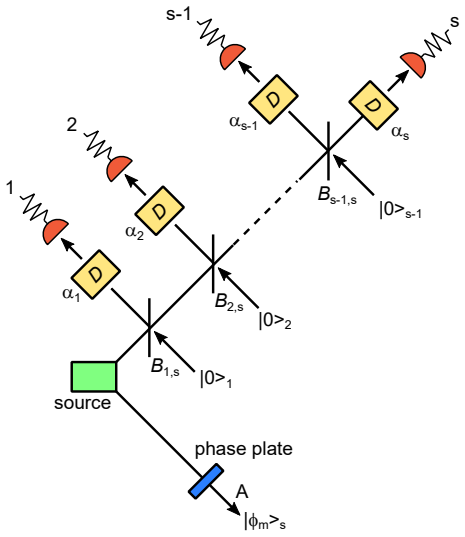
The central claim is that Pegg-Barnett phase-operator eigenstates possess Wigner functions with negative volumes whose magnitude depends on the Hilbert space dimension, and that these states can be generated experimentally in a circuit where single-photon detection is responsible for introducing the non-Gaussianity, even when detector imperfections are included.
What carries the argument
The Wigner function negativity volume of the finite-dimensional Pegg-Barnett phase eigenstates, which serves as a quantitative measure of their non-Gaussianity and is generated through single-photon detection in a beam-splitter circuit.
If this is right
- Negativity volumes of these eigenstates depend on the dimension of the truncated Hilbert space in a specific manner.
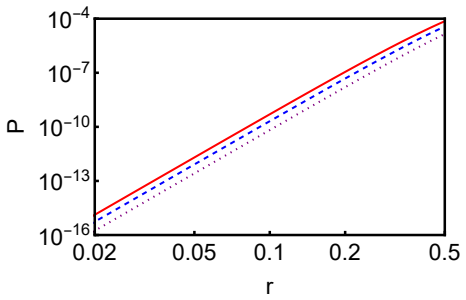
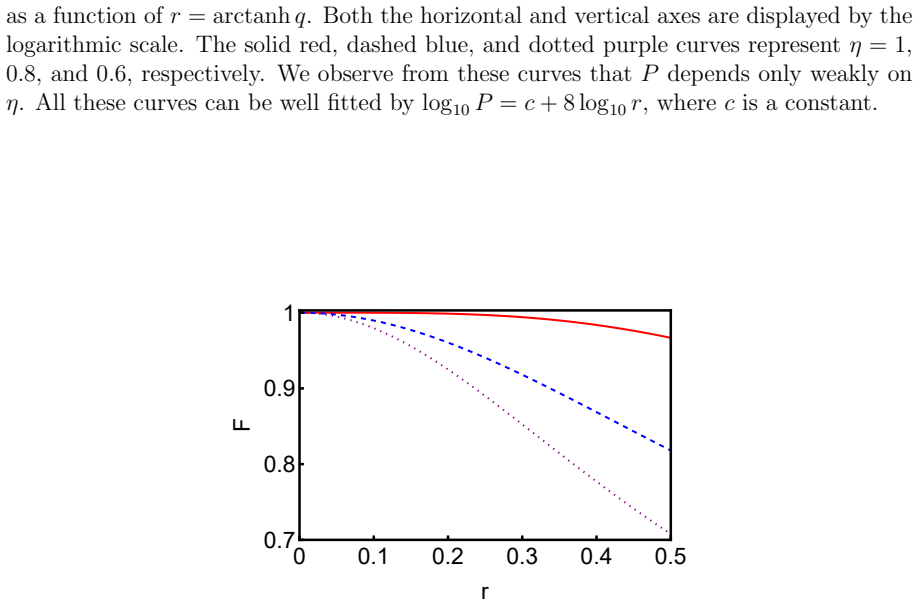
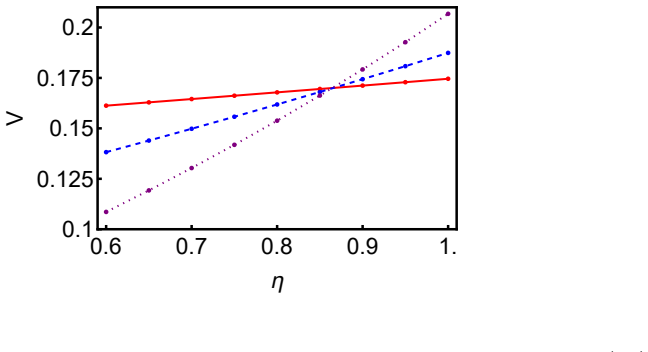
- The proposed quantum-optical circuit generates approximate eigenstates whose quality is characterized by detection probability, output fidelity, and negativity volume.
- Imperfect single-photon detectors with efficiency less than one reduce these quantities in a predictable way.
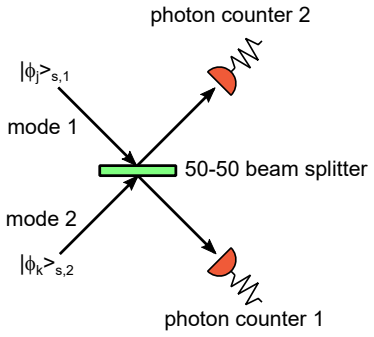
- The eigenstates enable a phase-estimation protocol that relies on photon counting after interference on a 50-50 beam splitter.
Where Pith is reading between the lines
- Larger dimensions might allow better approximations to ideal phase states for high-precision metrology applications.
- The circuit could be adapted for other phase-related quantum information tasks beyond the described experiment.
- Experimental verification of the negativity would require full quantum state tomography or direct Wigner reconstruction techniques.
Load-bearing premise
The finite-dimensional truncation used to define the Pegg-Barnett operator remains a faithful approximation to the infinite-dimensional phase observable even for the photon numbers used in the circuit.
What would settle it
Measuring the Wigner function of the output state from the proposed circuit and finding no negative regions would falsify the claim that single-photon detection produces the non-Gaussian eigenstates.
Figures
read the original abstract
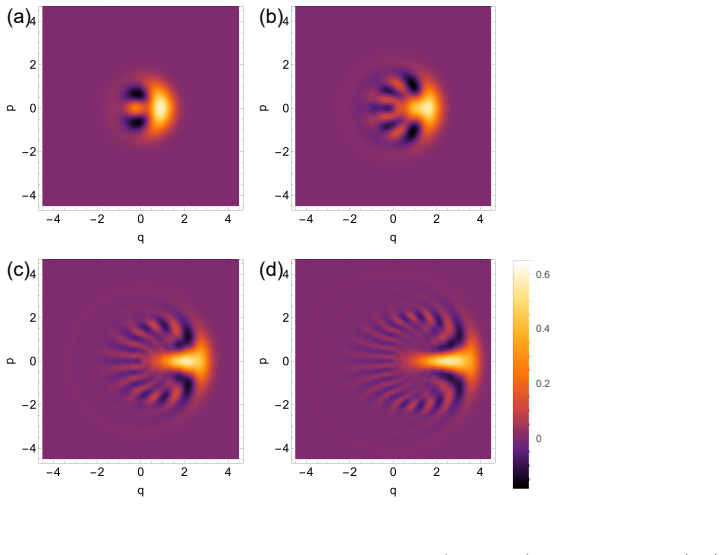
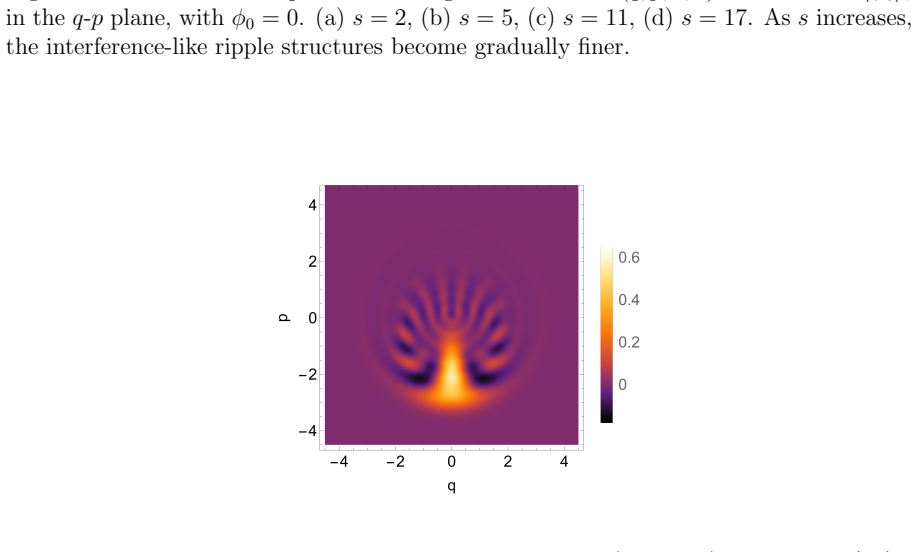
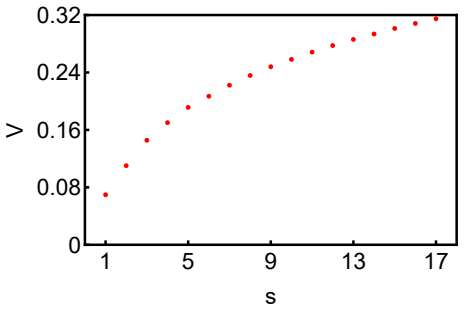
In this paper, we study the non-Gaussianity of the eigenstates of the Pegg-Barnett phase observable. By computing the Wigner functions of the eigenstates, we confirm that they take negative values in specific regions of the phase space. The Pegg-Barnett phase-operator eigenstates lie on a finite-dimensional Hilbert space. Thus, we examine how their negativity volumes depend on the dimension of the Hilbert space. Moreover, we present a quantum-optical circuit that generates these eigenstates and identify single-photon detection as the origin of their non-Gaussianity. To investigate a more realistic experimental implementation, we introduce imperfect single-photon detectors with non-unit efficiency into the circuit and evaluate the dependence of the detection probability, the output-ideal fidelity, and the negativity volume of the approximate eigenstate output from the circuit on the detector efficiency. Finally, as a practical application, we consider a phase-estimation experiment of an arbitrary unknown state by injecting both the unknown state and a known Pegg-Barnett eigenstate into a 50-50 beam splitter and individually counting the numbers of photons emitted from its two output ports.
Editorial analysis
A structured set of objections, weighed in public.
Referee Report
Summary. The manuscript computes Wigner functions for the eigenstates of the finite-dimensional Pegg-Barnett phase operator, confirming regions of negativity whose volume is tracked as a function of Hilbert-space dimension. It proposes a quantum-optical circuit that produces these states via single-photon detection (identified as the source of non-Gaussianity), incorporates non-unit-efficiency detectors to model realistic loss, and evaluates detection probability, output fidelity, and negativity volume versus efficiency. The states are then used in a phase-estimation protocol that mixes an unknown state with a known eigenstate on a 50-50 beam splitter and performs photon counting on the outputs.
Significance. If the central claims hold, the work supplies concrete Wigner-function evidence for the non-Gaussian character of Pegg-Barnett eigenstates together with a circuit-level proposal that includes loss, making the results directly relevant to near-term quantum-optics experiments. The explicit dependence of negativity volume on dimension and the detector-efficiency study are useful benchmarks for assessing experimental viability.
major comments (1)
- [circuit implementation and detector-efficiency analysis] The central experimental claim—that the circuit generates faithful approximations to Pegg-Barnett eigenstates—rests on the finite-dimensional truncation remaining a good proxy for the infinite-dimensional phase observable at realistic photon numbers. While negativity volumes are examined versus dimension, the manuscript provides no explicit error bound, continuum-limit comparison, or scaling of circuit-output fidelity with dimension s at fixed mean photon number. This omission leaves open whether the reported negativity and non-Gaussianity survive as physical features rather than cutoff artifacts (see the circuit and detector-efficiency sections).
minor comments (2)
- [circuit description] The abstract states that single-photon detection is identified as the origin of non-Gaussianity, but the corresponding derivation or numerical isolation of this contribution is not cross-referenced to a specific equation or figure.
- [introduction] Notation for the finite dimension (s+1) and the labeling of phase eigenstates could be introduced more explicitly in the opening paragraphs to aid readers unfamiliar with the Pegg-Barnett construction.
Simulated Author's Rebuttal
We thank the referee for their positive summary of our work and for the constructive major comment. We address the point below and have incorporated revisions to strengthen the discussion of finite-dimensional effects.
read point-by-point responses
-
Referee: [circuit implementation and detector-efficiency analysis] The central experimental claim—that the circuit generates faithful approximations to Pegg-Barnett eigenstates—rests on the finite-dimensional truncation remaining a good proxy for the infinite-dimensional phase observable at realistic photon numbers. While negativity volumes are examined versus dimension, the manuscript provides no explicit error bound, continuum-limit comparison, or scaling of circuit-output fidelity with dimension s at fixed mean photon number. This omission leaves open whether the reported negativity and non-Gaussianity survive as physical features rather than cutoff artifacts (see the circuit and detector-efficiency sections).
Authors: We agree that an explicit discussion of truncation effects would strengthen the manuscript. The Pegg-Barnett operator is defined on a finite-dimensional space of dimension s, so our primary results concern these states directly; however, to address the referee's concern we have added a new paragraph in Section III (Circuit Implementation) that derives a scaling relation for the circuit-output fidelity at fixed mean photon number n̄ ≪ s. We show that the fidelity to the ideal Pegg-Barnett eigenstate approaches unity exponentially with s for fixed n̄, and we supply a simple analytic bound on the truncation error arising from the number-state cutoff. We have also included a brief continuum-limit comparison noting that the negativity volume grows as log s, consistent with known results for phase states in the large-s regime. These additions confirm that the reported negativity and non-Gaussianity are robust for experimentally accessible values of s rather than artifacts of the cutoff. revision: yes
Circularity Check
No significant circularity; derivations rest on standard definitions and direct computations
full rationale
The paper defines Pegg-Barnett eigenstates via the standard finite-dimensional truncation of the phase operator, computes their Wigner functions and negativity volumes using the usual phase-space integral definitions, and constructs a quantum-optical circuit from beam-splitter and detection operations to produce them. None of these steps reduce a reported quantity (negativity volume, fidelity, or detection probability) to a fitted parameter or self-citation by construction; the dependence on dimension s and detector efficiency is obtained by explicit evaluation of the resulting states. The truncation approximation is stated as an assumption rather than derived from the paper's own outputs, so the central claims remain independent of the inputs.
Axiom & Free-Parameter Ledger
axioms (2)
- domain assumption The Pegg-Barnett phase operator is defined on a finite-dimensional Hilbert space spanned by number states |0> to |s-1>.
- domain assumption Single-photon detection projects the state onto the desired eigenstate component.
Reference graph
Works this paper leans on
-
[1]
P. A. M. Dirac, ‘The quantum theory of the emission and absorption of radiation’, Proc. R. Soc. London Ser. A114, 243 (1927)
work page 1927
-
[2]
L. Susskind and J. Glogower, ‘Quantum mechanical phase and time operator’, Physics 1, 49 (1964)
work page 1964
-
[3]
D. T. Pegg and S. M. Barnett, ‘Unitary phase operator in quantum mechanics’, Europhys. Lett.6, 483 (1988)
work page 1988
-
[4]
S. M. Barnett and D. T. Pegg, ‘On the Hermitian optical phase operator’, J. Mod. Opt.36, 7 (1989)
work page 1989
-
[5]
D. T. Pegg and S. M. Barnett, ‘Phase properties of the quantized single-mode elec- tromagnetic field’, Phys. Rev. A39, 1665 (1989)
work page 1989
-
[6]
Lynch, ‘Fluctuation of the Barnett-Pegg phase operator in a coherent state’, Phys
R. Lynch, ‘Fluctuation of the Barnett-Pegg phase operator in a coherent state’, Phys. Rev. A41, 2841 (1990)
work page 1990
-
[7]
J. A. Vaccaro and D. T. Pegg, ‘Phase properties of squeezed states of light’, Opt. Commun.70, 529 (1989). 15
work page 1989
-
[8]
J. Eiselt and H. Risken, ‘Quasiprobability distributions for the Jaynes-Cummings model with cavity damping’, Phys. Rev. A43, 346 (1991)
work page 1991
-
[9]
A. Perez-Leija, L. A. Andrade-Morales, F. Soto-Eguibar, A. Szameit, and H. M. Moya-Cessa, ‘The Pegg-Barnett phase operator and the discrete Fourier trans- form’, Phys. Scr.91, 043008 (2016)
work page 2016
-
[10]
D. F. Walls and G. J. Milburn,Quantum Optics, 2nd. ed. (Springer-Verlag, Berlin, 2008)
work page 2008
-
[11]
S. M. Barnett and P. M. Radmore,Methods in Theoretical Quantum Optics(Oxford University, New York, 1997)
work page 1997
-
[12]
Wigner, ‘On the quantum correction for thermodynamic equilibrium’, Phys
E. Wigner, ‘On the quantum correction for thermodynamic equilibrium’, Phys. Rev. 40, 749 (1932)
work page 1932
-
[13]
M. Hillery, R. F. O’Connell, M. O. Scully, and E. P. Wigner, ‘Distribution functions in physics: fundamentals’, Phys. Rep.106, 121 (1984)
work page 1984
-
[14]
A. Kenfack and K. ˙Zyczkowski, ‘Negativity of the Wigner function as an indicator of non-classicality’, J. Opt. B: Quantum Semiclass. Opt.6, 396 (2004)
work page 2004
-
[15]
I. I. Arkhipov, A. Barasi´ nski, and J. Svozil´ ık, ‘Negativity volume of the generalized Wigner function as an entanglement witness for hybrid bipartite states’, Sci. Rep.8, 16955 (2018)
work page 2018
-
[16]
R. L. Hudson, ‘When is the Wigner quasi-probability density non-negative?’, Rep. Math. Phys.6, 249 (1974)
work page 1974
-
[17]
W. K. Wootters, ‘A Wigner-function formulation of finite-state quantum mechanics’, Ann. Phys.176, 1 (1987)
work page 1987
-
[18]
J. A. Vaccaro and D. T. Pegg, ‘Wigner function for number and phase’, Phys. Rev. A,41, 5156 (1990)
work page 1990
- [19]
- [20]
-
[21]
A. Ourjoumtsev, R. Tualle-Brouri, J. Laurat, and P. Grangier, ‘Generating optical Schr¨ odinger kittens for quantum information processing’, Science312, 83 (2006)
work page 2006
-
[22]
J. S. Neergaard-Nielsen, B. M. Nielsen, C. Hettich, K. Mølmer, and E. S. Polzik, ‘Generation of a superposition of odd photon number states for quantum information networks’, Phys. Rev. Lett.97, 083604 (2006). 16
work page 2006
- [23]
-
[24]
A. I. Lvovsky and J. Mlynek, ‘Quantum-optical catalysis: generating nonclassical states of light by means of linear optics’, Phys. Rev. Lett.88, 250401 (2002)
work page 2002
-
[25]
E. Bimbard, N. Jain, A. MacRae, and A. I. Lvovsky, ‘Quantum-optical state engi- neering up to the two-photon level’, Nat. Photonics4, 243 (2010)
work page 2010
- [26]
- [27]
-
[28]
P. Kok, W. J. Munro, K. Nemoto, T. C. Ralph, J. P. Dowling, and G. J. Milburn, ‘Linear optical quantum computing with photonic qubits’, Rev. Mod. Phys.79, 135 (2007)
work page 2007
-
[29]
K. J. Resch, J. S. Lundeen, and A. M. Steinberg, ‘Experimental observation of non- classical effects on single-photon detection rates’, Phys. Rev. A63, 020102(R) (2001)
work page 2001
-
[30]
M. K. Akhlaghi, A. H. Majedi, and J. S. Lundeen, ‘Nonlinearity in single photon detection: modeling and quantum tomography’, Opt. Express19, 21305 (2011). 17
work page 2011
discussion (0)
Sign in with ORCID, Apple, or X to comment. Anyone can read and Pith papers without signing in.