Matched asymptotics of Rayleigh-wave fields near cuspidal ridges and gorges
Pith reviewed 2026-05-08 07:05 UTC · model grok-4.3
The pith
Cuspidal ridges behave like vanishing-width horns and support bounded-stress Rayleigh-wave fields.
A machine-rendered reading of the paper's core claim, the machinery that carries it, and where it could break.
Core claim
The central claim is that near a cuspidal ridge the elastic field generated by an incident Rayleigh wave can be described by matching to a local solution in a vanishing-width horn geometry, yielding an asymptotically rigid leading term with bounded stress at the free tip; this is distinct from the singular high-energy field that appears when the cusp is replaced by a truncated tip with finite opening.
What carries the argument
Matched asymptotics linking the far-field Rayleigh-wave solution to local solutions of the Lamé equations in cusp or horn geometries defined by a graph exponent 0 < α < 1.
Load-bearing premise
The traction-free surface can be locally approximated by a cusp-shaped graph whose width vanishes as a power law with exponent greater than one, allowing standard matched asymptotics to connect the Rayleigh far field to the near-tip Lamé solution.
What would settle it
A direct numerical solution or measurement of the stress field at the tip of a free cuspidal ridge showing divergence like ρ to the power -m rather than remaining bounded.
Figures


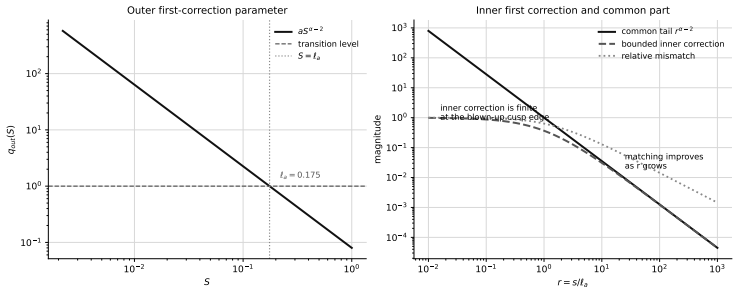


read the original abstract
We construct a local matched-asymptotic description of time-harmonic elastic fields generated by Rayleigh waves near cuspidal elements of a traction-free surface. The free surface is represented locally by a cusp graph with exponent $0<\alpha<1$, or equivalently by a vanishing-width horn $b(s)=B s^m$, $m=1/\alpha>1$. A cuspidal gorge is a zero-opening re-entrant notch: its leading field is the Williams crack-tip field, and the stresses behave as $r^{-1/2}$. The cusp exponent affects the gorge through lower-order corrections and through the stress cut-off produced by rounding the bottom. In contrast, a cuspidal ridge behaves as an elastic horn with vanishing width. The leading admissible free-tip field is asymptotically rigid (bounded stress), distinct from the high-energy branch supported by a finite tip truncation, where stresses grow as $\sigma \sim \rho^{-m}$. Finite-element calculations for the local static Lam\'e problems support these predictions: the free-tip ridge test confirms the absence of crack-like growth, the truncated ridge recovers the high-energy law, and the gorge stress slope is found to be close to $-1/2$.
Editorial analysis
A structured set of objections, weighed in public.
Referee Report
Summary. The paper develops a matched-asymptotic description of time-harmonic Rayleigh-wave fields near cuspidal ridges and gorges on a traction-free elastic surface. The local geometry is represented as a cusp graph with exponent 0<α<1 (equivalently a vanishing-width horn b(s)=B s^m, m>1). For gorges the leading admissible field is the Williams crack-tip singularity with stresses behaving as r^{-1/2}; for free-tip ridges the leading field is asymptotically rigid (bounded stress), while a finite tip truncation supports a high-energy branch with stresses growing as σ∼ρ^{-m}. The constructions are illustrated by explicit local Lamé solutions and are stated to be supported by finite-element computations of the static inner problems.
Significance. If the central constructions hold, the work supplies explicit local fields that clarify how geometric singularities of different types (ridge versus gorge, free versus truncated) control stress concentration and energy distribution for surface waves. This distinction is useful for asymptotic modeling in elastodynamics and could inform numerical schemes or applications in seismology and materials with complex surface topography. The combination of matched asymptotics with numerical checks of the inner static problems is a positive feature.
minor comments (2)
- [Abstract and numerical validation] The abstract states that finite-element calculations support the predictions (free-tip ridge shows no crack-like growth, truncated ridge recovers the high-energy law, gorge stress slope is close to -1/2), yet no quantitative error measures, mesh-refinement studies, convergence rates, or comparison plots are supplied. Adding these details would allow readers to assess the numerical confirmation of the asymptotic claims.
- A short paragraph clarifying the range of validity of the scale-separation assumption (cusp size ≪ wavelength) for the time-harmonic case would help readers understand the limits of the static-inner-problem approximation.
Simulated Author's Rebuttal
We thank the referee for the positive assessment of our manuscript on matched asymptotics for Rayleigh-wave fields near cuspidal ridges and gorges. The recommendation for minor revision is noted, and we will incorporate any editorial or minor clarifications in the revised version. No specific major comments were raised in the report.
Circularity Check
No significant circularity
full rationale
The derivation proceeds by standard matched asymptotics: the surface is represented locally as a cusp graph (0<α<1) or equivalent horn b(s)=B s^m (m>1), the outer Rayleigh field is matched to inner solutions of the static Lamé system on the respective domains, and admissible free-tip fields are identified by bounded-stress conditions. These steps rely on the scale separation (cusp size ≪ wavelength) and explicit local constructions rather than any fitted parameters or self-referential definitions. Finite-element solutions of the inner static problems are presented as independent numerical checks that confirm the analytic stress exponents and boundedness claims; they do not supply the exponents themselves. No load-bearing self-citations, uniqueness theorems imported from prior work by the same author, or ansätze smuggled via citation appear in the argument chain. The central distinction between the asymptotically rigid free-tip ridge field and the high-energy truncated branch is obtained directly from the boundary-value problems and is not equivalent to the input data by construction.
Axiom & Free-Parameter Ledger
free parameters (1)
- cusp exponent α (or m=1/α)
axioms (2)
- standard math Linear isotropic elasticity governed by Lamé equations
- domain assumption Traction-free boundary conditions on the cuspidal surface
Reference graph
Works this paper leans on
-
[1]
Nuber, A., Manukyan, E., and Maurer, H. (2016). Ground topography effects on near-surface elastic full waveform inversion.Geophysical Jour- nal International, 207(1), 67–71. doi:10.1093/gji/ggw267
-
[2]
Li, J., Lin, F.-C., Allam, A., Ben-Zion, Y., Liu, Z., and Schuster, G. T. (2019). Wave equation dispersion inversion of surface waves recorded on irregular topography.Geophysical Journal International, 217(1), 346–
work page 2019
-
[3]
doi:10.1093/gji/ggz005
-
[4]
Du, N., Yang, T., Xu, T., and Liu, Q. (2024). Incorporating to- pographic effects in surface wave tomography based on shortest-path ray tracing.Geophysical Journal International, 237(2), 1235–1248. doi:10.1093/gji/ggae115
-
[5]
Lu, Y., Tian, X., and Liu, Y. (2022). Removing the surface waves scat- tered by steep topography from receiver functions.Geophysical Journal International, 231(2), 1334–1348. doi:10.1093/gji/ggac260
-
[6]
Luzon, F., Sanchez-Sesma, F. J., Rodriguez-Zuniga, J. L., Posadas, A. M., Garcia, J. M., Martin, J., Romacho, M. D., and Navarro, M. (1997). Diffraction of P, S and Rayleigh waves by three-dimensional topographies.Geophysical Journal International, 129(3), 571–578. doi:10.1111/j.1365-246X.1997.tb04493.x. 36
-
[7]
Aki, K., and Richards, P. G. (2002).Quantitative Seismology, 2nd ed. University Science Books. ISBN 978-1-891389-63-4. publisher page
work page 2002
-
[8]
Bouchon, M., and Barker, J. S. (1996). Seismic response of a hill: the example of Tarzana, California.Bulletin of the Seismological Society of America, 86(1A), 66–72. doi:10.1785/bssa08601a0066
-
[9]
Robertsson, J. O. A. (1996). A numerical free-surface condition for elas- tic/viscoelastic finite-difference modeling in the presence of topography. Geophysics, 61(6), 1921–1934. doi:10.1190/1.1444107
-
[10]
Pan, Y., Gao, L., and Bohlen, T. (2018). Time-domain full- waveform inversion of Rayleigh and Love waves in presence of free-surface topography.Journal of Applied Geophysics, 152, 77–85. doi:10.1016/j.jappgeo.2018.03.006
-
[11]
Schmidt, K. M., and Montgomery, D. R. (1995). Limits to relief.Science, 270(5236), 617–620. doi:10.1126/science.270.5236.617
-
[12]
W., Leland, J., Fielding, E., Anderson, R
Burbank, D. W., Leland, J., Fielding, E., Anderson, R. S., Brozovic, N., Reid, M. R., and Duncan, C. (1996). Bedrock incision, rock uplift and threshold hillslopes in the northwestern Himalayas.Nature, 379(6565), 505–510. doi:10.1038/379505a0
-
[13]
Montgomery, D. R. (2001). Slope distributions, threshold hillslopes, and steady-state topography.American Journal of Science, 301(4–5), 432–
work page 2001
-
[14]
doi:10.2475/ajs.301.4-5.432
-
[15]
Larsen, I. J., and Montgomery, D. R. (2012). Landslide erosion cou- pled to tectonics and river incision.Nature Geoscience, 5, 468–473. doi:10.1038/ngeo1479
-
[16]
Williams, M.L.(1952).Stresssingularitiesresultingfromvariousbound- ary conditions in angular corners of plates in extension.Journal of Ap- plied Mechanics, 19(4), 526–528. doi:10.1115/1.4010553
-
[17]
Movchan, A. B., and Nazarov, S. A. (1992). Asymptotic behaviour of stress-strain state in the vicinity of sharp defects in an elas- tic body.IMA Journal of Applied Mathematics, 49(3), 245–272. doi:10.1093/imamat/49.3.245. 37
-
[18]
Nazarov, S. A., and Polyakova, O. R. (1993). Asymptotic behavior of the stress-strain state near a spatial singularity of the boundary of the beak tip type.Journal of Applied Mathematics and Mechanics, 57(5), 887–902. Russian original:Prikl. Mat. Mekh., 57(5), 130–149
work page 1993
-
[19]
Kozlov, V. A., Maz’ya, V. G., and Rossmann, J. (1997).Elliptic Bound- ary Value Problems in Domains with Point Singularities. Mathemati- cal Surveys and Monographs, vol. 52. American Mathematical Society, Providence, RI. doi:10.1090/surv/052
-
[20]
Maz’ya, V. G., Nazarov, S. A., and Plamenevskij, B. A. (2000).Asymp- totic Theory of Elliptic Boundary Value Problems in Singularly Per- turbed Domains. Volume I. Operator Theory: Advances and Applica- tions, vol. 111. Birkhäuser, Basel. doi:10.1007/978-3-0348-8434-1
-
[21]
Maz’ya, V. G., Nazarov, S. A., and Plamenevskij, B. A. (2000).Asymp- totic Theory of Elliptic Boundary Value Problems in Singularly Per- turbed Domains. Volume II. Operator Theory: Advances and Applica- tions, vol. 112. Birkhäuser, Basel. doi:10.1007/978-3-0348-8432-7
-
[22]
Nazarov, S. A. (2008). The spectrum of the elasticity problem for a spiked body.Siberian Mathematical Journal, 49(5), 874–893. Russian original:Sibirsk. Mat. Zh., 49(5), 1105–1127. doi:10.1007/s11202-008- 0087-8
-
[23]
Bakharev, F. L., and Nazarov, S. A. (2009). On the structure of the spectrum for the elasticity problem in a body with a supersharp spike.Siberian Mathematical Journal, 50(4), 587–595. Russian original: Sibirsk. Mat. Zh., 50(4), 746–756. doi:10.1007/s11202-009-0065-9
-
[24]
Nazarov, S. A. (2009). The essential spectrum of boundary value problems for systems of differential equations in a bounded domain with a cusp.Functional Analysis and Its Applications, 43(1), 44–
work page 2009
-
[25]
Russian original:Funktsional. Anal. i Prilozhen., 43(1), 55–67. doi:10.1007/s10688-009-0005-2
-
[26]
Cardone, G., Nazarov, S. A., and Taskinen, J. (2009). A criterion for the existence of the essential spectrum for beak-shaped elastic bod- ies.Journal de Mathématiques Pures et Appliquées, 92(6), 628–650. doi:10.1016/j.matpur.2009.05.007. 38
-
[27]
Nazarov, S. A. (2012). Notes to the proof of a weighted Korn inequality for an elastic body with peak-shaped cusps.Journal of Mathematical Sciences, 181(5), 632–667. Russian original:Problems in Mathematical Analysis, 63, 83–113. doi:10.1007/s10958-012-0709-3
-
[28]
Kozlov, V., and Nazarov, S. A. (2016). On the spectrum of an elastic solid with cusps.Advances in Differential Equations, 21(9–10), 887–944. doi:10.57262/ade/1465912586
-
[29]
Kozlov, V. A., and Nazarov, S. A. (2018). Waves and radiation condi- tions in a cuspidal sharpening of elastic bodies.Journal of Elasticity, 132, 103–140. doi:10.1007/s10659-017-9658-x
-
[30]
Nazarov, S. A., and Taskinen, J. (2011). Radiation conditions at the top of a rotational cusp in the theory of water-waves.ESAIM: Mathematical Modelling and Numerical Analysis, 45(5), 947–979. doi:10.1051/m2an/2011004
-
[31]
Antoniouk, A. Vict., Kiselev, O. M., and Tarkhanov, N. N. (2015). Asymptotic solutions of the Dirichlet problem for the heat equation at a characteristic point.Ukrainian Mathematical Journal, 66(10), 1455–
work page 2015
-
[32]
doi:10.1007/s11253-015-1038-8
-
[33]
Kiselev, O., and Shestakov, I. (2010). Asymptotics of solutions to the Laplace–Beltrami equation on a rotation surface with a cusp. Journal of Mathematical Analysis and Applications, 362(2), 393–400. doi:10.1016/j.jmaa.2009.08.039
-
[34]
Glebov, S. G., Kiselev, O. M., and Tarkhanov, N. N. (2018).Nonlin- ear Equations with Small Parameter. Volume 2: Waves and Boundary Problems. De Gruyter Series in Nonlinear Analysis and Applications, vol. 23/2. De Gruyter, Berlin/Boston. Chapter 3: Asymptotics at Char- acteristic Points, pp. 103–213. doi:10.1515/9783110534979
-
[35]
Cole, J. D. (1968).Perturbation Methods in Applied Mathematics. Blaisdell Publishing Company, Waltham, MA. 260 pp. See review: doi:10.1017/S0008439500030332
-
[36]
Il’in, A. M. (1992).Matching of Asymptotic Expansions of Solutions of Boundary Value Problems. Translations of Mathematical Monographs, 39 vol. 102. American Mathematical Society, Providence, RI. AMS book page
work page 1992
-
[37]
Kevorkian, J., and Cole, J. D. (1981).Perturbation Methods in Applied Mathematics. Applied Mathematical Sciences, vol. 34. Springer, New York. doi:10.1007/978-1-4757-4213-8. 40
discussion (0)
Sign in with ORCID, Apple, or X to comment. Anyone can read and Pith papers without signing in.