Recognition: unknown
Noise spectroscopy of insulating and itinerant altermagnets
Pith reviewed 2026-05-08 07:31 UTC · model grok-4.3
The pith
Altermagnets produce unique noise signatures in charge fluctuations that symmetry forbids in antiferromagnets.
A machine-rendered reading of the paper's core claim, the machinery that carries it, and where it could break.
Core claim
While altermagnetism and antiferromagnetism lead to different noise spectra for magnons, the most striking and symmetry-sensitive signatures appear in the charge fluctuations of itinerant altermagnets. Both for the homogeneous bulk case and in the presence of strain and/or around domain walls, noise contributions exist that are only permitted by symmetry in the altermagnet and thus provide a unique signature. The angular dependence of noise around domain walls also offers access to the orbital character of the altermagnet.
What carries the argument
Symmetry-allowed contributions to noise in charge fluctuations of itinerant altermagnets, which are forbidden in antiferromagnets.
If this is right
- Altermagnets and antiferromagnets exhibit distinct magnon noise spectra.
- Charge fluctuations in itinerant altermagnets carry symmetry-specific noise terms absent in antiferromagnets.
- Strain and domain walls enable additional unique noise contributions allowed only by altermagnetic symmetry.
- The angular dependence of noise around domain walls encodes the orbital character of the altermagnetic order parameter.
Where Pith is reading between the lines
- Noise spectroscopy could serve as a screening tool for identifying altermagnetism in new candidate materials without relying on transport or diffraction.
- The approach might extend to detecting other symmetry-broken magnetic phases by similar symmetry filtering of fluctuations.
- If confirmed, it would support device concepts that use domain walls or strained regions in altermagnets for noise-based sensing.
Load-bearing premise
The symmetry-based noise terms dominate over real-world effects such as disorder, phonons, and experimental resolution limits.
What would settle it
A noise measurement around domain walls in a candidate altermagnet that shows no angular-dependent charge fluctuations permitted only by altermagnetic symmetry would falsify the claim.
Figures
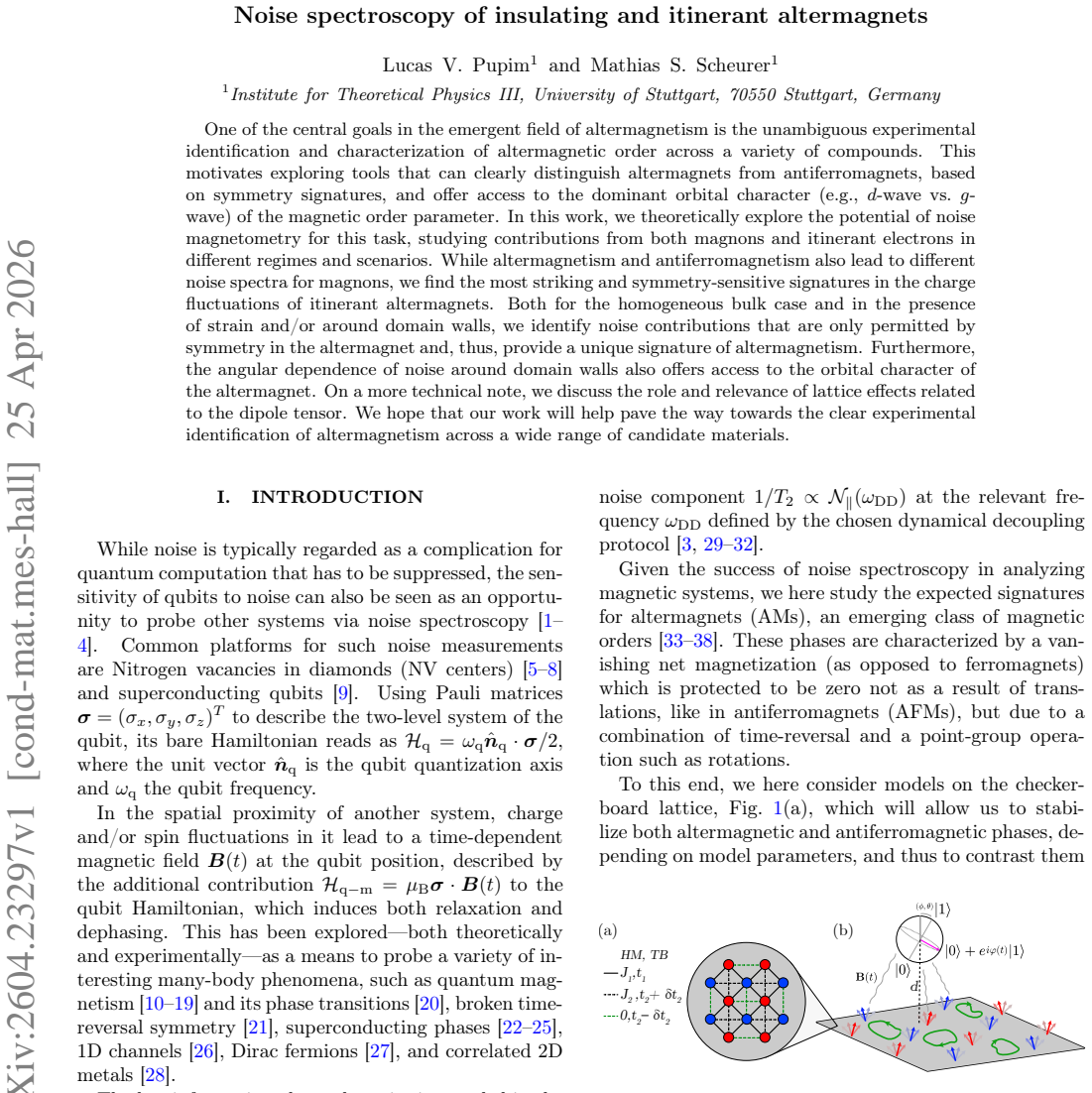


read the original abstract
One of the central goals in the emergent field of altermagnetism is the unambiguous experimental identification and characterization of altermagnetic order across a variety of compounds. This motivates exploring tools that can clearly distinguish altermagnets from antiferromagnets, based on symmetry signatures, and offer access to the dominant orbital character (e.g., $d$-wave vs. $g$-wave) of the magnetic order parameter. In this work, we theoretically explore the potential of noise magnetometry for this task, studying contributions from both magnons and itinerant electrons in different regimes and scenarios. While altermagnetism and antiferromagnetism also lead to different noise spectra for magnons, we find the most striking and symmetry-sensitive signatures in the charge fluctuations of itinerant altermagnets. Both for the homogeneous bulk case and in the presence of strain and/or around domain walls, we identify noise contributions that are only permitted by symmetry in the altermagnet and, thus, provide a unique signature of altermagnetism. Furthermore, the angular dependence of noise around domain walls also offers access to the orbital character of the altermagnet. On a more technical note, we discuss the role and relevance of lattice effects related to the dipole tensor. We hope that our work will help pave the way towards the clear experimental identification of altermagnetism across a wide range of candidate materials.
Editorial analysis
A structured set of objections, weighed in public.
Referee Report
Summary. The manuscript proposes noise spectroscopy (via magnon and charge fluctuations) as a tool for unambiguous experimental identification of altermagnetic order. It uses symmetry arguments to show that certain noise contributions are allowed in altermagnets but forbidden in antiferromagnets, both in the homogeneous bulk and under strain or near domain walls. For itinerant altermagnets the charge-noise signatures are highlighted as particularly distinctive, while the angular dependence of noise around domain walls is argued to encode the orbital character (d-wave vs. g-wave) of the order parameter. Lattice corrections arising from the dipole tensor are also examined.
Significance. If the symmetry classification holds, the work supplies concrete, falsifiable predictions that could help distinguish altermagnets from conventional antiferromagnets in a range of candidate materials. The explicit treatment of both insulating and itinerant regimes, together with the inclusion of strain and domain-wall geometries, broadens the proposal's applicability. The symmetry-based construction yields signatures that are, in the idealized models, independent of microscopic details, which is a clear strength for experimental design.
minor comments (3)
- [§3] §3 (itinerant-electron noise): the statement that charge fluctuations provide the 'most striking' signatures would be strengthened by a brief quantitative comparison (e.g., relative magnitude or frequency window) to the magnon contribution already derived in §2.
- [Fig. 4] Fig. 4 (domain-wall noise): the angular dependence is central to the orbital-character claim, yet the figure caption does not specify the precise definition of the angle or the integration limits used for the noise power; this should be clarified for reproducibility.
- [§4] The discussion of lattice dipole-tensor corrections (near the end of §4) is useful but appears only after the main results; moving a short summary of these corrections to the introduction would help readers assess their impact on the symmetry-allowed terms from the outset.
Simulated Author's Rebuttal
We thank the referee for the positive assessment of our manuscript, the recognition of its significance for distinguishing altermagnets from antiferromagnets via noise spectroscopy, and the recommendation for minor revision. No specific major comments were listed in the report, so we have no point-by-point rebuttals to provide. We will incorporate any minor editorial or technical suggestions in the revised version.
Circularity Check
No significant circularity in derivation chain
full rationale
The paper's central claims are based on standard symmetry analysis distinguishing altermagnetic order from antiferromagnetic order, identifying permitted noise contributions from magnons and itinerant electrons in bulk, strained, and domain-wall scenarios. This relies on group-theoretic selection rules applied to fluctuation spectra without any equations or steps that reduce predictions to fitted parameters, self-definitions, or load-bearing self-citations. The derivation remains self-contained within the idealized models, with no renaming of known results or smuggling of ansatzes via prior work; all signatures follow directly from symmetry constraints independent of the target observables.
Axiom & Free-Parameter Ledger
axioms (2)
- domain assumption Altermagnetic order possesses a symmetry that permits specific magnon and charge fluctuation channels forbidden in conventional antiferromagnets.
- domain assumption Lattice dipole tensor effects can be treated perturbatively without altering the leading symmetry distinctions.
Reference graph
Works this paper leans on
-
[1]
retained
cases. The black dashed line is the density of states (DOS, right axis). The rate curves are plotted for different distances (shade of blue) and they are shifted and rescaled for clarity. The insets showω < h= 0.5. HereT= 1. and pinned to the edges of the Brillouin zone. On the other hand, the altermagnetic magnon bands are split and therefore exhibit Van...
2021
-
[2]
Nanoscale diamond quantum sensors for many-body physics,
J. Rovny, S. Gopalakrishnan, A. C. B. Jayich, P. Maletinsky, E. Demler, and N. P. de Leon, “Nanoscale diamond quantum sensors for many-body physics,” Na- ture Reviews Physics , 1 (2024)
2024
-
[3]
Spin relaxometry with solid-state de- fects: Theory, platforms, and applications,
R. Gong, A. L. Melendez, G. He, Z. Liu, C. Zu, and H. Zhao, “Spin relaxometry with solid-state de- fects: Theory, platforms, and applications,” (2026), arXiv:2602.01521 [cond-mat.mes-hall]
-
[4]
Quantum sensing,
C. L. Degen, F. Reinhard, and P. Cappellaro, “Quantum sensing,” Rev. Mod. Phys.89, 035002 (2017)
2017
-
[5]
Qubits as spectrometers of quantum noise,
R. Schoelkopf, A. Clerk, S. Girvin, K. Lehnert, and M. Devoret, “Qubits as spectrometers of quantum noise,” inQuantum noise in mesoscopic physics(Springer, 2003) pp. 175–203
2003
-
[6]
High-sensitivity diamond magnetometer with nanoscale resolution,
J. M. Taylor, P. Cappellaro, L. Childress, L. Jiang, D.Budker, P.R.Hemmer, A.Yacoby, R.Walsworth, and M. D. Lukin, “High-sensitivity diamond magnetometer with nanoscale resolution,” Nature Physics4, 810 (2008)
2008
-
[7]
Probing surface noise with depth-calibrated spins in diamond,
B. A. Myers, A. Das, M. Dartiailh, K. Ohno, D. D. Awschalom, and A. Bleszynski Jayich, “Probing surface noise with depth-calibrated spins in diamond,” Physical Review Letters113, 027602 (2014)
2014
-
[8]
Spectroscopy of surface-induced noise using shallow spins in diamond,
Y. Romach, C. Müller, T. Unden, L. Rogers, T. Isoda, K. Itoh, M. Markham, A. Stacey, J. Meijer, S. Pezza- gna,et al., “Spectroscopy of surface-induced noise using shallow spins in diamond,” Physical review letters114, 017601 (2015)
2015
-
[9]
Probing johnson noise and ballistic transport in normal metals with a single- spin qubit,
S. Kolkowitz, A. Safira, A. High, R. Devlin, S. Choi, Q. Unterreithmeier, D. Patterson, A. Zibrov, V. Manucharyan, H. Park,et al., “Probing johnson noise and ballistic transport in normal metals with a single- spin qubit,” Science347, 1129 (2015)
2015
-
[10]
Noise spectroscopy through dy- namical decoupling with a superconducting flux qubit,
J. Bylander, S. Gustavsson, F. Yan, F. Yoshihara, K. Harrabi, G. Fitch, D. G. Cory, Y. Nakamura, J.-S. Tsai, and W. D. Oliver, “Noise spectroscopy through dy- namical decoupling with a superconducting flux qubit,” Nature Physics7, 565 (2011)
2011
-
[11]
Nanometre-scaleprobingofspinwavesusingsingle electron spins,
T. Van der Sar, F. Casola, R. Walsworth, and A. Ya- coby,“Nanometre-scaleprobingofspinwavesusingsingle electron spins,” Nature communications6, 7886 (2015)
2015
-
[12]
Quantum-impurity re- laxometry of magnetization dynamics,
B. Flebus and Y. Tserkovnyak, “Quantum-impurity re- laxometry of magnetization dynamics,” Phys. Rev. Lett. 121, 187204 (2018)
2018
-
[13]
Imaging non-collinear antifer- romagnetic textures via single spin relaxometry,
A. Finco, A. Haykal, R. Tanos, F. Fabre, S. Chouaieb, W. Akhtar, I. Robert-Philip, W. Legrand, F. Ajejas, K. Bouzehouane,et al., “Imaging non-collinear antifer- romagnetic textures via single spin relaxometry,” Nature communications12, 767 (2021)
2021
-
[14]
Proposal for dynamic imaging of antiferromagnetic domain wall via quantum-impurity relaxometry,
B. Flebus, H. Ochoa, P. Upadhyaya, and Y. Tserkovnyak, “Proposal for dynamic imaging of antiferromagnetic domain wall via quantum-impurity relaxometry,” Phys. Rev. B98, 180409 (2018)
2018
-
[15]
Diagnosing phases of magnetic insulators via noise mag- netometry with spin qubits,
S. Chatterjee, J. F. Rodriguez-Nieva, and E. Demler, “Diagnosing phases of magnetic insulators via noise mag- netometry with spin qubits,” Phys. Rev. B99, 104425 (2019)
2019
-
[16]
Quantum noise spectroscopy of crit- icality in an atomically thin magnet,
M. E. Ziffer, F. Machado, B. Ursprung, A. Lozovoi, A. B. Tazi, Z. Yuan, M. E. Ziebel, T. Delord, N. Zeng, E. Telford,et al., “Quantum noise spectroscopy of crit- icality in an atomically thin magnet,” arXiv preprint arXiv:2407.05614 (2024)
-
[17]
Quantum sensing of broadband spin dynamics and magnon transport in an- tiferromagnets,
A. L. Melendez, S. Das, F. A. Rodriguez, I.-H. Kao, W. Liu, A. J. Williams, B. Lv, J. Goldberger, S. Chatter- jee, S. Singh, and P. C. Hammel, “Quantum sensing of broadband spin dynamics and magnon transport in an- tiferromagnets,” Science Advances11, eadu9381 (2025)
2025
-
[18]
Signatures of Non-Abelian Kitaev quan- tum spin liquids in noise magnetormetry,
X. Xiao, M. O. Takahashi, P. Stevenson, S. Fujimoto, and A. Bansil, “Signatures of Non-Abelian Kitaev quan- tum spin liquids in noise magnetormetry,” arXiv e-prints (2025), arXiv:2501.19165 [cond-mat.str-el]
-
[19]
Proposal to detect emer- gent gauge field and its meissner effect in spin liquids using nv centers,
P. A. Lee and S. Morampudi, “Proposal to detect emer- gent gauge field and its meissner effect in spin liquids using nv centers,” Phys. Rev. B107, 195102 (2023)
2023
-
[20]
Probing the quantum noise of the spinon fermi surface with nv centers,
J. Y. Khoo, F. Pientka, P. A. Lee, and I. S. Villadiego, “Probing the quantum noise of the spinon fermi surface with nv centers,” Phys. Rev. B106, 115108 (2022)
2022
-
[21]
Quantum noise spectroscopy of dynamical critical phenomena,
F. Machado, E. A. Demler, N. Y. Yao, and S. Chatter- jee, “Quantum noise spectroscopy of dynamical critical phenomena,” Phys. Rev. Lett.131, 070801 (2023)
2023
-
[22]
Nanoscale defects as probes of time-reversal symmetry breaking,
S. J. De, T. Pereg-Barnea, and K. Agarwal, “Nanoscale defects as probes of time-reversal symmetry breaking,” Phys. Rev. X16, 011001 (2026)
2026
-
[23]
Character- izing two-dimensional superconductivity via nanoscale noise magnetometry with single-spin qubits,
P. E. Dolgirev, S. Chatterjee, I. Esterlis, A. A. Zibrov, M. D. Lukin, N. Y. Yao, and E. Demler, “Character- izing two-dimensional superconductivity via nanoscale noise magnetometry with single-spin qubits,” Phys. Rev. B105, 024507 (2022)
2022
-
[24]
Single-spin qubit magnetic spectroscopy of two-dimensional super- conductivity,
S. Chatterjee, P. E. Dolgirev, I. Esterlis, A. A. Zibrov, M. D. Lukin, N. Y. Yao, and E. Demler, “Single-spin qubit magnetic spectroscopy of two-dimensional super- conductivity,” Phys. Rev. Res.4, L012001 (2022)
2022
-
[25]
Probing vortex dynamics in 2d superconductors with scanning quantum microscope,
S. Jayaram, M. Lenger, D. Zhao, L. Pupim, T. Taniguchi, K. Watanabe, R. Peng, M. Scheffler, R. Stöhr, M. S. Scheurer, J. Smet, and J. Wrachtrup, “Probing vortex dynamics in 2d superconductors with scanning quantum microscope,” Phys. Rev. Lett.135, 126001 (2025)
2025
-
[26]
Quantum noise spectroscopy of supercon- 12 ducting dynamics in thin film bi2sr2cacu2o8+δ,
Z. Liu, R. Gong, J. Kim, O. K. Diessel, Q. Xu, Z. Re- hfuss, X. Du, G. He, A. Singh, Y. S. Eo, E. A. Henriksen, G. D. Gu, N. Y. Yao, F. Machado, S. Ran, S. Chatterjee, and C. Zu, “Quantum noise spectroscopy of supercon- 12 ducting dynamics in thin film bi2sr2cacu2o8+δ,” (2025), arXiv:2502.04439 [cond-mat.supr-con]
-
[27]
Probing one- dimensional systems via noise magnetometry with single spin qubits,
J. F. Rodriguez-Nieva, K. Agarwal, T. Giamarchi, B. I. Halperin, M. D. Lukin, and E. Demler, “Probing one- dimensional systems via noise magnetometry with single spin qubits,” Phys. Rev. B98, 195433 (2018)
2018
-
[28]
M.MorgenthalerandI.S.Villadiego,“Berryphaseeffects on the transverse conductivity of Fermi surfaces and their detectionviaspinqubitnoisemagnetometry,” Phys.Rev. B111, 075406 (2025), arXiv:2409.09117 [cond-mat.mes- hall]
-
[29]
Magnetic noise spectroscopy as a probe of local electronic corre- lations in two-dimensional systems,
K. Agarwal, R. Schmidt, B. Halperin, V. Oganesyan, G. Zaránd, M. D. Lukin, and E. Demler, “Magnetic noise spectroscopy as a probe of local electronic corre- lations in two-dimensional systems,” Phys. Rev. B95, 155107 (2017)
2017
-
[30]
Dynamical decoupling of open quantum systems,
L. Viola, E. Knill, and S. Lloyd, “Dynamical decoupling of open quantum systems,” Phys. Rev. Lett.82, 2417 (1999)
1999
-
[31]
How to enhance dephasing time in su- perconducting qubits,
L. Cywiński, R. M. Lutchyn, C. P. Nave, and S. Das Sarma, “How to enhance dephasing time in su- perconducting qubits,” Phys. Rev. B77, 174509 (2008)
2008
-
[32]
Measuring the spectrum of colored noise by dynamical decoupling,
G. A. Álvarez and D. Suter, “Measuring the spectrum of colored noise by dynamical decoupling,” Phys. Rev. Lett. 107, 230501 (2011)
2011
-
[33]
Measurement of the noise spectrum using a multiple-pulse sequence,
T. Yuge, S. Sasaki, and Y. Hirayama, “Measurement of the noise spectrum using a multiple-pulse sequence,” Phys. Rev. Lett.107, 170504 (2011)
2011
-
[34]
Symmetry, microscopy and spectroscopy signatures of altermagnetism,
T. Jungwirth, J. Sinova, R. M. Fernandes, Q. Liu, H. Watanabe, S. Murakami, S. Nakatsuji, and L. Šme- jkal, “Symmetry, microscopy and spectroscopy signatures of altermagnetism,” Nature649, 837 (2026)
2026
-
[35]
Crystal time-reversal symmetry breaking and spontaneous hall effect in collinear antiferromagnets,
L. Šmejkal, R. González-Hernández, T. Jungwirth, and J. Sinova, “Crystal time-reversal symmetry breaking and spontaneous hall effect in collinear antiferromagnets,” Science advances6, eaaz8809 (2020)
2020
-
[36]
Altermagnetism and superconductivity: A short historical review,
Z. Liu, H. Hu, and X.-J. Liu, “Altermagnetism and superconductivity: A short historical review,” (2025), arXiv:2510.09170 [cond-mat.supr-con]
-
[37]
Emerging re- search landscape of altermagnetism,
L. Šmejkal, J. Sinova, and T. Jungwirth, “Emerging re- search landscape of altermagnetism,” Phys. Rev. X12, 040501 (2022)
2022
-
[38]
Altermagnetism: an unconventional spin-ordered phase of matter,
T. Jungwirth, R. M. Fernandes, E. Fradkin, A. H. Mac- Donald, J. Sinova, and L. Šmejkal, “Altermagnetism: an unconventional spin-ordered phase of matter,” New- ton (2025)
2025
-
[39]
Beyond con- ventional ferromagnetism and antiferromagnetism: A phase with nonrelativistic spin and crystal rotation sym- metry,
L. Šmejkal, J. Sinova, and T. Jungwirth, “Beyond con- ventional ferromagnetism and antiferromagnetism: A phase with nonrelativistic spin and crystal rotation sym- metry,” Phys. Rev. X12, 031042 (2022)
2022
-
[40]
Chi- ral split magnon in altermagnetic mnte,
Z. Liu, M. Ozeki, S. Asai, S. Itoh, and T. Masuda, “Chi- ral split magnon in altermagnetic mnte,” Phys. Rev. Lett. 133, 156702 (2024)
2024
-
[41]
Chiral magnons in altermagneticruo2,
L. Šmejkal, A. Marmodoro, K.-H. Ahn, R. González- Hernández, I. Turek, S. Mankovsky, H. Ebert, S. W. D’Souza, O. c. v. Šipr, J. Sinova, and T. c. v. Jungwirth, “Chiral magnons in altermagneticruo2,” Phys. Rev. Lett. 131, 256703 (2023)
2023
-
[42]
Quantum fluctuations in two-dimensional altermagnets,
N. Cichutek, P. Kopietz, and A. Rückriegel, “Quantum fluctuations in two-dimensional altermagnets,” Phys. Rev. B112, 174404 (2025)
2025
-
[43]
Quantum-impurity sensing of altermagnetic order
V. A. S. V. Bittencourt, H. Hosseinabadi, J. Sinova, L. Šmejkal, and J. Marino, “Quantum-impurity sensing of altermagnetic order,” (2025), arXiv:2508.04788 [cond- mat.mes-hall]
work page internal anchor Pith review Pith/arXiv arXiv 2025
-
[44]
Planar pyrochlore antiferromagnet: A large-nanalysis,
J.-S. Bernier, C.-H. Chung, Y. B. Kim, and S. Sachdev, “Planar pyrochlore antiferromagnet: A large-nanalysis,” Phys. Rev. B69, 214427 (2004)
2004
-
[45]
Frustrated heisenberg antiferromagnet on the checkerboard lattice:J1-J2 model,
R. F. Bishop, P. H. Y. Li, D. J. J. Farnell, J. Richter, and C. E. Campbell, “Frustrated heisenberg antiferromagnet on the checkerboard lattice:J1-J2 model,” Phys. Rev. B 85, 205122 (2012)
2012
-
[46]
Phase diagram of j1-j2 transverse field ising model on the checkerboard lattice: a plaquette-operator approach,
M. Sadrzadeh and A. Langari, “Phase diagram of j1-j2 transverse field ising model on the checkerboard lattice: a plaquette-operator approach,” The European Physical Journal B88, 259 (2015)
2015
-
[47]
Ground-state phase struc- ture of the spin-1 2 anisotropic planar pyrochlore,
P. H. Y. Li and R. F. Bishop, “Ground-state phase struc- ture of the spin-1 2 anisotropic planar pyrochlore,” Journal of Physics: Condensed Matter27, 386002 (2015)
2015
-
[48]
Planar pyrochlore: A valence-bond crystal,
J.-B. Fouet, M. Mambrini, P. Sindzingre, and C. Lhuil- lier, “Planar pyrochlore: A valence-bond crystal,” Phys. Rev. B67, 054411 (2003)
2003
-
[49]
From the square lattice to the checkerboard lattice: Spin-wave and large-nlimit analysis,
B. Canals, “From the square lattice to the checkerboard lattice: Spin-wave and large-nlimit analysis,” Phys. Rev. B65, 184408 (2002)
2002
-
[50]
Bond order from disorder in the planar py- rochlore magnet,
O. Tchernyshyov, O. A. Starykh, R. Moessner, and A. G. Abanov, “Bond order from disorder in the planar py- rochlore magnet,” Phys. Rev. B68, 144422 (2003)
2003
-
[51]
A new paradigm for two-dimensional spin liquids,
R. Singh, O. Starykh, and P. Freitas, “A new paradigm for two-dimensional spin liquids,” Journal of applied physics83, 7387 (1998)
1998
-
[52]
Fluctuation-induced piezomagnetism inlocalmomentaltermagnets,
K. V. Yershov, V. P. Kravchuk, M. Daghofer, and J. van den Brink, “Fluctuation-induced piezomagnetism inlocalmomentaltermagnets,” Phys.Rev.B110,144421 (2024)
2024
-
[53]
Frac- tionalized altermagnets: From neighboring and alter- magnetic spin liquids to spin-symmetric band splitting,
J. a. A. Sobral, S. Mandal, and M. S. Scheurer, “Frac- tionalized altermagnets: From neighboring and alter- magnetic spin liquids to spin-symmetric band splitting,” Phys. Rev. Res.7, 023152 (2025)
2025
-
[54]
SU(n)altermagnetism: Lattice models, magnon modes, and flavor-split bands,
P. M. Cônsoli and M. Vojta, “SU(n)altermagnetism: Lattice models, magnon modes, and flavor-split bands,” Phys. Rev. Lett.134, 196701 (2025)
2025
-
[55]
Magnon topology driven by altermag- netism,
S. Khatua, V. P. Kravchuk, K. V. Yershov, and J. van den Brink, “Magnon topology driven by altermag- netism,” Phys. Rev. B112, 214422 (2025)
2025
-
[56]
Altermagnetism in modified lieblatticehubbardmodel,
N. Kaushal and M. Franz, “Altermagnetism in modified lieblatticehubbardmodel,” Phys.Rev.Lett.135,156502 (2025)
2025
-
[57]
Field dependence of the intrinsic domain magnetization of a ferromagnet,
T. Holstein and H. Primakoff, “Field dependence of the intrinsic domain magnetization of a ferromagnet,” Phys. Rev.58, 1098 (1940)
1940
-
[58]
Persistent spin currents in mesoscopic heisenberg rings,
F. Schütz, M. Kollar, and P. Kopietz, “Persistent spin currents in mesoscopic heisenberg rings,” Phys. Rev. Lett.91, 017205 (2003)
2003
-
[59]
Diagonalization of the quadratic boson hamil- tonian,
J. Colpa, “Diagonalization of the quadratic boson hamil- tonian,” Physica A: Statistical Mechanics and its Appli- cations93, 327 (1978)
1978
-
[60]
Linear spin wave theory for single-q incommensurate magnetic structures,
S. Toth and B. Lake, “Linear spin wave theory for single-q incommensurate magnetic structures,” Journal of Physics: Condensed Matter27, 166002 (2015)
2015
-
[61]
Weak-coupling theory of neutron scattering as a probe of altermagnetism,
T. A. Maier and S. Okamoto, “Weak-coupling theory of neutron scattering as a probe of altermagnetism,” Phys. 13 Rev. B108, L100402 (2023)
2023
-
[62]
Spin echoes,
E. L. Hahn, “Spin echoes,” Phys. Rev.80, 580 (1950)
1950
-
[63]
Twisted magnetic van der waals bilayers: An ideal platform for altermagnetism,
Y. Liu, J. Yu, and C.-C. Liu, “Twisted magnetic van der waals bilayers: An ideal platform for altermagnetism,” Phys. Rev. Lett.133, 206702 (2024)
2024
-
[64]
Stacking-Engineered Ferroelectricity in Bilayer Boron Nitride
A. M. Ruiz, A. Shumilin, R. González-Hernández, and J. J. Baldoví, “Twist-induced altermagnetism in a metallic van der Waals antiferromagnet,” arXiv e-prints (2026), arXiv:2602.19734 [cond-mat.mtrl-sci]
-
[65]
Tailoring altermagnetic spin splitting via strain-induced symmetry reconstruction in crsb thin films,
W.Lin, Z.-X.Shen, X.Zhang, C.-K.Li, Q.Ren, S.Wang, H.Li, L.Han, X.Lu, W.Niu, S.Zhang, S.Song, M.Zeng, Y. Liu, Z. Sun, Z. Liu, M. Ye, S. Qiao, G. Bian, C. Liu, Y. Xu, L. He, and L. Miao, “Tailoring altermagnetic spin splitting via strain-induced symmetry reconstruction in crsb thin films,” Advanced Materials38, e15712 (2026)
2026
-
[66]
Superconductivity in uniquely strained ruo2 films,
M. Uchida, T. Nomoto, M. Musashi, R. Arita, and M. Kawasaki, “Superconductivity in uniquely strained ruo2 films,” Phys. Rev. Lett.125, 147001 (2020)
2020
-
[67]
Altermagnetic nan- otextures revealed in bulkMnTe,
R. Yamamoto, L. A. Turnbull, M. Schmidt, J. C. Cor- saletti Filho, H. J. Binger, M. Di Pietro Martínez, M. Weigand, S. Finizio, Y. Prots, G. M. Ferguson, U. Vool, S. Wintz, and C. Donnelly, “Altermagnetic nan- otextures revealed in bulkMnTe,” Phys. Rev. Appl.24, 034037 (2025)
2025
-
[68]
Nanoscale imaging and control of alter- magnetism in MnTe,
O. J. Amin, A. Dal Din, E. Golias, Y. Niu, A. Za- kharov, S. C. Fromage, C. J. B. Fields, S. L. Heywood, R. B. Cousins, F. Maccherozzi, J. Krempaský, J. H. Dil, D. Kriegner, B. Kiraly, R. P. Campion, A. W. Rushforth, K. W. Edmonds, S. S. Dhesi, L. Šmejkal, T. Jungwirth, and P. Wadley, “Nanoscale imaging and control of alter- magnetism in MnTe,” Nature636,...
2024
-
[69]
Structure, control, and dynamics of altermag- netic textures,
O.Gomonay, V.P.Kravchuk, R.Jaeschke-Ubiergo, K.V. Yershov, T. Jungwirth, L. Šmejkal, J. v. d. Brink, and J. Sinova, “Structure, control, and dynamics of altermag- netic textures,” npj Spintronics2, 35 (2024)
2024
-
[70]
Skyrmionhalleffect in altermagnets,
Z.Jin, Z.Zeng, Y.Cao, andP.Yan,“Skyrmionhalleffect in altermagnets,” Phys. Rev. Lett.133, 196701 (2024)
2024
-
[71]
Spin-transfer torque in altermagnets with magnetic textures,
H.Vakili, E.Schwartz, andA.A.Kovalev,“Spin-transfer torque in altermagnets with magnetic textures,” Phys. Rev. Lett.134, 176401 (2025)
2025
-
[72]
Transport theory and spin-transfer physics ind-wave altermagnets,
R. Zarzuela, R. Jaeschke-Ubiergo, O. Gomonay, L. Šme- jkal, and J. Sinova, “Transport theory and spin-transfer physics ind-wave altermagnets,” Phys. Rev. B111, 064422 (2025)
2025
-
[73]
Altermagnetic spin tex- tures: Emergent electrodynamics, quantum geometry, and probes,
C. Schrade and M. S. Scheurer, “Altermagnetic spin tex- tures: Emergent electrodynamics, quantum geometry, and probes,” arXiv e-prints (2026), arXiv:2602.20236 [cond-mat.mes-hall]
-
[74]
Linear momentum in ferromagnets,
G. E. Volovik, “Linear momentum in ferromagnets,” Journal of Physics C: Solid State Physics20, L83 (1987)
1987
-
[75]
Optical and transport anisotropies in spin-textured altermagnets,
A. Maiani, “Optical and transport anisotropies in spin-textured altermagnets,” arXiv e-prints (2026), arXiv:2602.14950 [cond-mat.mes-hall]
-
[76]
Dynamic paramagnon-polarons in altermagnets,
C. R. W. Steward, R. M. Fernandes, and J. Schmalian, “Dynamic paramagnon-polarons in altermagnets,” Phys. Rev. B108, 144418 (2023)
2023
-
[77]
Magnetic-field-tuned randomness in inhomogeneous al- termagnets,
A. R. Chakraborty, J. Schmalian, and R. M. Fernandes, “Magnetic-field-tuned randomness in inhomogeneous al- termagnets,” Phys. Rev. B112, 035146 (2025). Appendix A: Holstein-Primakoff transformation in the local basis As mentioned in the main text, we parametrizeSi =m iS∥ +S ⊥ i , withm i ·S ⊥ i = 0, and rewrite the Heisenberg Hamiltonian as H=J 1 X ⟨i,j⟩...
2025
-
[78]
If we start with the quantization axis being alongˆz, that means theNzz component
Decoherence rate For the decoherence rate (1/T2), the important noise component is the one parallel to the qubit quantization axis. If we start with the quantization axis being alongˆz, that means theNzz component. If we now do an aribtrary rotationR tot =R x(ϕ)Rz(θ), it transforms as Nzz Rtot − − − →Nzz cos2 θ+ sin(2θ) sinϕN xz + sin2 θ Nyy cos2 ϕ+N xx s...
-
[79]
Relaxation rate Similarlytothedecoherencerate, wecanrelatetherelaxationratetoanoisecomponent. Inthiscase, thetransversal noise is the relevant one, e.g., for the qubit quantization axis alongˆzwe have1/T1 ∝ N −+ with these components being defined as(±) = ˆx±iˆy, i.e., as written out explicitly in Eq. (E8) below. If we now rotate into an arbitrary directi...
-
[80]
Here the qubit axis is aligned along±ˆz,ω= 0.25,h= 0.5andT= 1
and an AFM (η= 1). Here the qubit axis is aligned along±ˆz,ω= 0.25,h= 0.5andT= 1. The biggest difference with respect to the parallel noiseN∥, is the presence of the fully imaginaryNxy andN yz. We remark, once more, that for the continuum approximation ofDαγ(k), they are zero. Therefore, ford≫a, they vanish. Howeverd≪a, as shown before, requires the use o...
discussion (0)
Sign in with ORCID, Apple, or X to comment. Anyone can read and Pith papers without signing in.