Revisit viscous shock tube at low Reynolds number
Pith reviewed 2026-05-08 07:23 UTC · model grok-4.3
The pith
Non-equilibrium effects appear in viscous shock tubes at low Reynolds numbers even under continuum conditions.
A machine-rendered reading of the paper's core claim, the machinery that carries it, and where it could break.
Core claim
Discrepancies between UGKS and GKS solutions reveal pronounced non-equilibrium effects in regions where shock waves interact with boundary layers. For continuum flows at high Mach and low Reynolds numbers, such multiscale non-equilibrium transport becomes important, underscoring the need for multiscale methods in analysis and prediction.
What carries the argument
Direct comparison of the unified gas-kinetic scheme, which resolves multiscale non-equilibrium transport, against the gas-kinetic scheme that solves the Navier-Stokes equations.
If this is right
- Standard Navier-Stokes solvers become insufficient for high-Mach low-Reynolds-number flows with shock-boundary layer interactions.
- Multiscale kinetic methods are required to capture the full transport physics in the viscous shock tube.
- Non-equilibrium phenomena must be accounted for even when the global flow parameters place it inside the continuum regime.
Where Pith is reading between the lines
- The same shock-boundary layer coupling may produce non-equilibrium signatures in other high-speed internal flows such as nozzles or inlets.
- Re-examination of existing viscous shock tube experiments with finer diagnostics could confirm or refute the scale separation assumed in NS models.
- The finding suggests that validation benchmarks for continuum solvers need explicit low-Re high-Mach test cases beyond current standards.
Load-bearing premise
The observed differences between UGKS and GKS solutions arise from physical non-equilibrium effects rather than from variations in numerical dissipation or discretization between the two methods.
What would settle it
If independent high-resolution measurements or a third independent solver in the shock-boundary layer interaction zone match the GKS solution to within numerical tolerance, the non-equilibrium interpretation would be falsified.
Figures


read the original abstract
The viscous shock tube is a canonical test case for assessing Navier-Stokes (NS) solvers in the continuum-flow regime, widely used to validate numerical accuracy and probe flow physics. It features a rich set of interacting structures-shock and rarefaction waves, contact discontinuities, boundary layers, and their coupling-spanning multiple spatial and temporal scales. However, NS-based modeling, which presumes near-equilibrium behavior, may fail to capture important non-equilibrium effects even in nominally continuum conditions. This study investigates the viscous shock tube at low Reynolds numbers and demonstrates the presence of non-equilibrium phenomena within the conventional continuum regime. To obtain physically consistent solutions across scales, we employ the unified gas-kinetic scheme (UGKS) and compare its results with NS solutions computed using the gas-kinetic scheme (GKS). Discrepancies between UGKS and GKS solutions reveal pronounced non-equilibrium effects in regions where shock waves interact with boundary layers. For continuum flows at high Mach and low Reynolds numbers, such multiscale non-equilibrium transport becomes important, underscoring the need for multiscale methods in analysis and prediction.
Editorial analysis
A structured set of objections, weighed in public.
Referee Report
Summary. The manuscript revisits the viscous shock tube problem at low Reynolds numbers. It solves the unified kinetic equation with the unified gas-kinetic scheme (UGKS) and compares the results against Navier-Stokes solutions obtained with the gas-kinetic scheme (GKS). The central claim is that discrepancies between UGKS and GKS in shock-boundary-layer interaction regions demonstrate pronounced non-equilibrium effects even in nominally continuum flows at high Mach and low Re, underscoring the need for multiscale kinetic methods.
Significance. If the UGKS-GKS discrepancies are shown to be physical rather than numerical, the work would be significant for delineating the limits of continuum NS modeling in high-speed low-Re multiscale flows and for validating unified kinetic schemes on a canonical test case involving interacting shocks, rarefactions, contacts, and boundary layers. The study correctly identifies that GKS recovers NS while UGKS retains kinetic information, but the evidential basis for the physical interpretation remains incomplete.
major comments (1)
- [Abstract and numerical results] The central claim that UGKS-GKS differences reveal physical non-equilibrium transport rests on the unverified assumption that the two schemes are numerically equivalent in the continuum limit. No grid-convergence data, quantitative error bars, or reference equilibrium test (where both schemes must agree) is provided to exclude differences in numerical dissipation, flux construction, or boundary treatment as the source of the observed discrepancies. This directly undermines the interpretation advanced in the abstract and results.
Simulated Author's Rebuttal
We thank the referee for the careful and constructive review of our manuscript. The major comment highlights a valid concern about verifying numerical equivalence between UGKS and GKS in the continuum limit to support our physical interpretation of the discrepancies. We agree that this evidence is currently insufficient and will revise the manuscript accordingly to include the requested analyses.
read point-by-point responses
-
Referee: [Abstract and numerical results] The central claim that UGKS-GKS differences reveal physical non-equilibrium transport rests on the unverified assumption that the two schemes are numerically equivalent in the continuum limit. No grid-convergence data, quantitative error bars, or reference equilibrium test (where both schemes must agree) is provided to exclude differences in numerical dissipation, flux construction, or boundary treatment as the source of the observed discrepancies. This directly undermines the interpretation advanced in the abstract and results.
Authors: We agree with the referee that the interpretation of UGKS-GKS discrepancies as physical non-equilibrium effects requires explicit demonstration that the schemes are numerically equivalent in the continuum limit. In the revised manuscript, we will add grid-convergence studies for both schemes on successively refined meshes, reporting quantitative error norms and observed convergence rates. We will also include a reference equilibrium test case (such as the viscous shock tube at a higher Reynolds number within the continuum regime or a standard boundary-layer flow) where both UGKS and GKS are theoretically expected to agree, thereby isolating any potential differences in numerical dissipation, flux construction, or boundary conditions. These additions will be accompanied by a brief discussion of the theoretical reduction of UGKS to GKS (and thus to NS) in the continuum limit. We believe these revisions will directly address the concern and strengthen the evidential basis for our claims. revision: yes
Circularity Check
No significant circularity in numerical comparison study
full rationale
The paper conducts a numerical investigation of the viscous shock tube using UGKS and GKS solvers, attributing solution discrepancies to non-equilibrium effects at low Re/high Mach. No derivation chain, first-principles prediction, or fitted parameter is presented that reduces by construction to its own inputs. The abstract and description contain no self-definitional equations, renamed empirical patterns, or load-bearing self-citations that would create circularity. The central claim rests on empirical simulation differences rather than tautological logic, making this a standard (if interpretive) computational study with no detectable circular steps.
Axiom & Free-Parameter Ledger
axioms (1)
- domain assumption UGKS provides a physically consistent multiscale solution while GKS/NS does not in the low-Re regime
Reference graph
Works this paper leans on
-
[1]
Approach to translational equilibrium in a rigid sphere gas
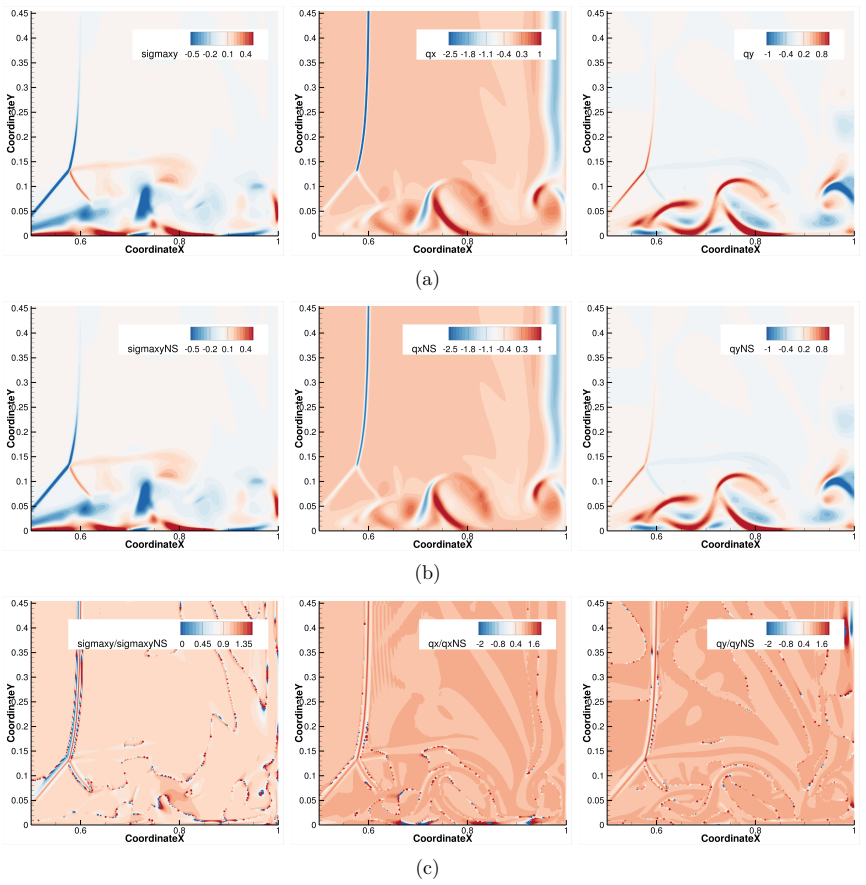
Bird, G., 1963. Approach to translational equilibrium in a rigid sphere gas. Physics of Fluids 6, 1518–1519. 16 (a) (b) (c) Figure 14: The σxy and qx and qy contour of UGKS at the time of t = 1 .0 at the Reynolds number of 50. (a) Calculated by the momentum of distribution function, (b) Calculated by the Newton stress tensor and Fourier’s law of heat cond...
work page 1963
-
[2]
Recent advances and current challenges for DSMC
Bird, G., 1998. Recent advances and current challenges for DSMC. Computers & Mathematics with Applications 35, 1–14
work page 1998
-
[3]
Molecular gas dynamics and the direct simulation of gas flows
Bird, G.A., 1994. Molecular gas dynamics and the direct simulation of gas flows. Oxford university press
work page 1994
-
[4]
Kinetic-theoretic description of the formation of a shock wave
Chu, C., 1965. Kinetic-theoretic description of the formation of a shock wave. Physics of Fluids 8, 12–22
work page 1965
-
[5]
Influence of reflected shock and boundary-layer interaction on shock-tube flows
Davies, L., Wilson, J., 1969. Influence of reflected shock and boundary-layer interaction on shock-tube flows. Physics of Fluids 12, I–37
work page 1969
-
[6]
Discrete unified gas kinetic scheme for all Knudsen number flows: Low-speed isothermal case
Guo, Z., Xu, K., Wang, R., 2013. Discrete unified gas kinetic scheme for all Knudsen number flows: Low-speed isothermal case. Physical Review E 88, 033305
work page 2013
-
[7]
A unified gas-kinetic framework from Boltzmann to Navier-Stokes scales
Guo, Z., Xu, K., Zhu, Y., 2026a. A unified gas-kinetic framework from Boltzmann to Navier-Stokes scales. Advances in Aerodynamics 8, 8
-
[8]
Kinetic representation of the unified gas-kinetic wave- particle method and beyond
Guo, Z., Zhu, Y., Xu, K., 2026b. Kinetic representation of the unified gas-kinetic wave- particle method and beyond. Communications in Computational Physics 39, 15121535
-
[9]
A unified gas-kinetic scheme for continuum and rarefied flows II: Multi-dimensional cases
Juan-Chen Huang, Xu, K., Yu, P., 2012. A unified gas-kinetic scheme for continuum and rarefied flows II: Multi-dimensional cases. Communications in Computational Physics 12, 662–690
work page 2012
-
[10]
Li, Z.H., Peng, A.P., Ma, Q., Dang, L.N., Tang, X.W., Sun, X.Z., 2019. Gas-kinetic unified algorithm for computable modeling of boltzmann equation and application to aerothermodynamics for falling disintegration of uncontrolled Tiangong No. 1 space- craft. Advances in Aerodynamics 1, 4
work page 2019
-
[11]
Unified gas-kinetic wave-particle methods I: Continuum and rarefied gas flow
Liu, C., Zhu, Y., Xu, K., 2020. Unified gas-kinetic wave-particle methods I: Continuum and rarefied gas flow. Journal of Computational Physics 401, 108977
work page 2020
-
[12]
The interaction of a reflected shock wave with the boundary layer in a shock tube
Mark, H., 1957. The interaction of a reflected shock wave with the boundary layer in a shock tube. Cornell University
work page 1957
-
[13]
The interaction of a reflected shock wave with the boundary layer in a shock tube
Matsuo, K., Kawagoe, S., Kage, K., 1974. The interaction of a reflected shock wave with the boundary layer in a shock tube. Bulletin of JSME 17, 1039–1046
work page 1974
-
[14]
Simulating the behavior of MEMS devices: computational methods and needs
Senturia, S.D., Azuru, N., White, J., 1997. Simulating the behavior of MEMS devices: computational methods and needs. IEEE Computational Science and engineering 4, 30–43
work page 1997
-
[15]
Small rarefaction, large consequences: Limits of Navier Stokes turbulence simulations
Tian, S., Wu, L., 2026. Small rarefaction, large consequences: Limits of Navier Stokes turbulence simulations. arXiv preprint arXiv:2602.08770 . 19
-
[16]
Wang, Y., Liu, S., Zhuo, C., Zhong, C., 2022. Investigation of nonlinear squeeze-film damping involving rarefied gas effect in micro-electro-mechanical systems. Computers & Mathematics with Applications 114, 188–209
work page 2022
-
[17]
A review on solid propellant micro-thruster array based on MEMS technology
Xu, J., Zhang, J., Li, F., Liu, S., Ye, Y., Shen, R., 2024. A review on solid propellant micro-thruster array based on MEMS technology. FirePhysChem 4, 95–106
work page 2024
-
[18]
Xu, K., 2001. A gas-kinetic BGK scheme for the Navier–Stokes equations and its connection with artificial dissipation and Godunov method. Journal of Computational Physics 171, 289–335
work page 2001
-
[19]
Direct modeling for computational fluid dynamics
Xu, K., 2015. Direct modeling for computational fluid dynamics. Acta Mechanica Sinica 31, 303–318
work page 2015
-
[20]
A unified computational fluid dynamics framework from rarefied to continuum regimes
Xu, K., 2021. A unified computational fluid dynamics framework from rarefied to continuum regimes. Cambridge University Press
work page 2021
-
[21]
A unified gas-kinetic scheme for continuum and rarefied flows
Xu, K., Huang, J.C., 2010. A unified gas-kinetic scheme for continuum and rarefied flows. Journal of Computational Physics 229, 7747–7764
work page 2010
-
[22]
Rarefied flow computations using nonlinear model Boltzmann equations
Yang, J., Huang, J., 1995. Rarefied flow computations using nonlinear model Boltzmann equations. Journal of Computational Physics 120, 323–339
work page 1995
-
[23]
Discrete unified gas-kinetic wave-particle method for flows in all flow regimes
Yang, L., Li, Z., Shu, C., Liu, Y., Liu, W., Wu, J., 2023. Discrete unified gas-kinetic wave-particle method for flows in all flow regimes. Physical Review E 108, 015302
work page 2023
-
[24]
Unified gas-kinetic wave-particle methods
Zhu, Y., Liu, C., Zhong, C., Xu, K., 2019. Unified gas-kinetic wave-particle methods. II. multiscale simulation on unstructured mesh. Physics of Fluids 31. 20
work page 2019
discussion (0)
Sign in with ORCID, Apple, or X to comment. Anyone can read and Pith papers without signing in.