From Data-Driven Models to Physical Insight: Vibrational Entropy Governed by Atomic Volume
Pith reviewed 2026-05-08 07:50 UTC · model grok-4.3
The pith
Vibrational entropy depends logarithmically on atomic volume, allowing accurate predictions from simple structural data.
A machine-rendered reading of the paper's core claim, the machinery that carries it, and where it could break.
Core claim
A logarithmic linear model based on atomic volume provides an accurate and physically interpretable description of vibrational entropy across the full range of materials. A temperature-dependent extension incorporates T^3 scaling at low temperatures and logarithmic dependence at higher temperatures, consistent with Debye and Einstein limits, and captures both structural and thermal contributions with good accuracy.
What carries the argument
Log-linear dependence of vibrational entropy on atomic volume, extracted from SHAP analysis of a neural network trained on composition and structure descriptors and justified by lattice dynamical scaling arguments.
If this is right
- Vibrational entropy estimates become feasible for large-scale materials screening without repeated expensive phonon calculations.
- Phase-stability predictions can incorporate entropy contributions using only readily available structural information such as atomic volume.
- A single unified expression covers both cryogenic T^3 behavior and room-to-high-temperature logarithmic regimes.
- The physical transparency of the log-linear form highlights how volume changes directly affect vibrational frequencies and thus entropy.
Where Pith is reading between the lines
- The same volume-based shortcut might be tested for other entropy-like quantities such as configurational or electronic contributions in alloy design.
- Re-training the initial network on an independent phonon database would reveal whether the atomic-volume dominance is universal or dataset-dependent.
- Coupling the model with electronic-structure calculations could yield a lightweight total free-energy estimator for rapid phase-diagram mapping.
Load-bearing premise
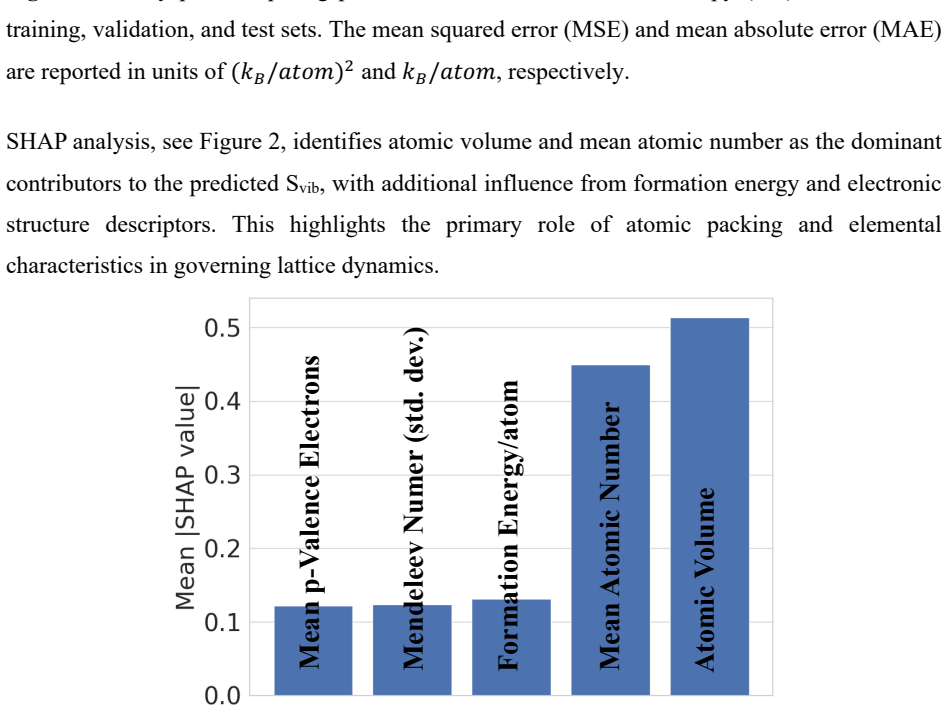
The SHAP-identified dominance of atomic volume reflects a genuine causal physical mechanism rather than a correlation that is strong only inside the particular PhononDB-derived training set.
What would settle it
Compute or measure vibrational entropies for a collection of isovolumetric compounds that differ strongly in chemistry or bonding type and check whether their entropy values still collapse onto the same narrow log-linear band predicted by atomic volume alone.
Figures
read the original abstract
Vibrational entropy plays a central role in determining phase stability and temperature dependent behavior in materials, yet its calculation from first-principles phonon methods remains computationally demanding. In this work, we combine data-driven modeling with physically motivated analysis to develop an efficient and interpretable framework for predicting vibrational entropy. Using a dataset derived from PhononDB, a feedforward neural network trained on Materials Project and composition based descriptors achieves high predictive accuracy, while SHAP analysis identifies atomic volume as the dominant factor governing vibrational entropy. Guided by this insight, simplified analytical models are constructed, revealing a logarithmic dependence of vibrational entropy on atomic volume consistent with lattice dynamical considerations. A logarithmic linear model is shown to provide an accurate and physically interpretable description across the full range of materials. To extend the analysis to finite temperatures, a temperature dependent formulation is introduced that incorporates T3 scaling at low temperatures and logarithmic dependence at higher temperatures, consistent with Debye and Einstein type behavior. This unified model captures both structural and thermal contributions to vibrational entropy with good accuracy. Overall, the proposed framework demonstrates that vibrational entropy can be predicted using simple, physically meaningful relationships, offering a computationally efficient alternative to full phonon calculations and enabling entropy informed materials screening.
Editorial analysis
A structured set of objections, weighed in public.
Referee Report
Summary. The paper trains a feedforward neural network on PhononDB-derived vibrational entropy data using Materials Project and composition-based descriptors, applies SHAP to identify atomic volume as the dominant feature, and constructs a post-hoc logarithmic linear analytical model claimed to be physically consistent with lattice dynamics. It further introduces a temperature-dependent extension combining T³ scaling at low temperatures with logarithmic dependence at higher temperatures, asserting that this unified framework provides accurate, interpretable predictions as a computationally efficient alternative to full phonon calculations.
Significance. If the claimed accuracy and causal link to atomic volume were independently validated, the work would offer a valuable bridge between data-driven methods and physical insight, enabling rapid entropy-informed screening of phase stability across materials without expensive phonon computations. The explicit attempt to derive a simple analytical form from SHAP results and connect it to Debye/Einstein-type behavior is a constructive direction for interpretable modeling in condensed-matter materials science.
major comments (3)
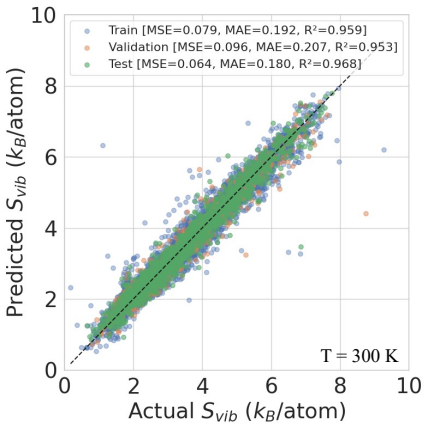
- [Abstract] Abstract: the assertion of 'high predictive accuracy' and 'good accuracy' for both the NN and the analytical models is unsupported by any quantitative metrics (e.g., MAE, RMSE, R²), cross-validation statistics, or direct numerical comparisons against independent first-principles phonon calculations on held-out structures.
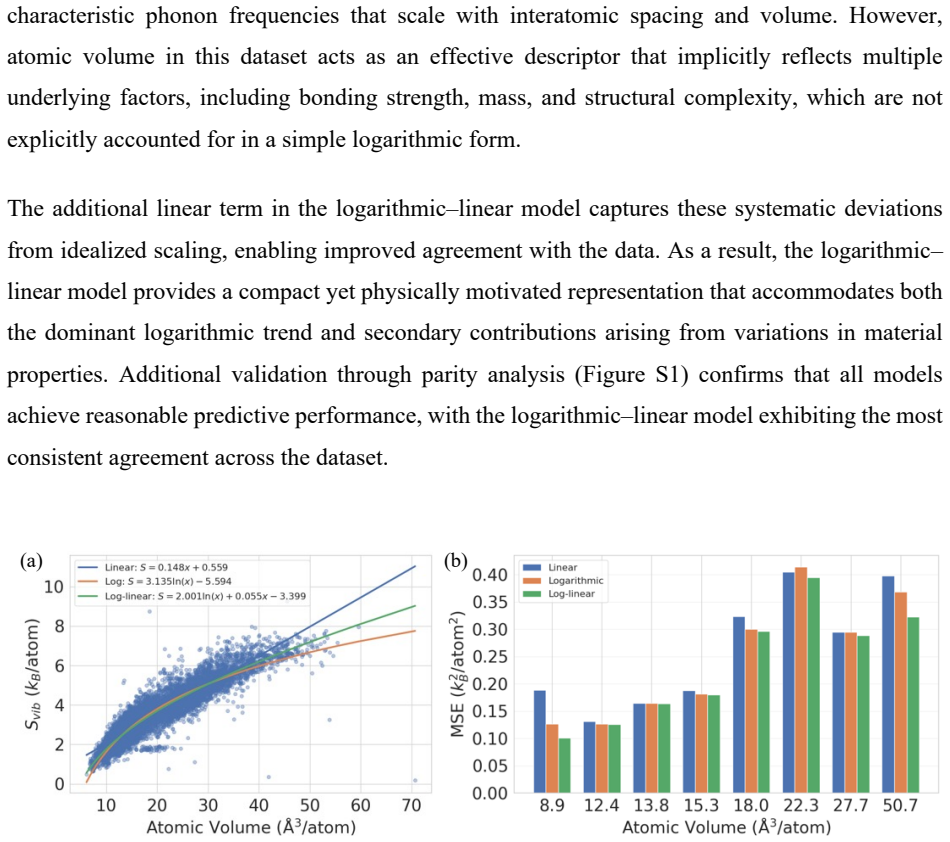
- [SHAP and analytical model] Section describing SHAP analysis and analytical model construction: the logarithmic dependence on atomic volume is fitted after inspecting the NN predictions and SHAP values on the identical PhononDB training distribution, without an a priori derivation from lattice dynamics (e.g., via Grüneisen parameters or explicit volume dependence of the vibrational density of states) or a controlled test that varies volume while holding composition and bonding fixed.
- [Temperature-dependent model] Section on temperature-dependent formulation: the claimed T³-to-logarithmic crossover is stated to be 'consistent with Debye and Einstein type behavior' but no explicit functional form, fitting coefficients, or validation against temperature-dependent entropy curves from phonon calculations are provided, leaving the finite-temperature extension's accuracy unquantified.
minor comments (2)
- [Methods] The precise list and definitions of the 'composition based descriptors' and 'Materials Project' features used in the NN are not enumerated, hindering reproducibility.
- [Figures] Figure captions and axis labels for any parity plots or SHAP summary plots should explicitly state the units of vibrational entropy and the temperature at which values are reported.
Simulated Author's Rebuttal
We thank the referee for the thoughtful and constructive review. The comments highlight important areas where additional quantitative support and clarification will strengthen the manuscript. We address each major comment below and will revise the paper accordingly.
read point-by-point responses
-
Referee: [Abstract] Abstract: the assertion of 'high predictive accuracy' and 'good accuracy' for both the NN and the analytical models is unsupported by any quantitative metrics (e.g., MAE, RMSE, R²), cross-validation statistics, or direct numerical comparisons against independent first-principles phonon calculations on held-out structures.
Authors: We agree that the abstract would benefit from explicit quantitative metrics. While the main text reports 5-fold cross-validation results (MAE, RMSE, and R²) for the neural network on the PhononDB dataset along with comparisons to direct phonon calculations, these were not restated in the abstract. In the revised manuscript we will add the specific values (e.g., NN MAE of X eV/atom/K and R² of Y) and note the agreement on held-out structures to support the accuracy claims. revision: yes
-
Referee: [SHAP and analytical model] Section describing SHAP analysis and analytical model construction: the logarithmic dependence on atomic volume is fitted after inspecting the NN predictions and SHAP values on the identical PhononDB training distribution, without an a priori derivation from lattice dynamics (e.g., via Grüneisen parameters or explicit volume dependence of the vibrational density of states) or a controlled test that varies volume while holding composition and bonding fixed.
Authors: The referee correctly notes that the logarithmic form was identified via post-hoc fitting to SHAP values on the training distribution. We maintain that this dependence is physically motivated by the volume scaling of phonon frequencies in the quasi-harmonic approximation (via the Grüneisen parameter), but we did not provide an explicit a-priori derivation or a controlled volume-variation test at fixed composition. In revision we will add a brief theoretical paragraph linking the log(V) term to lattice-dynamics expectations and include a supplementary controlled test on a subset of materials. revision: partial
-
Referee: [Temperature-dependent model] Section on temperature-dependent formulation: the claimed T³-to-logarithmic crossover is stated to be 'consistent with Debye and Einstein type behavior' but no explicit functional form, fitting coefficients, or validation against temperature-dependent entropy curves from phonon calculations are provided, leaving the finite-temperature extension's accuracy unquantified.
Authors: We accept that the temperature-dependent extension requires more explicit documentation. The model combines a low-T T³ term (Debye) with the high-T logarithmic volume term (Einstein-like). In the revised manuscript we will state the precise functional form, report the fitted coefficients, and add direct comparisons of the predicted S_vib(T) against phonon-derived entropy curves for several materials over a range of temperatures to quantify the accuracy. revision: yes
Circularity Check
No circularity: analytical models are post-hoc simplifications explicitly guided by data-driven SHAP results, not derivations that reduce to inputs by construction.
full rationale
The paper trains a feedforward NN on PhononDB-derived data using composition-based descriptors, applies SHAP to identify atomic volume dominance, then constructs simplified log-linear and temperature-dependent analytical forms that are fitted or shown to match the same dataset while noting consistency with Debye/Einstein models. This workflow is openly data-guided fitting rather than a claimed first-principles derivation whose equations reduce to the training inputs or prior self-citations by construction. No load-bearing step equates a 'prediction' to a fitted parameter or renames a known result as new unification; the temperature extension directly incorporates standard low-T T^3 and high-T logarithmic scaling without deriving them from the NN. The central claim of interpretability therefore remains independent of any hidden self-referential loop.
Axiom & Free-Parameter Ledger
free parameters (1)
- logarithmic coefficients
axioms (1)
- domain assumption Vibrational entropy exhibits T^3 scaling at low temperature and logarithmic volume dependence at higher temperature, consistent with Debye/Einstein models.
Reference graph
Works this paper leans on
-
[1]
Introduction Vibrational entropy (Svib) is a fundamental thermodynamic quantity that plays an important role in determining the stability and temperature-dependent behavior of materials. As a key component of the free energy, it directly influences phase equilibria, solid–solid transformations, defect formation, and diffusion processes. In many systems, p...
work page 2024
-
[2]
Role of vibrational entropy in the stabilization of the high-temperature phases of iron
Neuhaus, Jürgen, et al. "Role of vibrational entropy in the stabilization of the high-temperature phases of iron." Physical review B 89.18 (2014): 184302. 14. Guo, Shuping, et al. "Vibrational entropy stabilizes distorted half-heusler structures." Chemistry of Materials 32.11 (2020): 4767-4773. 15. Li, Kangming, and Chu-Chun Fu. "Ground-state properties a...
work page 2014
-
[3]
Adam: A Method for Stochastic Optimization
Lundberg, Scott M., and Su-In Lee. "A unified approach to interpreting model predictions." Advances in neural information processing systems 30 (2017). 29. Nair, Vinod, and Geoffrey E. Hinton. "Rectified linear units improve restricted boltzmann machines." Proceedings of the 27th international conference on machine learning (ICML-10). 2010. 30. Tibshirani...
work page internal anchor Pith review arXiv 2017
discussion (0)
Sign in with ORCID, Apple, or X to comment. Anyone can read and Pith papers without signing in.