Recognition: unknown
Physics-Informed Deep Image Prior Reconstruction of In-Plane Magnetization from Scanning NV Magnetometry
Pith reviewed 2026-05-08 06:44 UTC · model grok-4.3
The pith
A convolutional autoencoder with physics-informed priors reconstructs in-plane magnetization from scanning NV magnetometry.
A machine-rendered reading of the paper's core claim, the machinery that carries it, and where it could break.
Core claim
The paper claims that a physics-informed deep image prior framework employing a simple convolutional autoencoder, together with user-defined spatial masks, conditionally achieves a reasonable qualitative and quantitative reconstruction of complex in-plane magnetization patterns from scanning NV magnetometry data.
What carries the argument
The deep image prior implemented as a convolutional autoencoder, regularized by physics-informed spatial masks that constrain the solution space of the ill-posed inverse problem.
If this is right
- The reconstruction works for Landau and dipole domain structures in Permalloy nanostructures.
- Optimal mask orientation improves reconstruction SNR by up to 3 dB.
- Mask alignment can diagnose issues in the reconstruction process.
- The DIP method avoids the need for pre-trained datasets and is less computationally intensive than supervised learning approaches.
Where Pith is reading between the lines
- Such a framework could be adapted to reconstruct magnetization in other magnetic materials or geometries if appropriate masks are available.
- Combining this with other imaging modalities might enhance accuracy in determining three-dimensional magnetization configurations.
- Reduced computational demands suggest potential for on-the-fly analysis during experimental scans.
Load-bearing premise
User-defined spatial masks can be oriented to restrict the infinite solution space without introducing systematic bias or excluding the true magnetization.
What would settle it
Generating the stray field from the reconstructed magnetization using the forward model and finding it inconsistent with the measured NV data within experimental uncertainty would falsify the claim of accurate reconstruction.
Figures


read the original abstract
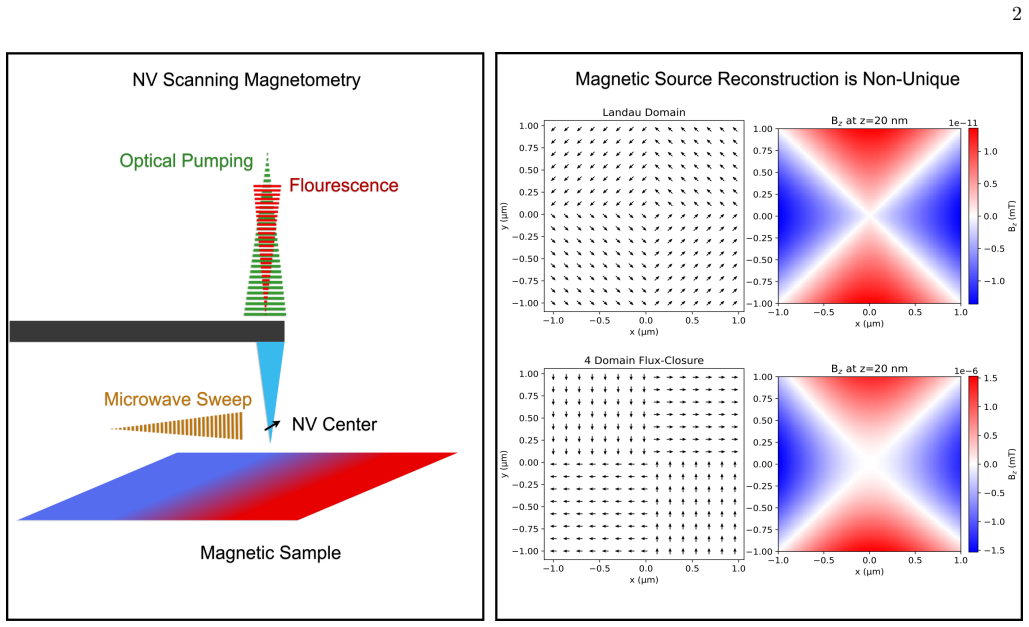
Reconstructing magnetization in nanoscale magnetic thin films is essential for developing next-generation memory, sensors, and various spintronic technologies. However, this remains challenging due to the ill-posed nature of the stray field inverse problem, i.e., there are infinitely many magnetization solutions to a given stray field distribution. Here, we demonstrate that a physics-informed deep image prior (DIP) framework, using a simple convolutional autoencoder conditionally achieves a reasonable qualitative and quantitative reconstruction of complex in-plane magnetization patterns from scanning NV magnetometry. We find that the orientation of user-defined masks implemented to restrict the reconstruction solution space dramatically affects convergence. The optimal alignment of the mask improves the reconstruction signal-to-noise ratio by up to $\SI{3}{\decibel}$, thereby also serving as a diagnostic tool. The DIP approach requires no pre-trained datasets and is considered computationally less intensive as compared to supervised learning approaches. We analyze both Landau and dipole domain structures in lithographically patterned Permalloy nanostructures by incorporating experimentally-guided spatial constraints. Complementary magnetic force microscopy measurements were carried out to support the Scanning NV measurements.
Editorial analysis
A structured set of objections, weighed in public.
Referee Report
Summary. The manuscript proposes a physics-informed deep image prior (DIP) framework using a convolutional autoencoder to reconstruct complex in-plane magnetization patterns from scanning NV magnetometry stray-field data. User-defined spatial masks are introduced to constrain the ill-posed inverse problem, with the key observation that mask orientation dramatically affects convergence and can yield up to 3 dB SNR improvement when optimally aligned. The method is applied to Landau and dipole domain structures in lithographically patterned Permalloy nanostructures, requires no pre-training, and is validated with complementary magnetic force microscopy measurements.
Significance. If the reconstructions prove quantitatively accurate without mask-induced bias, the work would offer a useful unsupervised, physics-constrained approach to ill-posed inverse problems in nanomagnetism, with lower computational cost than supervised methods and a diagnostic role for mask alignment. The combination of experimental NV data, forward magnetostatic modeling, and spatial constraints is a positive feature.
major comments (2)
- [Abstract] Abstract: the claim of 'reasonable qualitative and quantitative reconstruction' is not accompanied by any reported error metrics (e.g., MSE, correlation, or pixel-wise deviation from ground truth), cross-validation details, or ablation studies on reconstruction fidelity. This information is load-bearing for the central claim.
- [Results (mask orientation)] Results section on mask alignment: the reported strong dependence of convergence on mask orientation, together with the 3 dB SNR gain for optimal alignment, raises the possibility that the masks encode expected structural priors rather than neutrally restricting the null space. A quantitative ablation showing reconstruction error versus controlled mask misalignment (including cases where the true magnetization deviates from the mask geometry) is required to confirm that valid solutions are not systematically excluded.
minor comments (2)
- [Abstract] Abstract: the phrase 'conditionally achieves' is vague; the conditions under which the reconstruction succeeds should be stated explicitly.
- [Methods] The manuscript would benefit from a clear statement of the autoencoder architecture (number of layers, filter sizes, activation functions) and the precise form of the physics-informed loss term that combines the forward magnetostatic model with the mask constraint.
Simulated Author's Rebuttal
We thank the referee for their constructive and detailed review of our manuscript. We address each major comment below and will incorporate revisions to provide stronger quantitative support for our claims.
read point-by-point responses
-
Referee: [Abstract] Abstract: the claim of 'reasonable qualitative and quantitative reconstruction' is not accompanied by any reported error metrics (e.g., MSE, correlation, or pixel-wise deviation from ground truth), cross-validation details, or ablation studies on reconstruction fidelity. This information is load-bearing for the central claim.
Authors: We agree that quantitative metrics are necessary to support the abstract's claim. In the revised manuscript, we will report explicit error metrics including MSE, Pearson correlation coefficient, and mean pixel-wise deviation for reconstructions against available ground truth (both simulated test cases and MFM-validated experimental structures). We will also add details on our validation procedure and include ablation studies on reconstruction fidelity under different network and mask conditions. revision: yes
-
Referee: [Results (mask orientation)] Results section on mask alignment: the reported strong dependence of convergence on mask orientation, together with the 3 dB SNR gain for optimal alignment, raises the possibility that the masks encode expected structural priors rather than neutrally restricting the null space. A quantitative ablation showing reconstruction error versus controlled mask misalignment (including cases where the true magnetization deviates from the mask geometry) is required to confirm that valid solutions are not systematically excluded.
Authors: We acknowledge the concern that mask orientation effects could imply encoding of structural priors. The masks are constructed from the known lithographic geometry of the Permalloy nanostructures (confirmed via SEM), with the goal of restricting the null space to physically allowed regions. The SNR improvement with optimal alignment reflects tighter constraint of the inverse problem rather than exclusion of valid solutions, since the in-plane magnetization in these patterned films is expected to follow the sample boundaries. To address this rigorously, we will add a quantitative ablation study to the revised manuscript. This will report reconstruction error (MSE and SNR) versus controlled mask misalignment angles, including test cases with simulated magnetization patterns that deliberately deviate from the mask geometry (e.g., perturbed Landau and dipole configurations). revision: yes
Circularity Check
No significant circularity; reconstruction grounded in external NV data and physics model
full rationale
The paper presents a physics-informed DIP framework (convolutional autoencoder + forward magnetostatic model) applied to experimental scanning NV magnetometry data for in-plane magnetization reconstruction. User-defined masks constrain the ill-posed inverse problem, with noted sensitivity to orientation affecting convergence and SNR. However, no derivation step reduces by construction to a fitted parameter renamed as prediction, self-definition, or load-bearing self-citation chain. The central result relies on external experimental inputs and physical forward modeling rather than internal equivalence to its own assumptions. This is the expected non-finding for a method paper with independent data grounding.
Axiom & Free-Parameter Ledger
free parameters (2)
- mask orientation and geometry
- autoencoder architecture hyperparameters
axioms (1)
- domain assumption The stray-field inverse problem for in-plane magnetization is ill-posed with infinitely many solutions for any given field distribution.
Reference graph
Works this paper leans on
-
[1]
Spintronics: A Spin-Based Elec- tronics Vision for the Future,
S. A. Wolf et al., “Spintronics: A Spin-Based Elec- tronics Vision for the Future,” Science294, 1488–1495 (2001), URLhttps://www.science.org/doi/full/10. 1126/science.1065389
2001
-
[3]
Antiferromagnetic spintron- ics,
V. Baltz, A. Manchon, M. Tsoi, T. Moriyama, T. Ono, and Y. Tserkovnyak, “Antiferromagnetic spintron- ics,” Rev. Mod. Phys.90, 015005 (2018), URL https://journals.aps.org/rmp/abstract/10.1103/ RevModPhys.90.015005
2018
-
[4]
The emer- gence of spin electronics in data storage,
C. Chappert, A. Fert, and F. N. Van Dau, “The emer- gence of spin electronics in data storage,” Nature Mate- rials6, 813–823 (2007), URLhttps://www.nature.com/ articles/nmat2024
2007
-
[5]
Opportuni- ties at the frontiers of spintronics,
A. Hoffmann and S. D. Bader, “Opportuni- ties at the frontiers of spintronics,” Physi- cal Review Applied4, 047001 (2015), URL https://journals.aps.org/prapplied/abstract/ 10.1103/PhysRevApplied.4.047001
-
[6]
High- sensitivity diamond magnetometer with nanoscale resolution,
J. M. Taylor, P. Cappellaro, L. Childress, L. Jiang, D. Budker, P. R. Hemmer, A. Yacoby, R. Walsworth, and M. D. Lukin, “High-sensitivity diamond magnetometer with nanoscale resolution,” Nature Physics4, 810–816 (2008), URLhttps://doi.org/10.1038/nphys1075
-
[7]
Nanoscale imaging magne- tometry with diamond spins under ambient conditions,
G. Balasubramanian, I.-Y. Chan, R. Kolesov, M. Al- Hmoud, J. Tisler, C.-S. Shin, C. Kim, A. Wojcik, P. R. Hemmer, A. Krueger, et al., “Nanoscale imaging magne- tometry with diamond spins under ambient conditions,” Nature455, 648–651 (2008), URLhttps://doi.org/10. 1038/nature07278
2008
-
[8]
Available: https://doi.org/10.1038/nnano.2012.50
P. Maletinsky, S. Hong, M. S. Grinolds, B. Hausmann, M. D. Lukin, R. L. Walsworth, M. Loncar, and A. Ya- coby, “A robust scanning diamond sensor for nanoscale imaging with single nitrogen-vacancy centres,” Nature Nanotechnology7, 320–324 (2012), URLhttps://doi. org/10.1038/nnano.2012.50
-
[9]
L. Rondin, J.-P. Tetienne, P. Spinicelli, C. Dal Savio, K. Karrai, G. Dantelle, A. Thiaville, S. Rohart, J.-F. Roch, and V. Jacques, “Nanoscale magnetic field map- ping with a single spin scanning probe magnetometer,” Applied Physics Letters100, 153118 (2012), URLhttps: //doi.org/10.1063/1.3703128
-
[10]
Nanoscale magnetometry with NV centers in diamond,
S. Hong, M. S. Grinolds, L. M. Pham, D. Le Sage, L. Luan, R. L. Walsworth, and A. Yacoby, “Nanoscale magnetometry with NV centers in diamond,” MRS Bul- letin38, 155–161 (2013), URLhttps://doi.org/10. 1557/mrs.2013.23
2013
-
[11]
L. Rondin, J.-P. Tetienne, T. Hingant, J.-F. Roch, P. Maletinsky, and V. Jacques, “Magnetometry with nitrogen-vacancy defects in diamond,” Reports on Progress in Physics77, 056503 (2014), URLhttps: //doi.org/10.1088/0034-4885/77/5/056503
-
[12]
The nature of domain walls in 8 ultrathin ferromagnets revealed by scanning nanomagne- tometry,
J.-P. Tetienne, T. Hingant, L. J. Mart´ ınez, S. Rohart, A. Thiaville, L. H. Diez, K. Garcia, J.-P. Adam, J.-V. Kim, J.-F. Roch, et al., “The nature of domain walls in 8 ultrathin ferromagnets revealed by scanning nanomagne- tometry,” Nature Communications6, 6733 (2015), URL https://doi.org/10.1038/ncomms7733
-
[13]
Subpicotesla diamond magnetometry,
T. Wolf, P. Neumann, K. Nakamura, H. Sumiya, T. Ohshima, J. Isoya, and J. Wrachtrup, “Subpicotesla diamond magnetometry,” Physical Review X5, 041001 (2015), URLhttps://doi.org/10.1103/PhysRevX.5. 041001
-
[14]
Real-space imaging of non-collinear antiferromagnetic order with a single- spin magnetometer,
I. Gross, W. Akhtar, V. Garcia, L. J. Mart´ ınez, S. Chouaieb, K. Garcia, C. Carr´ et´ ero, A. Barth´ el´ emy, P. Appel, P. Maletinsky, et al., “Real-space imaging of non-collinear antiferromagnetic order with a single- spin magnetometer,” Nature549, 252–256 (2017), URL https://doi.org/10.1038/nature23656
-
[15]
Probing condensed matter physics with magnetometry based on nitrogen-vacancy centres in diamond,
F. Casola, T. van der Sar, and A. Yacoby, “Probing condensed matter physics with magnetometry based on nitrogen-vacancy centres in diamond,” Nature Reviews Materials3, 17088 (2018), URLhttps://doi.org/10. 1038/natrevmats.2017.88
2018
-
[16]
High-resolution magnetic reso- nance spectroscopy using a solid-state spin sensor,
D. R. Glenn, D. B. Bucher, J. Lee, M. D. Lukin, H. Park, and R. L. Walsworth, “High-resolution magnetic reso- nance spectroscopy using a solid-state spin sensor,” Na- ture555, 351–354 (2018), URLhttps://doi.org/10. 1038/nature25781
2018
-
[17]
Probing mag- netism in 2D materials at the nanoscale with single- spin microscopy,
L. Thiel, Z. Wang, M. A. Tschudin, D. Rohner, I. Guti´ errez-Lezama, N. Ubrig, M. Gibertini, E. Gian- nini, A. F. Morpurgo, and P. Maletinsky, “Probing mag- netism in 2D materials at the nanoscale with single- spin microscopy,” Science364, 973–976 (2019), URL https://doi.org/10.1126/science.aav6926
-
[18]
R. J. Blakely,Potential theory in gravity and magnetic applications(Cambridge University Press, 1995)
1995
-
[19]
Quantita- tive magnetic force microscopy on perpendicu- larly magnetized samples,
H. J. Hug, B. Stiefel, P. J. Van Schendel, A. Moser, R. Hofer, S. Martin, H.-J. G¨ untherodt, S. Porthun, L. Abelmann, J. Lodder, et al., “Quantita- tive magnetic force microscopy on perpendicu- larly magnetized samples,” Journal of Applied Physics83, 5609–5620 (1998), URLhttps:// pubs.aip.org/aip/jap/article/83/11/5609/488088/ Quantitative-magnetic-force...
1998
-
[20]
Obtaining vector magnetic field maps from single-component mea- surements of geological samples,
E. A. Lima and B. P. Weiss, “Obtaining vector magnetic field maps from single-component mea- surements of geological samples,” Journal of Geo- physical Research: Solid Earth114(2009), URL https://agupubs.onlinelibrary.wiley.com/doi/10. 1029/2008JB006006
2009
-
[21]
Physics-informed neural networks: A deep learn- ing framework for solving forward and inverse prob- lems involving nonlinear partial differential equa- tions,
M. Raissi, P. Perdikaris, and G. E. Karniadakis, “Physics-informed neural networks: A deep learn- ing framework for solving forward and inverse prob- lems involving nonlinear partial differential equa- tions,” Journal of Computational Physics378, 686– 707 (2019), URLhttps://www.sciencedirect.com/ science/article/pii/S0021999118307125
2019
-
[22]
Untrained physically informed neural network for image reconstruction of magnetic field sources,
A. Dubois, D. Broadway, A. Stark, M. Tschudin, A. Healey, S. Huber, J.-P. Tetienne, E. Greplova, and P. Maletinsky, “Untrained physically informed neural network for image reconstruction of magnetic field sources,” Physical Review Applied18, 064076 (2022), URLhttps://journals.aps.org/prapplied/ abstract/10.1103/PhysRevApplied.18.064076
-
[23]
D. A. Broadway, M. Flaks, A. E. Dubois, and P. Maletinsky, “Reconstruction of nontrivial magneti- zation textures from magnetic field images using neural networks,” Phys. Rev. Appl.23, 044012 (2025), URL https://link.aps.org/doi/10.1103/PhysRevApplied. 23.044012
-
[24]
Magnetic domain-wall racetrack memory,
S. S. Parkin, M. Hayashi, and L. Thomas, “Magnetic domain-wall racetrack memory,” Science320, 190–194 (2008), URLhttps://www.science.org/doi/10.1126/ science.1145799
2008
-
[25]
D. A. Allwood, G. Xiong, C. Faulkner, D. Atkinson, D. Petit, and R. P. Cowburn, “Magnetic domain-wall logic,” Science309, 1688–1692 (2005), URLhttps:// www.science.org/doi/10.1126/science.1108813
-
[26]
Hubert and R
A. Hubert and R. Sch¨ afer,Magnetic domains: the analy- sis of magnetic microstructures(Springer Science & Busi- ness Media, 1998)
1998
-
[27]
R. M. Bozorth,Ferromagnetism(Van Nostrand, 1951)
1951
-
[28]
Chikazumi and C
S. Chikazumi and C. D. Graham,Physics of ferromag- netism(Oxford University Press, 2009)
2009
-
[29]
Geometry driven intermediate states in artificial square ice structures,
H. Arava, I. Tapia, T. Cote, J. S. Woods, F. Bar- rows, J. Fullerton, and P. Mellado, “Geometry driven intermediate states in artificial square ice structures,” Communications Materials (2026), ISSN 2662-4443, URL https://doi.org/10.1038/s43246-026-01147-4
-
[30]
Ulyanov, A
D. Ulyanov, A. Vedaldi, and V. Lempitsky, in Proceedings of the IEEE Conference on Com- puter Vision and Pattern Recognition (CVPR) (IEEE, 2018), pp. 9446–9454, URLhttps: //openaccess.thecvf.com/content_cvpr_2018/html/ Ulyanov_Deep_Image_Prior_CVPR_2018_paper.html
2018
-
[31]
A. Vansteenkiste, J. Leliaert, M. Dvornik, M. Helsen, F. Garcia-Sanchez, and B. Van Waeyenberge, “The design and verification of Mumax3,” AIP Advances 4, 107133 (2014), URLhttp://doi.org/10.1063/1. 4899186
work page doi:10.1063/1 2014
-
[32]
Denoising Prior Driven Deep Neural Network for Im- age Restoration,
W. Dong, P. Wang, W. Yin, G. Shi, F. Wu, and X. Lu, “Denoising Prior Driven Deep Neural Network for Im- age Restoration,” IEEE Transactions on Pattern Analy- sis and Machine Intelligence41, 2305–2318 (2019), URL https://ieeexplore.ieee.org/document/8481558
discussion (0)
Sign in with ORCID, Apple, or X to comment. Anyone can read and Pith papers without signing in.