Amorphous High Density Plutonium
Pith reviewed 2026-05-08 06:15 UTC · model grok-4.3
The pith
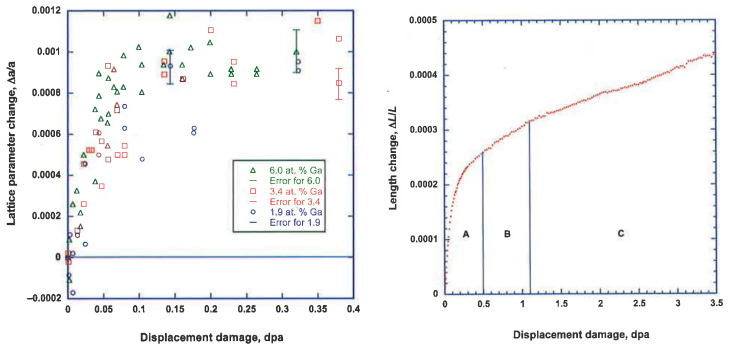
An amorphous plutonium phase of density between alpha and delta forms explains the rapid cryogenic shrinkage of alloyed delta-plutonium and the room-temperature mismatch between lattice expansion and bulk density change.
A machine-rendered reading of the paper's core claim, the machinery that carries it, and where it could break.
Core claim
The cryogenic results may be explained by ingrowth of an amorphous phase with density intermediate between those of alpha and delta. This phase, when formed from alloyed delta-plutonium, rapidly but not instantaneously anneals to delta-plutonium at temperatures greater than or equal to 100 K; when formed from pure alpha-plutonium it anneals to alpha at similar temperatures. The room temperature discrepancy between growth of lattice parameter and length of delta-plutonium is also explained by ingrowth of a denser amorphous phase that is continuously formed and annealed out.
What carries the argument
Ingrowth of an undetected amorphous plutonium phase whose density lies between the alpha and delta crystalline phases.
If this is right
- The rate of amorphous-phase formation at 4 K must equal the observed contraction rate of delta-plutonium.
- Above 100 K the amorphous phase converts back to the parent crystalline phase on a time scale of hours or less.
- At room temperature the continuous formation and annealing of the denser amorphous phase slows the net bulk-density decrease relative to the X-ray lattice expansion.
- No new Bragg peaks appear in X-ray diffraction because the phase lacks long-range order.
Where Pith is reading between the lines
- If the amorphous phase can be retained at low temperature, it may offer a route to study radiation-damage accumulation in plutonium without crystalline diffraction interference.
- Stabilization of the amorphous phase by rapid cooling or alloy adjustments could be tested by measuring whether the cryogenic contraction saturates or reverses.
- The same mechanism may operate in other actinide metals that exhibit self-irradiation swelling, suggesting a general class of intermediate-density amorphous states.
Load-bearing premise
The observed length, density, and lattice-parameter discrepancies are produced by ingrowth of an amorphous phase rather than by defects, impurities, or measurement artifacts.
What would settle it
Direct structural evidence from a local-probe method such as neutron pair-distribution-function analysis or extended X-ray absorption fine structure, performed at 4 K on alloyed delta-plutonium, that shows an amorphous component with density between alpha and delta and that disappears upon warming above 100 K.
Figures
read the original abstract
Metastable aluminum-alloyed $\delta$-plutonium shrinks rapidly and pure $\alpha$-plutonium swells rapidly at 4 K. At ambient temperature alloyed $\delta$-plutonium swells about $10^{-3}$ as fast as it shrinks at 4 K, but its bulk density decreases more slowly than would be inferred from the increase in its lattice parameter determined by X-ray diffraction. These results might be explained as the result of ingrowth of the opposite phases, but they have not been found in X-ray diffraction. The cryogenic results may be explained by ingrowth of an amorphous phase with density intermediate between those of $\alpha$ and $\delta$. This phase, when formed from alloyed $\delta$-plutonium, rapidly but not instantaneously anneals to $\delta$-plutonium at temperatures $\gtrapprox 100\,$K; when formed from pure $\alpha$-plutonium it anneals to $\alpha$ at similar temperatures. The room temperature discrepancy between growth of lattice parameter and length of $\delta$-plutonium is also explained by ingrowth of a denser amorphous phase that is continuously formed and annealed out.
Editorial analysis
A structured set of objections, weighed in public.
Referee Report
Summary. The manuscript hypothesizes that rapid cryogenic shrinkage in Al-alloyed δ-plutonium and swelling in pure α-plutonium at 4 K, together with the room-temperature mismatch between X-ray lattice-parameter expansion and slower bulk-density decrease in δ-plutonium, arise from ingrowth of an undetected amorphous plutonium phase whose density lies between the α and δ values. This phase is stated to anneal rapidly but not instantaneously to the parent crystalline phase at temperatures ≳100 K and to be invisible to X-ray diffraction.
Significance. If the proposed amorphous phase and its kinetics were confirmed, the hypothesis would offer a single mechanism for several long-standing discrepancies in plutonium length, density, and diffraction data under irradiation and temperature cycling, with potential relevance to actinide aging models. The manuscript supplies no quantitative predictions, fitted parameters, or new data, so its immediate impact is limited to stimulating targeted experiments.
major comments (3)
- [Abstract] Abstract: the central claim attributes the observed ~10^{-3} shrinkage ratio and the lattice-parameter vs. bulk-density discrepancy to ingrowth of an amorphous phase, yet no rate equations, activation-energy estimates, or volume-fraction calculations are supplied to show that the stated annealing temperatures and “rapid but not instantaneous” kinetics can reproduce the reported magnitudes.
- [Abstract] Abstract: the assertion that the phase is invisible to X-ray diffraction is unsupported by any estimate of expected diffuse-scattering intensity, minimum detectable fraction, or comparison with the sensitivity of the cited diffraction measurements.
- [Abstract] Abstract: alternative explanations (defect clusters, helium ingrowth, impurity effects, or systematic errors in dilatometry and density measurements) are neither modeled nor excluded, leaving the attribution to an amorphous phase as an untested post-hoc interpretation.
Simulated Author's Rebuttal
We thank the referee for the thoughtful review and for highlighting opportunities to strengthen the presentation of our hypothesis. The manuscript is a concise proposal for a unifying mechanism rather than a quantitative model or experimental report. Below we respond point by point to the major comments and indicate the limited revisions we can make without new data.
read point-by-point responses
-
Referee: [Abstract] Abstract: the central claim attributes the observed ~10^{-3} shrinkage ratio and the lattice-parameter vs. bulk-density discrepancy to ingrowth of an amorphous phase, yet no rate equations, activation-energy estimates, or volume-fraction calculations are supplied to show that the stated annealing temperatures and “rapid but not instantaneous” kinetics can reproduce the reported magnitudes.
Authors: We agree that the manuscript contains no explicit rate equations or fitted parameters. Its purpose is to identify a single mechanism consistent with the reported temperature thresholds, the ~10^{-3} magnitude of the effects, and the absence of new crystalline peaks. A volume fraction of order 10^{-3} would suffice if the amorphous density lies between the α and δ values, and the annealing onset near 100 K matches the temperature at which the cryogenic anomalies disappear. In revision we will add a short qualitative section estimating the required ingrowth and annealing rates from the observed time scales at 4 K and room temperature. revision: partial
-
Referee: [Abstract] Abstract: the assertion that the phase is invisible to X-ray diffraction is unsupported by any estimate of expected diffuse-scattering intensity, minimum detectable fraction, or comparison with the sensitivity of the cited diffraction measurements.
Authors: The paper states that the phase has not appeared in the cited X-ray studies. For a volume fraction ~10^{-3} the diffuse scattering would be weak and broadly distributed, falling well below the intensity of the dominant crystalline Bragg peaks and likely beneath the noise floor of conventional laboratory diffractometers used in the referenced work. We will insert a brief estimate of the expected diffuse intensity together with a comparison to typical detection limits in the revised manuscript. revision: partial
-
Referee: [Abstract] Abstract: alternative explanations (defect clusters, helium ingrowth, impurity effects, or systematic errors in dilatometry and density measurements) are neither modeled nor excluded, leaving the attribution to an amorphous phase as an untested post-hoc interpretation.
Authors: The manuscript offers the amorphous-phase hypothesis as one mechanism that simultaneously accounts for the cryogenic shrinkage/swelling, the specific annealing temperature, and the lattice-parameter versus bulk-density mismatch. While defect clusters or helium could contribute to room-temperature swelling, they do not naturally reproduce the rapid 4 K effects or the sharp annealing threshold near 100 K. We do not claim to have excluded every alternative; the paper is intended to stimulate experiments that can distinguish among them. In revision we will add a short paragraph outlining why the principal alternatives are less consistent with the full data set. revision: partial
Circularity Check
No derivation chain or equations present; qualitative hypothesis only.
full rationale
The manuscript offers a post-hoc qualitative attribution of cryogenic shrinkage/swelling and room-temperature density-lattice mismatches to ingrowth of an undetected amorphous phase with intermediate density that anneals above ~100 K. No equations, rate laws, fitted parameters, predictions, or first-principles derivations appear in the abstract or described full text. Consequently no step reduces by construction to its own inputs, no self-citation chain is invoked to justify uniqueness, and no ansatz is smuggled in. The central claim remains an unquantified hypothesis whose verification would require independent experiments, but the absence of any mathematical structure precludes circularity by the enumerated patterns.
Axiom & Free-Parameter Ledger
axioms (1)
- domain assumption Observed discrepancies between bulk length/density and X-ray lattice parameters are caused by ingrowth of an amorphous phase rather than other physical mechanisms.
invented entities (1)
-
amorphous high-density plutonium phase
no independent evidence
Reference graph
Works this paper leans on
-
[1]
W. G. Wolfer, P. S¨oderlind, A. Landa, V olume changes inδ-plutonium from helium and other decay products, J. Nucl. Matl. 355 (2006) 21–29
work page 2006
-
[2]
D. T. Olive, D. L. Wang, C. H. Booth, E. D. Bauer, A. L. Pugmire, F. J. Freib- ert, S. K. McCall, M. A. Wall, P. G. Allen, Isochronal annealing effects on local structure, crystalline fraction and undamaged region size of radiation damage in Ga-stabilizedδ-Pu, J. Appl. Phys. 120 (2016) 035103. 11
work page 2016
-
[3]
J. A. C. Marples, M. J. Mortimer, The length changes inα-plutonium during self-irradiation damage below 4.2 k, Phys. Lett. 34A (1971) 242–243
work page 1971
-
[4]
B. W. Chung, S. R. Thompson, C. H. Woods, D. J. Hopkins, W. H. Gourdin, B. B. Ebbinghaus, Density changes in plutonium observed from accelerated aging using Pu-238 enrichment, J. Nucl. Matl. 355 (2006) 142–149
work page 2006
- [5]
-
[6]
J. A. C. Marples, A. Hough, M. J. Mortimer, A. Smith, J. A. Lee, Length changes in actinide metals due to self-irradiation damage at 4 K, in: W. N. Miner (Ed.), Plutonium 1970 and Other Actinides, Proc. Fourth Int. Conf. on Plutonium and Other Actinides, The Metallurgical Society of the AIME, Englewood, Col., 1970, pp. 635–648
work page 1970
-
[7]
J. A. C. Marples, R. O. A. Hall, Length changes inβ-plutonium due to self- irradiation damage at 4k, J. Nucl. Matl. 42 (1972) 212–216, despite the title, this paper also discusses length changes of theαandδphases at 4 K
work page 1972
-
[8]
J. Jacquemin, R. Lallement, Contraction des phasesβetδdu plutonium sous l’effet de l’autoirradiation a 4.2◦ K?, Physics Letters A 33 (6) (1970) 384– 385
work page 1970
-
[9]
J. Jacquemin, R. Lallement, Allongement par autoirradiation a 1.5 ◦ k du plutoniumα, Physics Letters A 32 (3) (1970) 181–182
work page 1970
-
[10]
S. S. Hecker, Plutonium—an element never at equilibrium, Metal. and Matl. Trans. A 39A (2008) 1585–1593, the reference for Table I should be to Marples and Hall J. Nucl. Matl. 42, 212. 12
work page 2008
- [11]
- [12]
-
[13]
S. Kitching, P. G. Planterose, D. C. Gill, Phase transformations in delta- stabilized plutonium, AIP Conf. Proc. 673 (2003) 79–81
work page 2003
-
[14]
D. L. Clark, D. A. Geeson, R. J. J. Hanrahan, Plutonium Handbook 2nd ed., V ol. 2, Am. Nucl. Soc., Westmont, Ill., 2019, Ch. 12.3.1, pp. 1011–1012, table 5
work page 2019
- [15]
-
[16]
D. L. Clark, D. A. Geeson, R. J. J. Hanrahan, Plutonium Handbook 2nd ed., V ol. 2, Am. Nucl. Soc., Westmont, Ill., 2019, Ch. 12.3.4, p. 1019, fig. 24
work page 2019
-
[17]
W. G. Wolfer, B. Oudot, N. Baclet, Reversible expansion of gallium- stabilizedδ-plutonium, J. Nucl. Matl. 359 (2006) 185–191
work page 2006
-
[18]
D. L. Clark, D. A. Geeson, R. J. J. Hanrahan, Plutonium Handbook 2nd ed., V ol. 2, Am. Nucl. Soc., Westmont, Ill., 2019, Ch. 12.3.3, p. 1016, fig. 21
work page 2019
-
[19]
D. L. Clark, D. A. Geeson, R. J. J. Hanrahan, Plutonium Handbook 2nd ed., V ol. 2, Am. Nucl. Soc., Westmont, Ill., 2019, Ch. 12.3.4, p. 1017, fig. 22. 13
work page 2019
-
[20]
S. D. Conradson, N. Bock, J. M. Castro, D. R. Conradson, L. E. Cox, W. Dmowski, D. E. Dooley, T. Egami, F. J. Espinosa-Faller, F. J. Freibert, A. J. Garcia-Adeva, N. J. Hess, E. K. Holmstr ¨om, R. C. Howell, B. Katz, J. C. Lashley, R. J. Martinez, D. P. Moore, L. A. Morales, J. D. Olivas, R. S. Pereyra, R. Michael, S. P. Rudin, P. M. Villella, Nanoscale h...
work page 2014
-
[21]
S. D. Conradson, N. Bock, J. M. Castro, D. R. Conradson, L. E. Cox, W. Dmowski, D. E. Dooley, T. Egami, F. J. Espinosa-Faller, F. J. Freibert, A. J. Garcia-Adeva, N. J. Hess, E. K. Holmstr ¨om, R. C. Howell, B. Katz, J. C. Lashley, R. J. Martinez, D. P. Moore, L. A. Morales, J. D. Olivas, R. S. Pereyra, R. Michael, H. T. Jeffrey, P. M. Villella, Intrinsic...
work page 2014
-
[22]
S. I. Gorbunov, A. G. Seleznev, Effect of intense self-irradiation on the phase composition of metallic plutonium, Radiochemistry 43 (2) (2001) 111–117
work page 2001
-
[23]
K. J. Kingma, C. Meade, R. J. Hemley, H.-K. Mao, D. R. Veblen, Mi- crostructural observations ofα-quartz amorphization, Science 259 (1993) 666–669
work page 1993
-
[24]
R. J. Hemley, C. T. Prewitt, K. J. Kingma, High-pressure behavior of silica, Reviews of Mineralogy 29 (1994) 41–81
work page 1994
-
[25]
Y . Li, H. Y . Bai, W. H. Wang, K. Samwer, Low temperature specific 14 heat anomalies associated with the boson peak in cuzr-based bulk metallic glasses, Phys. Rev. B 74 (2006) 052201
work page 2006
-
[26]
Y . K. Kuo, K. M. Sivakumar, C. A. Su, C. N. Ku, S. T. Lin, A. B. Kaiser, J. B. Qiang, Q. Wang, C. Dong, Measurement of low temperature transport properties of cu-based cu-zr-ti bulk metallic glass, Phys. Rev. B. 74 (2006) 014208
work page 2006
-
[27]
A. Migliori, J. L. Sarrao, W. M. Visscher, T. M. Bell, M. Lei, Z. Fisk, R. G. Leisure, Resonant ultrasound spectroscopic techniques for measurement of the elastic modulii of solids, Physica 183B (1993) 1–24. 15
work page 1993
discussion (0)
Sign in with ORCID, Apple, or X to comment. Anyone can read and Pith papers without signing in.