Partial solvability induced by dark states in a box trap with decentered two-body interaction
Pith reviewed 2026-05-08 06:11 UTC · model grok-4.3
The pith
Decentered two-body interaction in a one-dimensional box creates dark states that form exactly solvable subspaces.
A machine-rendered reading of the paper's core claim, the machinery that carries it, and where it could break.
Core claim
The central claim is that a decentered two-body interaction in a one-dimensional box, active only at particle separation c, produces dark states unaffected by the interaction. These dark states constitute exactly solvable subspaces inside an otherwise nonintegrable spectrum, allowing exact determination of certain energies and wave functions.
What carries the argument
Dark states: bosonic or fermionic eigenstates of the full Hamiltonian that remain identical to noninteracting box states because the decentered interaction vanishes on their wave-function support.
If this is right
- Dark states appear only for specific values of the decentering distance c that align with the nodal structure of box eigenfunctions.
- The full spectrum splits into exactly solvable dark sectors and sectors that remain interacting and require numerical solution.
- Stationary properties such as energies, densities, and correlation functions are available in closed form inside the dark subspaces.
- The partial solvability delineates interacting from noninteracting sectors in the energy spectrum.
Where Pith is reading between the lines
- Varying the decentering parameter c offers a tunable knob to enlarge or shrink the dimension of the solvable subspace without changing the overall nonintegrability.
- The same nodal-avoidance mechanism that protects dark states may appear in other position-dependent interaction models, suggesting a broader route to partial analytic control in few-body systems.
Load-bearing premise
The interaction occurs strictly only when the particles are separated by exactly distance c inside a strictly one-dimensional hard-wall box.
What would settle it
Numerical diagonalization of the two-particle Hamiltonian for a chosen value of c should yield a subset of eigenenergies and wave functions that exactly match the noninteracting particle-in-a-box solutions; absence of such states would disprove the claim.
Figures


read the original abstract
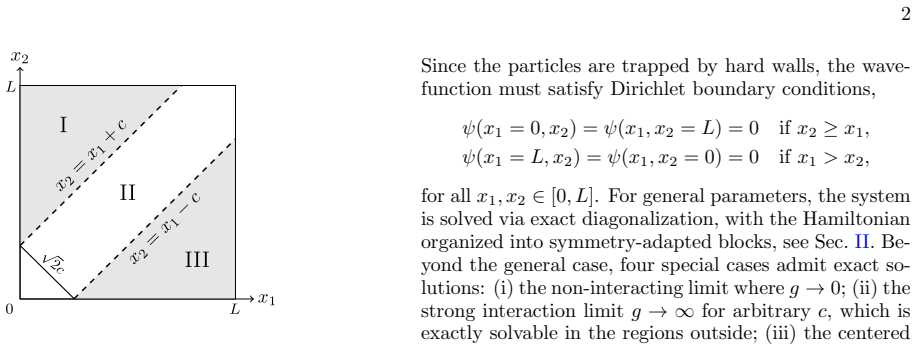
We consider a generalization of the two-body contact interaction for nonrelativistic particles confined to a one-dimensional box, in which the interaction is decentered, i.e., the particles interact only when they are separated by a distance c. In contrast to the harmonically trapped system, this model is nonintegrable. Despite this, we demonstrate that the system exhibits partial solvability due to the presence of dark states, i.e., bosonic or fermionic states unaffected by the interaction. These states form exactly solvable subspaces embedded within an interacting spectrum. We characterize the stationary properties of the system, identify the conditions for the appearance of dark states, and show how they structure the spectrum and delineate interacting and noninteracting sectors.
Editorial analysis
A structured set of objections, weighed in public.
Referee Report
Summary. The manuscript considers two particles confined to a one-dimensional infinite square well subject to a decentered contact interaction that acts only at interparticle separation exactly equal to a fixed distance c. It identifies a class of eigenstates of the non-interacting Hamiltonian (dark states) that vanish identically on the locus |x1−x2|=c and therefore remain exact eigenstates of the full interacting Hamiltonian for arbitrary interaction strength. These states form solvable subspaces embedded in an otherwise non-integrable spectrum; the authors derive the algebraic conditions on the ratio c/L under which such states exist for both bosonic and fermionic statistics and characterize the resulting stationary properties and spectral structure.
Significance. If the construction is correct, the work supplies a transparent, analytically tractable example of partial exact solvability induced by dark states in a non-integrable few-body quantum system. The explicit conditions on c/L, the contrast with the integrable harmonic-trap analog, and the separation into interacting and non-interacting sectors are useful for studies of integrability breaking and the emergence of solvable sectors in confined geometries.
major comments (1)
- [Introduction and discussion of integrability] The non-integrability claim is asserted by noting the absence of the additional conserved quantities present in the harmonic-trap version, but no explicit verification (e.g., via level-spacing statistics or direct search for further integrals of motion) is supplied; this leaves open whether the dark-state subspaces are embedded in a spectrum that is genuinely non-integrable or merely appears so at the two-body level.
minor comments (3)
- [Model definition] The definition of the interaction potential (Eq. (2) or equivalent) should be written with an explicit indicator function or delta-function form to avoid ambiguity about whether the interaction is strictly on the line |x1−x2|=c or in a neighborhood.
- [Numerical results and figures] Several figures lack explicit labels for the values of c/L used in the plotted spectra; adding these labels would make the comparison between dark-state and interacting sectors immediate.
- [Conditions for dark states] The manuscript would benefit from a short table summarizing the allowed c/L ratios that produce dark states for N=2 bosons and fermions, together with the corresponding quantum numbers.
Simulated Author's Rebuttal
We thank the referee for the careful reading of our manuscript, the positive assessment of its significance, and the recommendation for minor revision. We address the single major comment below.
read point-by-point responses
-
Referee: The non-integrability claim is asserted by noting the absence of the additional conserved quantities present in the harmonic-trap version, but no explicit verification (e.g., via level-spacing statistics or direct search for further integrals of motion) is supplied; this leaves open whether the dark-state subspaces are embedded in a spectrum that is genuinely non-integrable or merely appears so at the two-body level.
Authors: We appreciate the referee highlighting this point. The non-integrability of the model follows directly from the structure of the Hamiltonian: the infinite square well breaks translational invariance (preventing center-of-mass separation), and the decentered interaction acts only at a fixed separation c rather than depending solely on the relative coordinate in a manner that would preserve additional integrals of motion. This contrasts with the harmonic-trap case, where the quadratic potential allows exact separation and yields extra conserved quantities. At the two-body level, the system is fully described by this Hamiltonian, and the absence of further symmetries implies that the spectrum (outside the dark-state subspaces) is not analytically solvable in closed form. We will revise the introduction and discussion sections to articulate this structural argument more explicitly, thereby clarifying why the dark states are embedded in a genuinely non-integrable spectrum. revision: partial
Circularity Check
No significant circularity detected
full rationale
The central construction defines dark states as eigenstates of the non-interacting box Hamiltonian (products of sine functions) that additionally vanish identically on the interaction locus |x1-x2|=c. Because the interaction term is supported only on that locus, it annihilates these states, so they remain exact eigenstates of the full Hamiltonian for arbitrary interaction strength. This is a direct algebraic consequence of the Hamiltonian definition rather than a self-referential fit or imported uniqueness theorem. Conditions on c/L for the existence of such states follow from the explicit nodal structure of the free solutions and are stated as algebraic constraints without parameter fitting. Non-integrability is asserted by explicit contrast with the harmonic-trap case (absence of extra conserved quantities) and does not rely on self-citation chains. No step renames a fitted quantity as a prediction or reduces the solvability claim to its own inputs by construction.
Axiom & Free-Parameter Ledger
free parameters (1)
- decentering distance c
axioms (2)
- domain assumption Particles obey the non-relativistic Schrödinger equation in one dimension with infinite walls.
- domain assumption The two-body interaction is exactly zero except at separation c.
invented entities (1)
-
dark states
no independent evidence
Reference graph
Works this paper leans on
-
[1]
The Lanczos method is a special case of the Arnoldi algorithm [38]
as implemented in ARPACK [36] and accessed via SciPy’seigsh[37]. The Lanczos method is a special case of the Arnoldi algorithm [38]. It exploits the Hermiticity of the Hamiltonian to project it onto a Krylov subspace, yielding a real symmetric tridiagonal matrix whose eigen- values approximate the extremal eigenvalues (in our case the lowest-lying eigenva...
-
[2]
B. Sutherland,Beautiful models: 70 years of exactly solved quantum many-body problems(World Scientific Publishing Company, 2004)
work page 2004
- [3]
-
[4]
Gaudin,The Bethe Wavefunction, edited by J.-S
M. Gaudin,The Bethe Wavefunction, edited by J.-S. Caux (Cambridge University Press, 2014)
work page 2014
-
[5]
Franchiniet al.,An introduction to integrable tech- niques for one-dimensional quantum systems, Vol
F. Franchiniet al.,An introduction to integrable tech- niques for one-dimensional quantum systems, Vol. 940 (Springer, 2017)
work page 2017
-
[6]
T. Busch, B.-G. Englert, K. Rza˙ zewski, and M. Wilkens, Found. Phys.28, 549 (1998)
work page 1998
- [7]
- [8]
- [9]
-
[10]
A. Farrell and B. P. van Zyl, J. Phys. A: Math. Theor. 43, 015302 (2009)
work page 2009
-
[11]
E. H. Lieb and W. Liniger, Phys. Rev.130, 1605 (1963)
work page 1963
-
[12]
C. N. Yang, Phys. Rev. Lett.19, 1312 (1967)
work page 1967
- [13]
-
[14]
M. T. Batchelor, X. W. Guan, N. Oelkers, and C. Lee, J. Phys. A: Math. Gen.38, 7787 (2005)
work page 2005
-
[15]
N. Oelkers, M. T. Batchelor, M. Bortz, and X.-W. Guan, J. Phys. A: Math. Gen.39, 1073 (2006)
work page 2006
-
[16]
X.-W. Guan, M. T. Batchelor, and C. Lee, Rev. Mod. Phys.85, 1633 (2013)
work page 2013
-
[17]
M. A. Cazalilla, R. Citro, T. Giamarchi, E. Orignac, and M. Rigol, Rev. Mod. Phys.83, 1405 (2011)
work page 2011
-
[18]
S. Mistakidis, A. Volosniev, R. Barfknecht, T. Fogarty, Th. Busch, A. Foerster, P. Schmelcher, and N. Zinner, Phys. Rep.1042, 1 (2023)
work page 2023
- [19]
-
[20]
T. Sowi´ nski and M. ´Angel Garc´ ıa-March, Rep. Prog. Phys.82, 104401 (2019)
work page 2019
- [21]
- [22]
- [23]
- [24]
- [25]
-
[26]
I. R. Lapidus, Am. J. Phys.50, 663 (1982)
work page 1982
- [27]
-
[28]
M. Fleischhauer, A. Imamoglu, and J. P. Marangos, Rev. Mod. Phys.77, 633 (2005)
work page 2005
-
[29]
M. Olshanii, M. Albert, G. Aupetit-Diallo, P. Vignolo, and S. G. Jackson, SciPost Phys. Core8, 083 (2025)
work page 2025
- [30]
-
[31]
T. Fogarty, M. ´A. Garc´ ıa-March, L. F. Santos, and N. L. Harshman, Quantum5, 486 (2021)
work page 2021
- [32]
-
[33]
Shankar,Principles of quantum mechanics(Springer Science & Business Media, 2012)
R. Shankar,Principles of quantum mechanics(Springer Science & Business Media, 2012)
work page 2012
-
[34]
J. J. Sakurai and J. Napolitano,Modern quantum me- chanics(Cambridge university press, 2020)
work page 2020
-
[35]
N. L. Harshman, Few-Body Syst.57, 11 (2016)
work page 2016
- [36]
-
[37]
R. B. Lehoucq, D. C. Sorensen, and C. Yang,ARPACK Users’ Guide: Solution of Large-Scale Eigenvalue Prob- lems with Implicitly Restarted Arnoldi Methods(SIAM, Philadelphia, 1998)
work page 1998
-
[38]
P. Virtanen, R. Gommers, T. E. Oliphant, M. Haber- land, T. Reddy, D. Cournapeau, E. Burovski, P. Pe- terson, W. Weckesser, J. Bright, S. J. van der Walt, M. Brett, J. Wilson, K. J. Millman, N. Mayorov, A. R. J. Nelson, E. Jones, R. Kern, E. Larson, C. J. Carey, ˙I. Po- lat, Y. Feng, E. W. Moore, J. VanderPlas, D. Laxalde, J. Perktold, R. Cimrman, I. Henr...
work page 2020
-
[39]
W. E. Arnoldi, Quart. Appl. Math.9, 17 (1951)
work page 1951
-
[40]
A. Weiße and H. Fehske, Exact diagonalization tech- niques, inComputational Many-Particle Physics, edited by H. Fehske, R. Schneider, and A. Weiße (Springer Berlin Heidelberg, Berlin, Heidelberg, 2008) pp. 529–544
work page 2008
-
[41]
G. B. Shaw, J. Phys. A: Math. Gen.7, 1537 (1974)
work page 1974
-
[42]
N. L. Harshman, Few-Body Syst.58, 41 (2017)
work page 2017
-
[43]
N. L. Harshman, Phys. Rev. A95, 053616 (2017)
work page 2017
-
[44]
F. Leyvraz, A. Frank, R. Lemus, and M. V. Andr´ es, Am. J. Phys.65, 1087 (1997)
work page 1997
-
[45]
R. L. Liboff, J. Math. Phys.35, 596 (1994)
work page 1994
-
[46]
P. J. Richens and M. V. Berry, Physica D2, 495 (1981)
work page 1981
- [47]
- [48]
- [49]
- [50]
-
[51]
F. Deuretzbacher, K. Fredenhagen, D. Becker, K. Bongs, K. Sengstock, and D. Pfannkuche, Phys. Rev. Lett.100, 160405 (2008)
work page 2008
-
[52]
B. Fang, P. Vignolo, M. Gattobigio, C. Miniatura, and A. Minguzzi, Phys. Rev. A84, 023626 (2011)
work page 2011
-
[53]
B. J. McCartin, Appl. Math. Sci2, 2891 (2008)
work page 2008
discussion (0)
Sign in with ORCID, Apple, or X to comment. Anyone can read and Pith papers without signing in.