Gravitational Collapse of an Inhomogeneous Fluid in Rastall Theory
Pith reviewed 2026-05-08 05:43 UTC · model grok-4.3
The pith
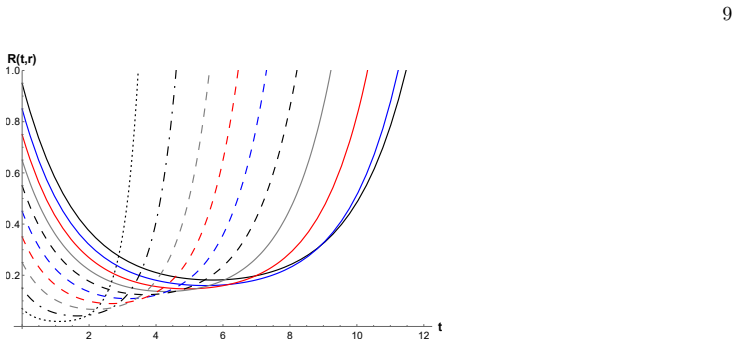
Rastall gravity yields exact nonsingular solutions for inhomogeneous fluid collapse that bounce without apparent horizons.
A machine-rendered reading of the paper's core claim, the machinery that carries it, and where it could break.
Core claim
The paper finds a class of exact nonsingular solutions in which the matter shells undergo a collapse process in a contracting regime, reach a bounce point, and then enter an expanding phase. It is found that for the obtained solutions, the trapped surface formation can be avoided and consequently, the bounce event is not covered by the apparent horizon.
What carries the argument
The Rastall parameter tuned to nullify effective radial pressure, which permits closed-form metric functions describing contraction to a finite minimum radius followed by expansion.
If this is right
- Collapsing shells reach a finite minimum radius and subsequently expand.
- No apparent horizon forms during the evolution, leaving the bounce region untrapped.
- The weak energy condition remains satisfied for the inhomogeneous profiles and chosen parameters.
- The solutions are regular at the bounce and contain no spacetime singularity.
Where Pith is reading between the lines
- The same parameter tuning could be tested in homogeneous Rastall collapse to confirm consistency with the inhomogeneous case.
- Avoidance of trapped surfaces leaves open the possibility that the bounce dynamics could in principle produce observable exterior effects.
Load-bearing premise
The Rastall parameter must be chosen to make effective radial pressure vanish and must stay consistent with the given inhomogeneous density profiles and energy conditions for the entire evolution.
What would settle it
Explicit computation of the apparent-horizon radius as a function of time for the derived scale factors, checking whether it ever coincides with or lies inside the matter-shell radius at or before the bounce.
Figures



read the original abstract
We study spherically symmetric gravitational collapse of an inhomogeneous fluid with anisotropic energy momentum tensor (EMT) in Rastall gravity. Considering a linear equation of state (EoS) for the fluid profiles, i.e., $p_r=w_r\rho$ and $p_\theta=w_\theta\rho$, we try to build and investigate non-singular collapse scenarios for which, the spacetime singularity that appears in the homogeneous case~\cite{ahz2019}, is absent. We therefore set the Rastall parameter in such a way that the effective radial pressure vanishes. This helps us to obtain a class of exact nonsingular solutions in which the matter shells undergo a {collapse} process in a contracting regime, reach a bounce point, and then enter an expanding phase. We further investigate formation of trapped surfaces during the dynamical evolution of the collapsing body. {It is found} that for the obtained solutions, {the} trapped surface formation can be avoided and consequently, the bounce event is not covered by the apparent horizon. Validity of weak energy condition (WEC) is also examined for the obtained solutions.
Editorial analysis
A structured set of objections, weighed in public.
Referee Report
Summary. The manuscript studies spherically symmetric gravitational collapse of an inhomogeneous anisotropic fluid with linear equations of state p_r = w_r ρ and p_θ = w_θ ρ in Rastall gravity. By fixing the Rastall parameter to make the effective radial pressure vanish, the authors construct a class of exact nonsingular solutions in which collapsing shells reach a bounce and then expand, with no trapped surfaces or apparent horizons forming and with the weak energy condition satisfied.
Significance. If the consistency of the fixed Rastall parameter with the inhomogeneous density profiles and energy conditions can be rigorously established across the full evolution, the work would supply concrete, explicit examples of bounce dynamics in modified gravity that avoid both singularities and horizons. This is of interest for exploring how inhomogeneity and anisotropy modify collapse outcomes relative to the homogeneous case in general relativity.
major comments (3)
- The choice of the Rastall parameter to enforce vanishing effective radial pressure is the load-bearing step for obtaining the exact nonsingular bounce solutions (as stated in the abstract and the paragraph introducing the solutions). It is necessary to demonstrate explicitly that this single fixed value satisfies the Rastall field equations identically for arbitrary inhomogeneous ρ(r,t) at every stage of the evolution (pre-bounce contraction, at the bounce, and post-bounce expansion) without forcing additional constraints on the metric functions or the anisotropy parameters w_r and w_θ.
- The avoidance of trapped surfaces and apparent horizons is shown only for the solutions constructed with the tuned parameter. A clearer statement is required on whether this avoidance is a generic feature of inhomogeneous fluids in Rastall theory or whether it is an artifact of setting the effective radial pressure to zero; the current presentation leaves open the possibility that the result is parameter-specific rather than a robust prediction.
- The weak energy condition is examined for the obtained solutions, but the check must be extended to confirm that no violations arise at the bounce point itself, where the density reaches its maximum and the anisotropy (controlled by w_r and w_θ) could potentially produce transient violations during the transition from contraction to expansion.
minor comments (3)
- The abstract contains a minor grammatical issue: 'the bounce event is not covered by the apparent horizon' would read more clearly as 'the bounce is not covered by an apparent horizon.'
- The metric ansatz and coordinate conventions should be restated explicitly at the start of the section presenting the field equations to aid readability for readers unfamiliar with the homogeneous reference case.
- A brief quantitative comparison (e.g., via a table or plot) between the inhomogeneous bounce solutions and the singular homogeneous solutions of the cited reference would strengthen the discussion of the role of inhomogeneity.
Simulated Author's Rebuttal
We thank the referee for the careful reading and valuable comments on our manuscript. We address each major comment below and will incorporate revisions to strengthen the presentation.
read point-by-point responses
-
Referee: The choice of the Rastall parameter to enforce vanishing effective radial pressure is the load-bearing step for obtaining the exact nonsingular bounce solutions (as stated in the abstract and the paragraph introducing the solutions). It is necessary to demonstrate explicitly that this single fixed value satisfies the Rastall field equations identically for arbitrary inhomogeneous ρ(r,t) at every stage of the evolution (pre-bounce contraction, at the bounce, and post-bounce expansion) without forcing additional constraints on the metric functions or the anisotropy parameters w_r and w_θ.
Authors: We agree this verification is essential. The Rastall parameter is fixed to a constant value determined only by w_r and w_θ such that the effective radial pressure vanishes identically. Substituting this choice into the Rastall field equations yields a reduced system whose solutions for the metric functions admit a family of inhomogeneous ρ(r,t) profiles. These profiles are not completely arbitrary but are constrained by the reduced equations; once chosen consistently with the metric, the original field equations are satisfied by construction at all times. We will add an explicit back-substitution of the fixed parameter and the resulting ρ(r,t) into the full set of Rastall equations, evaluated at representative times before, at, and after the bounce, to confirm no further constraints arise. revision: yes
-
Referee: The avoidance of trapped surfaces and apparent horizons is shown only for the solutions constructed with the tuned parameter. A clearer statement is required on whether this avoidance is a generic feature of inhomogeneous fluids in Rastall theory or whether it is an artifact of setting the effective radial pressure to zero; the current presentation leaves open the possibility that the result is parameter-specific rather than a robust prediction.
Authors: We do not claim the result is generic. Horizon avoidance in our solutions follows directly from the vanishing effective radial pressure, which keeps the expansion of outgoing null geodesics positive throughout the evolution. We will revise the relevant sections to state explicitly that this feature is tied to the specific choice of the Rastall parameter that enforces p_r^eff = 0 and is therefore not asserted to hold for arbitrary values of the parameter or for other inhomogeneous fluids in Rastall gravity. A brief remark will be added noting that other parameter choices would generally require numerical integration and lie outside the scope of the present analytic study. revision: yes
-
Referee: The weak energy condition is examined for the obtained solutions, but the check must be extended to confirm that no violations arise at the bounce point itself, where the density reaches its maximum and the anisotropy (controlled by w_r and w_θ) could potentially produce transient violations during the transition from contraction to expansion.
Authors: We will extend the WEC analysis as requested. At the bounce, where the scale factor reaches its minimum and density is maximum, the conditions reduce to ρ ≥ 0 (satisfied by construction), ρ + p_r ≥ 0, and ρ + p_θ ≥ 0. Because p_r^eff = 0, the first combination is simply ρ > 0. For the tangential direction the inequality holds for the range of w_θ we consider, with no sign change during the contraction-to-expansion transition. We will add an explicit evaluation of all three WEC inequalities at the bounce time t_b for representative values of w_r and w_θ, confirming that no transient violations occur. revision: yes
Circularity Check
No significant circularity; parameter choice is explicit model assumption for constructing solutions.
full rationale
The paper explicitly sets the Rastall parameter to nullify effective radial pressure as a deliberate step to enable exact nonsingular solutions with bounce behavior under the linear anisotropic EoS. This is presented transparently as a means to investigate specific scenarios rather than a hidden reduction or prediction derived from general equations. Solutions are then obtained by solving the field equations with this choice and the inhomogeneous density profiles; properties such as WEC validity and absence of trapped surfaces are verified on the resulting metrics. The self-citation to the homogeneous case is only contextual background and not load-bearing. No step equates a claimed result to an input by construction, and the derivation remains self-contained against the stated assumptions.
Axiom & Free-Parameter Ledger
free parameters (2)
- Rastall parameter
- w_r and w_theta
axioms (2)
- domain assumption Spherically symmetric spacetime metric for the collapsing body
- domain assumption Linear equation of state p_r = w_r rho and p_theta = w_theta rho
Reference graph
Works this paper leans on
-
[1]
A H Ziaie, H Moradpour and S GhaffariPhys. Lett. B793276 (2019)
work page 2019
-
[2]
A Heger, C L Fryer, S E Woosley, N Langer and D H Hartmann,Astrophys. J.591288 (2003) S Woosley and H-T JankaNature Physics1147 (2005) L Boccioli and L RobertiUniverse10148 (2024)
work page 2003
-
[3]
M. Camenzind,Compact Objects in Astrophysics: White Dwarfs, Neutron Stars and Black Holes,Germany, Springer Berlin Heidelberg (2007)
work page 2007
-
[4]
K. Ichi NomotoAstrophys. J.253798 (1982) C L Fryer and V Kalogera,ApJ554548 (2001) C-H Lee, H-J Park and G E BrownApJ670741 (2007)
work page 1982
-
[5]
A Possenti, M Colpi, P Casella, U Moschella and V. Gorini (eds.)Physics of Relativistic Objects in Compact Binaries: 14 from Birth to Coalescence,Germany, Springer Netherlands (2009)
work page 2009
-
[6]
G S FraleyAstrophys. Space Sci.296 (1968) C L Fryer, S E Woosley and A HegerApJ550372 (2001) A Heger and S E Woosley,ApJ567532 (2002)
work page 1968
-
[7]
D Spolyar, K Freese and P Gondolo,Phys. Rev. Lett.100051101 (2008) K Freese, P Bodenheimer, D Spolyar and P GondoloApJ685L101 (2008) K Freese, C Ilie, D Spolyar, M Valluri, and P BodenheimerApJ7161397 (2010)
work page 2008
-
[8]
A W Alsabti and P Murdin (eds.)Handbook of SupernovaeSpringer Cham (2017)
work page 2017
-
[9]
S W Hawking and G. F. R EllisThe Large Scale Structure of Space-TimeCambridge University Press (1973)
work page 1973
-
[10]
R PenroseNuovo Cimento1252 (1969) R PenroseGen. Rel. Grav.341141 (2002)
work page 1969
-
[11]
P S Joshi,Gravitational Collapse and Space-Time Singularities,Cambridge University Press, Cambridge (2007)
work page 2007
-
[12]
P S Joshi and D MalafarinaInt. J. Mod. Phys. D202641 (2011)
work page 2011
-
[13]
Phys.26623 (1996) G E RomeroFound
J Earman,Bangs, Crunches, Whimpers, and Shrieks Singularities and Acausalities in Relativistic SpacetimesUnited Kingdom: Oxford University Press (1995) J EarmanFound. Phys.26623 (1996) G E RomeroFound. Sci.18297 (2013) N SfetcuThe Singularities As Ontological Limits of the General Relativity,N.p., Lulu.com (2019)
work page 1995
-
[14]
S DattZs. f. Phys.108314 (1938) J R Oppenheimer and H SnyderPhys. Rev.56455 (1939)
work page 1938
-
[15]
T P Singh and P S JoshiClass. Quant. Grav.13559 (1996)
work page 1996
-
[16]
S Jhingan, P S Joshi and T P SinghClass. Quant. Grav.133057 (1996)
work page 1996
-
[17]
I H Dwivedi and P S JoshiClass. Quant. Grav.141223 (1997)
work page 1997
-
[18]
Y C OngInt. J. Mod. Phys. A352030007 (2020)
work page 2020
-
[19]
P S JoshiGlobal Aspects in Gravitation and CosmologyOxford University Press, Oxford (1993)
work page 1993
-
[20]
Quantum Grav.61599 (1989) P S Joshi and I H DwivediPhys
I H Dwivedi and P S JoshiClass. Quantum Grav.61599 (1989) P S Joshi and I H DwivediPhys. Rev. D475357 (1993) P S Joshi and A KrolakClass. Quantum Grav.133069 (1996) R V Saraykar and S H GhateClass. Quantum Grav.16281 (1999) P S Joshi, N Dadhich and R MaartensPhys. Rev. D65101501 (2002) T Harada, H Iguchi and K-ichi Nakao,Prog. Theor. Phys.107449 (2002)
work page 1989
-
[21]
P S Joshi and D Malafarina (eds.)New Frontiers in Gravitational Collapse and Spacetime SingularitiesGermany: Springer Nature Singapore, Imprint: Springer (2024)
work page 2024
- [22]
-
[23]
J M M SenovillaGen. Relativ. Gravit.30701 (1998)
work page 1998
-
[24]
D C MooreTrends in Quantum Gravity Research,Nova Science Publishers, New York, (2006)
work page 2006
-
[25]
M Bojowald, R Goswami, R Maartens and P Singh,Phys. Rev. Lett.95, 091302 (2005) R Goswami, P S Joshi and P. SinghPhys. Rev. Lett.96031302 (2006) J Ziprick and G KunstatterPhys. Rev. D82044031 (2010) B-F Li and P SinghLoop Quantum Cosmology: Physics of Singularity Resolution and Its Implications.In: C Bambi, L Modesto, I Shapiro, (eds)Handbook of Quantum G...
work page 2005
-
[26]
S Hergott, V Husain and S Rastgoo, Phys. Rev. D106, 046012 (2022) L Cipriani, F Fazzini and E W-EwingPhys. Rev. D110066004 (2024) P RudraNuc. Phys. B1000116461 (2024) B-F Li and P SinghLoop Quantum Cosmology: Physics of Singularity Resolution and Its ImplicationsIn: C. Bambi, L. Modesto, I. Shapiro, (eds) Handbook of Quantum Gravity. Springer, Singapore (2024)
work page 2022
-
[27]
K Bamba, S Nojiri and S D OdintsovPhys. Lett. B698451 (2011)
work page 2011
-
[28]
G Brando, F T Falciano and L F GuimaraesPhys. Rev. D98044027 (2018)
work page 2018
-
[29]
A H Ziaie, P V Moniz, A Ranjbar and H R SepangiEur. Phys. J. C743154 (2014) M Hashemi, S Jalalzadeh and A H ZiaieEur. Phys. J. C7553 (2015) N Poplawski,Universe in a black hole with spin and torsion,The Sixteenth Marcel Grossmann Meeting (2023)
work page 2014
-
[30]
C Bambi, D Malafarina, A Marciano and L Modesto,Phys. Lett. B73427 (2014)
work page 2014
-
[31]
A H Ziaie, H Shabani and H MoradpourEur. Phys. J. Plus139148 (2024)
work page 2024
-
[32]
S Nojiri and S D. OdintsovAIP Conf. Proc.12411094 (2010) L R Abramo and I YasudaPhys. Rev. D81023511 (2010) H Shabani and A H ZiaieEur. Phys. J. C78397 (2018) I Banerjee, T Paul and S SenGuptaGen. Relativ. Gravit.54119 (2022) J K Singh, A Shaily, A Singh, A Beesham and H ShabaniAnnals of Phys.455169382 (2023)
work page 2010
-
[33]
O Latief, F T Akbar and B E GunaraGen
G Ekatria, A. O Latief, F T Akbar and B E GunaraGen. Relativ. Gravit.5772 (2025) 15
work page 2025
-
[34]
P RastallPhys. Rev. D63357 (1972)
work page 1972
-
[35]
L ParkerPhys. Rev. D3346 (1971) L ParkerPhys. Rev. D32546 (1971) L H FordPhys. Rev. D352955 (1987) G W Gibbons and S W HawkingPhys. Rev. D152738 (1977) N D Birrell and P C W DaviesQuantum Fields in Curved Space,Cambridge University Press, Cambridge (1982)
work page 1971
-
[36]
S Nojiri and S D OdintsovPhys. Lett. B599137 (2004) G Allemandi, A Borowiec, M Francaviglia and S D OdintsovPhys. Rev. D72063505 (2005) T KoivistoClass. Quant. Grav.234289 (2006) O Bertolami, C G Boehmer, T Harko and F S N LoboPhys. Rev. D75104016 (2007) T Harko and F S N LoboGalaxies2410 (2014)
work page 2004
-
[37]
H Moradpour, I Licata, C Corda and I. G. SalakoMod. Phys. Lett. A331950096 (2019) K A Bronnikov, J C Fabris, O F Piattella and E C SantosGen. Rel. Grav.48162 (2016)
work page 2019
-
[38]
M VisserPhys. Lett. B78283 (2018)
work page 2018
- [39]
-
[40]
H Shabani and A H ZiaieEuro. Phys. Lett.12920004 (2020) J C Fabris, O F Piattell and D C RodriguesEur. Phys. J. Plus138232 (2023)
work page 2020
-
[41]
F Darabi, H Moradpour, I Licata, Y Heydarzade and C CordaEur. Phys. J. C7825 (2018)
work page 2018
-
[42]
A S Al-Rawaf and M O TahaPhys. Lett. B36669 (1996) A S AI-Rawaf and M O TahaGen. Relative. Gravit.28935 (1996) W E HanafyApJ94051 (2022) G G L Nashed and W E HanafyEur. Phys. J. C82679 (2022) M Yarahmadi, A Salehi and H MousaviPhys. Scr.99105057 (2024) A Banerjee, A Pradhan, I Sakalli and A DixitClass. Quantum Grav.42025008 (2025)
work page 1996
-
[43]
A I ArbabJ. Cosmol. Astropart. Phys.2003008 (2003) C E M Batista, J C Fabris and M H DaoudaNuovo Cim. B125957 (2010) C E M Batista, M H Daouda, J C Fabris, O F Piattella and D C RodriguesPhys. Rev. D85084008 (2012) H Moradpour, N Sadeghnezhad and S H HendiCan. J. Phys951257 (2017) W Khyllep and J Dutta,Phys. Lett. B797134796 (2019) S K Maurya and F Tello-...
work page 2003
-
[44]
Quantum Grav.38165013 (2021) B
R Li , J Wang , Z Xu and X Guo,MNRAS4862407 (2019) S Guo, K-J He, G-R Li and G-P LiClass. Quantum Grav.38165013 (2021) B. Narzilloev, I Hussain, A Abdujabbarov and B AhmedovEur. Phys. J. Plus137645 (2022)
work page 2019
-
[45]
O Akarsu, N Katirci, S Kumar, R C Nunes, B Ozturk and S SharmaEur. Phys. J. C801050 (2020) J M Z Pretel and C E MotaGen. Relativ. Gravit.5643 (2024) Q Sun, Y Zhang, C-H Xie and Q-Q LiPhys. Dark Univ.46101599 (2024) J A-Moreno, K Jacobo, S Arteaga, M A G-Aspeitia and A H-AlmadaClass. Quantum Grav.41065003 (2024) M Sharif and M Sallah Astron. Comput.50100897 (2025)
work page 2020
-
[46]
Space Sci.278385 (2001) A M M Abdel-Rahman and M H A HashimAstrophys
A M M Abdel-RahmanAstrophys. Space Sci.278385 (2001) A M M Abdel-Rahman and M H A HashimAstrophys. Space Sci.298519 (2005)
work page 2001
-
[47]
Z Li and T ZhouPhys. Rev. D 104104044 (2021) Q Li, C Ma, Y Zhang, Z-W Lin and P-F DuanEur. Phys. J. C82658 (2022) Q Sun, Y Zhang, C-H Xie and Q-Q LiPhys. Dark Univ.46101599 (2024)
work page 2021
-
[48]
J Chagoya, J C L-Dominguez and C OrtizClass. Quantum Grav.40075005 (2023)
work page 2023
-
[49]
A M Oliveira, H E S Velten, J C Fabris and L CasariniPhys. Rev. D92044020 (2015) L Meng and D-J LiuAstrophys. Space Sci.366105 (2021) W E HanafyApJ94051 (2022) G G L Nashed and W E HanafyEur. Phys. J. C82679 (2022) T Tangphati, A Banerjee, S. Hansraj and A PradhanAnn. Phys.452169285 (2023) J M Z Pretel and C E MotaGen. Relativ. Gravit.5643 (2024) A Banerj...
work page 2015
-
[50]
D-il Hwang and D-han YeomClass. Quant. Grav.27205002 (2010) S M M Rasouli, A H Ziaie, . Jalalzadeh and P V MonizAnn. Phys.375154 (2016) K D Kokkotas, R A Konoplya and A ZhidenkoPhys. Rev. D96064004 (2017) O A Evseev and O I MelichevPhys. Rev. D97124040 (2018) S Mironov, V Rubakov and V VolkovaClass. Quantum Grav.36135008 (2019) J L Ripley and F PretoriusC...
work page 2010
-
[51]
A H Ziaie, H Moradpour and M Mohammadi SabetEur. Phys. J. Plus1361085 (2021)
work page 2021
-
[52]
H Moradpour, Y Heydarzade, F Darabi and I G SalakoEur. Phys. J. C77259 (2017)
work page 2017
-
[53]
G S Hall and D A NegmInt. J. Theor. Phys.25405 (1986) H MaedaPhys. Rev. D104084088 (2021)
work page 1986
- [54]
-
[55]
D Bhattacharjee and P K ChattopadhyayEur. Phys. J. C8477 (2024) T Cadogan and E PoissonGen. Relativ. Gravit.56118 (2024) S Das, B C Paul, I H Sardar and S K PalEur. Phys. J. C85275 (2025)
work page 2024
-
[56]
R ChanMon. Not. R. Astron. Soc.288589 (1997) R ChanMon. Not. R. Astron. Soc.299811 (1998) R ChanMon. Not. R. Astron. Soc.316588 (2000) G Pinheiro, R ChanGen. Relativ. Gravit.431451 (2011)
work page 1997
-
[57]
Quantum Grav.151759 (1998) R A Sussman and J TriginerClass
R A SussmanClass. Quantum Grav.151759 (1998) R A Sussman and J TriginerClass. Quantum Grav.16167 (1999) R A Sussman, arXiv0812.4430 [gr-qc] P S Joshi, R Goswami and N Dadhich, arXiv: gr-qc/0308012 G Pinheiro and R ChanInt. J. Mod. Phys. D191797 (2010) L Herrera, A D Prisco and J OspinoSymmetry131568 (2021) A B Modan and S M KoksbangClass. Quantum Grav.412...
-
[58]
E PoissonA Relativist’s Toolkit: The Mathematics of Black Hole Mechanics, Cambridge University Press, Cambridge (2004)
work page 2004
-
[59]
Rev.B571136 (1964) D Bak and S J ReyClass
C W Misner and D H SharpPhys. Rev.B571136 (1964) D Bak and S J ReyClass. Quantum Grav.17L83 (2000) T Koike, H Onozawa and M Siino arXiv: gr-qc/9312012
work page internal anchor Pith review arXiv 1964
-
[60]
Cambridge University Press (2006)
J Plebanski and A Krasinski,An Introduction to General Relativity and Cosmology,N.p. Cambridge University Press (2006)
work page 2006
-
[61]
P S Joshi and T P SinghPhys. Rev. D516778 (1995)
work page 1995
-
[62]
G Halevi, B Wu, P Mosta, O Gottlieb, A Tchekhovskoy, D R A-DenaApJL944L38 (2023)
work page 2023
-
[63]
G C Gomez, E V-Semadeni and A PalauMNRAS5024963 (2021) K Sharma and C L RodriguezApJ983162 (2025)
work page 2021
-
[64]
P C Vaidya and R TikekarJ. Astrophys. Astron.3325 (1982) M C Durgapal and R BannerjiPhys. Rev. D27328 (1983); ErratumPhys. Rev. D282695 (1983) M C Durgapal, A K Pande and R S PhuloriaAstrophys. Space Sci.10249 (1984) H L Duorah and R RayClass. Quantum Grav.41691 (1987) M R Finch and J E F SkeaClass. Quantum Grav.6467 (1989)
work page 1982
-
[65]
C W Misner, K S Thorne, and J A WheelerGravitationPrinceton University Press (2017)
work page 2017
-
[66]
B F Schutz,A First Course in General Relativity,United Kingdom: Cambridge University Press (1985)
work page 1985
-
[67]
J Hansson and F SandinPhys. Lett. B6161 (2005)
work page 2005
-
[68]
F Sandin and J HanssonPhys. Rev. D76125006 (2007)
work page 2007
-
[69]
F SandinEur. Phys. J. C40(Suppl 2) 15 (2005)
work page 2005
- [70]
-
[71]
I A D’Souza and C S KalmanPreons: Models of Leptons, Quarks and Gauge Bosons as Composite Objects,Singapore: World Scientific (1992)
work page 1992
-
[72]
K Schertler, C Greiner, J S-Bielich and M H ThomaNuc. Phys. A677463 (2000)
work page 2000
-
[73]
In: Beyond the Desert 2003, (eds) H V Klapdor-Kleingrothaus, Springer Proceedings in Physics, vol 92
S Fredriksson, Preon Prophecies by the Standard Model. In: Beyond the Desert 2003, (eds) H V Klapdor-Kleingrothaus, Springer Proceedings in Physics, vol 92. Springer, Berlin, Heidelberg (2004)
work page 2003
-
[74]
E WittenPhys. Rev. D30272 (1984)
work page 1984
-
[75]
V Burdyuzha, G Vereshkov, O Lalakulich and Y. PonomarevAIP Conf. Proc.478392 (1999)
work page 1999
-
[76]
Vereshkov, hep-ph/9907531 [hep-ph]
V Burdyuzha, O Lalakulich, Y Ponomarev and G. Vereshkov, hep-ph/9907531 [hep-ph]
-
[77]
S M C V GoncalvesPhys. Rev. D63124017 (2001) A MeszarosMon. Not. R. Astro. Soc.25323 (1991)
work page 2001
-
[78]
C J S Clarke,The Analysis of Space-Time Singularities,Cambridge University Press, Cambridge, UK (1993) B C NolanClass. Quantum Grav.20575 (2003)
work page 1993
-
[79]
S A HaywardPhys. Rev. D49, 831 (1994) S A HaywardPhys. Rev. D496467 (1994) S A HaywardPhys. Rev. D531938 (1994)
work page 1994
-
[80]
M. GuidryModern General Relativity: Black Holes, Gravitational Waves, and Cosmology,United Kingdom: Cambridge University Press (2019) A C-Avendano and C Bambi (eds.)Recent Progress on Gravity Tests: Challenges and Future Perspectives,Germany: Springer Nature Singapore (2024)
work page 2019
discussion (0)
Sign in with ORCID, Apple, or X to comment. Anyone can read and Pith papers without signing in.