Causal Discovery as Dialectical Aggregation: A Quantitative Argumentation Framework
Pith reviewed 2026-05-08 05:57 UTC · model grok-4.3
The pith
Treating conditional independence tests as graded defeasible arguments rather than hard constraints improves causal graph recovery in noisy finite-sample data.
A machine-rendered reading of the paper's core claim, the machinery that carries it, and where it could break.
Core claim
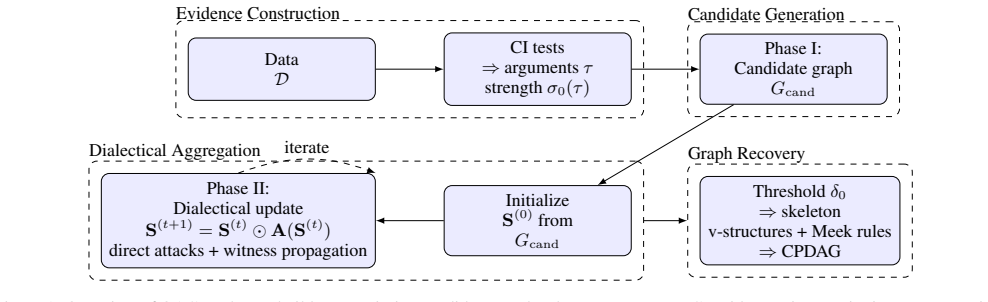
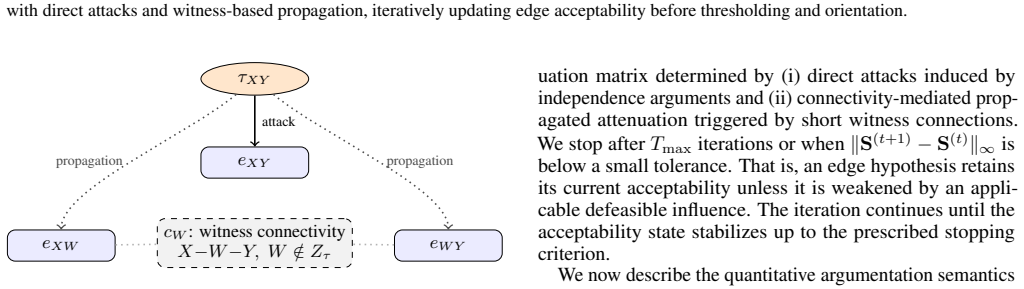
QACD represents each conditional-independence outcome as a graded, defeasible argument whose strength derives from the statistical test. These arguments are aggregated by connectivity-mediated witness propagation, which computes a fixed-point acceptability labeling over candidate adjacencies, thereby resolving conflicts without irreversible commitment to any single test result.
What carries the argument
Connectivity-mediated witness propagation, which computes a fixed-point labeling by letting stronger arguments defeat weaker ones along paths in the candidate graph.
If this is right
- Erroneous CI decisions no longer cascade into large structural errors because conflicting evidence is reconciled at the labeling stage.
- The resulting graphs support more accurate do-calculus interventions in regimes where classical constraint-based methods degrade.
- The framework can be combined with existing constraint-based or hybrid algorithms without requiring changes to the underlying statistical tests.
- Performance remains competitive with prior argumentation-based methods while extending them to quantitative strengths.
Where Pith is reading between the lines
- The method may reduce the need for large sample sizes in causal discovery tasks where data collection is costly.
- It could be extended to settings with latent variables by incorporating additional argument types for unobserved confounders.
- The fixed-point computation might serve as a post-processing step for any constraint-based algorithm that outputs soft CI decisions.
Load-bearing premise
That graded argument strengths derived from finite-sample tests can be aggregated via witness propagation to produce a stable labeling that improves structural and interventional accuracy without introducing new systematic errors.
What would settle it
An experiment on a benchmark network with known ground truth in which QACD produces lower structural Hamming distance or worse interventional accuracy than a standard PC algorithm under the same level of CI-test noise would falsify the claimed improvement.
Figures
read the original abstract
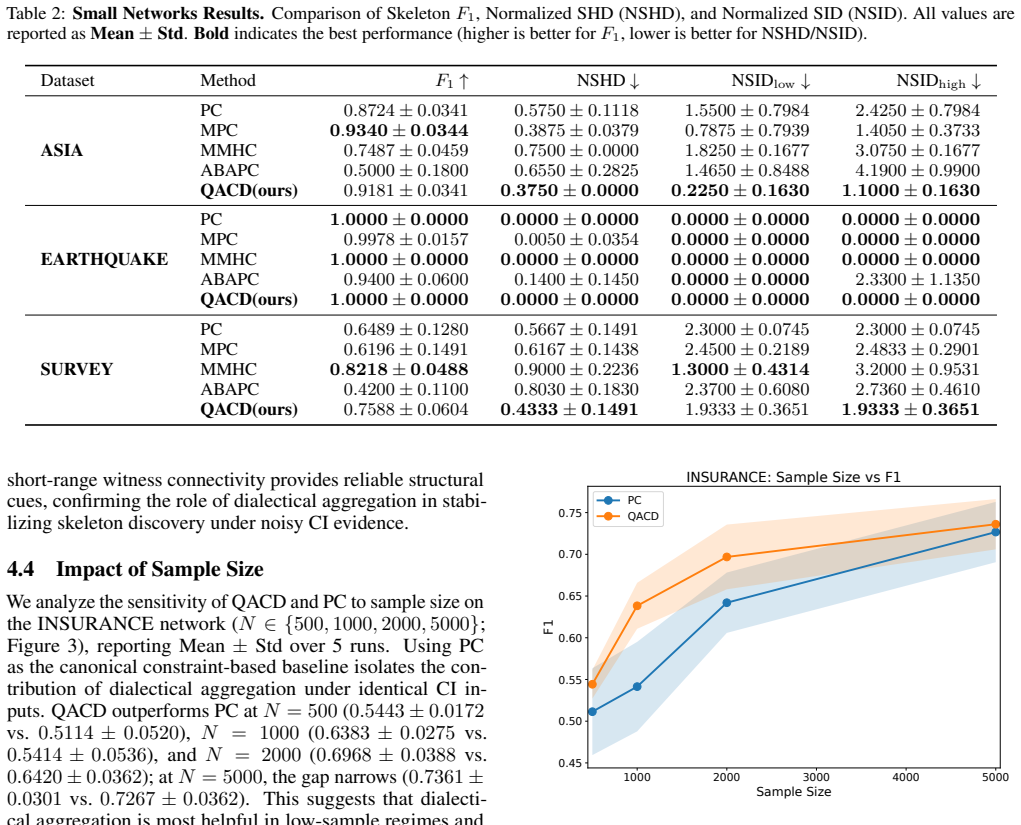
Constraint-based causal discovery is brittle in finite-sample regimes because erroneous conditional-independence (CI) decisions can cascade into substantial structural errors. We propose Quantitative Argumentation for Causal Discovery (QACD), a semantics-driven framework that represents CI outcomes as graded, defeasible arguments rather than irreversible constraints. QACD maps statistical test outcomes to argument strengths and aggregates conflicting evidence through connectivity-mediated witness propagation, producing a fixed-point acceptability labeling over candidate adjacencies. Experiments on standard benchmark Bayesian networks suggest that QACD improves structural coherence and interventional reliability in several noisy or inconsistent CI regimes, while remaining competitive with classical constraint-based, hybrid, and prior argumentation-based baselines.
Editorial analysis
A structured set of objections, weighed in public.
Referee Report
Summary. The paper claims that constraint-based causal discovery is brittle in finite-sample regimes due to cascading errors from erroneous conditional-independence (CI) decisions. It proposes Quantitative Argumentation for Causal Discovery (QACD), which represents CI test outcomes as graded defeasible arguments and aggregates conflicting evidence via connectivity-mediated witness propagation to compute a fixed-point acceptability labeling over candidate adjacencies. Experiments on standard benchmark Bayesian networks are said to show that QACD improves structural coherence and interventional reliability in noisy or inconsistent CI regimes while remaining competitive with classical constraint-based, hybrid, and prior argumentation-based baselines.
Significance. If the fixed-point labeling reliably nets-reduces CI errors without introducing new systematic biases, the framework could offer a principled, semantics-driven alternative to brittle constraint-based methods by integrating quantitative argumentation theory. The parameter-free construction and use of fixed-point semantics are strengths that provide clear mathematical grounding independent of fitted parameters. The empirical competitiveness with baselines, if substantiated with detailed metrics, would support broader applicability in real-world noisy data settings.
major comments (2)
- [Abstract] Abstract: the central claim that QACD improves structural coherence and interventional reliability is asserted solely via experiments on benchmarks, yet the abstract provides no specific metrics, error bars, implementation details, or comparison tables. This is load-bearing because the improvement is not supported by any theoretical bound on error reduction.
- [The QACD framework] The QACD framework (connectivity-mediated witness propagation): witness strength depends on connectivity derived from the evolving labeling, creating a potential feedback loop in which an early erroneous non-edge can weaken witnesses for true edges (or amplify spurious ones). No analysis or bound is given showing that the fixed point is closer to the true skeleton than raw CI decisions, leaving the mechanism vulnerable to the risk of propagating rather than correcting finite-sample errors when CI mistakes correlate with graph connectivity.
minor comments (1)
- [Abstract] The abstract would benefit from at least one concrete quantitative result (e.g., a reported F1 improvement or SHD reduction on a named benchmark) to convey the scale of the claimed gains.
Simulated Author's Rebuttal
We thank the referee for their constructive and detailed comments. We address each major comment point by point below, indicating where revisions will be made to strengthen the manuscript.
read point-by-point responses
-
Referee: [Abstract] Abstract: the central claim that QACD improves structural coherence and interventional reliability is asserted solely via experiments on benchmarks, yet the abstract provides no specific metrics, error bars, implementation details, or comparison tables. This is load-bearing because the improvement is not supported by any theoretical bound on error reduction.
Authors: We agree that the abstract would be strengthened by including concrete quantitative support. In the revised manuscript we will update the abstract to report key empirical metrics, such as average structural Hamming distance reductions and F1-score improvements with standard deviations across repeated runs on the benchmark networks, along with brief notes on implementation and comparisons to baselines. We will also clarify that the observed improvements are empirical rather than supported by a theoretical error-reduction bound, consistent with the paper's focus on practical performance in noisy finite-sample regimes. revision: yes
-
Referee: [The QACD framework] The QACD framework (connectivity-mediated witness propagation): witness strength depends on connectivity derived from the evolving labeling, creating a potential feedback loop in which an early erroneous non-edge can weaken witnesses for true edges (or amplify spurious ones). No analysis or bound is given showing that the fixed point is closer to the true skeleton than raw CI decisions, leaving the mechanism vulnerable to the risk of propagating rather than correcting finite-sample errors when CI mistakes correlate with graph connectivity.
Authors: We thank the referee for identifying this potential vulnerability in the propagation mechanism. The connectivity-mediated weighting is intended to enable evidence aggregation and inconsistency resolution at the fixed point, and our benchmark experiments indicate net error reduction relative to raw CI tests. In the revision we will add a dedicated discussion subsection analyzing the iterative dynamics, including a small illustrative example of error correction versus propagation and conditions under which correlated CI errors might persist. We acknowledge that no formal bound guaranteeing improvement over raw decisions is provided; such a bound would require substantial additional theoretical development beyond the current scope, and we will explicitly note this limitation while emphasizing the empirical results. revision: partial
Circularity Check
No circularity detected in derivation chain
full rationale
The QACD framework defines a mapping from CI test outcomes to graded arguments, followed by aggregation via connectivity-mediated witness propagation to compute a fixed-point acceptability labeling. This is a constructive, self-contained semantics drawing on standard argumentation theory concepts, without any reduction of the output labeling to a tautological re-expression of the inputs, a fitted parameter renamed as prediction, or a load-bearing self-citation chain. The fixed-point computation is a standard recursive definition (labeling depends on propagation which depends on connectivity derived from labeling) rather than a self-definitional loop that forces empirical claims. No equations or steps in the provided abstract and description exhibit the specific reductions required by the circularity criteria; claimed improvements in structural coherence are presented as empirical outcomes from benchmark experiments, not as consequences forced by the framework's own construction.
Axiom & Free-Parameter Ledger
axioms (2)
- domain assumption Erroneous conditional independence decisions can cascade into substantial structural errors in causal graphs.
- domain assumption Statistical test outcomes can be mapped to graded, defeasible argument strengths.
invented entities (2)
-
Quantitative Argumentation for Causal Discovery (QACD)
no independent evidence
-
connectivity-mediated witness propagation
no independent evidence
Reference graph
Works this paper leans on
-
[1]
Dags with no tears: Continuous optimization for struc- ture learning.Advances in neural information processing systems31. A Orientation Rules (Meek Rules) After the dialectical aggregation phase determines the final skeleton and identifies unshielded colliders (v-structures), QACD applies the standard Meek orientation rules (Meek
-
[2]
to orient the remaining undirected edges. These rules are applied iteratively to closure, while avoiding the introduc- tion of new unshielded colliders or directed cycles, yielding a CPDAG representation of the corresponding Markov equiv- alence class. The four rules are applied iteratively until no further edges can be oriented: • R1 (Chain Propagation):...
work page 2015
discussion (0)
Sign in with ORCID, Apple, or X to comment. Anyone can read and Pith papers without signing in.