DynProto: Dynamic Prototype Evolution for Out-of-Distribution Detection
Pith reviewed 2026-05-08 06:27 UTC · model grok-4.3
The pith
DynProto dynamically evolves OOD prototypes from clustered test-time patterns using only in-distribution data.
A machine-rendered reading of the paper's core claim, the machinery that carries it, and where it could break.
Core claim
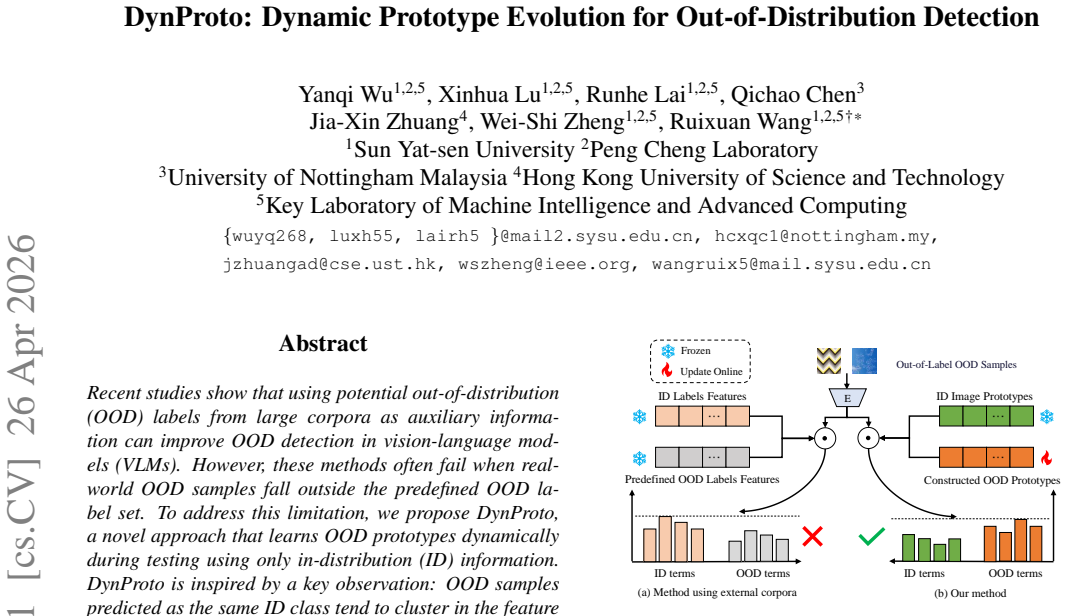
DynProto learns OOD prototypes dynamically during testing using only ID information. Inspired by OOD samples predicted as the same ID class clustering in feature space, it uses easy OOD as anchors for harder counterparts. The Coarse OOD Pattern Capturing Module caches OOD patterns easily confused with each ID class, while the Fine-grained OOD Pattern Refinement Module clusters these within each cache and aggregates into prototypes. Measuring similarity to ID and these dynamic OOD prototypes enables accurate detection, with significant gains like reducing FPR95 by 11.60% on ImageNet OOD benchmark.
What carries the argument
The dynamic prototype evolution via the Coarse OOD Pattern Capturing Module, which caches easily confused OOD patterns per ID class during testing, and the Fine-grained OOD Pattern Refinement Module, which clusters within caches and aggregates into representative OOD prototypes.
If this is right
- Outperforms prior methods on multiple benchmarks, notably reducing FPR95 by 11.60% and improving AUROC by 4.70% on ImageNet OOD.
- Operates without predefined OOD label sets, handling real-world OOD outside fixed categories.
- Remains architecture-agnostic, integrable with various backbones and vision models.
- Relies solely on in-distribution information during the testing phase for prototype learning.
Where Pith is reading between the lines
- If the clustering of same-predicted-class OOD holds across models, this could enable fully unsupervised OOD adaptation in new domains.
- The method might generalize to non-vision tasks where feature clustering of misclassified outliers occurs.
- Combining with existing VLM methods could further boost performance by using dynamic prototypes as supplements to fixed labels.
Load-bearing premise
That out-of-distribution samples which get predicted as the same in-distribution class will form clusters in the feature space that can be captured and refined into useful prototypes.
What would settle it
An experiment showing that OOD samples misclassified to the same ID class do not cluster meaningfully in feature space, or that disabling the clustering refinement step removes all performance improvements over baselines.
Figures


read the original abstract
Recent studies show that using potential out-of-distribution (OOD) labels from large corpora as auxiliary information can improve OOD detection in vision-language models (VLMs). However, these methods often fail when real-world OOD samples fall outside the predefined OOD label set. To address this limitation, we propose DynProto, a novel approach that learns OOD prototypes dynamically during testing using only in-distribution (ID) information. DynProto is inspired by a key observation: OOD samples predicted as the same ID class tend to cluster in the feature space. With this insight, we leverage easy-to-detect OOD samples as ``anchors'' to find their harder-to-detect, similar counterparts. To this end, DynProto introduces two modules: \textbf{Coarse OOD Pattern Capturing Module} caches OOD patterns that are easily confused with each ID class during testing, and \textbf{Fine-grained OOD Pattern Refinement Module} subsequently clusters these patterns within each cache and aggregates them into representative OOD prototypes. By measuring similarity to ID and dynamic OOD prototypes, DynProto enables accurate OOD detection. DynProto significantly outperforms prior methods across multiple benchmarks. On ImageNet OOD benchmark, DynProto reduces FPR95 by 11.60\% and improves AUROC by 4.70\%. Moreover, the framework is architecture-agnostic and can be integrated into various backbones.
Editorial analysis
A structured set of objections, weighed in public.
Referee Report
Summary. The paper proposes DynProto for OOD detection in vision-language models. It dynamically learns OOD prototypes at test time using only ID information, based on the observation that OOD samples predicted as the same ID class cluster in feature space. Easy-to-detect OOD samples act as anchors for harder ones via two modules: Coarse OOD Pattern Capturing (caching patterns confused with each ID class) and Fine-grained OOD Pattern Refinement (clustering within caches and aggregating into representative prototypes). Similarity to ID and dynamic OOD prototypes enables detection, with reported gains of 11.60% FPR95 reduction and 4.70% AUROC improvement on the ImageNet OOD benchmark. The method is architecture-agnostic.
Significance. If the clustering observation is verified and the anchor selection proves robust, DynProto would address a key limitation of prior VLM-based OOD methods that depend on fixed auxiliary OOD label sets. The test-time dynamic evolution using only ID data and the architecture-agnostic design represent practical strengths for real-world deployment where OOD samples lie outside predefined sets.
major comments (2)
- [Coarse OOD Pattern Capturing Module and Fine-grained OOD Pattern Refinement Module] The Coarse OOD Pattern Capturing Module and Fine-grained OOD Pattern Refinement Module: The entire approach is load-bearing on the unverified claim that OOD samples predicted as the same ID class cluster in feature space, with easy OOD serving as anchors. No visualizations, quantitative clustering metrics, or ablations are provided to confirm this holds across benchmarks; at test time the initial selection of easy OOD (implicitly confidence-based) has no ground truth and risks contaminating prototypes with misclassified low-confidence ID samples, directly determining whether the 11.60% FPR95 reduction follows from the proposed mechanism.
- [Experimental evaluation section] Experimental evaluation section: Quantitative claims (e.g., 11.60% FPR95 and 4.70% AUROC gains on ImageNet OOD) are presented without error bars, multiple random seeds, statistical significance tests, or detailed ablations isolating the contribution of each module and the dynamic prototype update. This leaves open whether the gains are reproducible or sensitive to the unshown implementation details of anchor selection and clustering.
minor comments (1)
- [Abstract] The abstract states the method uses 'only in-distribution (ID) information' yet operates at test time on unlabeled samples; the manuscript should explicitly clarify the boundary between ID-only training and test-time use of unlabeled data to avoid reader confusion.
Simulated Author's Rebuttal
We thank the referee for the constructive and insightful comments on our manuscript. We have carefully reviewed the major concerns and provide detailed point-by-point responses below. We propose targeted revisions to address the issues raised, which we believe will strengthen the empirical support and reproducibility of our work.
read point-by-point responses
-
Referee: [Coarse OOD Pattern Capturing Module and Fine-grained OOD Pattern Refinement Module] The entire approach is load-bearing on the unverified claim that OOD samples predicted as the same ID class cluster in feature space, with easy OOD serving as anchors. No visualizations, quantitative clustering metrics, or ablations are provided to confirm this holds across benchmarks; at test time the initial selection of easy OOD (implicitly confidence-based) has no ground truth and risks contaminating prototypes with misclassified low-confidence ID samples, directly determining whether the 11.60% FPR95 reduction follows from the proposed mechanism.
Authors: We acknowledge that the clustering observation is central to DynProto and agree that stronger empirical validation is warranted. In the revised manuscript, we will include t-SNE visualizations of feature embeddings demonstrating OOD samples clustering according to their predicted ID class on multiple benchmarks. We will also report quantitative clustering metrics (e.g., silhouette score and Davies-Bouldin index) to verify the tightness of these clusters. To address the selection of easy OOD samples and potential contamination risk, we will add an ablation study varying the confidence threshold used for caching, along with an analysis showing how the subsequent fine-grained clustering step aggregates patterns into robust prototypes that mitigate the impact of any misclassified ID samples. These additions will directly link the observed gains to the proposed mechanism. revision: yes
-
Referee: [Experimental evaluation section] Experimental evaluation section: Quantitative claims (e.g., 11.60% FPR95 and 4.70% AUROC gains on ImageNet OOD) are presented without error bars, multiple random seeds, statistical significance tests, or detailed ablations isolating the contribution of each module and the dynamic prototype update. This leaves open whether the gains are reproducible or sensitive to the unshown implementation details of anchor selection and clustering.
Authors: We agree that the experimental section would benefit from greater statistical rigor and transparency. In the revision, we will re-run all main experiments over at least five random seeds (accounting for any stochasticity in clustering or data ordering) and report means with standard deviations, including error bars in the result tables. We will also conduct statistical significance tests (e.g., paired t-tests) against baselines to confirm the reported improvements. Additionally, we will expand the ablation section to isolate the individual contributions of the Coarse OOD Pattern Capturing Module, the Fine-grained OOD Pattern Refinement Module, and the dynamic prototype evolution, including sensitivity analysis on anchor selection and clustering parameters. These changes will demonstrate reproducibility and clarify the source of the performance gains. revision: yes
Circularity Check
No significant circularity in derivation chain
full rationale
The paper's core derivation rests on an external empirical observation (OOD samples predicted as the same ID class tend to cluster) that motivates the two modules for dynamic prototype construction during test time. No equations, fitted parameters, or self-referential definitions are shown to reduce the claimed performance gains (e.g., FPR95 reduction on ImageNet OOD) to the inputs by construction. The approach is algorithmic and architecture-agnostic, with the observation treated as an independent starting point rather than a tautology derived from the method itself. No self-citation load-bearing steps, uniqueness theorems, or ansatz smuggling appear in the provided text, leaving the central claim self-contained against external benchmarks.
Axiom & Free-Parameter Ledger
axioms (1)
- domain assumption OOD samples predicted as the same ID class tend to cluster in the feature space
Reference graph
Works this paper leans on
-
[1]
Line: Out-of-distribution detection by leveraging important neurons.CVPR, 2023
Yong Hyun Ahn, Gyeong-Moon Park, and Seong Tae Kim. Line: Out-of-distribution detection by leveraging important neurons.CVPR, 2023. 5
2023
-
[2]
Negrefine: Refining negative label-based zero-shot ood detection
Amirhossein Ansari, Ke Wang, and Pulei Xiong. Negrefine: Refining negative label-based zero-shot ood detection. In ICCV, 2025. 2, 5, 6, 4
2025
-
[3]
In or out? fixing imagenet out-of-distribution detection eval- uation
Julian Bitterwolf, Maximilian Mueller, and Matthias Hein. In or out? fixing imagenet out-of-distribution detection eval- uation. InICML, 2023. 5, 1
2023
-
[4]
Noisy test-time adap- tation in vision-language models, 2025
Chentao Cao, Zhun Zhong, Zhanke Zhou, Tongliang Liu, Yang Liu, Kun Zhang, and Bo Han. Noisy test-time adap- tation in vision-language models, 2025. 2, 5, 6, 7, 4
2025
-
[5]
Conju- gated semantic pool improves ood detection with pre-trained vision-language models
Mengyuan Chen, Junyu Gao, and Changsheng Xu. Conju- gated semantic pool improves ood detection with pre-trained vision-language models. InNeurIPS, 2024. 1, 2, 5, 6, 4
2024
-
[6]
Describing textures in the wild
Mircea Cimpoi, Subhransu Maji, Iasonas Kokkinos, Sammy Mohamed, and Andrea Vedaldi. Describing textures in the wild. InCVPR, 2014. 5, 1
2014
-
[7]
Bimcv covid-19+: a large annotated dataset of rx and ct images from covid-19 patients,
Maria de la Iglesia Vay ´a, Jose Manuel Saborit, Joaquim An- gel Montell, Antonio Pertusa, Aurelia Bustos, Miguel Ca- zorla, Joaquin Galant, Xavier Barber, Domingo Orozco- Beltr´an, Francisco Garc´ıa-Garc´ıa, Marisa Caparr´os, Germ´an Gonz´alez, and Jose Mar´ıa Salinas. Bimcv covid-19+: a large annotated dataset of rx and ct images from covid-19 patients,
-
[8]
Imagenet: A large-scale hierarchical im- age database.IEEE Trans
Jia Deng, Wei Dong, Richard Socher, Li-Jia Li, Kai Li, and Li Fei-Fei. Imagenet: A large-scale hierarchical im- age database.IEEE Trans. Pattern Anal. Mach. Intell., pages 248–255, 2009. 5, 1
2009
-
[9]
Extremely simple activation shaping for out- of-distribution detection
Andrija Djurisic, Nebojsa Bozanic, Arjun Ashok, and Rosanne Liu. Extremely simple activation shaping for out- of-distribution detection. InICLR, 2023. 5, 6, 4
2023
-
[10]
An image is worth 16x16 words: Trans- formers for image recognition at scale
Alexey Dosovitskiy, Lucas Beyer, Alexander Kolesnikov, Dirk Weissenborn, Xiaohua Zhai, Thomas Unterthiner, Mostafa Dehghani, Matthias Minderer, Georg Heigold, Syl- vain Gelly, et al. An image is worth 16x16 words: Trans- formers for image recognition at scale. InICLR, 2020. 2
2020
-
[11]
Siren: Shaping representations for detecting out-of- distribution objects
Xuefeng Du, Gabriel Gozum, Yifei Ming, and Yixuan Li. Siren: Shaping representations for detecting out-of- distribution objects. InNeurIPS, 2022. 2
2022
-
[12]
Zero-shot out-of-distribution detection based on the pre-trained model clip
Sepideh Esmaeilpour, Bing Liu, Eric Robertson, and Lei Shu. Zero-shot out-of-distribution detection based on the pre-trained model clip. InAAAI, 2022. 1, 2
2022
-
[13]
Test-time linear out-of-distribution detection
Ke Fan, Tong Liu, Xingyu Qiu, Yikai Wang, Lian Huai, Zeyu Shangguan, Shuang Gou, Fengjian Liu, Yuqian Fu, Yanwei Fu, et al. Test-time linear out-of-distribution detection. In CVPR, 2024. 2
2024
-
[14]
Out-of-distribution detection with prototyp- ical outlier proxy
Mingrong Gong, Chaoqi Chen, Qingqiang Sun, Yue Wang, and Hui Huang. Out-of-distribution detection with prototyp- ical outlier proxy. InAAAI, 2025. 2
2025
-
[15]
Deep residual learning for image recognition
Kaiming He, Xiangyu Zhang, Shaoqing Ren, and Jian Sun. Deep residual learning for image recognition. InCVPR,
-
[16]
Patrick Helber, Benjamin Bischke, Andreas Dengel, and Damian Borth. Eurosat: A novel dataset and deep learning benchmark for land use and land cover classification.IEEE Journal of Selected Topics in Applied Earth Observations and Remote Sensing, 2019. 5, 7
2019
-
[17]
A baseline for detect- ing misclassified and out-of-distribution examples in neural networks
Dan Hendrycks and Kevin Gimpel. A baseline for detect- ing misclassified and out-of-distribution examples in neural networks. InICLR, 2017. 4, 5, 6
2017
-
[18]
Densely connected convolutional net- works
Gao Huang, Zhuang Liu, Laurens Van Der Maaten, and Kil- ian Q Weinberger. Densely connected convolutional net- works. InCVPR, 2017. 5
2017
-
[19]
Negative label guided OOD detec- tion with pretrained vision-language models
Xue Jiang, Feng Liu, Zhen Fang, Hong Chen, Tongliang Liu, Feng Zheng, and Bo Han. Negative label guided OOD detec- tion with pretrained vision-language models. InICLR, 2024. 1, 2, 3, 5, 6, 7, 8, 4
2024
-
[20]
Learning multiple layers of features from tiny images.(2009), 2009
Alex Krizhevsky, Geoffrey Hinton, et al. Learning multiple layers of features from tiny images.(2009), 2009. 5, 1
2009
-
[21]
Synthesizing near- boundary ood samples for out-of-distribution detection
Jinglun Li, Kaixun Jiang, Zhaoyu Chen, Bo Lin, Yao Tang, Weifeng Ge, and Wenqiang Zhang. Synthesizing near- boundary ood samples for out-of-distribution detection. In ICCV, 2025. 2, 5, 6
2025
-
[22]
On the robust- ness of open-world test-time training: Self-training with dy- namic prototype expansion
Yushu Li, Xun Xu, Yongyi Su, and Kui Jia. On the robust- ness of open-world test-time training: Self-training with dy- namic prototype expansion. InICCV, 2023. 4
2023
-
[23]
Cadref: Robust out- of-distribution detection via class-aware decoupled relative feature leveraging
Zhiwei Ling, Yachen Chang, Hailiang Zhao, Xinkui Zhao, Kingsum Chow, and Shuiguang Deng. Cadref: Robust out- of-distribution detection via class-aware decoupled relative feature leveraging. InCVPR, 2025. 5, 4
2025
-
[24]
Energy-based out-of-distribution detection
Weitang Liu, Xiaoyun Wang, John Owens, and Yixuan Li. Energy-based out-of-distribution detection. InNeurIPS,
-
[25]
Swin transformer: Hierarchical vision transformer using shifted windows
Ze Liu, Yutong Lin, Yue Cao, Han Hu, Yixuan Wei, Zheng Zhang, Stephen Lin, and Baining Guo. Swin transformer: Hierarchical vision transformer using shifted windows. In ICCV, 2021. 2
2021
-
[26]
A convnet for the 2020s
Zhuang Liu, Hanzi Mao, Chao-Yuan Wu, Christoph Feicht- enhofer, Trevor Darrell, and Saining Xie. A convnet for the 2020s. InCVPR, 2022. 2
2022
-
[27]
Learning with mixture of prototypes for out-of-distribution detection
Haodong Lu, Dong Gong, Shuo Wang, Jason Xue, Lina Yao, and Kristen Moore. Learning with mixture of prototypes for out-of-distribution detection. InICLR, 2024. 2
2024
-
[28]
Fa: Forced prompt learning of vision-language models for out-of-distribution detection
Xinhua Lu, Runhe Lai, Yanqi Wu, Kanghao Chen, Wei-Shi Zheng, and Ruixuan Wang. Fa: Forced prompt learning of vision-language models for out-of-distribution detection. In ICCV, 2025. 4, 5, 6, 7
2025
-
[29]
George A. Miller. Wordnet: An electronic lexical database,
-
[30]
Delving into out-of-distribution detection with vision-language representations
Yifei Ming, Ziyang Cai, Jiuxiang Gu, Yiyou Sun, Wei Li, and Yixuan Li. Delving into out-of-distribution detection with vision-language representations. InNeurIPS, 2022. 4, 5, 6, 1
2022
-
[31]
On the impact of spu- rious correlation for out-of-distribution detection
Yifei Ming, Hang Yin, and Yixuan Li. On the impact of spu- rious correlation for out-of-distribution detection. InAAAI,
-
[32]
How to exploit hyperspherical embeddings for out-of-distribution detection? InICLR, 2023
Yifei Ming, Yiyou Sun, Ousmane Dia, and Yixuan Li. How to exploit hyperspherical embeddings for out-of-distribution detection? InICLR, 2023. 2
2023
-
[33]
Zero-shot in-distribution detection in multi-object settings using vision-language foundation models, 2023
Atsuyuki Miyai, Qing Yu, Go Irie, and Kiyoharu Aizawa. Zero-shot in-distribution detection in multi-object settings using vision-language foundation models, 2023. 6, 4, 5
2023
-
[34]
Locoop: Few-shot out-of-distribution detection via prompt learning
Atsuyuki Miyai, Qing Yu, Go Irie, and Kiyoharu Aizawa. Locoop: Few-shot out-of-distribution detection via prompt learning. InNeurIPS, 2023. 5, 6, 4
2023
-
[35]
Yuval Netzer, Tao Wang, Adam Coates, Alessandro Bis- sacco, Bo Wu, and Andrew Y . Ng. Reading digits in natural images with unsupervised feature learning. InNIPS Work- shop on Deep Learning and Unsupervised Feature Learning,
-
[36]
End-to-end convolu- tional network for saliency prediction, 2015
Junting Pan and Xavier Gir ´o i Nieto. End-to-end convolu- tional network for saliency prediction, 2015. 5, 1
2015
-
[37]
Learn- ing transferable visual models from natural language super- vision
Alec Radford, Jong Wook Kim, Chris Hallacy, Aditya Ramesh, Gabriel Goh, Sandhini Agarwal, Girish Sastry, Amanda Askell, Pamela Mishkin, Jack Clark, et al. Learn- ing transferable visual models from natural language super- vision. InICML, 2021. 2
2021
-
[38]
Dice: Leveraging sparsification for out-of-distribution detection
Yiyou Sun and Yixuan Li. Dice: Leveraging sparsification for out-of-distribution detection. InECCV, 2022. 5, 4
2022
-
[39]
React: Out-of- distribution detection with rectified activations
Yiyou Sun, Chuan Guo, and Yixuan Li. React: Out-of- distribution detection with rectified activations. InNeurIPS,
-
[40]
The inaturalist species classification and de- tection dataset
Grant Van Horn, Oisin Mac Aodha, Yang Song, Yin Cui, Chen Sun, Alex Shepard, Hartwig Adam, Pietro Perona, and Serge Belongie. The inaturalist species classification and de- tection dataset. InCVPR, 2018. 5, 1
2018
-
[41]
Open-set recognition: a good closed-set classifier is all you need? InICLR, 2022
Sagar Vaze, Kai Han, Andrea Vedaldi, and Andrew Zisser- man. Open-set recognition: a good closed-set classifier is all you need? InICLR, 2022. 5, 1
2022
-
[42]
Vim: Out-of-distribution with virtual-logit matching
Haoqi Wang, Zhizhong Li, Litong Feng, and Wayne Zhang. Vim: Out-of-distribution with virtual-logit matching. In CVPR, 2022. 5, 4
2022
-
[43]
Knowledge guided disambiguation for large- scale scene classification with multi-resolution cnns.IEEE TIP, 26:2055–2068, 2016
Limin Wang, Sheng Guo, Weilin Huang, Yuanjun Xiong, and Yu Qiao. Knowledge guided disambiguation for large- scale scene classification with multi-resolution cnns.IEEE TIP, 26:2055–2068, 2016. 5, 1
2055
-
[44]
Sun database: Large-scale scene recognition from abbey to zoo
Jianxiong Xiao, James Hays, Krista A Ehinger, Aude Oliva, and Antonio Torralba. Sun database: Large-scale scene recognition from abbey to zoo. InCVPR, 2010. 5, 1
2010
-
[45]
Overcoming short- cut problem in vlm for robust out-of-distribution detection
Zhuo Xu, Xiang Xiang, and Yifan Liang. Overcoming short- cut problem in vlm for robust out-of-distribution detection. InCVPR, 2025. 8
2025
-
[46]
Auto: Adap- tive outlier optimization for online test-time ood detection,
Puning Yang, Jian Liang, Jie Cao, and Ran He. Auto: Adap- tive outlier optimization for online test-time ood detection,
-
[47]
Oodd: Test-time out-of-distribution detection with dynamic dictionary
Yifeng Yang, Lin Zhu, Zewen Sun, Hengyu Liu, Qinying Gu, and Nanyang Ye. Oodd: Test-time out-of-distribution detection with dynamic dictionary. InCVPR, 2025. 2, 5, 6
2025
-
[48]
Self- calibrated tuning of vision-language models for out-of- distribution detection
Geng Yu, Jianing Zhu, Jiangchao Yao, and Bo Han. Self- calibrated tuning of vision-language models for out-of- distribution detection. InNeurIPS, 2024. 5
2024
-
[49]
Openood v1.5: Enhanced benchmark for out-of-distribution detection,
Jingyang Zhang, Jingkang Yang, Pengyun Wang, Haoqi Wang, Yueqian Lin, Haoran Zhang, Yiyou Sun, Xuefeng Du, Yixuan Li, Ziwei Liu, Yiran Chen, and Hai Li. Openood v1.5: Enhanced benchmark for out-of-distribution detection,
-
[50]
Birch: an efficient data clustering method for very large databases
Tian Zhang, Raghu Ramakrishnan, and Miron Livny. Birch: an efficient data clustering method for very large databases. InProceedings of the 1996 ACM SIGMOD International Conference on Management of Data, page 103–114, 1996. 4
1996
-
[51]
Adaneg: Adaptive negative proxy guided ood detection with vision-language models
Yabin Zhang and Lei Zhang. Adaneg: Adaptive negative proxy guided ood detection with vision-language models. NeurIPS, 2024. 3, 5, 6
2024
-
[52]
Tulip: Test-time uncertainty estimation via lin- earization and weight perturbation, 2025
Yuhui Zhang, Dongshen Wu, Yuichiro Wada, and Takafumi Kanamori. Tulip: Test-time uncertainty estimation via lin- earization and weight perturbation, 2025. 2
2025
-
[53]
Towards optimal feature- shaping methods for out-of-distribution detection
Qinyu Zhao, Ming Xu, Kartik Gupta, Akshay Asthana, Liang Zheng, and Stephen Gould. Towards optimal feature- shaping methods for out-of-distribution detection. InICLR,
-
[54]
Places: A 10 million image database for scene recognition.IEEE Trans
Bolei Zhou, Agata Lapedriza, Aditya Khosla, Aude Oliva, and Antonio Torralba. Places: A 10 million image database for scene recognition.IEEE Trans. Pattern Anal. Mach. In- tell., 40:1452–1464, 2017. 5, 1
2017
-
[55]
Learning to prompt for vision-language models.IJCV,
Kaiyang Zhou, Jingkang Yang, Chen Change Loy, and Ziwei Liu. Learning to prompt for vision-language models.IJCV,
-
[56]
Spurious-aware prototype refinement for reliable out-of-distribution detection, 2025
Reihaneh Zohrabi, Hosein Hasani, Mahdieh Soleymani Baghshah, Anna Rohrbach, Marcus Rohrbach, and Moham- mad Hossein Rohban. Spurious-aware prototype refinement for reliable out-of-distribution detection, 2025. 2
2025
-
[57]
Provable discriminative hy- perspherical embedding for out-of-distribution detection
Zhipeng Zou, Sheng Wan, Guangyu Li, Bo Han, Tongliang Liu, Lin Zhao, and Chen Gong. Provable discriminative hy- perspherical embedding for out-of-distribution detection. In AAAI, 2025. 2 DynProto: Dynamic Prototype Evolution for Out-of-Distribution Detection Supplementary Material A. Details of Datasets A.1. ID Datasets ImageNet[8] serves as one of the mo...
2025
discussion (0)
Sign in with ORCID, Apple, or X to comment. Anyone can read and Pith papers without signing in.