Recognition: unknown
On the stability of large-amplitude gravity-capillary surface waves
Pith reviewed 2026-05-08 05:31 UTC · model grok-4.3
The pith
Surface tension stabilizes the modulational instability of finite-amplitude gravity waves at smaller values than weakly nonlinear theory predicts, with nonmonotonic dependence.
A machine-rendered reading of the paper's core claim, the machinery that carries it, and where it could break.
Core claim
When the energy is fixed as an amplitude constraint, the superharmonic instability associated with near-limiting gravity waves emerges at smaller amplitudes in the presence of surface tension. Further, the modulational (long-wave) instability is seen to be stabilised for finite-amplitude solutions in the presence of surface tension. This occurs at surface tension values well below that previously obtained via weakly-nonlinear theory, and the stabilisation is nonmonotonic as very small fluctuations in the surface tension of solutions produce large changes in their stability properties.
What carries the argument
The full eigenvalue spectrum of linear stability operators for periodic gravity-capillary wave solutions, obtained across the countably infinite solution branches that coalesce as surface tension approaches zero.
If this is right
- Superharmonic instabilities set in at lower wave amplitudes once surface tension is present.
- Modulational instabilities are suppressed for finite-amplitude waves at small but nonzero surface tension.
- Stability properties change abruptly with minute variations in surface tension, so that nearby solutions on different branches can be stable or unstable.
- Accurate small-tension limits require tracking the full set of coalescing solution branches rather than a single limiting gravity-wave profile.
Where Pith is reading between the lines
- The nonmonotonic stabilization suggests that laboratory waves with controlled trace surfactants could exhibit abrupt shifts from unstable to stable behavior as tension is varied by fractions of a percent.
- The earlier onset of superharmonic instability may shorten the distance over which large gravity-capillary waves remain intact before breaking.
- Similar branch-coalescence structures could appear in other free-surface problems with competing restoring forces, such as interfacial waves between two fluids.
Load-bearing premise
The numerical method accurately resolves the countably infinite solution branches and computes the complete eigenvalue spectrum without missing unstable modes or introducing discretization artifacts.
What would settle it
A computation or laboratory measurement showing that the modulational growth rate remains positive at surface-tension values below the reported stabilization threshold, or that the stabilization threshold varies monotonically with tension.
Figures





read the original abstract
We consider the stability of periodic gravity-capillary waves of finite amplitude for small values of the surface tension. Linear stability with respect to both superharmonic and subharmonic perturbations is calculated for each solution, and our methodology obtains the full eigenvalue spectrum consisting of growth rates and temporal frequencies. For small surface tension, the gravity-capillary wave solution space consists of a countably-infinite number of solution branches that coalesce in the small-surface-tension limit, which forms one of the main complications of our study. When the energy is fixed as an amplitude constraint, we find that the superharmonic instability associated with near-limiting gravity waves emerges at smaller amplitudes in the presence of surface tension. Further, the modulational (long-wave) instability is seen to be stabilised for finite-amplitude solutions in the presence of surface tension. This occurs at surface tension values well below that previously obtained via weakly-nonlinear theory, and the stabilisation is nonmonotonic as very small fluctuations in the surface tension of solutions produce large changes in their stability properties.
Editorial analysis
A structured set of objections, weighed in public.
Referee Report
Summary. The manuscript examines the linear stability of finite-amplitude periodic gravity-capillary surface waves for small surface tension. It computes the full eigenvalue spectrum (growth rates and frequencies) for superharmonic and subharmonic perturbations on countably infinite solution branches that coalesce as surface tension T approaches zero. With energy fixed as the amplitude constraint, the superharmonic instability of near-limiting gravity waves is reported to onset at smaller amplitudes when surface tension is present. The modulational (long-wave) instability is found to be stabilized at surface tension values below those from weakly nonlinear theory, with the stabilization being nonmonotonic under small fluctuations in T.
Significance. If the numerical results hold, the work provides new information on how small surface tension modifies the stability boundaries of large-amplitude waves beyond the reach of weakly nonlinear approximations. The technical treatment of coalescing branches and the full spectrum computation could be useful for related problems in nonlinear water waves. However, the central claims rest entirely on unvalidated numerical output, limiting the immediate impact until convergence and benchmarking are demonstrated.
major comments (2)
- [§3 (Numerical method and eigenvalue computation)] The abstract and §3 state that the methodology obtains the full eigenvalue spectrum and handles the countably infinite coalescing branches, yet no discretization details (Fourier truncation, collocation points, or branch-tracking algorithm), convergence tests with respect to resolution, or validation against the T=0 gravity-wave limit are supplied. This directly undermines in the reported earlier onset of superharmonic instability and the nonmonotonic stabilization, as truncation artifacts could produce spurious mode crossings or missed unstable eigenvalues precisely when branches coalesce.
- [§4 (Stability results)] In §4, the claim that modulational instability is stabilized at surface tensions well below weakly nonlinear predictions, and that this stabilization is nonmonotonic, is presented without any benchmark comparisons to known analytical or numerical results for pure gravity waves (T=0) or to existing gravity-capillary computations at moderate T. Without such checks, it is impossible to determine whether the observed sensitivity to small T fluctuations is physical or an artifact of the numerical scheme.
minor comments (2)
- [Abstract] The abstract refers to 'very small fluctuations in the surface tension of solutions' without quantifying the range of T or the amplitude of fluctuations examined; a brief numerical example would improve clarity.
- [Introduction] Notation for the surface tension parameter and the precise definition of the energy constraint as an amplitude measure should be introduced earlier in the introduction to help readers follow the fixed-energy comparisons.
Simulated Author's Rebuttal
We thank the referee for their thorough review and insightful comments on our manuscript. We will address the concerns regarding numerical details and benchmarks by making substantial revisions to the relevant sections. We believe these changes will enhance the clarity and credibility of our numerical results on the stability of large-amplitude gravity-capillary waves.
read point-by-point responses
-
Referee: [§3 (Numerical method and eigenvalue computation)] The abstract and §3 state that the methodology obtains the full eigenvalue spectrum and handles the countably infinite coalescing branches, yet no discretization details (Fourier truncation, collocation points, or branch-tracking algorithm), convergence tests with respect to resolution, or validation against the T=0 gravity-wave limit are supplied. This directly undermines in the reported earlier onset of superharmonic instability and the nonmonotonic stabilization, as truncation artifacts could produce spurious mode crossings or missed unstable eigenvalues precisely when branches coalesce.
Authors: We agree with the referee that the submitted manuscript lacks sufficient explicit details on the discretization, convergence tests, and validation. We will revise §3 to include the Fourier truncation level (e.g., number of modes), collocation points, the branch-tracking algorithm for handling coalescing branches as T approaches zero, and results from convergence tests with respect to resolution. We will also include a direct comparison to the T=0 gravity-wave limit to validate the superharmonic instability onset. These revisions will demonstrate that the reported instabilities are not due to truncation artifacts. revision: yes
-
Referee: [§4 (Stability results)] In §4, the claim that modulational instability is stabilized at surface tensions well below weakly nonlinear predictions, and that this stabilization is nonmonotonic, is presented without any benchmark comparisons to known analytical or numerical results for pure gravity waves (T=0) or to existing gravity-capillary computations at moderate T. Without such checks, it is impossible to determine whether the observed sensitivity to small T fluctuations is physical or an artifact of the numerical scheme.
Authors: We concur that benchmark comparisons to known results are necessary to build confidence in the findings. The revised manuscript will incorporate comparisons of our results for T=0 to established gravity wave stability data, as well as to gravity-capillary wave computations at moderate surface tension values. This will help verify that the stabilization of modulational instability at smaller T and its nonmonotonic dependence are physical effects. revision: yes
Circularity Check
No circularity: results from direct numerical computation of solutions and spectra
full rationale
The paper computes finite-amplitude gravity-capillary wave profiles and their full linear stability spectra via numerical methods. Claims regarding earlier onset of superharmonic instability and nonmonotonic stabilization of modulational instability at small surface tension follow from these computations on the solution branches. No self-definitional relations, fitted parameters renamed as predictions, load-bearing self-citations, or ansatzes smuggled via prior work are present; the derivation chain consists of independent numerical resolution rather than reduction to its own inputs by construction.
Axiom & Free-Parameter Ledger
axioms (1)
- domain assumption Inviscid, irrotational, incompressible flow with gravity and constant surface tension
Reference graph
Works this paper leans on
-
[1]
On the stability of large-amplitude gravity-capillary surface waves
Introduction Consider the behaviour of a travelling wave on the surface of a fluid subject to the effect of gravity. Travelling gravity waves of large amplitude have high curvature at the wave crest, and this curvature is known to tend to infinity as the limiting Stokes wave is approached. However, the effect of surface tension on the dynamics of the wave...
work page internal anchor Pith review Pith/arXiv arXiv 2026
-
[2]
The method used to study tempo- ral stability of the travelling wave solutions is described in section 2 3
Outline of our paper The time-dependent boundary-value problem is given in section 2, in which boundary- integral formulations are described for both general time-dependent solutions in section 2 1 and for steadily travelling wave solutions in section 2 2. The method used to study tempo- ral stability of the travelling wave solutions is described in secti...
-
[3]
Mathematical formulation We consider a two-dimensional inviscid, irrotational and incompressible fluid that is bounded above by the periodic free surfacey=ζ(x, t) and extends without bound asy→ −∞. The velocity field (u, v) is expressed as the gradient of the velocity potentialϕby writing (u, v) =∇ϕ, for which the free-boundary problem of the Euler equati...
-
[4]
The time-dependent boundary-integral formulation We consider a time-dependent conformal map that takes the two-dimensional free-boundary problem (1) to a one-dimensional boundary-integral problem. This time-dependent confor- mal mapping for free-surface waves was developed by Dyachenkoet al.[17], and further 4 details on the derivation are given by Choi &...
-
[5]
The stability of these with respect to subharmonic perturbations is the focus of this work
The time-independent boundary-integral formulation Solutions which are steady in the comoving frame (corresponding to permanently propagat- ing waves in the lab frame) haveY t = 0 and Φ t = 0 in the boundary-integral system (4). The stability of these with respect to subharmonic perturbations is the focus of this work. Steady solutions have Ψ =Y, Φ =X−ξ, ...
-
[6]
Linear stability The methodology used to study the stability of subharmonic perturbations to steady so- lutions of the gravity-capillary wave problem is now introduced. First, we consider time- dependent perturbations about steady solutions,X 0(ξ),Y 0(ξ), Φ 0(ξ), and Ψ 0(ξ), of the conformal formulation from section 2 2 by writing {X, Y,Φ,Ψ} ∼ {X 0, Y0,Φ ...
-
[7]
The solution space for steadily travelling gravity waves is shown in figure 1
Subharmonic instability of gravity waves In this section we summarise known results for the subharmonic instability of travelling gravity waves on a fluid of infinite depth. The solution space for steadily travelling gravity waves is shown in figure 1. When the amplitudeAis small, solutions are described by the linear approximationF∼(2π) −1/2 +O(A) andζ(x...
-
[8]
Firstly, in section 4 1 we use weakly-nonlinear theory to analytically derive the stability of long-wave perturbations to small-amplitude solutions
Subharmonic instability of gravity-capillary waves We now consider the stability of travelling wave solutions subject to the effects of both grav- ity and surface tension. Firstly, in section 4 1 we use weakly-nonlinear theory to analytically derive the stability of long-wave perturbations to small-amplitude solutions. Branches of fully nonlinear solution...
-
[9]
Modulational instability of weakly-nonlinear solutions We now examine the modulational instability of gravity-capillary waves predicted by weakly- nonlinear theory. By perturbing about the exact solutionY(ξ) = 0 of the steady system (6) asY∼ϵY 1 +· · ·, the linear solution and dispersion relation are found to be Y1(ξ) =Ae 2kπiξ +c.c., F= r 1 + 4k2π2B 2kπ ...
-
[10]
These solutions satisfy the boundary- integral system, consisting of the integral equation (4c) and the nonlinear differential equa- tion (6)
The gravity-capillary wave solution space Travelling gravity-capillary wave solutions exist within a three-dimensional parameter space characterised by the Bond number,B, the Froude number,F, and an amplitude parameter, which we specify to be the energyEdefined in (5). These solutions satisfy the boundary- integral system, consisting of the integral equat...
2047
-
[11]
These solutions contained the effects of both gravity and surface tension, and were calculated at a fixed value of the energy (5)
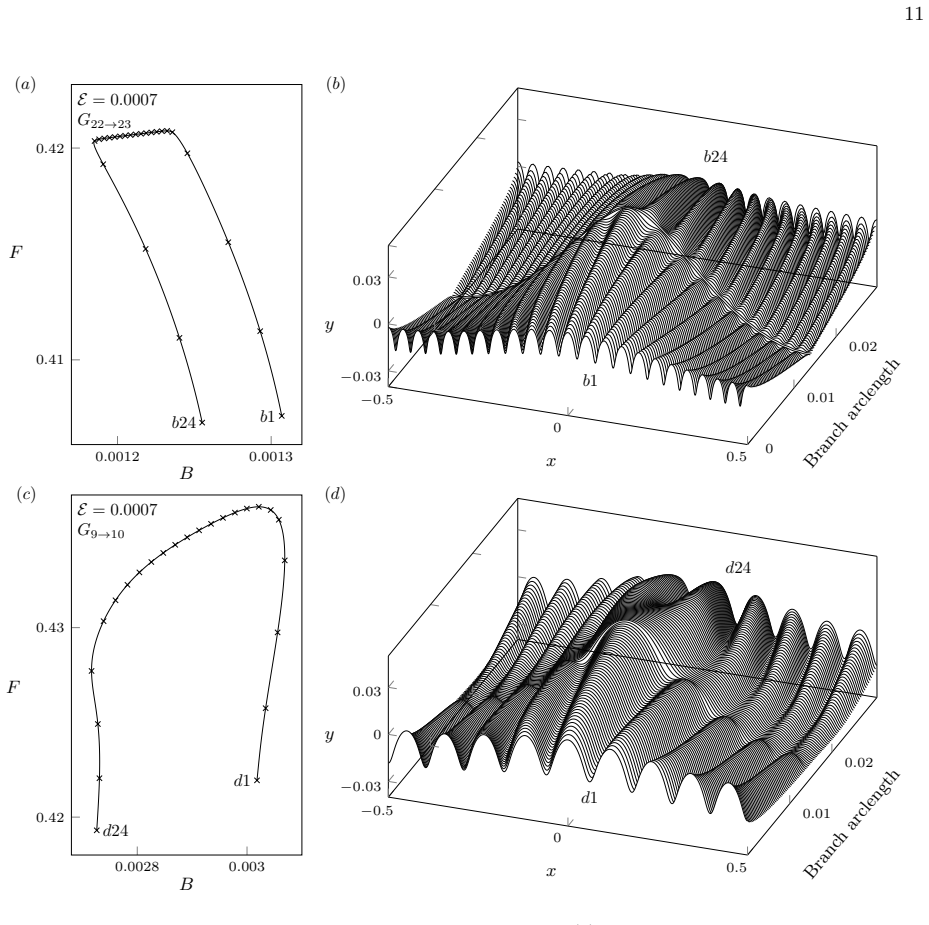
Subharmonic stability of solutions withE= 0.0007 We now calculate the linear stability of the steady solutions introduced in section 4 2. These solutions contained the effects of both gravity and surface tension, and were calculated at a fixed value of the energy (5). We first discuss the stability of solutions withE= 0.0007. Due to nondimensionalisation,...
-
[12]
It is now investigated how these transitions occur along each solution branch
Superharmonic and modulational instabilities We demonstrated in section 4 3 that along each solution branch there is a change (and consequently stabilisation) in both the superharmonic and modulational instabilities. It is now investigated how these transitions occur along each solution branch. Firstly, in figure 10 we study the superharmonic instability ...
-
[13]
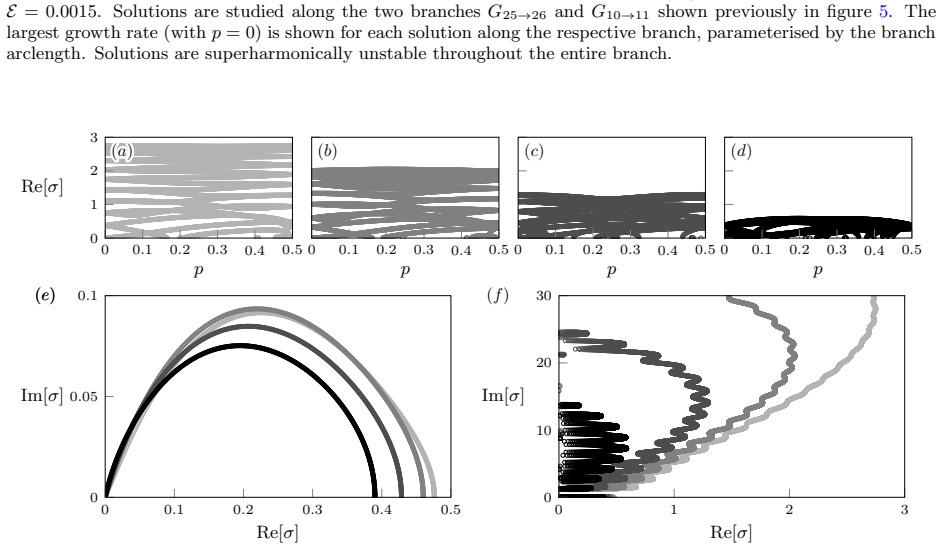
Subharmonic stability of solutions withE= 0.0015 We now consider the stability of gravity-capillary waves obtained with a higher energy value,E= 0.0015. In the absence of surface tension, theE= 0.0015 Stokes wave is both superharmonically and modulationally stable, but is subject to subharmonic instability with a maximum growth rate of Re[σ] = 0.1288 atp=...
-
[14]
Conclusion and discussion We have studied the linear temporal stability of travelling gravity-capillary waves at large values of the solution amplitude. One of the main difficulties in our analysis is the complexity of the underlying solution space that emerges for non-zero surface tension, which takes the form of a countably infinite set of branches that...
2025
-
[15]
Steady solutions Solutions of the gravity-capillary wave problem that are steady in a comoving frame satisfy equation (6). To obtain these numerically, we consider the Fourier series decomposition Y(ξ) = NX n=0 an cos (2nπξ),(A1) which yieldsN+ 2 unknown constants to be determined:N+ 1 Fourier coefficients from (A1) and the Froude number,F. This is closed...
2047
-
[16]
The disintegration of wave trains on deep water. Part 1. Theory,
Linear stability Given a numerical solution of the steady problem obtained withNFourier coefficients via decomposition (A1), the Fourier series expansion for the perturbation is truncated similarly via {X1, Y1,Φ 1,Ψ 1}= e σt NX n=−N {an, bn, cn, dn}e2(n+p)πiξ.(A2) Upon using the identityH[e 2(n+p)πiξ] = i·sgn(n+p)e 2(n+p)πiξ, theO(ϵ) harmonic relations (9...
work page internal anchor Pith review arXiv 1967
discussion (0)
Sign in with ORCID, Apple, or X to comment. Anyone can read and Pith papers without signing in.