Recognition: unknown
Pixelated Plastic Scintillator Array Manufacturing using Fast-, Photo-Curable Resin
Pith reviewed 2026-05-08 04:53 UTC · model grok-4.3
The pith
A new automated method using custom photocurable resin produces two-dimensional pixelated plastic scintillator arrays with per-pixel resolution and gamma-neutron discrimination.
A machine-rendered reading of the paper's core claim, the machinery that carries it, and where it could break.
Core claim
The central claim is that two-dimensional pixelated plastic scintillator arrays can be fabricated through fully autonomous production of one-dimensional layered arrays followed by semi-autonomous cutting and stacking, using a custom photocurable resin with significant non-aromatic acrylate oligomer content. Arrays up to 70 mm long are completed in about 3.5 hours with dimensional deviations below 0.5 mm. When read out by a multi-anode photomultiplier tube, these arrays exhibit per-pixel position resolution and pulse-shape discrimination that enables separation of gamma-neutron interactions.
What carries the argument
An automated assembly machine that extrudes and cures the custom fast-photo-curable resin into one-dimensional layered arrays, followed by cutting and stacking steps to form two-dimensional pixel grids.
If this is right
- Arrays of 7 by 7 pixels can be produced in roughly 3.5 hours while holding dimensional tolerances under 0.5 mm.
- Coupling to a multi-anode photomultiplier tube yields independent position signals from each pixel.
- Pulse-shape differences between gamma and neutron events remain usable after manufacturing.
- The resulting detectors support high-resolution neutron imaging in environments containing both radiation types.
Where Pith is reading between the lines
- The same layering and stacking approach might be extended to larger grids or different pixel sizes without changing the resin chemistry.
- If the curing speed and tolerance control hold for longer strips, the method could reduce production time for full-scale imaging planes.
- Integration with existing multi-anode readout electronics could allow rapid prototyping of custom detector geometries for specific applications.
Load-bearing premise
The custom photocurable resin retains enough scintillation light yield, optical transparency, and pulse-shape discrimination capability after the full curing and assembly process.
What would settle it
Exposing a finished array to a mixed gamma-neutron source and observing no separable pulse-shape distributions between the two particle types would show that the resin lost its discrimination ability during fabrication.
Figures




read the original abstract
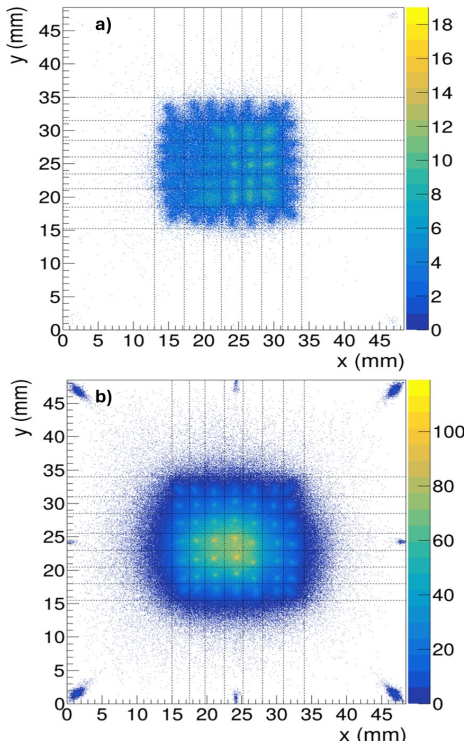
Pixelated plastic scintillator arrays can serve as high efficiency and high resolution neutron imaging detectors. Manufacturing these arrays is intensive in both time and labor. This work presents a fabrication method based on additive manufacturing for two-dimensional plastic organic scintillator arrays using a custom-built automated assembly machine and a custom photocurable resin that has significant non-aromatic acrylate oligomer content. The process involves two main stages: fully autonomous production of one-dimensional layered arrays, followed by semi-autonomous cutting and stacking to form two-dimensional pixel arrays. One-dimensional arrays were manufactured at a rate of around 4 layers per hour with minimal defects and tight dimensional tolerances, while two-dimensional arrays up to 7 x 7 pixels and 70 mm in length were completed in approximately 3.5 hours. Final arrays exhibited dimensional deviations of less than 0.5 mm. Two-dimensional arrays read out by a multi-anode photomultiplier tube demonstrated per-pixel position resolution and pulse-shape discrimination, enabling gamma-neutron interaction separation in mixed radiation environments.
Editorial analysis
A structured set of objections, weighed in public.
Referee Report
Summary. The manuscript presents an additive manufacturing method for fabricating two-dimensional pixelated plastic scintillator arrays using a custom photocurable resin with significant non-aromatic acrylate oligomer content. The process uses a custom-built automated machine for autonomous production of one-dimensional layered arrays (at ~4 layers per hour) followed by semi-autonomous cutting and stacking to form 2D arrays up to 7x7 pixels and 70 mm long. Arrays are completed in ~3.5 hours with dimensional deviations <0.5 mm. When read out by a multi-anode photomultiplier tube, the 2D arrays demonstrate per-pixel position resolution and pulse-shape discrimination, enabling gamma-neutron separation in mixed fields.
Significance. If the central claims hold, this work offers a substantial reduction in the time and labor required to produce high-resolution neutron imaging detectors compared to traditional methods. The reported build speeds, tight tolerances, and functional demonstration of position sensitivity plus PSD directly support scalability for applications in nuclear security, safeguards, and particle physics instrumentation. The experimental focus on a fully autonomous 1D stage plus semi-autonomous 2D assembly, combined with concrete fabrication metrics, represents a practical engineering advance.
major comments (2)
- [Results / radiation testing section] The abstract and results section claim that the fabricated 2D arrays 'demonstrated per-pixel position resolution and pulse-shape discrimination' for gamma-neutron separation. However, no quantitative performance metrics are supplied (e.g., light yield in ph/MeV, attenuation length, PSD figure-of-merit, or energy resolution). Without these values or before/after comparisons of the custom resin after full curing, UV exposure, cutting, and stacking, it is not possible to confirm that scintillation efficiency, optical transparency, and delayed-fluorescence characteristics were retained at a level sufficient to support the functional claim.
- [Methods and results on resin and array characterization] The manufacturing claim rests on the custom resin surviving the complete process without degradation. The text reports successful array completion and basic functionality but provides no data on post-process optical or scintillation properties (e.g., transmission spectra, light output relative to a reference scintillator, or PSD quality factor). This omission is load-bearing because the strongest claim (usable gamma-neutron separation) cannot be evaluated without evidence that the non-aromatic acrylate formulation retained adequate performance after autonomous layering and mechanical assembly.
minor comments (2)
- [Figures] Figure captions and axis labels should explicitly state the number of pixels, pixel pitch, and readout configuration for each presented image or spectrum to allow direct comparison with the stated 7x7 array dimensions.
- [Methods] The description of the custom resin composition would benefit from a table listing the exact oligomer, monomer, and dopant percentages rather than the qualitative statement 'significant non-aromatic acrylate oligomer content'.
Simulated Author's Rebuttal
We thank the referee for their careful and constructive review of our manuscript. The comments highlight the importance of quantitative performance data to support the functional claims for the fabricated arrays, and we address each point below with plans for revision.
read point-by-point responses
-
Referee: [Results / radiation testing section] The abstract and results section claim that the fabricated 2D arrays 'demonstrated per-pixel position resolution and pulse-shape discrimination' for gamma-neutron separation. However, no quantitative performance metrics are supplied (e.g., light yield in ph/MeV, attenuation length, PSD figure-of-merit, or energy resolution). Without these values or before/after comparisons of the custom resin after full curing, UV exposure, cutting, and stacking, it is not possible to confirm that scintillation efficiency, optical transparency, and delayed-fluorescence characteristics were retained at a level sufficient to support the functional claim.
Authors: We agree that the current manuscript presents a qualitative demonstration of per-pixel position resolution and PSD-enabled gamma-neutron separation via the multi-anode PMT readout, without supplying the specific quantitative metrics listed. This is a valid observation. In the revised version we will add a dedicated subsection to the results with measured light yield (ph/MeV), PSD figure-of-merit, energy resolution, and attenuation length for the completed 2D arrays. We will also include before/after comparisons of the resin's optical transmission and scintillation properties after the full curing, UV exposure, cutting, and stacking sequence to confirm retention of performance. revision: yes
-
Referee: [Methods and results on resin and array characterization] The manufacturing claim rests on the custom resin surviving the complete process without degradation. The text reports successful array completion and basic functionality but provides no data on post-process optical or scintillation properties (e.g., transmission spectra, light output relative to a reference scintillator, or PSD quality factor). This omission is load-bearing because the strongest claim (usable gamma-neutron separation) cannot be evaluated without evidence that the non-aromatic acrylate formulation retained adequate performance after autonomous layering and mechanical assembly.
Authors: We concur that post-process characterization of the resin is essential to substantiate that the non-aromatic acrylate formulation retained adequate scintillation and optical properties after the complete fabrication sequence. The submitted manuscript emphasizes manufacturing success and basic functionality but does not provide the requested quantitative post-process data. We will revise the methods and results sections to include transmission spectra, relative light output compared to a reference scintillator, and PSD quality factor values measured on samples taken through the full autonomous layering, cutting, and stacking process. revision: yes
Circularity Check
No circularity: purely experimental fabrication and performance demonstration
full rationale
The paper reports an additive manufacturing process for scintillator arrays using a custom resin, followed by direct experimental readout with a multi-anode PMT to show per-pixel resolution and PSD. No equations, derivations, fitted parameters, or predictions appear in the abstract or described content. Claims rest on measured outcomes (dimensional tolerances, observed separation) rather than any self-referential reduction or self-citation chain. This is a standard experimental methods paper with no load-bearing theoretical steps that could be circular.
Axiom & Free-Parameter Ledger
Reference graph
Works this paper leans on
-
[1]
Sowerby, N
B. Sowerby, N. Cutmore, Y. Liu, H. Peng, J. Tickner, Y. Xie, C. Zong, Recent developments in fast neutron radiography for the interrogation of air cargo containers, International Topical Meeting on Nuclear Research Applications and Utilization of Accelerators (2009) 4–8
2009
-
[2]
J. Y. Park, J. Mun, J. H. Lee, Y.-H. Yeon, M. Chae, M. Lee, N.-H. Lee, Development of a dual-modality gamma-ray/fast neutron imag- ing system for air cargo inspection, Applied Sciences 12 (19) (2022). doi:10.3390/app12199775. URLhttps://www.mdpi.com/2076-3417/12/19/9775
-
[3]
Radle, D
J. Radle, D. Archer, R. Carter, J. Mullens, J. Mihalczo, C. Jr, R. Lind, M. Wright, Fieldable nuclear material identification system (01 2010). 37
2010
-
[4]
J. T. Mihalczo, P. R. Bingham, M. Blackston, J. M. Crye, B. Grogan, P. Hausladen, S. McConchie, J. A. Mullens, Fast-neutron imaging with api dt neutron generators, IEEE (2012). URLhttps://ntrl.ntis.gov/NTRL/dashboard/searchResults/ titleDetail/DE20131079274.xhtml
2012
-
[5]
M. C. Wright, E. W. Nelius, J. T. Mihalczo, S. M. Mcconchie, P. Haus- laden, Initial investigation of the small feature detection capability of the ornl fast neutron tomographic imaging system, IEEE (4 2018). doi:10.2172/1494902. URLhttps://www.osti.gov/biblio/1494902
-
[6]
M. Heath, J. Daughhetee, P. Hausladen, J. Matta, J. Newby, Develop- ment of techniques for gantryless associated-particle imaging, Nuclear Instruments and Methods in Physics Research Section A: Accelerators, Spectrometers, Detectors and Associated Equipment 1062 (2024) 169220. doi:https://doi.org/10.1016/j.nima.2024.169220. URLhttps://www.sciencedirect.co...
-
[7]
N. G. Cutmore, Y. Liu, J. R. Tickner, Development and commercializa- tion of a fast-neutron/x-ray cargo scanner, in: 2010 IEEE International Conference on Technologies for Homeland Security (HST), 2010, pp. 330–336. doi:10.1109/THS.2010.5655030
-
[8]
J. Eberhardt, S. Rainey, R. Stevens, B. Sowerby, J. Tickner, Fast neutron radiography scanner for the detection of contraband in air cargo containers, Applied Radiation and Isotopes 63 (2) (2005) 179–188. doi:https://doi.org/10.1016/j.apradiso.2005.04.012. URLhttps://www.sciencedirect.com/science/article/pii/ S0969804305001247
-
[9]
Zaitseva, et al., Plastic scintillators with efficient neutron/gamma pulse shape discrimination, NIM A 668 (2012) 88–93
N. Zaitseva, et al., Plastic scintillators with efficient neutron/gamma pulse shape discrimination, NIM A 668 (2012) 88–93
2012
-
[10]
H. Z. Bilheux, R. McGreevy, I. S. Anderson, Neutron Imaging and Ap- plications: A Reference for the Imaging Community, Springer, 2009
2009
-
[11]
I. Oksuz, M. Bisbee, J. Hall, N. Cherepy, L. Cao, Quantifying spatial resolution in a fast neutron radiography system, Nuclear Instruments 38 and Methods in Physics Research Section A: Accelerators, Spec- trometers, Detectors and Associated Equipment 1027 (2022) 166331. doi:https://doi.org/10.1016/j.nima.2022.166331. URLhttps://www.sciencedirect.com/scien...
-
[12]
A. Wieczorek, Development of novel plastic scintillators based on polyvinyltoluene for the hybrid j-pet/mr tomograph (2017). arXiv:1710.08136. URLhttps://arxiv.org/abs/1710.08136
-
[13]
Plastic Scintillators - Eljen Technology — eljentechnology.com, https://eljentechnology.com/products/plastic-scintillators, [Accessed 17-03-2025] (”)
2025
-
[14]
pdf, [Accessed 21-10-2024] (2013)
R.J.Newby, P.A.Hausladen, M.B.Blackston, J.F.Liang, Performance of fast-neutron imaging detectors based on plastic scintillator ej-299- 34,https://info.ornl.gov/sites/publications/files/Pub41603. pdf, [Accessed 21-10-2024] (2013)
2024
-
[15]
J. Shuai, Y. Zhang, Z. Wei, Y. Guo, M. Fang, Y. Guo, X. Wen, X. Zhang, Experimental study of plastic scintillators array for compact fast neutron-gamma dual-modality imaging system, Nuclear Instru- ments and Methods in Physics Research Section A: Accelerators, Spectrometers, Detectors and Associated Equipment 1064 (2024) 169485. doi:https://doi.org/10.101...
-
[16]
J. Balajthy, A. Benin, P. Feng, P. Hausladen, N. Myllenbeck, M. Sweany, Neutron detection efficiency measurements of organic glass scintil- lator arrays, Journal of Instrumentation 20 (05) (2025) P05037. doi:10.1088/1748-0221/20/05/P05037. URLhttps://dx.doi.org/10.1088/1748-0221/20/05/P05037
-
[17]
Mishnayot, et al., Three-dimensional printing of scintillating materi- als, Review of Scientific Instruments 85 (8) (2014) 085102
Y. Mishnayot, et al., Three-dimensional printing of scintillating materi- als, Review of Scientific Instruments 85 (8) (2014) 085102
2014
-
[18]
D.-G. Kim, K. Kim, S. Lee, Y. Kim, Enhanced characteristics of 3d-printed plastic scintillators based on bisphenol fluorene di- 39 acrylates, Radiation Physics and Chemistry 198 (2022) 110255. doi:10.1016/j.radphyschem.2022.110255
-
[19]
A. Lim, et al., Plastic scintillators with efficient light output and pulse shape discrimination produced via photoinitiated polymerization, Jour- nal of Applied Polymer Science 136 (15) (2019) 47381
2019
-
[20]
Frandsen, et al., Fast-, light-cured scintillating plastic for 3d-printing applications, Journal of Nuclear Engineering 4 (1) (2023) 241–257
B. Frandsen, et al., Fast-, light-cured scintillating plastic for 3d-printing applications, Journal of Nuclear Engineering 4 (1) (2023) 241–257
2023
-
[21]
T. D. Doležal, J. J. Manfredi, B. G. Frandsen, J. E. Bevins, C. Gautam, T. W. Stephens, T. Ruland, M. T. Febbraro, Manufacturing and char- acterization of a boron-loaded fast-cured plastic organic scintillator, Nuclear Instruments and Methods in Physics Research Section A: Accelerators, Spectrometers, Detectors and Associated Equipment 1056 (2023) 168602....
-
[22]
Chandler, et al., Plastic scintillators via rapid photoinitiated cationic polymerization of vinyltoluene, Applied Polymer Materials 4 (6) (2022)
C. Chandler, et al., Plastic scintillators via rapid photoinitiated cationic polymerization of vinyltoluene, Applied Polymer Materials 4 (6) (2022)
2022
-
[23]
C. Chandler, D. H. Porcincula, M. J. Ford, T. J. Kolibaba, B. Fein-Ashley, J. Brodsky, J. P. Killgore, A. Sellinger, Influence of fluorescent dopants on the vat photopolymerization of acrylate- based plastic scintillators for application in neutron/gamma pulse shape discrimination, Additive Manufacturing 73 (2023) 103688. doi:https://doi.org/10.1016/j.add...
-
[24]
Kim, et al., 3d printable polyvinyltoluene-based plastic scintillators with pulse shape discrimination, NIM-A 1055 (2023) 168537
Y. Kim, et al., 3d printable polyvinyltoluene-based plastic scintillators with pulse shape discrimination, NIM-A 1055 (2023) 168537
2023
-
[25]
V. Anand, B. Bansal, K. Banerjee, G. Bizarri, R. Datta, G. A. Kumar, Development and characterization of digital light processing-based 3d-printed plastic scintillator for radiation detec- tion, IEEE Transactions on Nuclear Science 72 (6) (2025) 1947–1958. doi:10.1109/TNS.2025.3567872. 40
-
[26]
C. Moore, M. Febbraro, J. Manfredi, A. Wood, D. Rutstrom, T. Ruland, B. Hackett, P.Hausladen, High-resolution 3d-printed plastic scintillators with tertiary dye, Journal of Instrumentation 20 (10) (2025) P10043. doi:10.1088/1748-0221/20/10/P10043. URLhttps://doi.org/10.1088/1748-0221/20/10/P10043
-
[27]
Moore, Automated additive layering of vat polymerized plastic or- ganic scintillators, Master’s thesis, Air Force Institute of Technology (2023)
C. Moore, Automated additive layering of vat polymerized plastic or- ganic scintillators, Master’s thesis, Air Force Institute of Technology (2023)
2023
-
[28]
3M ESR — apioptics.com,https://www.apioptics.com/product/ enhanced-specular-reflector-film-esr/, [Accessed 30-05-2025] (2025)
2025
-
[29]
Lua: about — lua.org,https://www.lua.org/about.html, [Accessed 30-05-2025] (2025)
2025
-
[30]
C. Wu, B. C. Meng, L. ho Tam, L. He, Yellowing mechanisms of epoxy and vinyl ester resins under thermal, uv and natural aging conditions and protection methods, Polymer Testing 114 (2022) 107708. doi:https://doi.org/10.1016/j.polymertesting.2022.107708. URLhttps://www.sciencedirect.com/science/article/pii/ S0142941822002306
-
[31]
Yousif, R
E. Yousif, R. Haddad, Photodegradation and photostabilization of poly- mers, especially polystyrene: review, Springerplus 2 (2013) 398
2013
-
[32]
hamamatsu.com,https://www.hamamatsu.com/content/dam/ hamamatsu-photonics/sites/documents/99_SALES_LIBRARY/etd/ H12700_H14220_TPMH1379E.pdf, [Accessed 17-03-2025] (”)
2025
-
[33]
H. O. Anger, SCINTILLATION CAMERA WITH MULTICHANNEL COLLIMATORS, J Nucl Med 5 (1964) 515–531
1964
-
[34]
T. E. Peterson, L. R. Furenlid, SPECT detectors: the anger camera and beyond, Phys Med Biol 56 (17) (2011) R145–82
2011
-
[35]
team, ROOT: analyzing petabytes of data, scientifically
R. team, ROOT: analyzing petabytes of data, scientifically. — root.cern, https://root.cern/, [Accessed 30-05-2025] (2025). 41
2025
-
[36]
W. R. Broughton, A. S. Maxwell, Accelerated ageing of polymeric materials., Measurement Good Practice Guide 10.47120/npl.mgpg103, National Physical Laboratory (NPL) (June 2023). doi:10.47120/npl.mgpg103. URLhttp://eprintspublications.npl.co.uk/3866/
-
[37]
N.Zaitseva, etal., Recentdevelopmentsinplasticscintillatorswithpulse shape discrimination, NIM A 889 (2018) 97–104
2018
-
[38]
A. International, Standard Test Method for Apparent Shear Strength of Single-Lap-Joint Adhesively Bonded Metal Specimens by Tension Load- ing (Metal-to-Metal), Standard, International Organization for Stan- dardization (Apr. 2019)
2019
-
[39]
M. Janecek, Reflectivity spectra for commonly used reflectors, IEEE Transactions on Nuclear Science 59 (3) (2012) 490–497. doi:10.1109/TNS.2012.2183385
-
[40]
Knoll, General Properties of Radiation Detectors; Radiation detec- tion and measurement, John Wiley & Sons, Inc., New York, 1993
G. Knoll, General Properties of Radiation Detectors; Radiation detec- tion and measurement, John Wiley & Sons, Inc., New York, 1993. 42
1993
discussion (0)
Sign in with ORCID, Apple, or X to comment. Anyone can read and Pith papers without signing in.