Recognition: unknown
Rotating End of the World
Pith reviewed 2026-05-08 05:45 UTC · model grok-4.3
The pith
Dynamical end-of-world branes in rotating BTZ black holes permit interior transitions despite identical exteriors.
A machine-rendered reading of the paper's core claim, the machinery that carries it, and where it could break.
Core claim
The central claim is that dynamical EoW branes in the rotating BTZ admit an effective JT description from their induced metric, which produces the first law for the BCFT including boundary degrees of freedom. The paper verifies that shadow entropy coincides with boundary entropy through HRT surfaces. Two representative interior configurations, single-joint and double-joint EoW branes, share identical exterior brane profiles yet possess different energies, allowing an energetically favored transition to occur within the horizon.
What carries the argument
The mapping of the brane induced metric to an effective Jackiw-Teitelboim gravity system that supports thermodynamic relations and SYK duality for the rotating BTZ case.
If this is right
- The first law of thermodynamics for the BCFT holds with explicit boundary degrees of freedom contributions.
- Shadow entropy equals boundary entropy when evaluated with HRT surfaces.
- Single-joint and double-joint EoW branes that match outside the horizon can differ in energy inside the horizon.
- The JT-SYK framework applies directly to thermodynamics of these dynamical branes in rotating geometries.
Where Pith is reading between the lines
- Boundary observables remain unchanged under certain interior brane rearrangements in rotating black holes.
- The same energy-comparison logic could be applied to non-rotating BTZ or to higher-dimensional rotating black holes with dynamical branes.
- Interior transitions of this type may constrain models of black hole interiors that rely on fixed brane configurations.
Load-bearing premise
The induced metric on the dynamical EoW branes can be mapped to an effective JT system that permits use of JT thermodynamics and SYK duality for the rotating BTZ case.
What would settle it
An explicit calculation of the energies for the single-joint and double-joint configurations at fixed exterior data and rotation parameter that shows the energies are always equal or that the lower-energy state is always the single-joint one would disprove the possibility of an interior transition.
Figures


read the original abstract
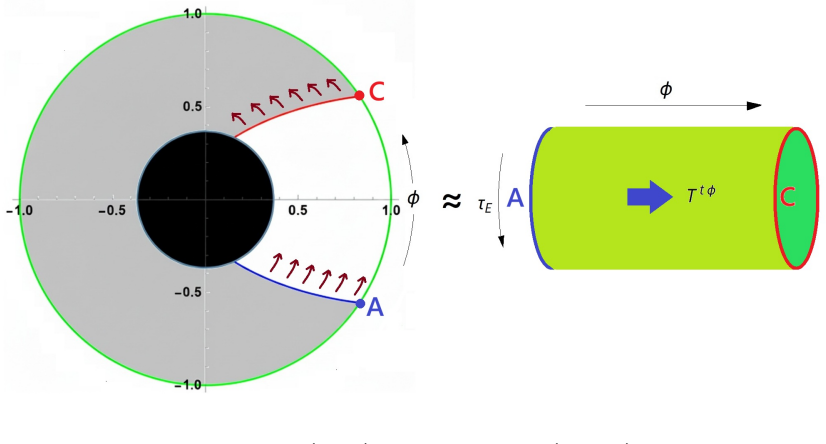
We study the thermodynamics and interior structures of dynamical end of the world (EoW) branes in the rotating BTZ black hole. By mapping the induced metric of the branes to an effective Jackiw-Teitelboim (JT) system, we derive the first law of thermodynamics for the boundary conformal field theory (BCFT), incorporating boundary degrees of freedom. To construct this thermodynamics, we adopt two frameworks of black hole chemistry and the duality between the JT black hole and the Sachdev-Ye-Kitaev (SYK) model. In addition, we verify that the shadow entropy is equivalent to the boundary entropy via Hubeny-Ryu-Takayanagi (HRT) surfaces. Furthermore, we explore the possible interior configurations of the EoW brane inside the horizon. Two representative configurations, namely single and double-joint EoW branes, are considered. These disparate configurations share the same exterior brane configuration outside the horizon. By comparing their energies, we show that a transition could occur within the horizon.
Editorial analysis
A structured set of objections, weighed in public.
Referee Report
Summary. The paper studies thermodynamics and interior structures of dynamical end-of-the-world (EoW) branes in rotating BTZ black holes. It maps the induced metric of the branes to an effective JT gravity system, derives the first law of thermodynamics for the boundary CFT (incorporating boundary degrees of freedom) via black hole chemistry and JT-SYK duality, verifies that shadow entropy equals boundary entropy using HRT surfaces, and argues that single- and double-joint EoW brane configurations sharing the same exterior can undergo a transition inside the horizon by comparing their energies.
Significance. If the mapping from rotating BTZ brane metrics to JT thermodynamics is valid and the energies are correctly obtained, the result would extend EoW brane studies to rotating cases, offering insights into interior black-hole dynamics and possible holographic phase transitions. The HRT verification and use of JT-SYK duality provide concrete checks that strengthen the boundary-bulk connection. The work is technically ambitious but its impact hinges on whether angular momentum is properly retained in the effective 2D description.
major comments (2)
- [thermodynamics construction / abstract] Abstract and thermodynamics construction: the mapping of the induced metric (including g_{tφ} cross terms from nonzero J or r_- in rotating BTZ) to an effective JT system is not shown to preserve an independent rotational contribution. Standard JT gravity is a 2D dilaton theory without a U(1) for angular momentum, and its SYK dual is 0+1D; if the mapping gauges away or omits the rotational piece while still invoking JT thermodynamics for the first law and energies, the subsequent energy comparison between single- and double-joint interior configurations is not reliable.
- [interior configurations] Section on interior configurations and energy comparison: the claim that a transition can occur inside the horizon rests on energies extracted from the JT-SYK framework after the mapping. Because the rotating BTZ metric induces cross terms that standard JT does not independently carry, the energy difference between the two brane configurations (which share the same exterior) may be miscomputed; an explicit check that the first law and boundary entropy remain consistent with nonzero J is required for the transition conclusion to hold.
minor comments (2)
- [abstract] The abstract asserts derivations of the first law, entropy equivalence, and energy comparisons but does not display the key equations or steps; the main text should include them (e.g., the explicit form of the first law after mapping) to permit direct verification.
- [thermodynamics construction] Notation for the effective JT parameters (dilaton, temperature, etc.) after the brane mapping should be defined once and used consistently when comparing energies of the single- versus double-joint configurations.
Simulated Author's Rebuttal
We thank the referee for the thorough review and valuable comments on our work concerning dynamical EoW branes in rotating BTZ black holes. The concerns about the mapping to JT gravity and the reliability of the interior energy comparisons are well taken. We address each major comment below and outline the revisions that will be made to clarify the treatment of angular momentum.
read point-by-point responses
-
Referee: Abstract and thermodynamics construction: the mapping of the induced metric (including g_{tφ} cross terms from nonzero J or r_- in rotating BTZ) to an effective JT system is not shown to preserve an independent rotational contribution. Standard JT gravity is a 2D dilaton theory without a U(1) for angular momentum, and its SYK dual is 0+1D; if the mapping gauges away or omits the rotational piece while still invoking JT thermodynamics for the first law and energies, the subsequent energy comparison between single- and double-joint interior configurations is not reliable.
Authors: We agree that the manuscript would benefit from a more explicit derivation showing how the cross terms are handled. In the revised version we will add a dedicated subsection deriving the effective JT action from the induced metric on the brane. This derivation will demonstrate that the rotational contribution is retained by identifying the effective temperature and chemical potential of the JT black hole with the rotating BTZ parameters (r+, r-), so that J enters the first law through black-hole chemistry as a conjugate variable. The JT-SYK duality is then applied with the corresponding boundary conditions that encode the nonzero angular momentum. We will also present explicit checks confirming that the first law and boundary entropy remain consistent for J ≠ 0. revision: yes
-
Referee: Section on interior configurations and energy comparison: the claim that a transition can occur inside the horizon rests on energies extracted from the JT-SYK framework after the mapping. Because the rotating BTZ metric induces cross terms that standard JT does not independently carry, the energy difference between the two brane configurations (which share the same exterior) may be miscomputed; an explicit check that the first law and boundary entropy remain consistent with nonzero J is required for the transition conclusion to hold.
Authors: We acknowledge that the energy comparison relies on the validity of the mapping for each interior configuration. Because the two configurations share identical exterior data (including the same J), their energy difference arises only from the distinct interior geometries, each of which is mapped separately to its own effective JT system. In the revision we will supply the requested explicit verification: we will recompute the first law including the rotational term for both the single- and double-joint cases and confirm that the boundary entropy obtained from the JT-SYK side matches the shadow entropy computed via HRT surfaces when J is nonzero. These additions will substantiate the possibility of an interior transition. revision: yes
Circularity Check
No significant circularity; derivation applies established JT-SYK and black-hole-chemistry frameworks to new brane configurations without self-referential reduction.
full rationale
The paper maps the induced metric on dynamical EoW branes to an effective JT system, adopts the standard JT-SYK duality and black-hole-chemistry first law to obtain thermodynamics for the BCFT, verifies shadow entropy equivalence via HRT surfaces, and then compares energies of single- versus double-joint interior configurations that share the same exterior. None of these steps reduce by construction to a fitted parameter, self-definition, or a load-bearing self-citation whose content is itself unverified. The central energy comparison is an independent application of the derived thermodynamics rather than a tautology or renaming of inputs.
Axiom & Free-Parameter Ledger
axioms (3)
- domain assumption Induced metric on dynamical EoW branes maps to effective JT system
- domain assumption JT black hole dual to SYK model
- standard math HRT surfaces compute shadow entropy equivalently to boundary entropy
Reference graph
Works this paper leans on
-
[1]
The LargeNlimit of superconformal field the- ories and supergravity,
J. M. Maldacena, “The LargeNlimit of superconformal field theories and super- gravity,” Adv. Theor. Math. Phys.2, 231-252 (1998) doi:10.4310/ATMP.1998.v2.n2.a1 [arXiv:hep-th/9711200 [hep-th]]
-
[2]
O. Aharony, S. S. Gubser, J. M. Maldacena, H. Ooguri and Y. Oz, “Large N field the- ories, string theory and gravity,” Phys. Rept.323, 183-386 (2000) doi:10.1016/S0370- 1573(99)00083-6 [arXiv:hep-th/9905111 [hep-th]]
-
[3]
J. Maldacena, “The Gauge/gravity duality,” [arXiv:1106.6073 [hep-th]]
-
[4]
Conformal invariance and surface critical behavior,
J. L. Cardy, “Conformal Invariance and Surface Critical Behavior,” Nucl. Phys. B240, 514-532 (1984) doi:10.1016/0550-3213(84)90241-4 32
-
[5]
Conformal field theories near a boundary in gen- eral dimensions,
D. M. McAvity and H. Osborn, “Conformal field theories near a boundary in gen- eral dimensions,” Nucl. Phys. B455, 522-576 (1995) doi:10.1016/0550-3213(95)00476-9 [arXiv:cond-mat/9505127 [cond-mat]]
-
[6]
Boundary Conditions, Fusion Rules and the Verlinde Formula,
J. L. Cardy, “Boundary Conditions, Fusion Rules and the Verlinde Formula,” Nucl. Phys. B324, 581-596 (1989) doi:10.1016/0550-3213(89)90521-X
-
[7]
I. Affleck and A. W. W. Ludwig, “Universal noninteger ’ground state de- generacy’ in critical quantum systems,” Phys. Rev. Lett.67, 161-164 (1991) doi:10.1103/PhysRevLett.67.161
-
[8]
On the boundary entropy of one-dimensional quantum systems at low temperature,
D. Friedan and A. Konechny, “On the boundary entropy of one-dimensional quantum systems at low temperature,” Phys. Rev. Lett.93, 030402 (2004) doi:10.1103/PhysRevLett.93.030402 [arXiv:hep-th/0312197 [hep-th]]
-
[9]
T. Takayanagi, “Holographic Dual of BCFT,” Phys. Rev. Lett.107, 101602 (2011) doi:10.1103/PhysRevLett.107.101602 [arXiv:1105.5165 [hep-th]]
-
[10]
M. Fujita, T. Takayanagi and E. Tonni, “Aspects of AdS/BCFT,” JHEP11, 043 (2011) doi:10.1007/JHEP11(2011)043 [arXiv:1108.5152 [hep-th]]
-
[11]
Central Charges for BCFTs and Hologra- phy,
M. Nozaki, T. Takayanagi and T. Ugajin, “Central Charges for BCFTs and Hologra- phy,” JHEP06, 066 (2012) doi:10.1007/JHEP06(2012)066 [arXiv:1205.1573 [hep-th]]
-
[12]
Reviews of Modern Physics , year =
A. Almheiri, T. Hartman, J. Maldacena, E. Shaghoulian and A. Tajdini, “The entropy of Hawking radiation,” Rev. Mod. Phys.93, no.3, 035002 (2021) doi:10.1103/RevModPhys.93.035002 [arXiv:2006.06872 [hep-th]]
-
[13]
Surface/State Correspondence as a Generalized Holog- raphy,
M. Miyaji and T. Takayanagi, “Surface/State Correspondence as a Generalized Holog- raphy,” PTEP2015, no.7, 073B03 (2015) doi:10.1093/ptep/ptv089 [arXiv:1503.03542 [hep-th]]
-
[14]
Black hole microstate cosmology,
S. Cooper, M. Rozali, B. Swingle, M. Van Raamsdonk, C. Waddell and D. Wakeham, “Black hole microstate cosmology,” JHEP07, 065 (2019) doi:10.1007/JHEP07(2019)065 [arXiv:1810.10601 [hep-th]]
-
[15]
Flat space holography via AdS/BCFT,
P. X. Hao, N. Ogawa, T. Takayanagi and T. Waki, “Flat space holography via AdS/BCFT,” JHEP10, 159 (2025) doi:10.1007/JHEP10(2025)159 [arXiv:2509.00652 [hep-th]]. 33
-
[16]
Pure states in the SYK model and nearly-$AdS_2$ gravity
I. Kourkoulou and J. Maldacena, “Pure states in the SYK model and nearly-AdS 2 gravity,” [arXiv:1707.02325 [hep-th]]
-
[17]
Conformal four point functions and the operator product expansion
R. E. Behrend, P. A. Pearce, V. B. Petkova and J. B. Zuber, “Boundary conditions in ra- tional conformal field theories,” Nucl. Phys. B570, 525-589 (2000) doi:10.1016/S0550- 3213(99)00592-1 [arXiv:hep-th/9908036 [hep-th]]
-
[18]
Boundary conformal field theory,
J. L. Cardy, “Boundary conformal field theory,” [arXiv:hep-th/0411189 [hep-th]]
-
[19]
End of the world perspective to BCFT,
K. K. Kim, S. Kim, J. H. Lee, C. Park and Y. Seo, “End of the world perspective to BCFT,” Eur. Phys. J. C84, no.5, 530 (2024) doi:10.1140/epjc/s10052-024-12850-2 [arXiv:2309.13624 [hep-th]]
-
[20]
Enthalpy and the Mechanics of AdS Black Holes
D. Kastor, S. Ray and J. Traschen, “Enthalpy and the Mechanics of AdS Black Holes,” Class. Quant. Grav.26, 195011 (2009) doi:10.1088/0264-9381/26/19/195011 [arXiv:0904.2765 [hep-th]]
work page Pith review doi:10.1088/0264-9381/26/19/195011 2009
-
[21]
The cosmological constant and the black hole equation of state,
B. P. Dolan, “The cosmological constant and the black hole equation of state,” Class. Quant. Grav.28, 125020 (2011) doi:10.1088/0264-9381/28/12/125020 [arXiv:1008.5023 [gr-qc]]
-
[22]
Pressure and volume in the first law of black hole thermodynamics,
B. P. Dolan, “Pressure and volume in the first law of black hole thermodynam- ics,” Class. Quant. Grav.28, 235017 (2011) doi:10.1088/0264-9381/28/23/235017 [arXiv:1106.6260 [gr-qc]]
-
[23]
Black Hole Enthalpy and an Entropy Inequality for the Thermodynamic Volume,
M. Cvetic, G. W. Gibbons, D. Kubiznak and C. N. Pope, “Black Hole Enthalpy and an Entropy Inequality for the Thermodynamic Volume,” Phys. Rev. D84, 024037 (2011) doi:10.1103/PhysRevD.84.024037 [arXiv:1012.2888 [hep-th]]
-
[24]
P − V criticality of charged AdS black holes
D. Kubiznak and R. B. Mann, “P-V criticality of charged AdS black holes,” JHEP07, 033 (2012) doi:10.1007/JHEP07(2012)033 [arXiv:1205.0559 [hep-th]]
-
[25]
Black hole chem- istry: thermodynamics with Lambda,
D. Kubiznak, R. B. Mann and M. Teo, “Black hole chemistry: thermodynamics with Lambda,” Class. Quant. Grav.34, no.6, 063001 (2017) doi:10.1088/1361-6382/aa5c69 [arXiv:1608.06147 [hep-th]]
-
[26]
S. Sachdev and J. Ye, “Gapless spin fluid ground state in a random, quantum Heisen- berg magnet,” Phys. Rev. Lett.70, 3339 (1993) doi:10.1103/PhysRevLett.70.3339 [arXiv:cond-mat/9212030 [cond-mat]]. 34
-
[27]
J. Maldacena and D. Stanford, “Remarks on the Sachdev-Ye-Kitaev model,” Phys. Rev. D94, no.10, 106002 (2016) doi:10.1103/PhysRevD.94.106002 [arXiv:1604.07818 [hep-th]]
-
[28]
G. S´ arosi, “AdS2 holography and the SYK model,” PoSModave2017, 001 (2018) doi:10.22323/1.323.0001 [arXiv:1711.08482 [hep-th]]
-
[29]
M. Berkooz, M. Isachenkov, V. Narovlansky and G. Torrents, “Towards a full solution of the large N double-scaled SYK model,” JHEP03, 079 (2019) doi:10.1007/JHEP03(2019)079 [arXiv:1811.02584 [hep-th]]
-
[30]
The bulk Hilbert space of double scaled SYK
H. W. Lin, “The bulk Hilbert space of double scaled SYK,” JHEP11, 060 (2022) doi:10.1007/JHEP11(2022)060 [arXiv:2208.07032 [hep-th]]
-
[31]
BCFT and Islands in two dimensions,
K. Suzuki and T. Takayanagi, “BCFT and Islands in two dimensions,” JHEP06, 095 (2022) doi:10.1007/JHEP06(2022)095 [arXiv:2202.08462 [hep-th]]
-
[32]
Gravitational action for space-times with nonsmooth boundaries
G. Hayward, “Gravitational action for space-times with nonsmooth boundaries,” Phys. Rev. D47, 3275-3280 (1993) doi:10.1103/PhysRevD.47.3275
-
[33]
Lower-Dimensional Black Hole Chemistry,
A. M. Frassino, R. B. Mann and J. R. Mureika, “Lower-Dimensional Black Hole Chemistry,” Phys. Rev. D92, no.12, 124069 (2015) doi:10.1103/PhysRevD.92.124069 [arXiv:1509.05481 [gr-qc]]
-
[34]
Black hole chemistry: The first 15 years,
R. B. Mann, “Black hole chemistry: The first 15 years,” Int. J. Mod. Phys. D34, no.09, 2542001 (2025) doi:10.1142/S0218271825420015 [arXiv:2508.01830 [gr-qc]]
-
[35]
J. Maldacena, D. Stanford and Z. Yang, “Conformal symmetry and its breaking in two dimensional Nearly Anti-de-Sitter space,” PTEP2016, no.12, 12C104 (2016) doi:10.1093/ptep/ptw124 [arXiv:1606.01857 [hep-th]]
-
[36]
A Covariant holographic entan- glement entropy proposal,
V. E. Hubeny, M. Rangamani and T. Takayanagi, “A Covariant holographic entan- glement entropy proposal,” JHEP07, 062 (2007) doi:10.1088/1126-6708/2007/07/062 [arXiv:0705.0016 [hep-th]]
-
[37]
A simple model of quantum holography,
A. Kitaev, “A simple model of quantum holography,” Talks at KITP, University of California, Santa Barbara, Feb. 12, April 7, and May 27, 2015,http://online.kitp. ucsb.edu/online/entangled15/kitaev/. . 35
2015
discussion (0)
Sign in with ORCID, Apple, or X to comment. Anyone can read and Pith papers without signing in.