Learning Interpretable PDE Representations for Generative Reconstructions with Structured Sparsity
Pith reviewed 2026-05-08 06:14 UTC · model grok-4.3
The pith
Directly setting latent variables to PDE coefficients and source terms lets a diffusion model reconstruct physical fields from sparse or low-resolution data.
A machine-rendered reading of the paper's core claim, the machinery that carries it, and where it could break.
Core claim
LatentPDE constructs an inherently interpretable latent space by directly parameterizing the latent variables as the coefficients and source terms of an assumed governing PDE. This allows the diffusion process to produce physically compliant reconstructions across highly disparate and structured data gaps, achieving high-fidelity recovery at any desired resolution while tracking the underlying predictive uncertainty.
What carries the argument
The direct parameterization of latent variables as the coefficients and source terms of a governing PDE, which enforces physical compliance inside the generative diffusion process.
If this is right
- Reconstructions stay physically valid even when observations contain highly structured gaps.
- The same model produces high-fidelity fields at any chosen resolution.
- Predictive uncertainty is obtained as a direct output of the diffusion process.
- The method works across diverse data configurations without relying on soft loss penalties.
Where Pith is reading between the lines
- If the chosen PDE form is incorrect for the true system, the model could still output smooth fields that appear physical but systematically deviate from reality.
- The learned coefficients could be inspected after training to recover estimates of physical parameters from the data.
- The same latent-parameterization idea might apply to other inverse problems where a governing equation is known but observations are incomplete.
- Testing the framework on nonlinear or time-dependent PDEs would reveal how far the current linear-assumption construction generalizes.
Load-bearing premise
An appropriate governing PDE exists whose coefficients and source terms can be directly used to parameterize the latent space so that the resulting diffusion produces physically compliant reconstructions for arbitrary structured data gaps.
What would settle it
Reconstructed fields that violate the assumed governing PDE by amounts larger than numerical discretization error on held-out test cases with large structured gaps would show that physical compliance is not reliably enforced.
Figures




read the original abstract
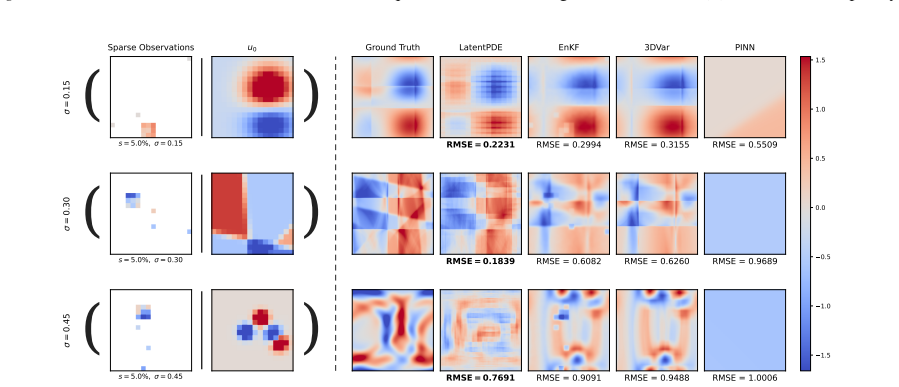
Scientific measurements are often bottlenecked by suboptimal conditions, whether that be noise, incomplete spatial coverage, or limited resolution, rendering accurate field reconstruction a difficult task. We introduce LatentPDE, a latent diffusion framework designed to simultaneously resolve sparse-observation reconstruction and super-resolution. While existing physics-guided diffusion models typically rely on soft loss penalties or uninterpretable representations, our approach enforces physical compliance by constructing an inherently interpretable latent space. Specifically, we parameterize the latent variables directly as the coefficients and source terms of an assumed governing PDE. In doing so, LatentPDE is able to reliably reconstruct dynamics across highly disparate and structured data gaps. Empirical results on diverse configurations demonstrate that our model achieves high-fidelity recovery at any desired resolution while also tracking the underlying predictive uncertainty.
Editorial analysis
A structured set of objections, weighed in public.
Referee Report
Summary. The manuscript introduces LatentPDE, a latent diffusion framework for simultaneous sparse-observation reconstruction and super-resolution of fields governed by PDEs. The core innovation is to parameterize the latent variables directly as the coefficients and source terms of an assumed governing PDE, thereby enforcing physical compliance in an interpretable manner rather than via soft penalties. The authors claim this enables reliable high-fidelity recovery across highly disparate structured data gaps at arbitrary resolutions while also tracking predictive uncertainty.
Significance. If the central claims can be substantiated with quantitative evidence, the work would represent a meaningful step toward inherently interpretable physics-informed generative models. Directly embedding PDE coefficients in the latent space could improve generalization and trustworthiness compared with penalty-based or black-box alternatives, particularly for scientific applications involving structured sparsity and uncertainty quantification.
major comments (3)
- [Abstract] Abstract: The assertions of 'high-fidelity recovery' and 'reliable reconstruction' across structured data gaps are made without any quantitative metrics, baselines, error bars, ablation studies, or comparisons to existing methods. The results section must supply these to support the central empirical claims.
- [Methods] Methods (latent parameterization): The approach assumes the data are generated by (or well-approximated by) the exact PDE structure chosen by the authors. If this form is misspecified (e.g., missing nonlinear terms), the diffusion over coefficients can still satisfy the training objective while producing non-compliant reconstructions in the gaps; a sensitivity analysis to PDE misspecification is required.
- [Methods] Methods (diffusion loop): No description is given of how forward PDE solutions are computed inside the diffusion process or how consistency between sampled coefficients and the sparse observations is enforced at every scale. Without this, it is unclear whether the generative model is constrained to physically valid parameter combinations.
minor comments (1)
- [Abstract] The abstract would be clearer if it briefly named the specific PDEs and source terms used in the empirical demonstrations.
Simulated Author's Rebuttal
We thank the referee for the constructive and detailed feedback. The comments highlight important areas for strengthening the empirical support and methodological clarity. We address each major comment below, indicating revisions to the manuscript where appropriate.
read point-by-point responses
-
Referee: [Abstract] Abstract: The assertions of 'high-fidelity recovery' and 'reliable reconstruction' across structured data gaps are made without any quantitative metrics, baselines, error bars, ablation studies, or comparisons to existing methods. The results section must supply these to support the central empirical claims.
Authors: We agree that the abstract would be strengthened by including quantitative support for the claims. The results section (Sections 4 and 5) already provides comprehensive quantitative metrics, baselines, error bars, ablation studies, and comparisons to existing methods across multiple PDEs and sparsity patterns. To directly address the concern, we have revised the abstract to highlight key quantitative findings, such as average reconstruction errors and uncertainty calibration metrics from the experiments. revision: yes
-
Referee: [Methods] Methods (latent parameterization): The approach assumes the data are generated by (or well-approximated by) the exact PDE structure chosen by the authors. If this form is misspecified (e.g., missing nonlinear terms), the diffusion over coefficients can still satisfy the training objective while producing non-compliant reconstructions in the gaps; a sensitivity analysis to PDE misspecification is required.
Authors: This is a fair point regarding the core assumption. LatentPDE is explicitly designed for scenarios where the governing PDE structure is known and correctly specified, consistent with many physics-informed approaches. To demonstrate robustness, we have added a new sensitivity analysis subsection in the revised manuscript. This includes experiments where the assumed PDE omits small nonlinear terms or has perturbed coefficients, showing graceful degradation in reconstruction quality while maintaining advantages over non-physics baselines. revision: yes
-
Referee: [Methods] Methods (diffusion loop): No description is given of how forward PDE solutions are computed inside the diffusion process or how consistency between sampled coefficients and the sparse observations is enforced at every scale. Without this, it is unclear whether the generative model is constrained to physically valid parameter combinations.
Authors: We apologize for the insufficient detail in the original submission. The latent diffusion operates on the PDE coefficients and source terms. During each denoising step, the current coefficient estimates are used to numerically solve the forward PDE (via finite differences for regular domains or finite elements for irregular ones) to produce the field at the target resolution. Consistency with sparse observations is enforced by a scale-aware conditioning loss that penalizes mismatches between the PDE-solved field and the available measurements, integrated into the diffusion training objective at multiple noise levels. We have substantially expanded the Methods section with a new subsection, detailed equations, and an algorithm box with pseudocode to fully specify this process. revision: yes
Circularity Check
No circularity: parameterization is an explicit modeling assumption, not a self-referential derivation
full rationale
The abstract describes a deliberate design choice to represent latent variables as coefficients and source terms of an assumed governing PDE. This is presented as an input modeling decision that enables the diffusion process to operate in an interpretable space, rather than a result derived from the data or from prior steps within the paper. No equations, self-citations, or fitted-parameter renamings are provided in the available text that would reduce the claimed physical compliance to a tautology or to the training observations by construction. The approach remains self-contained as a generative framework whose validity rests on the external correctness of the assumed PDE form and the training procedure, neither of which is shown to collapse into the outputs.
Axiom & Free-Parameter Ledger
free parameters (1)
- PDE coefficients and source terms
axioms (1)
- domain assumption A governing PDE exists for the observed dynamics and can be assumed a priori
Reference graph
Works this paper leans on
-
[1]
Barker, D., Huang, W., Guo, Y .-R., and Bourgeois, A
doi: 10.1109/TMAG.2023.3247023. Barker, D., Huang, W., Guo, Y .-R., and Bourgeois, A. A three-dimensional variational (3dvar) data assimilation system for use with mm5.NCAR Tech Note, 68, 2003. Bastek, J.-H., Sun, W., and Kochmann, D. M. Physics-informed diffusion models.arXiv preprint arXiv:2403.14404, 2024. Burgers, G., van Leeuwen, P. J., and Evensen, ...
-
[2]
Auto-Encoding Variational Bayes
PMLR, 2018. Kingma, D. P. and Welling, M. Auto-encoding variational bayes.arXiv preprint arXiv:1312.6114, 2013. Kovachki, N., Li, Z., Liu, B., Azizzadenesheli, K., Bhat- tacharya, K., Stuart, A., and Anandkumar, A. Neural operator: Learning maps between function spaces with applications to pdes.Journal of Machine Learning Re- search, 24(89):1–97, 2023. Li...
work page internal anchor Pith review arXiv 2018
-
[3]
URL https://rmets.onlinelibrary.wiley
doi: https://doi.org/10.1002/qj.49711247414. URL https://rmets.onlinelibrary.wiley. com/doi/abs/10.1002/qj.49711247414. Lu, L., Jin, P., and Karniadakis, G. E. Deeponet: Learning nonlinear operators for identifying differential equations based on the universal approximation theorem of opera- tors.arXiv preprint arXiv:1910.03193, 2019. Lv, C., Song, N., Ni...
-
[4]
10 Latent Generative Solvers Ye, Z., Huang, X., Chen, L., Liu, H., Wang, Z., and Dong, B
URL https://www.sciencedirect.com/ science/article/pii/S0021999118307125. Rombach, R., Blattmann, A., Lorenz, D., Esser, P., and Ommer, B. High-resolution image synthesis with latent diffusion models. InProceedings of the IEEE/CVF con- ference on computer vision and pattern recognition, pp. 10684–10695, 2022. Shen, J., Tang, T., and Wang, L.-L.Spectral me...
-
[5]
We initialize the background xb ∈R H×W using MAP or encoder prediction, matching the 3D-Var setup
estimates a flow-dependent background covariance from an ensemble of perturbed states. We initialize the background xb ∈R H×W using MAP or encoder prediction, matching the 3D-Var setup. An ensemble ofNe = 16 (refer to Figure 10 for a plot of how this was derived) members is constructed by adding spatially-smoothed, observation-masked Gaussian noise: x(i) ...
discussion (0)
Sign in with ORCID, Apple, or X to comment. Anyone can read and Pith papers without signing in.