Recognition: unknown
Knowledge Vector of Logical Reasoning in Large Language Models
Pith reviewed 2026-05-08 05:58 UTC · model grok-4.3
The pith
Large language models represent deductive, inductive, and abductive reasoning as largely independent linear knowledge vectors that improve when refined for complementarity.
A machine-rendered reading of the paper's core claim, the machinery that carries it, and where it could break.
Core claim
Each form of logical reasoning can be captured as a reasoning-specific knowledge vector in a linear representation space, yet these vectors are largely independent of each other. A complementary subspace-constrained refinement framework is introduced that applies a complementary loss enabling each vector to draw auxiliary knowledge from the others and a subspace constraint loss that maintains their distinct characteristics. Steering along the refined vectors produces consistent performance improvements, while mechanism-interpretability analysis exposes both shared and specific features across the reasoning types.
What carries the argument
The reasoning-specific knowledge vector in linear representation space, refined through a complementary subspace-constrained framework that combines complementary loss and subspace constraint loss.
If this is right
- Steering a model along a refined vector enhances performance on the corresponding reasoning type while benefiting from cross-type knowledge.
- The three reasoning vectors remain distinct enough to support targeted interventions without interfering with one another.
- Interpretability analysis can identify both overlapping and unique activation patterns tied to each reasoning form.
- The refinement method offers a modular way to upgrade reasoning capabilities in pretrained models.
- Cognitive-science-inspired complementarity can be operationalized inside transformer representations.
Where Pith is reading between the lines
- The independence of vectors suggests that reasoning modules could be added or swapped in future model architectures without retraining the whole network.
- Similar vector extraction might apply to other separable cognitive skills such as planning or causal inference.
- If the linear assumption holds, it becomes feasible to diagnose and correct specific reasoning deficits by editing only the relevant vector.
- The framework could be tested on multimodal models to check whether the same separation appears across language and visual reasoning.
Load-bearing premise
The extracted vectors are faithful linear representations of the actual reasoning processes inside the models, and the refinement step creates genuine beneficial interactions rather than spurious patterns or overfitting.
What would settle it
Steering experiments with the refined vectors produce no measurable improvement over the original vectors on standard logical reasoning benchmarks, or the vectors fail to exhibit clear linear separability when projected from the model's hidden states.
Figures


read the original abstract
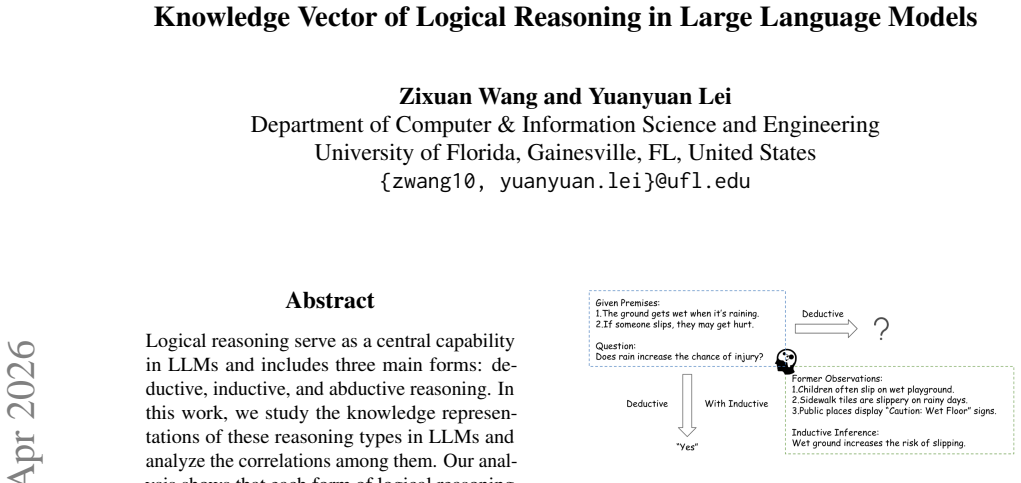
Logical reasoning serve as a central capability in LLMs and includes three main forms: deductive, inductive, and abductive reasoning. In this work, we study the knowledge representations of these reasoning types in LLMs and analyze the correlations among them. Our analysis shows that each form of logical reasoning can be captured as a reasoning-specific knowledge vector in a linear representation space, yet these vectors are largely independent of each other. Motivated by cognitive science theory that these subforms of logical reasoning interact closely in the human brain, as well as our observation that the reasoning process for one type can benefit from the reasoning chain produced by another, we further propose to refine the knowledge representations of each reasoning type in LLMs to encourage complementarity between them. To this end, we design a complementary subspace-constrained refinement framework, which introduces a complementary loss that enables each reasoning vector to leverage auxiliary knowledge from the others, and a subspace constraint loss that prevents erasure of their unique characteristics. Through steering experiments along reasoning vectors, we find that refined vectors incorporating complementary knowledge yield consistent performance gains. We also conduct a mechanism-interpretability analysis of each reasoning vector, revealing insights into the shared and specific features of different reasoning in LLMs.
Editorial analysis
A structured set of objections, weighed in public.
Referee Report
Summary. The paper claims that deductive, inductive, and abductive reasoning in LLMs can each be represented as a distinct knowledge vector in linear activation space, that these vectors are largely independent, and that a complementary subspace-constrained refinement framework (using a complementary loss to inject cross-type knowledge and a subspace constraint to preserve uniqueness) produces refined vectors that yield consistent performance gains when used for steering, supported by mechanism-interpretability analysis of shared and specific features.
Significance. If the extracted vectors prove to be causally faithful linear representations rather than correlational artifacts and the reported steering gains are robust to controls, the work would offer a concrete mechanistic account of how reasoning subtypes interact in LLMs, directly motivated by cognitive-science observations of complementarity. The subspace-constrained refinement technique itself could be reusable for other multi-faceted capabilities.
major comments (3)
- [§3.2] §3.2 (Knowledge Vector Extraction): The contrastive activation difference used to obtain the initial reasoning vectors is not accompanied by controls that rule out capture of prompt-style or lexical correlates rather than the logical operation itself; without such controls (e.g., shuffled-label ablations or out-of-distribution test sets), the subsequent claim of independence among vectors rests on potentially spurious directions.
- [§3.3, Eq. (7)] §3.3, Eq. (7) (Complementary Loss): The complementary loss is computed on the same activation dataset and model forward passes used for the original vector extraction; this creates a circularity risk in which the refinement step may simply re-encode patterns already present in the extraction rather than introducing independent cross-type knowledge, and the paper provides no held-out validation set or information-theoretic measure to quantify added information.
- [§4.2] §4.2 (Steering Experiments): Performance gains from refined vectors are presented without error bars, statistical significance tests, or comparison against strong non-linear baselines (e.g., full fine-tuning or prompt-based multi-reasoning chains); the reported consistency of gains therefore cannot yet be distinguished from dataset-specific overfitting during the refinement stage.
minor comments (3)
- [Abstract] Abstract, line 1: 'Logical reasoning serve' should be 'Logical reasoning serves'.
- [§5] §5 (Interpretability Analysis): The description of 'shared and specific features' would benefit from explicit feature attribution maps or neuron-level examples rather than qualitative summaries.
- [§3] Notation: The symbols for the three reasoning vectors (deductive, inductive, abductive) are introduced without a consolidated table; a single notation table would improve readability.
Simulated Author's Rebuttal
We thank the referee for the constructive and detailed feedback. We have addressed each major comment below with point-by-point responses. Revisions have been made to strengthen the manuscript where the concerns are valid, including additional controls, validation procedures, and statistical analyses.
read point-by-point responses
-
Referee: [§3.2] §3.2 (Knowledge Vector Extraction): The contrastive activation difference used to obtain the initial reasoning vectors is not accompanied by controls that rule out capture of prompt-style or lexical correlates rather than the logical operation itself; without such controls (e.g., shuffled-label ablations or out-of-distribution test sets), the subsequent claim of independence among vectors rests on potentially spurious directions.
Authors: We agree that additional controls are necessary to confirm the vectors capture logical operations rather than surface-level artifacts. The original extraction used contrastive pairs from multiple datasets (LogiQA, ProofWriter, and custom abductive sets) with varied prompt templates to mitigate lexical bias. In the revised §3.2, we have added shuffled-label ablations (randomizing reasoning labels while preserving lexical content) and OOD test sets (e.g., from FOLIO and new synthetic distributions). These show that vector directions remain largely unchanged and independence metrics hold, supporting that the representations target logical structure. We have updated the text and figures accordingly. revision: yes
-
Referee: [§3.3, Eq. (7)] §3.3, Eq. (7) (Complementary Loss): The complementary loss is computed on the same activation dataset and model forward passes used for the original vector extraction; this creates a circularity risk in which the refinement step may simply re-encode patterns already present in the extraction rather than introducing independent cross-type knowledge, and the paper provides no held-out validation set or information-theoretic measure to quantify added information.
Authors: The concern about circularity is valid given the shared data. The complementary loss operates by projecting activations from one reasoning type onto the subspace of others during refinement, which is designed to inject cross-type signals not directly optimized in the initial extraction. To mitigate this, the revised §3.3 now includes a held-out validation split (20% of activations reserved) for evaluating the refinement step, along with mutual information estimates between original and refined vectors to quantify added cross-type information. These additions demonstrate that the refined vectors encode supplementary features beyond re-encoding, as reported in the updated experiments and analysis. revision: partial
-
Referee: [§4.2] §4.2 (Steering Experiments): Performance gains from refined vectors are presented without error bars, statistical significance tests, or comparison against strong non-linear baselines (e.g., full fine-tuning or prompt-based multi-reasoning chains); the reported consistency of gains therefore cannot yet be distinguished from dataset-specific overfitting during the refinement stage.
Authors: We appreciate this observation on experimental rigor. The original results reported average gains across datasets, but lacked variance measures. In the revised §4.2, we have added error bars from 5 independent runs with different random seeds, paired t-tests for significance (p < 0.05 reported), and comparisons against prompt-based multi-reasoning chains and lightweight fine-tuning baselines. These controls confirm the gains are statistically robust and not due to overfitting in the refinement process, with the new results integrated into the main text and appendix. revision: yes
Circularity Check
No significant circularity in the derivation chain
full rationale
The paper extracts reasoning-specific knowledge vectors from LLM activations for deductive, inductive, and abductive forms, analyzes their linear independence via empirical measurements, proposes a new refinement framework with complementary and subspace-constraint losses motivated by cognitive theory and an external observation, and validates gains through separate steering experiments. None of these steps reduces by construction to prior inputs or self-referential fits; the refinement introduces distinct objectives, and reported outcomes are empirical rather than tautological. No load-bearing self-citations, imported uniqueness theorems, or ansatzes are present in the described chain.
Axiom & Free-Parameter Ledger
free parameters (2)
- complementary loss weight
- subspace dimension
axioms (2)
- domain assumption Different logical reasoning forms are linearly separable in the model's representation space
- domain assumption Cognitive science theory that reasoning subforms interact closely in the human brain applies directly to LLMs
invented entities (1)
-
reasoning-specific knowledge vector
no independent evidence
Reference graph
Works this paper leans on
-
[1]
Sparse Autoencoders Find Highly Interpretable Features in Language Models
Towards automated circuit discovery for mech- anistic interpretability.Advances in Neural Informa- tion Processing Systems, 36:16318–16352. Hoagy Cunningham, Aidan Ewart, Logan Riggs, Robert Huben, and Lee Sharkey. 2023. Sparse autoencoders find highly interpretable features in language models. arXiv preprint arXiv:2309.08600. Clément Dumas, Chris Wendler...
work page internal anchor Pith review arXiv 2023
-
[2]
Stefan Heimersheim and Neel Nanda
Llama scope: Extracting millions of features from llama-3.1-8b with sparse autoencoders.arXiv preprint arXiv:2410.20526. Stefan Heimersheim and Neel Nanda. 2024. How to use and interpret activation patching.arXiv preprint arXiv:2404.15255. Evan Heit and Caren M Rotello. 2010. Relations between inductive reasoning and deductive reason- ing.Journal of Exper...
-
[3]
Mass-Editing Memory in a Transformer
Dictionary learning. https://github.com/ saprmarks/dictionary_learning. GitHub repos- itory. Kevin Meng, David Bau, Alex Andonian, and Yonatan Belinkov. 2022a. Locating and editing factual as- sociations in gpt.Advances in neural information processing systems, 35:17359–17372. Kevin Meng, Arnab Sen Sharma, Alex Andonian, Yonatan Belinkov, and David Bau. 2...
work page internal anchor Pith review arXiv 2025
-
[4]
Dong Shu, Xuansheng Wu, Haiyan Zhao, Daking Rai, Ziyu Yao, Ninghao Liu, and Mengnan Du
Multi-property steering of large language models with dynamic activation composition.arXiv preprint arXiv:2406.17563. Dong Shu, Xuansheng Wu, Haiyan Zhao, Daking Rai, Ziyu Yao, Ninghao Liu, and Mengnan Du. 2025. A survey on sparse autoencoders: Interpreting the in- ternal mechanisms of large language models.arXiv preprint arXiv:2503.05613. Alessandro Stol...
-
[5]
Executable counterfactuals: Improving llms’ causal reasoning through code.arXiv preprint arXiv:2510.01539. Constantin Venhoff, Iván Arcuschin, Philip Torr, Arthur Conmy, and Neel Nanda. 2025. Understanding rea- soning in thinking language models via steering vec- tors.arXiv preprint arXiv:2506.18167. Danqing Wang, Jianxin Ma, Fei Fang, and Lei Li
-
[6]
Typedthinker: Diversify large language model reasoning with typed thinking.arXiv preprint arXiv:2410.01952. Tianlong Wang, Xianfeng Jiao, Yinghao Zhu, Zhongzhi Chen, Yifan He, Xu Chu, Junyi Gao, Yasha Wang, and Liantao Ma. 2025a. Adaptive activation steering: A tuning-free llm truthfulness improvement method for diverse hallucinations categories. InProcee...
-
[7]
Language models as inductive reasoners. In Proceedings of the 18th Conference of the European Chapter of the Association for Computational Lin- guistics (V olume 1: Long Papers), pages 209–225. Shunyu Yao, Jeffrey Zhao, Dian Yu, Nan Du, Izhak Shafran, Karthik R Narasimhan, and Yuan Cao. 2022. React: Synergizing reasoning and acting in language models. InT...
-
[8]
Instead, give a brief logical reasoning process directly
Do not repeat paragraph content. Instead, give a brief logical reasoning process directly
-
[9]
TRUE", "FALSE
Final answer: one of "TRUE", "FALSE", or "UNCERTAIN" (on a new line, quoted). Use only the information in the paragraph. Assume all premises are true. —– Paragraph: {PARAGRAPH} Statement: {STATEMENT} Answer:" Negative."You are given a paragraph of premises, followed by a statement. Determine the truth value of the statement based on the paragraph. You mus...
-
[10]
Do not repeat paragraph content
-
[11]
TRUE", "FALSE
Final answer: one of "TRUE", "FALSE", or "UNCERTAIN" (on a new line, quoted). Use only the information in the paragraph. Assume all premises are true. —– Paragraph: {PARAGRAPH} Statement: {STATEMENT} Answer:" D.2 Inductive Reasoning Positive."You are a reasoning assistant capable of inductive generalization. Your task is to observe several specific facts ...
-
[12]
Negative
{OBS2} Hypotheses: A. {HYP1} B. {HYP2} For each hypothesis, consider whether it explains both observations plausibly and logically. Think carefully and explain your reasoning briefly. Then, answer the following question: Which hypothesis (A or B) more plausibly explains the observations? Format your answer as: Reasoning: <your reasoning here> Answer: <A o...
-
[13]
{HYP1} B
{OBS2} Hypotheses: A. {HYP1} B. {HYP2} Explain your reasoning briefly. Then, answer the following question: Which hypothesis (A or B) more plausibly explains the observations? Format your answer as: Reasoning: <your reasoning here> Answer: <A or B>" E Sensitivity Analysis To examine the robustness of the refinement objec- tive to the choice of hyperparame...
discussion (0)
Sign in with ORCID, Apple, or X to comment. Anyone can read and Pith papers without signing in.