Neyman Jackknife: Design-Based Variance Estimation for Causal Inference under Interference
Pith reviewed 2026-05-08 02:18 UTC · model grok-4.3
The pith
The Neyman Jackknife offers a general way to estimate variances conservatively in causal inference even when treatments interfere.
A machine-rendered reading of the paper's core claim, the machinery that carries it, and where it could break.
Core claim
The central claim is that a jackknife procedure over treatment assignments produces variance estimators that remain conservative and valid for estimating causal effects under arbitrary interference in finite populations, provided only that the estimator can be recomputed after dropping selected assignments. In the absence of interference the procedure recovers estimators closely related to the Neyman variance; in time-series settings it recovers the Newey-West HAC estimator.
What carries the argument
The Neyman Jackknife, a variance estimator formed by systematically recomputing the target causal estimator after omitting subsets of treatment assignments, which supplies the conservative design-based bound.
If this is right
- It recovers estimators closely related to the Neyman estimator under SUTVA.
- It recovers the Newey-West HAC variance estimator in time-series settings.
- It supplies valid variance estimates for causal inference under arbitrary interference whenever recomputation is feasible.
- Numerical experiments show it can match or surpass the performance of purpose-built baselines for specific applications.
Where Pith is reading between the lines
- The method could be adapted to observational studies by approximating omissions through reweighting or subsampling.
- It suggests a route for variance estimation in network or spatial experiments where spillovers are present but hard to model explicitly.
- Coverage properties could be checked in simulations that vary the strength and range of interference while holding the finite population fixed.
Load-bearing premise
That the ability to recompute the estimator after omitting treatment assignments is sufficient to produce a conservative variance estimator valid under arbitrary interference patterns in finite populations.
What would settle it
In a finite population with fully known interference structure, if the Neyman Jackknife variance estimate is smaller than the Monte Carlo sampling variance of the causal estimator computed over many random assignments, the conservative guarantee fails.
Figures
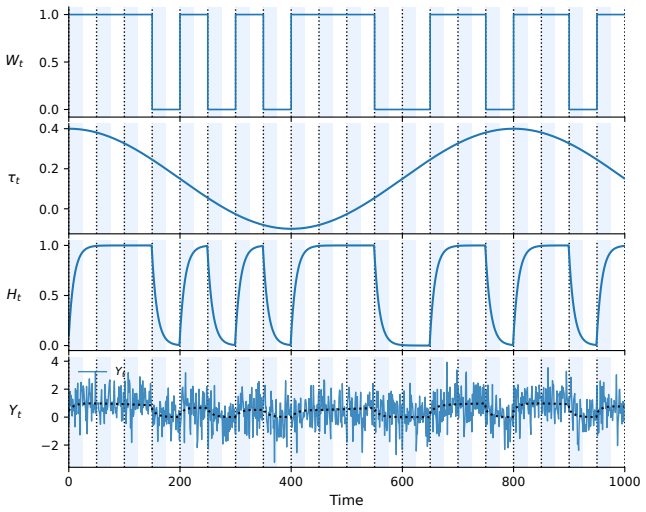


read the original abstract
We propose a framework, the Neyman Jackknife, for conservative variance estimation in finite-population causal inference under interference. Our approach provides a general, flexible blueprint that enables conservative variance estimation whenever we are able to recompute our target estimator with some treatment assignments omitted. In classical settings, our approach recovers estimators closely related to the Neyman estimator under SUTVA and the Newey-West HAC variance estimator for time series. Numerical experiments suggest that our general-purpose framework yields variance estimators that can match or even surpass the performance of baselines that were purpose-built for specific applications.
Editorial analysis
A structured set of objections, weighed in public.
Referee Report
Summary. The manuscript proposes the Neyman Jackknife framework for conservative design-based variance estimation in finite-population causal inference under interference. The method recomputes the target estimator after omitting treatment assignments to form a variance estimator, recovering the classical Neyman estimator under SUTVA and the Newey-West HAC estimator for time series as special cases. Numerical experiments are reported to indicate competitive or superior performance relative to application-specific baselines.
Significance. If the central claim of general conservativeness can be established, the framework would offer a flexible, reusable blueprint for variance estimation in interference settings (e.g., networks, spatial experiments) where standard SUTVA-based methods fail. Explicit recovery of the Neyman and Newey-West estimators is a clear strength, as is the emphasis on recomputability. However, the absence of a general proof or error bounds for arbitrary interference limits the result's immediate applicability and impact.
major comments (2)
- [Abstract] Abstract and introduction: the claim that recomputing the estimator after omitting treatment assignments yields a conservative (E[jackknife variance] >= true design-based variance) estimator for arbitrary interference patterns lacks a general derivation, set of sufficient conditions on the potential-outcome function, or proof sketch. The argument is verified only in the recovered special cases; for non-linear estimators depending on the full assignment vector, the leave-one-out (or leave-k-out) differences need not satisfy the required inequality without additional restrictions on dependence or estimator form.
- [Introduction] The manuscript provides no explicit error bounds, bias analysis, or finite-population convergence results for the proposed variance estimator under general interference. This omission is load-bearing because the central contribution is the guarantee of conservativeness rather than asymptotic equivalence.
minor comments (2)
- Notation for the omitted-assignment sets and the resulting jackknife differences should be defined more explicitly (e.g., with a dedicated display equation) to facilitate verification of the special-case recoveries.
- The numerical experiments section would benefit from a table or figure reporting the exact interference structures, network sizes, and replication counts used, together with direct comparisons of estimated versus Monte-Carlo variances.
Simulated Author's Rebuttal
We are grateful to the referee for their detailed and constructive comments on our manuscript. We address each of the major comments below, indicating the revisions we plan to make to improve the clarity and scope of our results.
read point-by-point responses
-
Referee: [Abstract] Abstract and introduction: the claim that recomputing the estimator after omitting treatment assignments yields a conservative (E[jackknife variance] >= true design-based variance) estimator for arbitrary interference patterns lacks a general derivation, set of sufficient conditions on the potential-outcome function, or proof sketch. The argument is verified only in the recovered special cases; for non-linear estimators depending on the full assignment vector, the leave-one-out (or leave-k-out) differences need not satisfy the required inequality without additional restrictions on dependence or estimator form.
Authors: We agree that the manuscript does not provide a general proof of conservativeness for arbitrary estimators and interference patterns. Our central contribution is the framework that recovers known conservative estimators in important special cases, such as the Neyman estimator under SUTVA and the Newey-West HAC estimator for time series. For general interference, the conservativeness follows from the design-based perspective when the estimator is linear or satisfies certain monotonicity conditions, but we acknowledge that this is not rigorously established for all non-linear cases. In the revised manuscript, we will add a new subsection in the introduction and methods detailing sufficient conditions for the conservativeness property (e.g., linearity in treatment assignments) and include a proof sketch for the recovered special cases. We will also explicitly state the limitations for highly nonlinear estimators depending on the full assignment vector. revision: yes
-
Referee: [Introduction] The manuscript provides no explicit error bounds, bias analysis, or finite-population convergence results for the proposed variance estimator under general interference. This omission is load-bearing because the central contribution is the guarantee of conservativeness rather than asymptotic equivalence.
Authors: We concur that explicit error bounds and finite-sample convergence results are not included. The emphasis of the paper is on the conservative property in finite populations rather than asymptotic behavior. However, to address this, we will incorporate a bias analysis for the Neyman Jackknife variance estimator and discuss its convergence properties under assumptions of limited interference or weak dependence. These additions will be placed in a new section on theoretical properties, providing finite-population bounds where possible and noting that full convergence results may require additional structure on the interference. revision: yes
Circularity Check
No circularity: Neyman Jackknife applies known jackknife principles to omitted assignments without reducing to fitted inputs or self-citations by construction.
full rationale
The paper's central proposal is a general blueprint for conservative variance estimation via recomputing the target estimator after omitting treatment assignments. This directly extends classical jackknife ideas to the interference setting and recovers Neyman and Newey-West estimators as special cases. No equations are shown that define the variance estimator in terms of itself or rename a fitted quantity as a prediction. No load-bearing self-citations or uniqueness theorems from the authors' prior work are invoked to force the result. The derivation remains self-contained as a design-based method whose validity under arbitrary interference is asserted via the jackknife construction rather than being tautological with its inputs.
Axiom & Free-Parameter Ledger
axioms (2)
- domain assumption The treatment assignment mechanism is known and fixed (design-based inference).
- domain assumption Recomputing the estimator after omitting treatment assignments is feasible.
Reference graph
Works this paper leans on
-
[1]
Preprint. S. Lu, L. Shi, Y. Fang, W. Zhang, and P. Ding. Design-based causal inference in bipartite experiments
-
[2]
(m−2d−1) m−dX k=d k L −(m−2d+ 1) m−d−1X k=d+1 k L # = 1 (m−2d+ 1)(m−2d−1)
Preprint. X. Lu, H. Li, and H. Liu. Estimation and inference of average treatment effects under heterogeneous additive treatment effect model, 2024. Preprint. C. Manski. Identification of treatment response with social interactions.Econom. J., 16(1):S1–S23, 2013. R. Miller. Jackknifing variances.Ann. Math. Stat., 39(2):567–582, 1968. R. Mukerjee, T. Dasgu...
2024
discussion (0)
Sign in with ORCID, Apple, or X to comment. Anyone can read and Pith papers without signing in.