Continuum-marginal optimal transport: a mesh-free kernel method
Pith reviewed 2026-05-08 02:39 UTC · model grok-4.3
The pith
A reproducing kernel Hilbert space embedding of the weak continuity equation yields a sample-only objective for recovering minimum-energy velocity fields that match a continuum of probability marginals.
A machine-rendered reading of the paper's core claim, the machinery that carries it, and where it could break.
Core claim
Embedding the weak continuity equation into a reproducing kernel Hilbert space produces a sample-based objective function whose minimizer recovers the true minimum-energy velocity field that transports the given family of marginal distributions. The velocity can be parametrized by any linear-in-parameters dictionary or neural network and is optimized by mini-batch stochastic gradient methods, with no spatial discretization required. The identical framework also handles the stochastic Nelson problem, and experiments confirm accurate drift recovery together with marginal consistency on synthetic data.
What carries the argument
The reproducing kernel Hilbert space embedding of the weak continuity equation, which converts the PDE constraint into a sample-only loss that requires no spatial discretization.
If this is right
- Recovery of velocity fields becomes possible from finite samples of the marginal distributions alone.
- The same solver applies without change to the stochastic Nelson problem.
- No spatial mesh or grid discretization is needed at any stage.
- Velocity parametrization remains flexible, accepting both linear dictionaries and neural networks.
- Mini-batch stochastic optimization enables scaling to larger sample sizes.
Where Pith is reading between the lines
- The approach could support inference of underlying dynamics when only snapshot distributions are observed in applications such as particle flows or population movement.
- Kernel choice might be varied to incorporate prior structure or to quantify uncertainty in the recovered velocity.
- Direct numerical comparisons against grid-based solvers on the same problems would measure gains in accuracy and cost for the mesh-free formulation.
- The framework may combine with other kernel-based machine learning tools for regularization in high-dimensional or noisy settings.
Load-bearing premise
That embedding the weak continuity equation in a reproducing kernel Hilbert space produces an objective whose minimizer recovers the true velocity field from finite samples without additional regularization or post-hoc corrections.
What would settle it
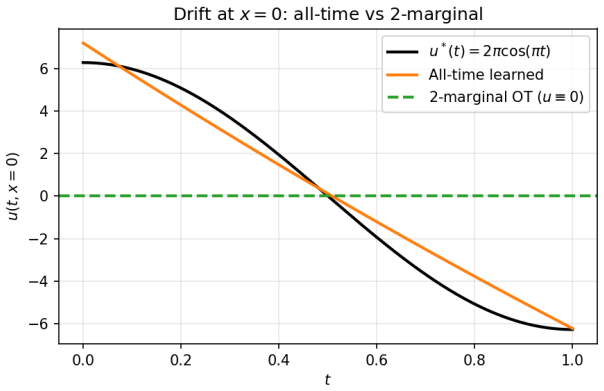
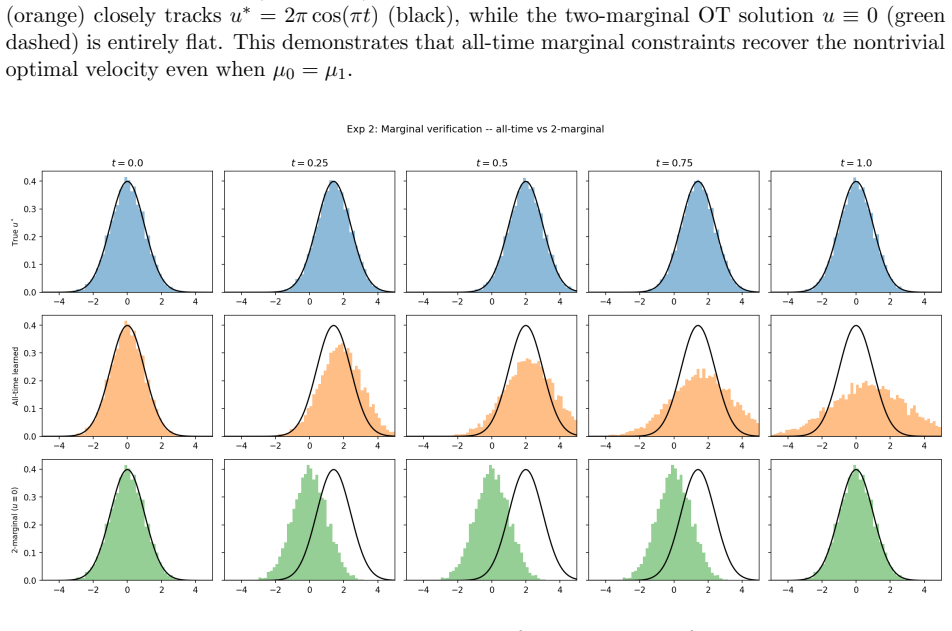
Generate synthetic data from a known simple velocity field such as constant drift on Gaussians, run the method on the resulting marginal samples, and verify whether the optimized velocity matches the known field while exactly reproducing the marginals at later times; systematic mismatch would disprove recovery.
Figures




read the original abstract
In this paper we study continuum-marginal optimal transport. Given a time-continuous family of probability marginals, the problem is to recover the minimum-energy velocity field whose flow reproduces every marginal. This problem is the continuum limit of the classical two-marginal Benamou--Brenier formulation, and also the deterministic limit of the Nelson problem of stochastic optimal transport. We propose a practical mesh-free solver for this problem. The weak continuity equation is embedded in a reproducing kernel Hilbert space, yielding a sample-only objective that requires no spatial discretization. The velocity is parametrized by any linear-in-parameters dictionary or neural network, and is optimized by mini-batch stochastic methods. Synthetic experiments confirm that the method achieves accurate drift recovery and marginal consistency. The same computational framework also applies to the stochastic Nelson problem.
Editorial analysis
A structured set of objections, weighed in public.
Referee Report
Summary. The paper proposes a mesh-free kernel method for continuum-marginal optimal transport: given a time-continuous family of probability marginals, recover the minimum-energy velocity field whose flow reproduces every marginal. This is framed as the continuum limit of the Benamou-Brenier problem and the deterministic limit of the Nelson stochastic OT problem. The approach embeds the weak continuity equation into an RKHS to obtain a sample-only objective with no spatial discretization; the velocity is parametrized by a linear dictionary or neural network and optimized via mini-batch stochastic methods. The same framework is said to apply to the stochastic Nelson problem. Synthetic experiments are asserted to confirm accurate drift recovery and marginal consistency.
Significance. If the RKHS embedding of the weak continuity equation indeed produces a population objective uniquely minimized at the Benamou-Brenier velocity and if finite-sample minimizers converge to it, the method would provide a practical, discretization-free solver for high-dimensional or continuous-time OT problems. The grounding in standard RKHS and continuity-equation theory, together with the flexibility to use neural-network parametrizations and stochastic optimization, are strengths. However, the significance is limited by the absence of any proof of uniqueness or consistency rates, leaving the central recovery claim dependent on unverified assumptions about kernel injectivity and marginal support.
major comments (2)
- [Section 3] The derivation of the sample objective (Section 3) asserts that embedding the weak continuity equation in an RKHS yields an objective whose minimizer recovers the true velocity field from finite samples. No analysis is supplied showing that the population RKHS objective is uniquely minimized at the Benamou-Brenier velocity, nor are conditions given on the kernel bandwidth or the supports of the time-dependent marginals that would guarantee injectivity of the embedding operator. Without such results, spurious velocities satisfying the embedded equation on observed samples but not the true continuity equation remain possible.
- [Section 5] The synthetic experiments (Section 5) are described only as confirming 'accurate drift recovery and marginal consistency.' No quantitative metrics (e.g., L2 velocity error, Wasserstein distance to true marginals), baselines, ablation studies on kernel choice or sample size, or statistical variability across runs are reported. Because the central claim rests on empirical validation of recovery, the lack of these details prevents assessment of whether the method outperforms existing discretizations or is robust to the very non-injectivity issues raised above.
minor comments (2)
- [Abstract] The abstract states that the method 'requires no spatial discretization,' yet the RKHS kernel itself implicitly discretizes the test functions; a brief remark clarifying the distinction would avoid confusion.
- Notation for the time-dependent marginals and the velocity parametrization is introduced without an explicit table of symbols; adding one would improve readability for readers outside the immediate subfield.
Simulated Author's Rebuttal
We thank the referee for the constructive feedback, which highlights important aspects of the theoretical grounding and empirical validation. We address each major comment below and outline the revisions we will make to strengthen the manuscript.
read point-by-point responses
-
Referee: [Section 3] The derivation of the sample objective asserts that embedding the weak continuity equation in an RKHS yields an objective whose minimizer recovers the true velocity field from finite samples. No analysis is supplied showing that the population RKHS objective is uniquely minimized at the Benamou-Brenier velocity, nor are conditions given on the kernel bandwidth or the supports of the time-dependent marginals that would guarantee injectivity of the embedding operator.
Authors: We agree that an explicit analysis of uniqueness for the population objective and conditions ensuring injectivity would strengthen the presentation. The derivation in Section 3 relies on the fact that the RKHS embedding of the weak continuity equation is injective for universal kernels when the marginals are absolutely continuous with respect to Lebesgue measure on a compact domain; this follows from standard results on RKHS embeddings of measures. However, we did not state the precise bandwidth and support conditions or discuss potential non-uniqueness in finite samples. We will revise Section 3 to include a short paragraph clarifying these assumptions, referencing the relevant RKHS injectivity theorems, and noting that the sample objective converges to the population objective under standard concentration arguments. A full proof of consistency rates is left for future work, as the current contribution focuses on the mesh-free formulation and practical optimization. revision: partial
-
Referee: [Section 5] The synthetic experiments are described only as confirming 'accurate drift recovery and marginal consistency.' No quantitative metrics (e.g., L2 velocity error, Wasserstein distance to true marginals), baselines, ablation studies on kernel choice or sample size, or statistical variability across runs are reported.
Authors: We acknowledge that the experimental results in Section 5 are presented qualitatively and lack the quantitative details needed for rigorous assessment. We will revise this section to report L2 velocity errors, Wasserstein distances between recovered and true marginals, and comparisons against a simple Eulerian discretization baseline. We will also include ablation studies varying kernel bandwidth and sample size, along with mean and standard deviation of errors over 10 independent runs. These additions will directly address concerns about robustness to non-injectivity and allow readers to evaluate performance relative to existing methods. revision: yes
Circularity Check
No circularity: derivation grounded in standard RKHS embedding of weak continuity equation
full rationale
The paper derives a mesh-free objective by embedding the weak form of the continuity equation into an RKHS and minimizing over a parametric velocity class via stochastic optimization. This construction follows directly from classical weak-form theory and reproducing-kernel properties without reducing any claimed result to a fitted parameter or self-citation by definition. The population objective is not asserted to be minimized uniquely at the true velocity solely by the embedding; recovery is instead validated empirically on synthetic data. No load-bearing step equates a prediction to its own inputs, and the method remains self-contained against external benchmarks from optimal transport and kernel methods.
Axiom & Free-Parameter Ledger
axioms (1)
- domain assumption The weak continuity equation holds between the velocity field and the given family of marginals.
Reference graph
Works this paper leans on
-
[1]
M. S. Albergo, N. M. Boffi, M. Lindsey, and E. Vanden-Eijnden. Multimarginal generative mod- eling with stochastic interpolants. InInternational Conference on Learning Representations, 2024. 38
work page 2024
-
[2]
M. S. Albergo and E. Vanden-Eijnden. Building normalizing flows with stochastic interpolants. InInternational Conference on Learning Representations, 2023
work page 2023
-
[3]
J.-D. Benamou and Y. Brenier. A computational fluid mechanics solution to the Monge– Kantorovich mass transfer problem.Numer. Math., 84:375–393, 2000
work page 2000
-
[4]
Sinkhorn distances: Lightspeed computation of optimal transport
Marco Cuturi. Sinkhorn distances: Lightspeed computation of optimal transport. InAdvances in Neural Information Processing Systems (NeurIPS), volume 26, 2013
work page 2013
-
[5]
V. De Bortoli, J. Thornton, J. Heng, and A. Doucet. Diffusion Schr¨ odinger bridge with ap- plications to score-based generative modeling. InAdvances in Neural Information Processing Systems, 2021
work page 2021
-
[6]
T. Hyt¨ onen, J. van Neerven, M. Veraar, and L. Weis.Analysis in Banach Spaces. Volume I: Martingales and Littlewood–Paley Theory, volume 63 ofErgebnisse der Mathematik und ihrer Grenzgebiete. Springer, 2016
work page 2016
- [7]
- [8]
-
[9]
R. J. McCann. A convexity principle for interacting gases.Advances in Mathematics, 128(1):153–179, 1997
work page 1997
-
[10]
T. Mikami. Variational processes from the weak forward equation.Communications in Math- ematical Physics, 135(1):19–40, 1990
work page 1990
-
[11]
T. Mikami. Dynamical systems in the variational formulation of the Fokker–Planck equation by the Wasserstein metric.Applied Mathematics and Optimization, 42:203–227, 2000
work page 2000
-
[12]
Mikami.Stochastic Optimal Transportation: Stochastic Control with Fixed Marginals
T. Mikami.Stochastic Optimal Transportation: Stochastic Control with Fixed Marginals. SpringerBriefs in Mathematics. Springer, Singapore, 2021
work page 2021
-
[13]
Moon, David van Dijk, Zheng Wang, Scott Gigante, Daniel B
Kevin R. Moon, David van Dijk, Zheng Wang, Scott Gigante, Daniel B. Burkhardt, William S. Chen, Kristina Yim, Antonia van den Elzen, Matthew J. Hirn, Ronald R. Coifman, Natalia B. Ivanova, Guy Wolf, and Smita Krishnaswamy. Visualizing structure and transitions in high- dimensional biological data.Nature Biotechnology, 37(12):1482–1492, 2019
work page 2019
- [14]
-
[15]
Y. Nakano and T. Saito. A deep learning approach to multi-marginal optimal transport via Hilbert space embeddings of probability measures.Statistics and Computing, 36(3):118, 2026
work page 2026
-
[16]
E. Nelson.Quantum Fluctuations. Princeton University Press, 1985. 39
work page 1985
-
[17]
N. Papadakis, G. Peyr´ e, and E. Oudet. Optimal transport with proximal splitting.SIAM Journal on Imaging Sciences, 7(1):212–238, 2014
work page 2014
-
[18]
G. Schiebinger, J. Shu, M. Tabaka, B. Cleary, V. Subramanian, A. Solomon, J. Gould, S. Liu, S. Lin, P. Berube, L. Lee, J. Chen, J. Brumbaugh, P. Hochedlinger, J. Jaenisch, A. Regev, and E. S. Lander. Optimal-transport analysis of single-cell gene expression identifies developmental trajectories in reprogramming.Cell, 176(4):928–943, 2019
work page 2019
-
[19]
B. Sch¨ olkopf and A. J. Smola.Learning with Kernels: Support Vector Machines, Regularization, Optimization, and Beyond. MIT Press, 2002
work page 2002
-
[20]
Y. Song, J. Sohl-Dickstein, D. P. Kingma, A. Kumar, S. Ermon, and B. Poole. Score-based generative modeling through stochastic differential equations. InInternational Conference on Learning Representations, 2021
work page 2021
-
[21]
B. K. Sriperumbudur, A. Gretton, K. Fukumizu, B. Sch¨ olkopf, and G. R. G. Lanckriet. Hilbert space embeddings and metrics on probability measures.Journal of Machine Learning Research, 11:1517–1561, 2010
work page 2010
-
[22]
A. Tong, N. Malkin, G. Huguet, Y. Zhang, J. Rector-Brooks, K. Fatras, G. Wolf, and Y. Bengio. Improving and generalizing flow matching with minibatch optimal transport.Transactions on Machine Learning Research, 2024
work page 2024
-
[23]
Wendland.Scattered Data Approximation
H. Wendland.Scattered Data Approximation. Cambridge Monographs on Applied and Com- putational Mathematics. Cambridge University Press, 2005. 40
work page 2005
discussion (0)
Sign in with ORCID, Apple, or X to comment. Anyone can read and Pith papers without signing in.