From Spoofing to Trust: Emergency Alerts Spoofing Testbed and Cross-Cell Verification
Pith reviewed 2026-05-08 02:47 UTC · model grok-4.3
The pith
5G emergency alerts can be faked with modified open-source radio software, but phones can flag them by comparing broadcasts from neighboring cells.
A machine-rendered reading of the paper's core claim, the machinery that carries it, and where it could break.
Core claim
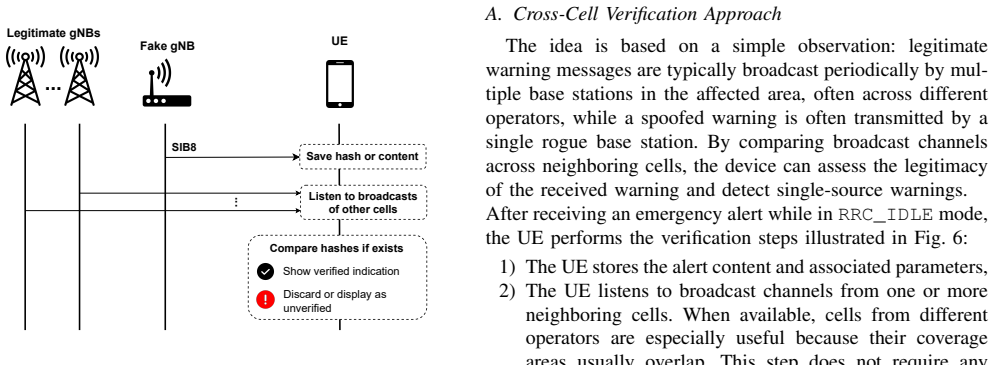
We present the first open-source 5G emergency alert spoofing attack, implemented by modifying the openairinterface RAN code and executed using a software-defined radio, complemented by a custom network management system to automate network and warning configuration. We conduct a detailed analysis of how different smartphones behave under various conditions, showing that devices readily display spoofed alerts and that the alerting mechanism enables multiple practical attack scenarios. Finally, to address this threat, we propose and implement a lightweight cross-cell verification mechanism in which the device compares the received warning with neighboring cell broadcasts to flag single-source
What carries the argument
The cross-cell verification mechanism, in which the receiving device compares an incoming emergency warning against broadcasts from neighboring cells and flags any alert that appears from only a single source.
If this is right
- Phones could adopt the verification to ignore alerts that do not match neighboring cells.
- Network operators would need to ensure consistent alert content across cells for the check to succeed.
- Attackers would require simultaneous control of multiple cells to evade detection.
- The open testbed enables further experiments on warning system behavior across device models.
Where Pith is reading between the lines
- The same comparison idea could apply to other cellular broadcast messages such as system information blocks.
- Widespread adoption would shift detection burden to the device without requiring core network upgrades.
- In areas with sparse cell coverage the mechanism might need fallback rules for when few neighbors are audible.
Load-bearing premise
That legitimate alerts will be broadcast identically from multiple neighboring cells at the same time, allowing a device to reliably spot a single fake source.
What would settle it
An experiment in which an attacker simultaneously spoofs the identical fake alert from two or more neighboring cells and checks whether the device-side comparison still marks it suspicious.
Figures


read the original abstract
Public warning systems (PWS) in cellular networks enable authorities to broadcast emergency alerts to all mobile phones in a geographic region in the event of threats such as earthquakes or severe weather. If an attacker can imitate these alerts and transmit a forged warning containing fake news or phishing links, the impact could range from public panic to user compromise. In this work, we present the first open-source 5G emergency alert spoofing attack, implemented by modifying the openairinterface (OAI) radio access network (RAN) code and executed using a software-defined radio, complemented by a custom network management system to automate network and warning configuration. We conduct a detailed analysis of how different smartphones behave under various conditions. Our findings show that while devices readily display spoofed alerts, the alerting mechanism enables multiple practical attack scenarios beyond simple warning display. Finally, to address this threat, we propose and implement a lightweight cross-cell verification mechanism in OAI, in which the device compares the received warning with neighboring cell broadcasts to flag single-source alerts as suspicious.
Editorial analysis
A structured set of objections, weighed in public.
Referee Report
Summary. The paper claims to present the first open-source 5G emergency alert spoofing attack implemented by modifying OpenAirInterface (OAI) RAN code and executed via software-defined radio, along with a custom network management system. It reports qualitative analysis of smartphone behavior under spoofed alerts and proposes/implements a lightweight cross-cell verification mechanism in OAI, where the device compares a received warning against neighboring cell broadcasts to flag single-source alerts as suspicious.
Significance. If the implementation is reproducible and the defense holds under realistic conditions, the work would be significant for demonstrating practical 5G PWS vulnerabilities and offering an open-source testbed plus device-side mitigation. The open-source attack implementation and OAI modifications are explicit strengths that support reproducibility and further research in cellular security.
major comments (2)
- Cross-cell verification mechanism: the proposal assumes legitimate alerts are identically broadcast by all neighboring cells and that an attacker cannot coordinate simultaneous spoofing across multiple cells. No analysis, evidence, or testbed results are provided to validate these assumptions in real 5G deployments where alert scheduling, cell configuration, or coverage boundaries may differ.
- Smartphone behavior analysis and findings: the abstract states that devices 'readily display spoofed alerts' and describes 'detailed analysis' under various conditions, but no quantitative results, error rates, tables, or specific metrics are referenced, undermining assessment of the attack's practical impact.
minor comments (1)
- Abstract: the description of the custom network management system for automating configuration lacks any implementation details or role in the experiments, which would improve clarity of the testbed setup.
Simulated Author's Rebuttal
We thank the referee for the thorough and constructive review of our manuscript. The comments highlight important areas for clarification and strengthening, particularly regarding the assumptions in our proposed defense and the presentation of our experimental findings. We address each major comment below and describe the revisions we will incorporate.
read point-by-point responses
-
Referee: Cross-cell verification mechanism: the proposal assumes legitimate alerts are identically broadcast by all neighboring cells and that an attacker cannot coordinate simultaneous spoofing across multiple cells. No analysis, evidence, or testbed results are provided to validate these assumptions in real 5G deployments where alert scheduling, cell configuration, or coverage boundaries may differ.
Authors: We appreciate this observation on the foundational assumptions of the cross-cell verification approach. The mechanism was implemented and evaluated in our OAI-based testbed under controlled conditions where uniform broadcast holds, and we observed effective detection of single-source spoofed alerts. We agree that real-world 5G deployments may exhibit variations in alert scheduling, cell configurations, and coverage boundaries. In the revised manuscript, we will add a dedicated subsection discussing these assumptions in detail, including potential limitations, scenarios where neighboring cells might legitimately differ, and the practical difficulties an attacker would face in coordinating multi-cell spoofing (such as requiring synchronized access to multiple base stations and knowledge of network topology). We will also include additional testbed results demonstrating the mechanism's operation. Comprehensive empirical validation across live commercial 5G networks remains outside the scope of this work, as it would require operator cooperation and infrastructure access not available in a research testbed setting. revision: partial
-
Referee: Smartphone behavior analysis and findings: the abstract states that devices 'readily display spoofed alerts' and describes 'detailed analysis' under various conditions, but no quantitative results, error rates, tables, or specific metrics are referenced, undermining assessment of the attack's practical impact.
Authors: The analysis in Section 4 is primarily qualitative, documenting observed smartphone responses across multiple device models, firmware versions, and attack parameters (e.g., alert content, timing, and network conditions), as the core outcome—whether an alert is displayed—is binary and device-specific rather than amenable to traditional error-rate metrics. To improve clarity and allow better assessment of practical impact, we will revise the manuscript to include a summary table listing the tested devices, conditions, and observed behaviors. This will provide a more structured presentation of the findings while preserving the qualitative insights into additional attack vectors beyond simple display. revision: yes
Circularity Check
No significant circularity; experimental implementation with no derivations or self-referential claims
full rationale
The paper presents an experimental testbed for 5G PWS spoofing via OAI modifications and proposes a cross-cell verification defense. No mathematical derivations, equations, fitted parameters, or predictions exist that could reduce to inputs by construction. The work relies on standard 5G RAN protocols and open-source code changes rather than any self-citation chains, uniqueness theorems, or ansatzes. The central claims are implementation results and a protocol-level proposal, which remain independent of the paper's own outputs.
Axiom & Free-Parameter Ledger
axioms (1)
- domain assumption Current 5G public warning system broadcasts lack source authentication, allowing spoofing from any transmitter in range.
Reference graph
Works this paper leans on
-
[1]
3GPP, “Digital cellular telecommunications system (phase 2+) (GSM); universal mobile telecommunications system (UMTS); LTE; 5G; pub- lic warning system (PWS) requirements,” 3rd Generation Partnership Project (3GPP), Tech. Rep. TS 22.268, 2025, release 18
work page 2025
-
[2]
You have been warned: Abusing 5G’s warning and emergency systems,
E. Bitsikas and C. P ¨opper, “You have been warned: Abusing 5G’s warning and emergency systems,” inProc. of the Annual Computer Security Applications Conference (ACSAC), Dec. 2022, p. 561–575
work page 2022
-
[3]
This is your president speaking: Spoofing alerts in 4G LTE networks,
G. Lee, J. Lee, J. Lee, Y . Im, M. Hollingsworth, E. Wustrow, D. Grun- wald, and S. Ha, “This is your president speaking: Spoofing alerts in 4G LTE networks,” inProc. of the Annual International Conference on Mobile Systems, Applications, and Services (MobiSys), 2019, p. 404–416
work page 2019
-
[4]
Openairinterface: Open-source software for 5G and LTE networks,
OpenAirInterface, “Openairinterface: Open-source software for 5G and LTE networks,” accessed: January 2026. [Online]. Available: https://openairinterface.org/
work page 2026
-
[5]
3GPP, “Digital cellular telecommunications system (phase 2+) (GSM); universal mobile telecommunications system (UMTS); LTE; 5G; tech- nical realization of cell broadcast service (CBS),” 3rd Generation Part- nership Project (3GPP), Tech. Rep. TS 23.041, 2025, release 18
work page 2025
-
[6]
5G; NR; radio resource control (RRC); protocol specification,
——, “5G; NR; radio resource control (RRC); protocol specification,” 3rd Generation Partnership Project (3GPP), Tech. Rep. TS 38.331, 2025, release 19
work page 2025
-
[7]
——, “Emergency communications (EMTEL); european public warning system (EU-ALERT) using the cell broadcast service,” 3rd Generation Partnership Project (3GPP), Tech. Rep. TS 02.900, 2023
work page 2023
-
[8]
5G; NR; user equipment (UE) procedures in idle mode and in RRC inactive state,
——, “5G; NR; user equipment (UE) procedures in idle mode and in RRC inactive state,” 3rd Generation Partnership Project (3GPP), Tech. Rep. TS 38.304, 2025, release 19
work page 2025
-
[9]
——, “Digital cellular telecommunications system (phase 2+) (GSM); universal mobile telecommunications system (UMTS); LTE; 5G; non- access-stratum (NAS) functions related to mobile station (MS) in idle mode,” 3rd Generation Partnership Project (3GPP), Tech. Rep. TS 23.122, 2025, release 18
work page 2025
-
[10]
Park,Why we cannot win: on fake base stations and their detection methods
S. Park,Why we cannot win: on fake base stations and their detection methods. Technische Universitaet Berlin (Germany), 2023
work page 2023
-
[11]
USRP B210 software defined radio
Ettus Research, “USRP B210 software defined radio.” [Online]. Available: https://www.ettus.com/all-products/ub210-kit/
-
[12]
Sysmocom, “Programmable SIM cards,” accessed: January 2026. [Online]. Available: https://www.sysmocom.de/products/sim/
work page 2026
-
[13]
When the base station flies: Rethinking security for UA V- based 6G networks,
A. El Falou, “When the base station flies: Rethinking security for UA V- based 6G networks,” inInt. Conf. on 6G Netw. (6GNet), 2025, pp. 87–91
work page 2025
-
[14]
3GPP, “Digital cellular telecommunications system (phase 2+) (GSM); universal mobile telecommunications system (UMTS); LTE; 5G; al- phabets and language-specific information,” 3rd Generation Partnership Project (3GPP), Tech. Rep. TS 23.038, 2025, release 19
work page 2025
-
[15]
OAI 5G SIB8 alert transmission,
A. Abouhasna, “OAI 5G SIB8 alert transmission,” 2025. [Online]. Available: https://github.com/5gattacks/5g-sib8-alert
work page 2025
discussion (0)
Sign in with ORCID, Apple, or X to comment. Anyone can read and Pith papers without signing in.