Densification Converses for Walker Constellations With Explicit Constants and Reuse Scaling Laws
Pith reviewed 2026-05-07 17:57 UTC · model grok-4.3
The pith
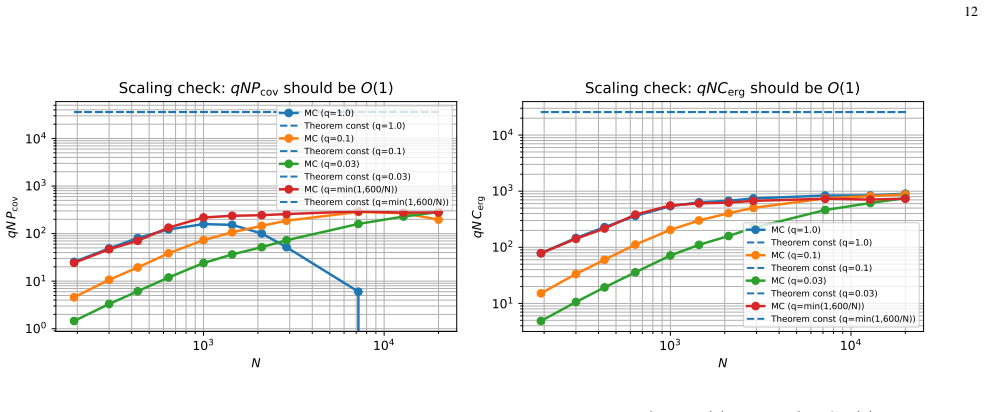
In Walker LEO constellations, densification under full frequency reuse makes downlink SINR coverage and ergodic spectral efficiency vanish as O(1/N) because interference grows linearly in N while the signal from the nearest visible satellite remains uniformly bounded.
A machine-rendered reading of the paper's core claim, the machinery that carries it, and where it could break.
Core claim
we prove that increasing the total satellite count N=N_oN_s forces the aggregate interference to grow at least linearly in N, while the useful signal remains uniformly bounded above. Consequently, the downlink SINR coverage probability at any fixed threshold and the ergodic spectral efficiency both vanish as N→∞.
Load-bearing premise
The performance is evaluated under the invariant (stationary) measure induced by the constellation/Earth dynamics, combined with the restriction of association to the bounded visible cap determined by Earth geometry and the specific two-level antenna-gain and power-law path-loss model.
Figures


read the original abstract
We establish densification converses for Walker LEO constellations under nearest-visible association in the full-frequency-reuse setting. Performance is evaluated under the invariant (stationary) measure induced by the constellation/Earth dynamics on the user--constellation ``phase state.'' A key Walker-specific feature, absent from unbounded planar models, is that association is restricted to a bounded visible cap determined by Earth geometry. Under power-law path-loss, a two-level antenna-gain model, i.i.d.\ nonnegative fading with unit mean and finite second moment, and nonzero noise, we prove that increasing the total satellite count $N=N_oN_s$ forces the aggregate interference to grow at least linearly in $N$, while the useful signal remains uniformly bounded above. Consequently, the downlink SINR coverage probability at any fixed threshold and the ergodic spectral efficiency both vanish as $N\to\infty$. The key technical ingredient is a deterministic visibility-annulus block lemma, uniform over all sufficiently large constellations and all "phase states", showing that a fixed fraction of visible satellites lies in a distance annulus strictly inside the horizon; this yields explicit finite-$N$ collapse bounds. In particular, we derive nonasymptotic $O(1/N)$ upper bounds on both coverage and ergodic spectral efficiency. Finally, in the case of frequency reuse through independent thinning, with activity probability $q$, we show that avoiding densification collapse necessarily requires $qN=O(1)$, equivalently a reuse factor $\Omega(N)$, and we obtain a corresponding explicit $O(1/(qN))$ upper bound.
Editorial analysis
A structured set of objections, weighed in public.
Axiom & Free-Parameter Ledger
axioms (2)
- domain assumption Existence of an invariant (stationary) measure induced by the constellation/Earth dynamics on the user-constellation phase state.
- domain assumption Power-law path-loss, two-level antenna-gain model, i.i.d. nonnegative fading with unit mean and finite second moment, nonzero noise, and nearest-visible association within the Earth-geometry visible cap.
Reference graph
Works this paper leans on
-
[1]
Stochastic geometry and dynamical system analysis of Walker satellite constellations,
C.-S. Choi and F. Baccelli, “Stochastic geometry and dynamical system analysis of Walker satellite constellations,” IEEE Trans. V eh. Technol. , vol. 75, no. 3, pp. 5127–5132, 2026
work page 2026
-
[2]
N. Okati, T. Riihonen, D. Korpi, I. Angervuori, and R. Wichman, “Downlink coverage and rate analysis of low Earth orbit satellite con- stellations using stochastic geometry,” IEEE Trans. Commun. , vol. 68, no. 8, pp. 5120–5134, 2020
work page 2020
-
[3]
Nearest neighbor and contact distance distribution for binomial point process on spherical surfaces,
A. Talgat, M. A. Kishk, and M.-S. Alouini, “Nearest neighbor and contact distance distribution for binomial point process on spherical surfaces,” IEEE Commun. Lett. , vol. 24, no. 12, pp. 2659–2663, 2020
work page 2020
-
[4]
Cox point processes for multi altitude LEO satellite networks,
C.-S. Choi and F. Baccelli, “Cox point processes for multi altitude LEO satellite networks,” IEEE Trans. V eh. Technol. , vol. 73, no. 10, pp. 15916–15921, 2024
work page 2024
-
[5]
A unified asymptotic analysis of area spectral efficiency in ultradense cellular networks,
A. AlAmmouri, J. G. Andrews, and F. Baccelli, “A unified asymptotic analysis of area spectral efficiency in ultradense cellular networks,” IEEE Trans. Inf. Theory , vol. 65, no. 2, pp. 1236–1248, 2019
work page 2019
-
[6]
Escaping the densification plateau in cellular networks through mmWave beam- forming,
A. AlAmmouri, M. Gupta, F. Baccelli, and J. G. Andrews, “Escaping the densification plateau in cellular networks through mmWave beam- forming,” IEEE Wireless Commun. Lett. , vol. 9, no. 11, pp. 1874–1878, 2020
work page 2020
discussion (0)
Sign in with ORCID, Apple, or X to comment. Anyone can read and Pith papers without signing in.