Demonstration of quantum random number generation using nitrogen vacancy centres
Pith reviewed 2026-05-08 03:49 UTC · model grok-4.3
The pith
Photon arrival times from NV centers in nanodiamonds generate random bits passing statistical tests at rates up to 4.77 Mbits/s without post-processing.
A machine-rendered reading of the paper's core claim, the machinery that carries it, and where it could break.
Core claim
The arrival times of photons emitted by NV centres in nanodiamonds serve as the entropy source for quantum random number generation, producing bit strings that pass the ENT and NIST statistical test suites without post-processing while achieving a min-entropy very close to one per bit at generation rates up to 4.77 Mbits/s.
What carries the argument
The quantum-mechanical timing statistics of photon emission from the NV centers, which supply the unpredictable intervals used to extract each random bit.
If this is right
- Random bits can be extracted directly from raw timing data without post-processing.
- Generation rate increases with the number of NV centers present in the observed region.
- The measured min-entropy remains near the ideal limit for both single-center and multi-center regions.
- The approach supports compact on-chip QRNG implementations.
Where Pith is reading between the lines
- Combining this timing source with nanodiamond-based quantum sensors could produce devices that both measure physical quantities and generate fresh cryptographic keys on the same chip.
- Eliminating post-processing reduces the hardware overhead needed to turn the raw timing signal into usable random numbers.
- Repeating the experiment under controlled temperature or magnetic-field variations would test whether environmental classical noise stays negligible.
- Arrays of nanodiamonds could be patterned to enable parallel, independent bit streams at still higher aggregate rates.
Load-bearing premise
Photon arrival times from the NV centers are governed solely by quantum mechanical processes with no significant classical noise, correlations, or detector artifacts that would reduce the true randomness below the reported min-entropy.
What would settle it
Detailed measurement of photon arrival intervals that reveals non-Poisson statistics or classical correlations would reduce the min-entropy and cause the generated bits to fail the NIST suite.
Figures
read the original abstract
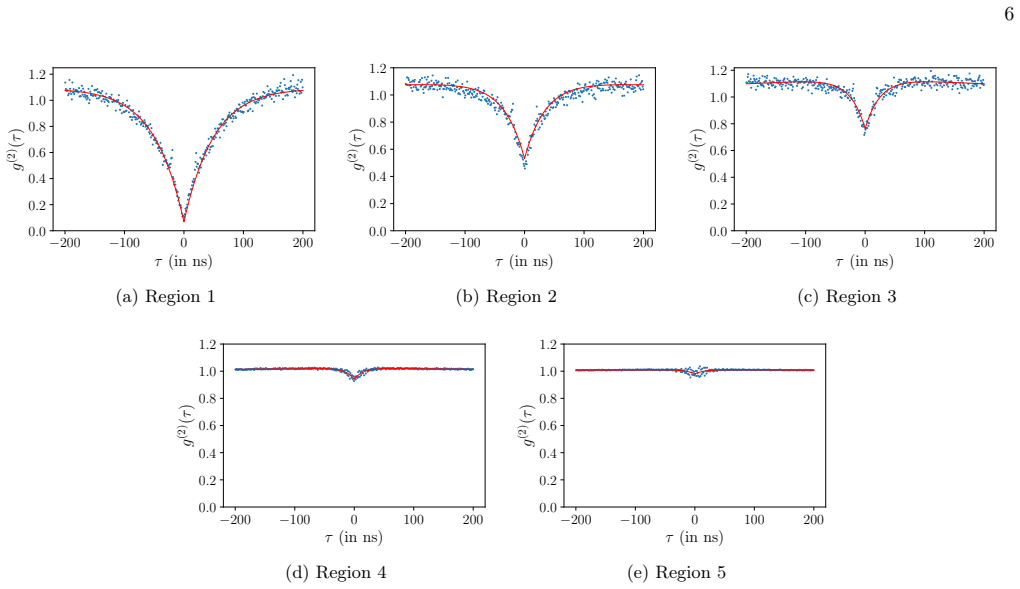
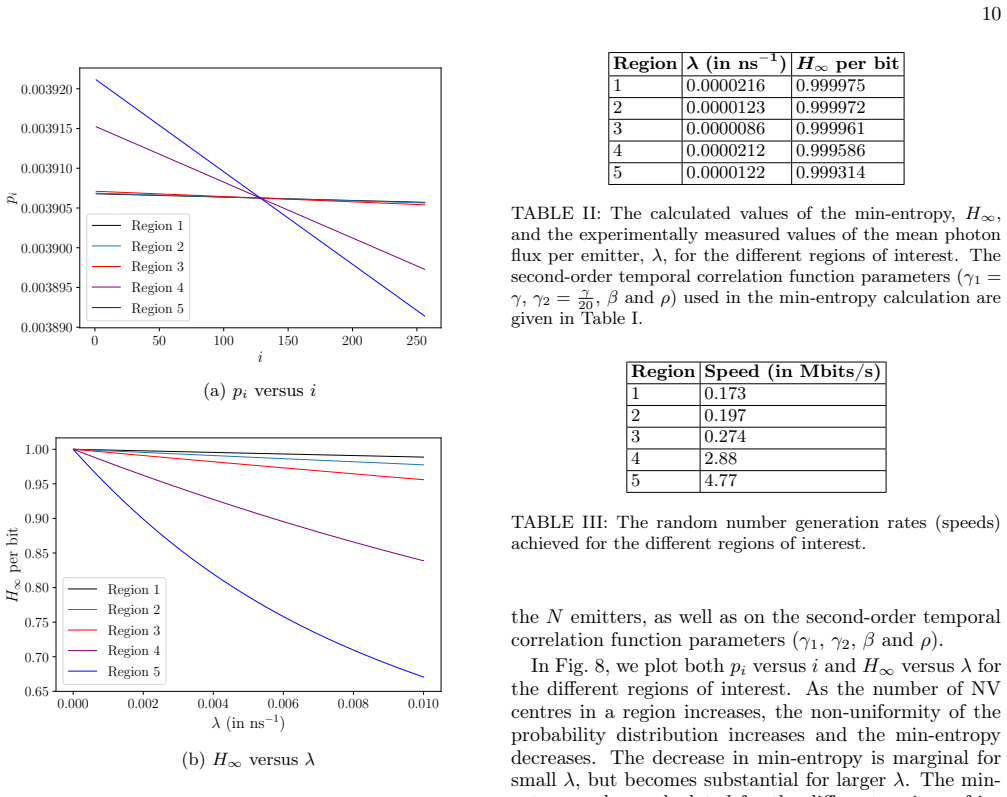
Quantum random number generation (QRNG) relies on the inherent unpredictability of quantum mechanical phenomena to efficiently generate high-quality random numbers that can be used in a wide range of cryptography and simulation applications. Here we report the experimental demonstration of QRNG from the arrival times of photons emitted by nitrogen vacancy (NV) centres in fluorescent nanodiamonds. The generation rates achieved range from 0.173 Mbits/s for a region with a single NV centre to 4.77 Mbits/s for a region with just under 50 NV centres, where the latter demonstrates an order of magnitude improvement compared to the highest generation rate previously achieved with NV centres. For all the regions investigated, the generated bits passed the ENT and NIST Statistical Test Suites without post-processing. The results are consistent with our theoretical analysis, where we show that the min-entropy is very close to the ideal value of one per bit for all the regions investigated. This work opens up new possibilities for robust QRNG in highly compact on-chip settings.
Editorial analysis
A structured set of objections, weighed in public.
Referee Report
Summary. The manuscript reports an experimental demonstration of quantum random number generation (QRNG) using photon arrival times from nitrogen-vacancy (NV) centers in fluorescent nanodiamonds. Achieved bit rates range from 0.173 Mbit/s (single NV) to 4.77 Mbit/s (~50 NV centers), with generated bits passing ENT and NIST statistical test suites without post-processing. The min-entropy is reported as very close to the ideal value of 1 bit per bit across investigated regions, consistent with a theoretical model of the emission process.
Significance. If the quantum origin of the randomness is rigorously validated, the work offers a compact, on-chip QRNG platform with rates an order of magnitude higher than prior NV demonstrations. The absence of post-processing and high min-entropy would be a practical strength for cryptography and simulation applications.
major comments (1)
- [Theoretical analysis / min-entropy estimation] The min-entropy analysis (theoretical section) assumes photon inter-arrival times arise solely from the quantum excited-state lifetime distribution (Poisson-like process) with negligible classical contributions. No quantitative error budget, upper bounds, or experimental characterization is provided for detector timing jitter, dead time, afterpulsing, or laser intensity fluctuations. This assumption is load-bearing for the central claims that min-entropy ≈ 1 bit/bit and no post-processing is required; if classical noise is present at even moderate levels, the true extractable randomness would be lower even if statistical tests pass.
minor comments (1)
- [Abstract and Results] The abstract and results section report rates and test-suite passage but do not specify the total number of bits tested, the exact NIST tests applied, or the raw data volume used for the min-entropy calculation.
Simulated Author's Rebuttal
We thank the referee for their detailed and constructive review of our manuscript. Their comment highlights an important aspect of rigorously validating the quantum origin of the randomness. We address the major comment point-by-point below and outline the revisions we will make.
read point-by-point responses
-
Referee: The min-entropy analysis (theoretical section) assumes photon inter-arrival times arise solely from the quantum excited-state lifetime distribution (Poisson-like process) with negligible classical contributions. No quantitative error budget, upper bounds, or experimental characterization is provided for detector timing jitter, dead time, afterpulsing, or laser intensity fluctuations. This assumption is load-bearing for the central claims that min-entropy ≈ 1 bit/bit and no post-processing is required; if classical noise is present at even moderate levels, the true extractable randomness would be lower even if statistical tests pass.
Authors: We agree that an explicit quantitative error budget would strengthen the manuscript and make the claims more robust. The theoretical model in the paper is based on the known radiative lifetime of the NV center (approximately 12 ns for the excited state), leading to an exponential inter-arrival time distribution whose min-entropy is calculated to be very close to 1 bit per bit. The experimental histograms of arrival times match this distribution closely across the investigated regions, and the generated bits pass all ENT and NIST tests without any post-processing. However, we acknowledge that manufacturer-specified timing jitter (typically <50 ps for the detectors used), dead time, afterpulsing probability, and laser intensity stability were not quantitatively propagated into the min-entropy bound in the original submission. In the revised manuscript we will add a dedicated subsection providing upper-bound estimates on the classical noise contribution using the detector specifications, measured count rates, and a simple model of how jitter and dead time would distort the inter-arrival distribution. We will also include a brief discussion of why these contributions remain small relative to the quantum lifetime broadening at the observed count rates (0.173–4.77 Mbit/s). This addition will not alter the central experimental results or the conclusion that post-processing is unnecessary, but it will directly address the load-bearing assumption raised by the referee. revision: yes
Circularity Check
No significant circularity in derivation chain
full rationale
The paper reports an experimental QRNG demonstration using measured photon arrival times from NV centers. Randomness is validated by passing independent external suites (ENT, NIST) with no post-processing, and min-entropy is computed from a first-principles quantum emission model (Poisson-like arrivals from excited-state lifetime). No equations reduce the reported min-entropy or test-passing results to fitted parameters renamed as predictions, self-citations that bear the uniqueness claim, or ansatzes smuggled via prior work. The theoretical analysis is consistent with data but not tautological; external benchmarks and statistical tests provide independent support.
Axiom & Free-Parameter Ledger
axioms (1)
- domain assumption Photon arrival times from NV centers in nanodiamonds are governed by quantum mechanics and exhibit sufficient unpredictability for QRNG.
Reference graph
Works this paper leans on
-
[1]
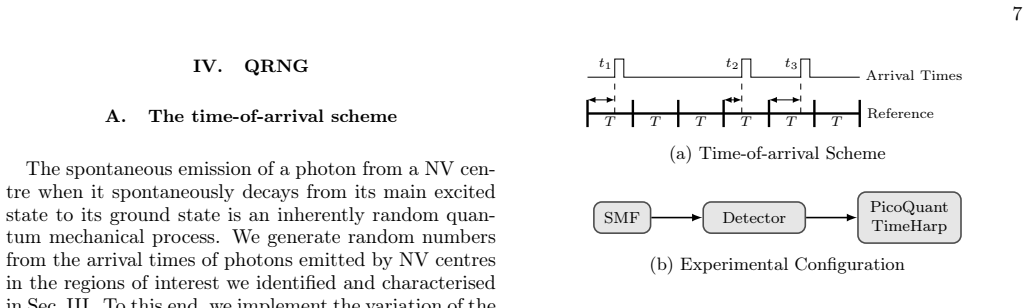
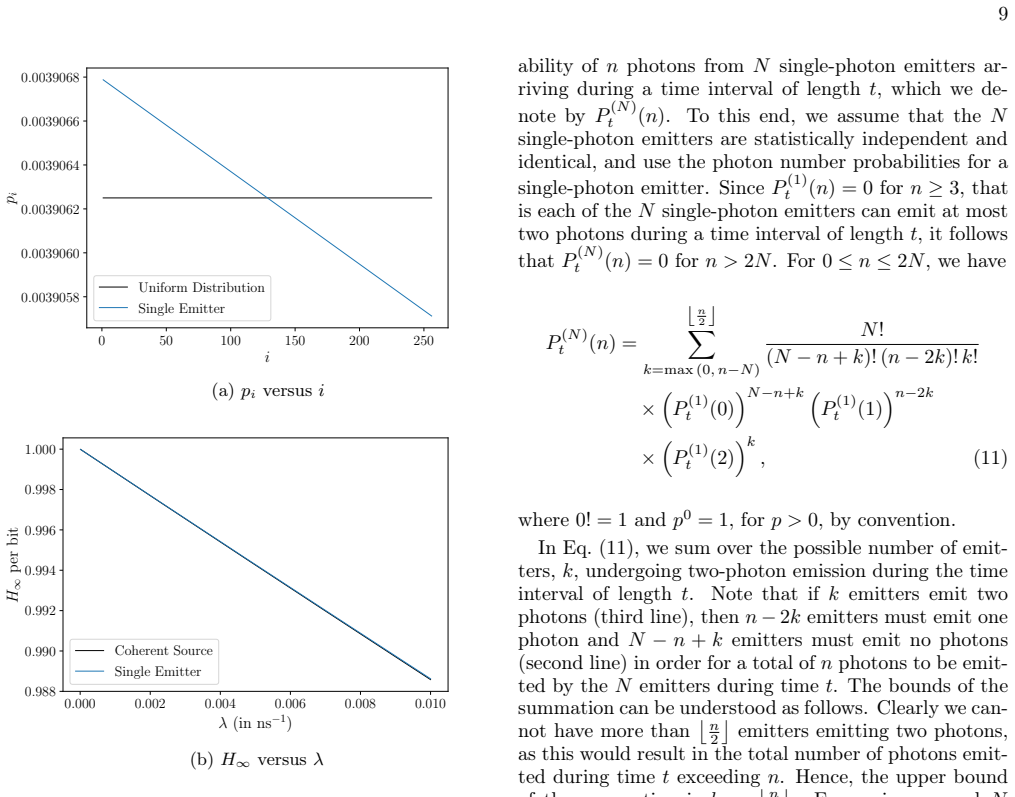
A single-photon emitter For any light source, we show in Appendix C that uni- form random numbers will be generated by an imple- mentation of the time-of-arrival scheme, provided that no multi-photon events can occur during a time interval of lengthT. However, even for an ideal single-photon 8 source (which never emits multiple photons simultane- ously) t...
-
[2]
Multiple single-photon emitters Our theory for a single-photon emitter can easily be generalised to the case where multiple single-photon emitters are present. We simply need to find the prob- ability ofnphotons fromNsingle-photon emitters ar- riving during a time interval of lengtht, which we de- note byP (N) t (n). To this end, we assume that theN singl...
-
[3]
Shannon, C. E. Communication theory of secrecy sys- tems.Bell Syst. Tech. J.28, 656–715 (1949)
work page 1949
- [4]
-
[5]
Lewis, T. G. & Payne, W. H. Generalized feedback shift register pseudorandom number algorithm.J. ACM20, 456–468 (1973)
work page 1973
- [6]
-
[7]
Matsumoto, M. & Nishimura, T. Mersenne twister: a 623-dimensionally equidistributed uniform pseudo- random number generator.ACM Trans. Model. Comput. Simul.8, 3–30 (1998)
work page 1998
-
[8]
Amigo, G., Dong, L. & Marks, R. J. Forecasting pseudo random numbers using deep learning in2021 15th Inter- national Conference on Signal Processing and Communi- cation Systems (ICSPCS)1–7 (IEEE, 2021)
work page 2021
-
[9]
Proskurin, D., Iavich, M., Okhrimenko, T., Chuk- wukaelonma, O. & Hryniuk, T. Predicting pseudo- random number generator output with sequential analy- sis inProceedings of the Cyber Security and Data Protec- tion42–57 (CEUR-WS.org, 2024)
work page 2024
-
[10]
Dogaru, I.&Dogaru, R.FPGAimplementationandeval- uation of two cryptographically secure hybrid cellular au- tomata in2014 10th International Conference on Com- munications (COMM)1–4 (IEEE, 2014)
work page 2014
-
[11]
Panda, A. K. & Ray, K. C. FPGA prototype of low la- tency BBS PRNG in2015 IEEE International Sympo- sium on Nanoelectronic and Information Systems118– 123 (IEEE, 2015)
work page 2015
-
[12]
Mongia, V., Kumar, A., Prabhakar, S. & Singh, R. P. Strengthening the no-go theorem for QRNGs. arXiv:2503.18026 (2025)
-
[13]
Ma, X., Yuan, X., Cao, Z., Qi, B. & Zhang, Z. Quantum random number generation.npj Quantum Inf.2, 16021 (2016)
work page 2016
-
[14]
Herrero-Collantes, M. & Garcia-Escartin, J. C. Quantum random number generators.Rev. Mod. Phys.89, 015004 (2017)
work page 2017
-
[15]
Mannalatha, V., Mishra, S. & Pathak, A. A comprehen- sive review of quantum random number generators: con- cepts, classification and the origin of randomness.Quan- tum Inf. Process.22, 439 (2023)
work page 2023
-
[16]
Isida, M. & Ikeda, H. Random number generator.Ann. Inst. Stat. Math.8, 119–126 (1956)
work page 1956
-
[17]
Vincent, C. H. The generation of truly random binary numbers.J. Phys. E: Sci. Instrum.3, 594–598 (1970)
work page 1970
-
[18]
Quantum-mechanical random-number gen- erator.J
Schmidt, H. Quantum-mechanical random-number gen- erator.J. Appl. Phys.41, 462–468 (1970)
work page 1970
-
[19]
Tamura, K. & Shikano, Y. Quantum random numbers generatedbyacloudsuperconductingquantumcomputer inInternational Symposium on Mathematics, Quantum Theory, and Cryptography17–37 (Springer, 2021)
work page 2021
- [20]
-
[21]
Li, Y., Fei, Y., Wang, W., Meng, X., Wang, H., Duan, Q. & Ma, Z. Quantum random number generator us- ing a cloud superconducting quantum computer based on source-independent protocol.Sci. Rep.11, 23873 (2021)
work page 2021
-
[22]
Liu, M.et al.Certified randomness using a trapped-ion quantum processor.Nature640, 343–348 (2025)
work page 2025
-
[23]
Stefanov, A., Gisin, N., Guinnard, O., Guinnard, L. & Zbinden, H. Optical quantum random number generator. J. Mod. Opt.47, 595–598 (2000)
work page 2000
-
[24]
Jennewein, T., Achleitner, U., Weihs, G., Weinfurter, H. & Zeilinger, A. A fast and compact quantum ran- dom number generator.Rev. Sci. Instrum.71, 1675–1680 (2000)
work page 2000
-
[25]
Francis, J. T., Zhang, X., Özdemir, Ş. K. & Tame, M. S. Quantum random number generation using an on- chip plasmonic beamsplitter.Quantum Sci. Technol.2, 035004 (2017)
work page 2017
- [26]
-
[27]
Ma, H. Q., Xie, Y. & Wu, L. A. Random number genera- tion based on the time of arrival of single photons.Appl. Opt.44, 7760–7763 (2005)
work page 2005
-
[28]
Dynes, J. F., Yuan, Z. L., Sharpe, A. W. & Shields, A. J. A high speed, postprocessing free, quantum random number generator.Appl. Phys. Lett.93, 031109 (2008)
work page 2008
-
[29]
Wayne, M. A., Jeffrey, E. R., Akselrod, G. M. & Kwiat, P. G. Photon arrival time quantum random number gen- eration.J. Mod. Opt.56, 516–522 (2009)
work page 2009
-
[30]
Wahl, M., Leifgen, M., Berlin, M., Röhlicke, T., Rahn, H. J. & Benson, O. An ultrafast quantum random number generator with provably bounded output bias based on photon arrival time measurements.Appl. Phys. Lett.98, 171105 (2011)
work page 2011
-
[31]
Nie, Y. Q., Zhang, H. F., Zhang, Z., Wang, J., Ma, X., Zhang, J. & Pan, J. W. Practical and fast quantum ran- dom number generation based on photon arrival time rel- ative to external reference.Appl. Phys. Lett.104, 051110 (2014)
work page 2014
- [32]
-
[33]
Khanmohammadi, A., Enne, R., Hofbauer, M. & Zim- mermanna, H. A monolithic silicon quantum random number generator based on measurement of photon de- tection time.IEEE Photon. J.7, 1–13 (2015)
work page 2015
-
[34]
Strydom, C., Soleymani, S., Özdemir, Ş. K. & Tame, M. S. Quantum random number generation using an on-chip nanowire plasmonic waveguide.New J. Phys.26, 043002 (2024)
work page 2024
-
[35]
Gabriel, C., Wittmann, C., Sych, D., Dong, R., Mauerer, W., Andersen, U. L., Marquardt, C. & Leuchs, G. A generator for unique quantum random numbers based on vacuum states.Nat. Photonics4, 711–715 (2010)
work page 2010
-
[36]
Shi, Y., Chng, B. & Kurtsiefer, C. Random numbers from vacuum fluctuations.Appl. Phys. Lett.109, 041101 (2016)
work page 2016
-
[37]
Raffaelli, F., Ferranti, G., Mahler, D. H., Sibson, P., Ken- nard, J. E., Santamato, A., Sinclair, G., Bonneau, D., Thompson, M. G. & Matthews, J. C. F. A homodyne detector integrated onto a photonic chip for measuring 14 quantum states and generating random numbers.Quan- tum Sci. Technol.3, 025003 (2018)
work page 2018
-
[38]
Bai, B., Huang, J., Qiao, G. R., Nie, Y. Q., Tang, W., Chu, T., Zhang, J. & Pan, J. W. 18.8 Gbps real-time quantum random number generator with a photonic in- tegrated chip.Appl. Phys. Lett.118, 264001 (2021)
work page 2021
-
[39]
Williams, C. R. S., Salevan, J. C., Li, X., Roy, R. & Murphy, T. E. Fast physical random number generator using amplified spontaneous emission.Opt. Express18, 23584–23597 (2010)
work page 2010
-
[40]
Xu, F., Qi, B., Ma, X., Xu, H., Zheng, H. & Lo, H. K. Ultrafast quantum random number generation based on quantum phase fluctuations.Opt. Express20, 12366– 12377 (2012)
work page 2012
-
[41]
Q., Huang, L., Liu, Y., Payne, F., Zhang, J
Nie, Y. Q., Huang, L., Liu, Y., Payne, F., Zhang, J. & Pan, J. W. The generation of 68 Gbps quantum random number by measuring laser phase fluctuations.Rev. Sci. Instrum.86, 063105 (2015)
work page 2015
-
[42]
Raffaelli, F., Sibson, P., Kennard, J. E., Mahler, D. H., Thompson, M. G. & Matthews, J. C. F. Generation of random numbers by measuring phase fluctuations from a laser diode with a silicon-on-insulator chip.Opt. Express 26, 19730–19741 (2018)
work page 2018
-
[43]
Z.et al.Device-independent randomness expan- sion against quantum side information.Nat
Liu, W. Z.et al.Device-independent randomness expan- sion against quantum side information.Nat. Phys.17, 448–451 (2021)
work page 2021
-
[44]
K.et al.Device-independent randomness ex- pansion with entangled photons.Nat
Shalm, L. K.et al.Device-independent randomness ex- pansion with entangled photons.Nat. Phys.17, 452–456 (2021)
work page 2021
-
[45]
H.et al.Experimental realization of device- independent quantum randomness expansion.Phys
Li, M. H.et al.Experimental realization of device- independent quantum randomness expansion.Phys. Rev. Lett.126, 050503 (2021)
work page 2021
-
[46]
Shafi, K. M., Chawla, P., Hegde, A. S., Gayatri, R. S., Padhye, A. & Chandrashekar, C. M. Multi-bit quan- tum random number generator from path-entangled sin- gle photons.EPJ Quantum Technol.10, 43 (2023)
work page 2023
- [47]
-
[48]
Doherty, M. W., Manson, N. B., Delaney, P., Jelezko, F., Wrachtrup, J. & Hollenberg, L. C. L. The nitrogen- vacancy colour centre in diamond.Phys. Rep.528, 1–45 (2013)
work page 2013
-
[49]
Berthel, M., Mollet, O., Dantelle, G., Gacoin, T., Huant, S. & Drezet, A. Photophysics of single nitrogen-vacancy centers in diamond nanocrystals.Phys. Rev. B91, 035308 (2015)
work page 2015
-
[50]
Beveratos, A., Brouri, R., Gacoin, T., Villing, A., Poizat, J. P. & Grangier, P. Single photon quantum cryptogra- phy.Phys. Rev. Lett.89, 187901 (2002)
work page 2002
-
[51]
F., Beveratos, A., Brouri-Tualle, R., Poizat, J
Alléaume, R., Treussart, F., Messin, G., Dumeige, Y., Roch, J. F., Beveratos, A., Brouri-Tualle, R., Poizat, J. P. & Grangier, P. Experimental open-air quantum key distribution with a single-photon source.New J. Phys. 6, 92 (2004)
work page 2004
-
[52]
Kolesov, R., Grotz, B., Balasubramanian, G., Stöhr, R. J., Nicolet, A. A. L., Hemmer, P. R., Jelezko, F. & Wrachtrup, J. Wave-particle duality of single surface plasmon polaritons.Nat. Phys.5, 470–474 (2009)
work page 2009
-
[53]
Huck, A., Kumar, S., Shakoor, A. & Andersen, U. L. Controlled coupling of a single nitrogen-vacancy center to a silver nanowire.Phys. Rev. Lett.106, 096801 (2011)
work page 2011
-
[54]
Smith, A. I., Steenkamp, C. M. & Tame, M. S. Verifica- tion of single-photon path entanglement using a nitrogen vacancy center.Appl. Opt.64, C41–C52 (2025)
work page 2025
-
[55]
Fuchs, G. D., Burkard, G., Klimov, P. V. & Awschalom, D. D. A quantum memory intrinsic to single nitro- gen–vacancy centres in diamond.Nat. Phys.7, 789–793 (2011)
work page 2011
-
[56]
E.et al.Robust quantum-network memory based on spin qubits in isotopically engineered diamond
Bradley, C. E.et al.Robust quantum-network memory based on spin qubits in isotopically engineered diamond. npj Quantum Inf.8, 122 (2022)
work page 2022
- [57]
-
[58]
Rondin, L., Tetienne, J. P., Hingant, T., Roch, J. F., Maletinsky, P. & Jacques, V. Magnetometry with nitrogen-vacancy defects in diamond.Rep. Prog. Phys. 77, 056503 (2014)
work page 2014
-
[59]
Casola, F., Van der Sar, T. & Yacoby, A. Probing condensed matter physics with magnetometry based on nitrogen-vacancy centres in diamond.Nat. Rev. Mater. 3, 17088 (2018)
work page 2018
-
[60]
Rovny, J., Gopalakrishnan, S., Jayich, A. C. B., Maletinsky, P., Demler, E. & De Leon, N. P. Nanoscale diamond quantum sensors for many-body physics.Nat. Rev. Phys.6, 753–768 (2024)
work page 2024
-
[61]
Fujiwara, M.&Shikano, Y.Diamondquantumthermom- etry: from foundations to applications.Nanotechnology 32, 482002 (2021)
work page 2021
-
[62]
Chigusa, S., Hazumi, M., Herbschleb, E.D., Mizuochi, N. & Nakayama, K. Light dark matter search with nitrogen- vacancy centers in diamonds.J. High Energy Phys.2025, 83 (2025)
work page 2025
-
[63]
Vicentini, M., Bernardi, E., Moreva, E., Piacentini, F., Napoli, C., Degiovanni, I. P., Manzin, A. & Genovese, M. Table-top nanodiamond interferometer enabling quan- tum gravity tests. arXiv:2405.21029 (2024)
-
[64]
Di Pietra, G., Piacentini, F., Bernardi, E., Moreva, E., Napoli, C., Degiovanni, I. P., Genovese, M., Vedral, V. & Marletto, C. The Bose-Marletto-Vedral experiment with nanodiamond interferometers: an insight on entangle- ment detection. arXiv:2410.19601 (2024)
-
[65]
Chen, X., Greiner, J. N., Wrachtrup, J. & Gerhardt, I. Single photon randomness based on a defect center in diamond.Sci. Rep.9, 18474 (2019)
work page 2019
-
[66]
Dastidar, M. G., Desikan, A., Sarbicki, G. & Bhallamudi, V. P. Signatures of superradiance in intensity correla- tion measurements in a two-emitter solid-state system. arXiv:2408.01799 (2024)
- [67]
-
[68]
White, S. J. U.et al.Quantum random number genera- tion using a hexagonal boron nitride single photon emit- ter.J. Opt.23, 01LT01 (2021)
work page 2021
-
[69]
Oberreiter, L. & Gerhardt, I. Light on a beam splitter: more randomness with single photons.Laser Photonics Rev.10, 108–115 (2016)
work page 2016
-
[70]
Jerome, W. G. & Price, R. L. Fluorescence microscopy inBasic Confocal Microscopy Second Edition37–71 (Springer, 2018)
work page 2018
-
[71]
Francis, J. T. Quantum state preparation in emitter- waveguide systems. (Stellenbosch University, 2021)
work page 2021
-
[72]
Alegre, T. P. M., Santori, C., Medeiros-Ribeiro, G. & Beausoleil, R. G. Polarization-selective excitation of ni- trogen vacancy centers in diamond.Phys. Rev. B76, 15 165205 (2007)
work page 2007
-
[73]
Ann, B.M., Song, Y., Kim, J., Yang, D.&An, K.Correc- tion for the detector-dead-time effect on the second-order correlation of stationary sub-Poissonian light in a two- detector configuration.Phys. Rev. A92, 023830 (2015)
work page 2015
-
[74]
Kimble, H. J. & Mandel, L. Theory of resonance fluores- cence.Phys. Rev. A13, 2123–2144 (1976)
work page 1976
-
[75]
Kurtsiefer, C., Mayer, S., Zarda, P. & Weinfurter, H. Stable solid-state source of single photons.Phys. Rev. Lett.85, 290–293 (2000)
work page 2000
-
[76]
Hui, Y. Y., Chang, Y. R., Mohan, N., Lim, T. S., Chen, Y. Y. & Chang, H. C. Polarization modulation spec- troscopy of single fluorescent nanodiamonds with mul- tiple nitrogen vacancy centers.J. Phys. Chem. A115, 1878–1884 (2011)
work page 2011
-
[77]
Chen, L. H., Lim, T. S. & Chang, H. C. Measuring the number of (N-V)− centers in single fluorescent nanodia- monds in the presence of quenching effects.J. Opt. Soc. Am. B29, 2309–2313 (2012)
work page 2012
-
[78]
Drezet, A., Sonnefraud, Y., Cuche, A., Mollet, O., Berthel, M. & Huant, S. Near-field microscopy with a scanning nitrogen-vacancy color center in a diamond nanocrystal: a brief review.Micron70, 55–63 (2015)
work page 2015
-
[79]
Stevens, M. J., Glancy, S., Nam, S. W. & Mirin, R. P. Third-order antibunching from an imperfect single- photon source.Opt. Express22, 3244–3260 (2014)
work page 2014
-
[80]
Edwards, A. L. The correlation coefficient inAn Intro- duction to Linear Regression and Correlation33–46 (W. H. Freeman, 1976)
work page 1976
discussion (0)
Sign in with ORCID, Apple, or X to comment. Anyone can read and Pith papers without signing in.