NMSSMScanner: Efficient Scans in the NMSSM Parameter Space Proof of Concept
Pith reviewed 2026-05-08 02:33 UTC · model grok-4.3
The pith
NMSSMScanner performs efficient scans across the full multi-parameter space of the Next-to-Minimal Supersymmetric Standard Model while enforcing all relevant constraints.
A machine-rendered reading of the paper's core claim, the machinery that carries it, and where it could break.
Core claim
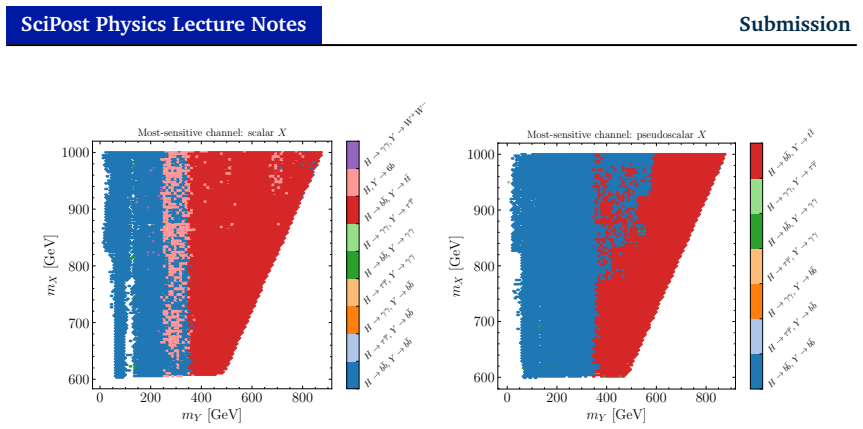
The authors present the first version of NMSSMScanner, a scanning tool that efficiently explores the complex multi-parameter space of the Next-to-Minimal Supersymmetric Standard Model while taking into account all relevant constraints. They demonstrate its performance as a proof of concept by applying it to the search for NMSSM parameter configurations that maximize Higgs boson pair production from resonant scalar or pseudoscalar production in various final states.
What carries the argument
NMSSMScanner, a dedicated scanning algorithm that traverses the NMSSM parameter space while applying the full set of theoretical and experimental constraints at each point.
If this is right
- Detailed studies of resonant Higgs pair production become feasible across the entire allowed NMSSM space rather than in isolated slices.
- Other collider observables can be optimized under the same constraint set without prohibitive computing cost.
- Phenomenological analyses can now systematically compare different NMSSM scenarios on equal footing.
- The same scanning framework can be reused for updated constraint sets as new experimental results appear.
Where Pith is reading between the lines
- The method could be extended to other supersymmetric models that share similar parameter-space complexity.
- Automated comparison of NMSSM predictions against future collider data sets becomes more practical once the scanning step is no longer the bottleneck.
- If the tool is made publicly available, it would allow independent groups to reproduce and extend the same scans without rebuilding the constraint machinery.
Load-bearing premise
The tool correctly classifies every point as viable or invalid without missing allowed regions or retaining disallowed ones when all constraints are applied simultaneously.
What would settle it
Running an exhaustive grid or Markov-chain scan on a reduced but still representative NMSSM subspace and finding a viable point that NMSSMScanner misses or an invalid point that it accepts.
Figures



read the original abstract
We present the first version of the new scanning tool NMSSMScanner that allows to perform efficient scans in the complex multi-parameter space of the Next-to-Minimal Supersymmetric extension of the Standard Model (NMSSM) while taking into account all relevant constraints. As a proof of concept we apply it to the search for NMSSM parameter configurations that maximize Higgs boson pair production from resonant scalar or pseudoscalar production in various final states.
Editorial analysis
A structured set of objections, weighed in public.
Referee Report
Summary. The manuscript introduces NMSSMScanner as a new tool for efficient parameter scans over the multi-dimensional space of the NMSSM, incorporating all relevant experimental and theoretical constraints. As a proof of concept, the tool is applied to the identification of NMSSM points that maximize resonant Higgs-boson pair production in various final states.
Significance. A validated, efficient scanner for the NMSSM would be a useful addition to the phenomenological toolkit, particularly for high-dimensional searches involving Higgs phenomenology where existing codes can be computationally expensive. The proof-of-concept focus on resonant di-Higgs production illustrates one concrete application area.
major comments (2)
- [Abstract] Abstract and proof-of-concept section: the central claim that the scanner 'takes into account all relevant constraints' and performs 'efficient scans' without missing viable or invalid regions is not supported by any reported validation. No benchmark comparisons to established tools (NMSSMTools, SPheno, etc.), no recovery tests on published viable points, and no quantification of false-positive or false-negative rates are provided, rendering the efficiency and correctness assertions untestable.
- [Proof of concept] Proof-of-concept application: the search for maximal resonant Higgs-pair production is presented without any cross-check that the identified points satisfy the full set of constraints or that the scan has not artificially excluded regions already known to be viable in the literature.
minor comments (2)
- The manuscript would benefit from a clear description (or pseudocode) of the scanning algorithm, the constraint-handling method, and the convergence criteria used.
- Figure captions and axis labels in the proof-of-concept plots should explicitly state the constraints applied and the scan range for each parameter.
Simulated Author's Rebuttal
We thank the referee for the careful reading of our manuscript and for the constructive comments. We appreciate the recognition that a validated scanner for the NMSSM would be a useful addition to the phenomenological toolkit. We address each major comment below and will revise the manuscript to incorporate the suggested improvements.
read point-by-point responses
-
Referee: [Abstract] Abstract and proof-of-concept section: the central claim that the scanner 'takes into account all relevant constraints' and performs 'efficient scans' without missing viable or invalid regions is not supported by any reported validation. No benchmark comparisons to established tools (NMSSMTools, SPheno, etc.), no recovery tests on published viable points, and no quantification of false-positive or false-negative rates are provided, rendering the efficiency and correctness assertions untestable.
Authors: We agree that the present version of the manuscript lacks explicit benchmark comparisons and recovery tests. The constraint-handling claims rest on the use of standard, publicly documented constraint modules, but we acknowledge that this does not substitute for direct validation. In the revised manuscript we will add a new validation subsection that (i) recovers a set of published viable NMSSM points from the literature, (ii) compares run-time and constraint outcomes against NMSSMTools and SPheno for the same input points, and (iii) reports any observed discrepancies together with an estimate of false-positive and false-negative rates for the constraint filters employed by NMSSMScanner. revision: yes
-
Referee: [Proof of concept] Proof-of-concept application: the search for maximal resonant Higgs-pair production is presented without any cross-check that the identified points satisfy the full set of constraints or that the scan has not artificially excluded regions already known to be viable in the literature.
Authors: We recognize that the proof-of-concept section would be strengthened by explicit verification that the highlighted points remain consistent with the full constraint set and that the scan has not inadvertently excluded known viable regions. In the revision we will (i) re-evaluate the reported maximal points with an independent constraint code, (ii) overlay the scanned parameter-space coverage on existing literature results for resonant di-Higgs production in the NMSSM, and (iii) discuss any regions that were excluded by our scan but are documented as viable elsewhere, together with the physical reason for their exclusion. revision: yes
Circularity Check
No circularity: tool presentation without derivation chain or fitted predictions
full rationale
The manuscript introduces the NMSSMScanner software for efficient parameter scans in the NMSSM and demonstrates it on resonant Higgs-pair production as a proof of concept. No equations, ansatze, or first-principles derivations are presented that could reduce to their own inputs by construction. The work contains no fitted parameters renamed as predictions, no self-citation load-bearing uniqueness theorems, and no renaming of known results. External constraints are incorporated via standard tools, but the paper's central claim is the tool's implementation and application rather than a closed theoretical result. This is the expected non-finding for a software tool paper.
Axiom & Free-Parameter Ledger
Reference graph
Works this paper leans on
-
[1]
[1]M. D. Goodsell and A. Joury ,BSMArt: Simple and fast parameter space scans, Comput. Phys. Commun.297, 109057 (2024), doi:10.1016/j.cpc.2023.109057, 2301.01154. [2]M. Maniatis,The Next-to-Minimal Supersymmetric extension of the Standard Model re- viewed, Int. J. Mod. Phys. A25, 3505 (2010), doi:10.1142/S0217751X10049827, 0906.0777. [3]U. Ellwanger, C. H...
-
[2]
03878. [47]J. Braathen, S. Heinemeyer, A. P . Arnay and A. Verduras Schaeidt,Impact of one-loop corrections to trilinear scalar couplings on di-Higgs production in the RxSM, Eur. Phys. J. C85(10), 1153 (2025), doi:10.1140/epjc/s10052-025-14770-1, 2507.02569. [48]S. Kraml, S. Kulkarni, U. Laa, A. Lessa, W . Magerl, D. Proschofsky-Spindler and W . Wal- tenb...
-
[3]
01789. [76]M. Misiak and M. Steinhauser,Weak radiative decays of the B meson and bounds on M H ± in the Two-Higgs-Doublet Model, Eur. Phys. J. C77(3), 201 (2017), doi:10.1140/epjc/s10052-017-4776-y, 1702.04571. [77]M. Misiak, A. Rehman and M. Steinhauser,Towards B→X sγat the NNLO in QCD without interpolation in mc, JHEP06, 175 (2020), doi:10.1007/JHEP06(2...
discussion (0)
Sign in with ORCID, Apple, or X to comment. Anyone can read and Pith papers without signing in.