Shearlet Neural Operators for Anisotropic-Shock-Dominated and Multi-scale parametric partial differential equations
Pith reviewed 2026-05-07 17:01 UTC · model grok-4.3
The pith
Shearlet Neural Operators replace Fourier bases with directional multiscale atoms to improve accuracy on parametric PDEs that contain anisotropy and shocks.
A machine-rendered reading of the paper's core claim, the machinery that carries it, and where it could break.
Core claim
By substituting the global Fourier transform with a shearlet-based representation inside the neural operator architecture, the model acquires an inductive bias aligned with the sparse directional structure of anisotropic and shock-dominated PDE solutions; the resulting SNO learns and predicts in the shearlet coefficient domain and recovers the physical field via the inverse shearlet transform, yielding consistent accuracy and fidelity gains over FNO on the tested parametric families without altering the overall spectral computation pipeline.
What carries the argument
The shearlet transform, whose atoms are directional, multiscale, and spatially localized and provide near-optimal sparse approximation for anisotropic features and discontinuities.
If this is right
- SNO improves predictive accuracy and feature fidelity most strongly on problems with strongly anisotropic advection or diffusion and on conservation laws containing straight, curved, interacting, spiral, or polygonal shocks.
- The architecture retains efficient spectral convolution while gaining locality and directional selectivity from the shearlet atoms.
- The same replacement of Fourier by shearlet bases can be applied inside other neural operator families that currently rely on global frequency representations.
- Gains are expected to be largest precisely where FNO performance degrades, i.e., in discontinuity-dominated and directionally biased regimes.
Where Pith is reading between the lines
- The method could be tested on time-dependent problems with moving shocks or on inverse problems where the operator must be learned from sparse observations.
- Hybrid shearlet-Fourier layers might be explored to handle both global smooth components and localized anisotropic features within a single model.
- Because shearlets are known to be near-optimal for cartoon-like functions, the approach may naturally extend to image-based or geometry-driven parametric PDEs without additional architectural redesign.
Load-bearing premise
That the shearlet representation supplies a sufficiently strong inductive bias for the targeted PDE classes without introducing reconstruction artifacts or requiring architecture changes that negate efficiency gains in practice.
What would settle it
A direct head-to-head experiment on one of the seven benchmark families in which SNO fails to improve test error or produces visible artifacts in reconstructed shock locations or anisotropic fronts relative to the FNO baseline.
Figures






read the original abstract
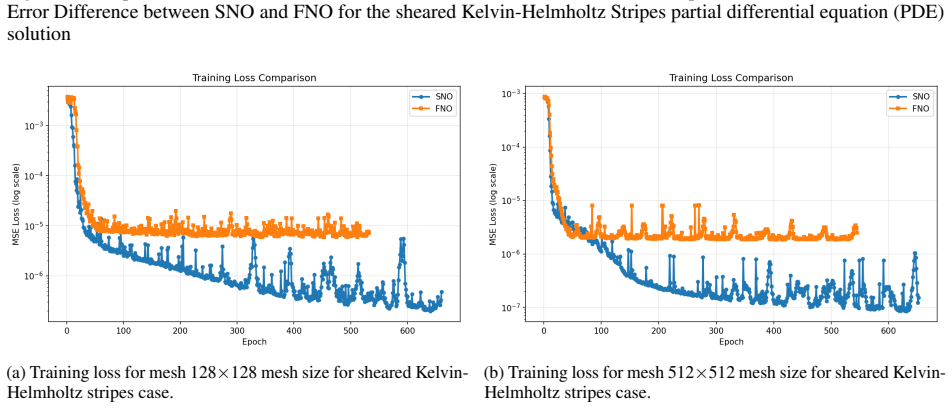
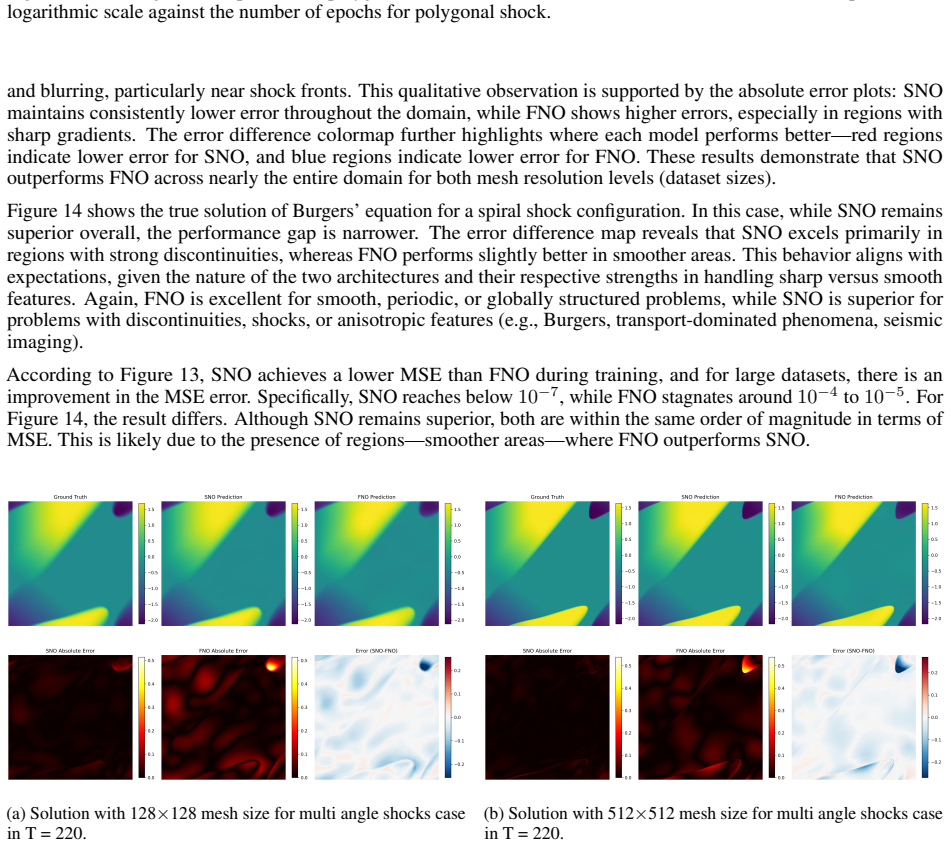
Neural operators have emerged as powerful data-driven surrogates for learning solution operators of parametric partial differential equations (PDEs). However, widely used Fourier Neural Operators (FNOs) rely on global Fourier representations, which can be inefficient for resolving anisotropic structures, sharp gradients, and spatially localized discontinuities that arise in shock-dominated and multiscale regimes. To address these limitations, we introduce the Shearlet Neural Operator (SNO), a neural operator architecture that replaces the Fourier transform with a shearlet-based representation. Shearlets offer directional, multiscale, and spatially localized atoms with near-optimal sparse approximation of anisotropic features, providing an inductive bias aligned with PDE solutions containing edges, fronts, and shocks. SNO learns in the shearlet domain and reconstructs predictions via the inverse transform, retaining efficient spectral computation while improving locality and directional selectivity. Across seven benchmark PDE families, including strongly anisotropic advection, anisotropic diffusion, and nonlinear conservation laws with straight, curved, interacting, spiral, and polygonal shock structures, SNO consistently improves predictive accuracy and feature fidelity over FNO baselines, with the largest gains observed in anisotropic and discontinuity-dominated settings.
Editorial analysis
A structured set of objections, weighed in public.
Referee Report
Summary. The manuscript introduces the Shearlet Neural Operator (SNO), which replaces the Fourier transform in neural operators with a shearlet-based representation to better capture directional, multiscale, and localized features in solutions of parametric PDEs. The central claim is that SNO yields consistent gains in predictive accuracy and feature fidelity over FNO baselines across seven benchmark families (anisotropic advection, anisotropic diffusion, and nonlinear conservation laws with straight, curved, interacting, spiral, and polygonal shocks), with the largest improvements in anisotropic and discontinuity-dominated regimes.
Significance. If the empirical results hold under rigorous controls, the work is significant for extending neural operator architectures with an inductive bias aligned to the sparsity properties of anisotropic and shock-containing PDE solutions. It preserves the resolution-independent, spectral-efficiency structure of the operator-learning framework while addressing a known limitation of global Fourier bases, which could improve surrogate modeling in applications such as fluid dynamics and materials science.
minor comments (3)
- The abstract states that SNO 'consistently improves predictive accuracy' across seven families but provides no numerical values, error bars, or training-protocol details; adding at least one concrete metric (e.g., relative L2 error reduction on a representative anisotropic case) would strengthen the summary.
- The description of the architecture (forward shearlet transform, learned coefficient operations, inverse transform) should include an explicit statement confirming that the discrete shearlet implementation used is exactly invertible up to machine precision, to rule out reconstruction artifacts as a confounding factor.
- The experimental section should report parameter counts and FLOPs for SNO versus FNO on each benchmark to verify that efficiency gains are not offset by increased model size or transform overhead.
Simulated Author's Rebuttal
We thank the referee for the accurate summary of our work and for recommending minor revision. The referee's description correctly captures the motivation for replacing the Fourier basis with shearlets and the reported gains on anisotropic and shock-dominated PDE benchmarks. No specific major comments were provided in the report.
Circularity Check
No significant circularity detected
full rationale
The paper defines SNO as an architectural replacement of the Fourier transform in FNO by the shearlet transform, with learned operations on shearlet coefficients followed by the inverse transform. This change is motivated by known properties of shearlets for sparse approximation of anisotropic features and is evaluated via direct empirical comparison on external benchmark PDE families. No equations, predictions, or central claims reduce by construction to fitted parameters, self-referential definitions, or unverified self-citations; the reported accuracy and feature-fidelity gains are independent measurements on held-out test cases. The derivation chain remains self-contained against the stated benchmarks.
Axiom & Free-Parameter Ledger
axioms (1)
- domain assumption Shearlets offer directional, multiscale, and spatially localized atoms with near-optimal sparse approximation of anisotropic features
Reference graph
Works this paper leans on
-
[1]
Chapter 6 - the biological basis of diffusion anisotropy
Christian Beaulieu. Chapter 6 - the biological basis of diffusion anisotropy. In Heidi Johansen-Berg and Timothy E.J. Behrens, editors,Diffusion MRI, pages 105–126. Academic Press, San Diego, 2009
work page 2009
-
[2]
Towards understanding the spectral bias of deep learning, 2020
Yuan Cao, Zhiying Fang, Yue Wu, Ding-Xuan Zhou, and Quanquan Gu. Towards understanding the spectral bias of deep learning, 2020
work page 2020
-
[3]
Clarendon Press, Oxford, UK, 2nd edition, 1975
John Crank.The Mathematics of Diffusion. Clarendon Press, Oxford, UK, 2nd edition, 1975
work page 1975
-
[4]
Total variation diminishing runge–kutta schemes.Mathematics of Computation, 67(221):73–85, 1998
Sigal Gottlieb and Chi-Wang Shu. Total variation diminishing runge–kutta schemes.Mathematics of Computation, 67(221):73–85, 1998
work page 1998
-
[5]
Shearlets: Sparse multidimensional representations using anisotropic dilation and shear operators
Kanghui Guo, Gitta Kutyniok, and Demetrio Labate. Shearlets: Sparse multidimensional representations using anisotropic dilation and shear operators. InWavelets and Splines, 05 2005
work page 2005
-
[6]
Yifan Hu, Weimin Zhang, Fukang Yin, and Jianping Wu. Hmgno: Hybrid multigrid neural operator with low-order numerical solver for partial differential equations.Neural Networks, 190:107649, 2025
work page 2025
-
[7]
Isakov.Inverse Problems for Partial Differential Equations
V . Isakov.Inverse Problems for Partial Differential Equations. Applied Mathematical Sciences. Springer New York, 2013
work page 2013
-
[8]
Zhi-Qin John Xu, Yaoyu Zhang, Tao Luo, Yanyang Xiao, and Zheng Ma. Frequency principle: Fourier analysis sheds light on deep neural networks.Communications in Computational Physics, 28(5):1746–1767, June 2020
work page 2020
-
[9]
Neural operator: learning maps between function spaces with applications to pdes.J
Nikola Kovachki, Zongyi Li, Burigede Liu, Kamyar Azizzadenesheli, Kaushik Bhattacharya, Andrew Stuart, and Anima Anandkumar. Neural operator: learning maps between function spaces with applications to pdes.J. Mach. Learn. Res., 24(1), January 2023
work page 2023
-
[10]
Applied and Numerical Harmonic Analysis
Gitta Kutyniok and Demetrio Labate, editors.Shearlets. Applied and Numerical Harmonic Analysis. Birkhäuser, Boston, MA, 1 edition, 2012
work page 2012
-
[11]
Gitta Kutyniok, Wang-Q Lim, and Rafael Reisenhofer. Shearlab 3d: Faithful digital shearlet transforms based on compactly supported shearlets.ACM Transactions on Mathematical Software, 42(1):1–42, January 2016
work page 2016
-
[12]
LeVeque.Finite Volume Methods for Hyperbolic Problems
Randall J. LeVeque.Finite Volume Methods for Hyperbolic Problems. Cambridge Texts in Applied Mathematics. Cambridge University Press, 2002
work page 2002
-
[13]
Fourier neural operator for parametric partial differential equations, 2021
Zongyi Li, Nikola Kovachki, Kamyar Azizzadenesheli, Burigede Liu, Kaushik Bhattacharya, Andrew Stuart, and Anima Anandkumar. Fourier neural operator for parametric partial differential equations, 2021
work page 2021
-
[14]
Physics-informed neural operator for learning partial differential equations, 2023
Zongyi Li, Hongkai Zheng, Nikola Kovachki, David Jin, Haoxuan Chen, Burigede Liu, Kamyar Azizzadenesheli, and Anima Anandkumar. Physics-informed neural operator for learning partial differential equations, 2023
work page 2023
-
[15]
Lizuo Liu and Wei Cai. Multiscale deeponet for nonlinear operators in oscillatory function spaces for building seismic wave responses, 2021. 19 arXivTemplateA PREPRINT
work page 2021
-
[16]
Lu Lu, Pengzhan Jin, Guofei Pang, Zhongqiang Zhang, and George Em Karniadakis. Learning nonlinear operators via deeponet based on the universal approximation theorem of operators.Nature Machine Intelligence, 3(3):218–229, March 2021
work page 2021
-
[17]
An upper limit of decaying rate with respect to frequency in linear frequency principle model
Tao Luo, Zheng Ma, Zhiwei Wang, Zhiqin John Xu, and Yaoyu Zhang. An upper limit of decaying rate with respect to frequency in linear frequency principle model. In Bin Dong, Qianxiao Li, Lei Wang, and Zhi-Qin John Xu, editors,Proceedings of Mathematical and Scientific Machine Learning, volume 190 ofProceedings of Machine Learning Research, pages 205–214. P...
work page 2022
-
[18]
Theory of the frequency principle for general deep neural networks, 2019
Tao Luo, Zheng Ma, Zhi-Qin John Xu, and Yaoyu Zhang. Theory of the frequency principle for general deep neural networks, 2019
work page 2019
-
[19]
Tao Luo, Zheng Ma, Zhi-Qin John Xu, and Yaoyu Zhang. On the exact computation of linear frequency principle dynamics and its generalization.SIAM Journal on Mathematics of Data Science, 4(4):1272–1292, 2022
work page 2022
-
[20]
James C. McWilliams. Submesoscale currents in the ocean.Proceedings of the Royal Society A: Mathematical, Physical and Engineering Sciences, 472(2189):20160117, 05 2016
work page 2016
-
[21]
Robert M. Miura. Linear and nonlinear waves (g. b. whitham).SIAM Review, 18(4):776–781, 1976
work page 1976
-
[22]
Hamprecht, Yoshua Bengio, and Aaron Courville
Nasim Rahaman, Aristide Baratin, Devansh Arpit, Felix Draxler, Min Lin, Fred A. Hamprecht, Yoshua Bengio, and Aaron Courville. On the spectral bias of neural networks, 2019
work page 2019
- [23]
-
[24]
Influence of cross perturbations on turbulent kelvin–helmholtz instability.Fluids, 9(3), 2024
Mae Sementilli, Rozie Zangeneh, and James Chen. Influence of cross perturbations on turbulent kelvin–helmholtz instability.Fluids, 9(3), 2024
work page 2024
-
[25]
Smith.Uncertainty Quantification: Theory, Implementation, and Applications, Second Edition
R.C. Smith.Uncertainty Quantification: Theory, Implementation, and Applications, Second Edition. Computa- tional science and engineering. Society for Industrial and Applied Mathematics, 2024
work page 2024
-
[26]
T. J. Sullivan.Introduction to Uncertainty Quantification, volume 63 ofTexts in Applied Mathematics. Springer, 2015
work page 2015
-
[27]
Energy propagation in deep convolutional neural networks, 2018
Thomas Wiatowski, Philipp Grohs, and Helmut Bölcskei. Energy propagation in deep convolutional neural networks, 2018
work page 2018
-
[28]
Overview frequency principle/spectral bias in deep learning, 2024
Zhi-Qin John Xu, Yaoyu Zhang, and Tao Luo. Overview frequency principle/spectral bias in deep learning, 2024
work page 2024
-
[29]
Training behavior of deep neural network in frequency domain, 2019
Zhi-Qin John Xu, Yaoyu Zhang, and Yanyang Xiao. Training behavior of deep neural network in frequency domain, 2019
work page 2019
-
[30]
Mscalefno: Multi-scale fourier neural operator learning for oscillatory function spaces, 2024
Zhilin You, Zhenli Xu, and Wei Cai. Mscalefno: Multi-scale fourier neural operator learning for oscillatory function spaces, 2024
work page 2024
-
[31]
Sh-cnn: Shearlet convolutional neural network for gender classification
Chaymae Ziani and Abdelalim Sadiq. Sh-cnn: Shearlet convolutional neural network for gender classification. Advances in Science, Technology and Engineering Systems Journal, 5:1328–1334, 12 2020. 20
work page 2020
discussion (0)
Sign in with ORCID, Apple, or X to comment. Anyone can read and Pith papers without signing in.