Asymptotic Solution of a Cheap Control Game with Slow and Fast State Variables
Pith reviewed 2026-05-07 15:53 UTC · model grok-4.3
The pith
Novel asymptotic analysis of the Riccati equation yields an approximate solution to the cheap control zero-sum game with slow and fast states
A machine-rendered reading of the paper's core claim, the machinery that carries it, and where it could break.
Core claim
By developing a significantly novel approach to the asymptotic analysis of the matrix Riccati differential equation, the authors derive an asymptotic solution of the finite-horizon zero-sum linear-quadratic differential game whose minimizing control cost is much smaller than the remaining terms and whose fast-state cost is a positive semi-definite but non-zero quadratic form.
What carries the argument
The novel asymptotic analysis of the matrix Riccati differential equation that simultaneously accommodates a small minimizing-control cost parameter and a positive semi-definite yet non-vanishing fast-state cost.
If this is right
- Approximate optimal strategies and game value become available for small values of the minimizing control cost without solving the full Riccati equation.
- The solution naturally decomposes into slow and fast components that reflect the two time scales present in the state variables.
- The same analysis technique supplies a concrete way to treat singularly perturbed differential games that standard Riccati methods cannot handle.
- An explicit example confirms that the asymptotic expressions can be computed and compared with the exact solution.
Where Pith is reading between the lines
- The same Riccati analysis might be adapted to infinite-horizon versions or to games whose cost functional contains additional cross terms.
- The derived asymptotic forms could be used to construct reduced-order controllers for large-scale systems that exhibit both cheap actuation and slow-fast dynamics.
- Iterating the expansion to higher orders would produce successively more accurate approximations whose error can be bounded uniformly on the finite horizon.
Load-bearing premise
The minimizing player's control cost must be much smaller than the maximizing player's control cost and the state cost, while the fast-state cost must remain positive semi-definite but not identically zero, because these conditions are what force the new Riccati analysis.
What would settle it
Numerical solution of the exact Riccati equation for a sequence of successively smaller values of the small control-cost parameter, followed by direct comparison with the leading terms of the derived asymptotic expansion; systematic mismatch at the first two orders would refute the claimed asymptotic correctness.
Figures

read the original abstract
A finite-horizon zero-sum linear-quadratic differential game is considered. Its features are: (i) the control cost of the minimizing player in the game's cost functional is much smaller than the control cost of the maximizing player and the state cost; (ii) the cost of the fast state variable in the integrand of the cost functional is a positive semi-definite (but non-zero) quadratic form. These features require developing a significantly novel approach to asymptotic analysis of the matrix Riccati differential equation associated with the considered game. Using this analysis, an asymptotic solution of the game is derived. An illustrative example is presented.
Editorial analysis
A structured set of objections, weighed in public.
Referee Report
Summary. The manuscript considers a finite-horizon zero-sum linear-quadratic differential game whose dynamics are singularly perturbed (small parameter ε) and whose cost functional features cheap control for the minimizing player (small parameter μ) together with a positive semi-definite but non-zero quadratic penalty on the fast state. A novel asymptotic analysis of the associated matrix Riccati differential equation is developed that accounts for these features, yielding an asymptotic solution of the game; the results are illustrated by a numerical example.
Significance. If the expansions are accompanied by rigorous error bounds, the work would usefully extend the singular-perturbation literature on differential games by treating the combination of cheap control and a semi-definite fast-state cost, a setting that precludes standard reduction techniques. The provision of an explicit example strengthens the practical value of the derived asymptotics.
major comments (2)
- [§4] §4, the construction of the outer and boundary-layer Riccati solutions: the argument that the fast-time-scale Riccati equation admits a unique stabilizing solution when the fast-state cost matrix is only semi-definite (rather than positive definite) is only sketched; a complete proof of existence and uniqueness, or an explicit spectral condition on the fast Hamiltonian matrix, is required to justify the subsequent matching procedure.
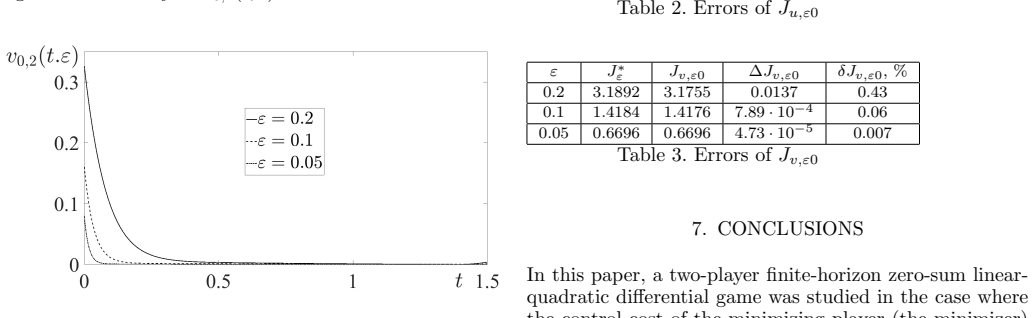
- [§5] §5, the illustrative example: the chosen values ε=0.01 and μ=0.001 are used to compare the asymptotic and exact solutions, yet no quantitative error table or plot of the approximation error versus ε and μ is supplied; without such data the claim that the asymptotics become accurate as ε,μ→0 cannot be assessed.
minor comments (2)
- The notation for the partitioned Riccati matrix blocks (P11, P12, etc.) is introduced without an explicit reference to the slow-fast state partitioning; a short paragraph recalling the state decomposition would improve readability.
- [§3] Several equations in §3 contain typographical inconsistencies in the placement of the small parameters ε and μ inside the matrix expressions; these should be checked against the original system matrices.
Simulated Author's Rebuttal
We thank the referee for the detailed and constructive report. The comments highlight important points regarding rigor and validation that we will address in the revision. Below we respond point by point to the major comments.
read point-by-point responses
-
Referee: [§4] §4, the construction of the outer and boundary-layer Riccati solutions: the argument that the fast-time-scale Riccati equation admits a unique stabilizing solution when the fast-state cost matrix is only semi-definite (rather than positive definite) is only sketched; a complete proof of existence and uniqueness, or an explicit spectral condition on the fast Hamiltonian matrix, is required to justify the subsequent matching procedure.
Authors: We agree that the existence and uniqueness argument for the stabilizing solution of the fast-time-scale Riccati equation is only sketched when the fast-state cost matrix is positive semi-definite. In the revised manuscript we will supply a complete proof. This will include an explicit spectral condition on the fast Hamiltonian matrix ensuring that it has no purely imaginary eigenvalues (adjusted for the semi-definite case) and that the associated algebraic Riccati equation possesses a unique positive semi-definite stabilizing solution. The proof will be placed in an appendix or expanded subsection to support the subsequent matching procedure without altering the main asymptotic results. revision: yes
-
Referee: [§5] §5, the illustrative example: the chosen values ε=0.01 and μ=0.001 are used to compare the asymptotic and exact solutions, yet no quantitative error table or plot of the approximation error versus ε and μ is supplied; without such data the claim that the asymptotics become accurate as ε,μ→0 cannot be assessed.
Authors: We concur that the current numerical example lacks quantitative error measures and convergence plots, which limits the ability to assess the rate at which the asymptotics approach the exact solution. In the revision we will add a table of L2-norm errors for the state trajectories, controls, and game value at the reported parameter values, together with additional runs or a log-log plot of the approximation error versus ε and μ (for several smaller values). These additions will be included in §5 and will not change the example’s illustrative purpose but will strengthen the validation of the asymptotic claims. revision: yes
Circularity Check
No significant circularity detected in the derivation
full rationale
The paper conducts a direct asymptotic analysis of the matrix Riccati differential equation associated with the zero-sum linear-quadratic game under cheap-control and singular-perturbation conditions (positive semi-definite fast-state cost). The abstract and high-level structure describe this as an independent derivation yielding an asymptotic solution, with no reduction of any claimed result to fitted inputs, self-definitions, or load-bearing self-citations. The approach augments standard singular-perturbation methods for the specific features noted, remaining self-contained without circular steps.
Axiom & Free-Parameter Ledger
free parameters (2)
- cheap-control weight mu
- fast-time-scale parameter epsilon
axioms (2)
- standard math The matrix Riccati differential equation associated with the linear-quadratic game admits a unique solution on the finite horizon.
- domain assumption The fast-state cost matrix is positive semi-definite and non-zero.
Reference graph
Works this paper leans on
-
[1]
H. Abou-Kandil, G. Freiling, V. Ionescu, and G. Jank. Matrix Riccati Equations in Control and Systems Theory. Birkh\" a user, Basel, Switzerland, 2003
work page 2003
-
[2]
T. Ba s ar, and G.J. Olsder. Dynamic Noncooparative Game Theory, 2nd ed. SIAM Books, Philadelphia, 1999
work page 1999
-
[3]
J.H. Braslavsky, M.M. Seron, D.Q. Mayne, and P.V. Kokotovi\' c . Limiting performance of optimal linear filters. Automatica, 35: 0 189–-199, 1999
work page 1999
-
[4]
V.Y. Glizer, and O. Kelis. Singular Linear-Quadratic Zero-Sum Differential Games and H_ Control Problems: Regularization Approach . Birkh\" a user, Basel, Switzerland, 2022
work page 2022
-
[5]
V.Y. Glizer, and V. Turetsky. Approximate solution of a zero-sum linear-quadratic differential game by the auxiliary parameter method: analytical/numerical study. Optimization: A Journal of Mathematical Programming and Operations Research, 74: 0 4627--4667, 2025
work page 2025
-
[6]
V.Y. Glizer, and V. Turetsky. The effect of the cost functional on asymptotic solution to one class of zero-sum linear-quadratic cheap control differential games. Symmetry, 17:Article ID 1394, 2025
work page 2025
-
[7]
P.V. Kokotovi\' c , H.K. Khalil, and J. O’Reilly. Singular Perturbation Methods in Control: Analysis and Design. SIAM Books, Philadelphia, 1999
work page 1999
-
[8]
H. Kwakernaak, and R. Sivan. The maximally achievable accuracy of linear optimal regulators and linear optimal filters. IEEE Trans. Autom. Control, 17: 0 79–-86, 1972
work page 1972
-
[9]
H. Kwakernaak, and R. Sivan. Linear Optimal Control Systems. Wiley-Interscience, New York, 1972
work page 1972
-
[10]
P.J. Moylan, and B.D.O. Anderson. Nonlinear regulator theory and an inverse optimal control problem. IEEE Trans. Autom. Control, 18: 0 460–-465, 1973
work page 1973
-
[11]
J. Shinar, V.Y. Glizer, and V. Turetsky. The effect of pursuer dynamics on the value of linear pursuit-evasion games with bounded controls. In V. K r ivan, G. Zaccour, editors, Advances in Dynamic Games -- Theory, Applications, and Numerical Methods, Annals of the International Society of Dynamic Games, volume 13, pages 313--350. Birkh\" a user, Basel, Sw...
work page 2013
-
[12]
A.B. Vasil’eva, V.F. Butuzov, and L.V. Kalachev. The Boundary Function Method for Singular Perturbation Problems. SIAM Books, Philadelphia, 1995
work page 1995
-
[13]
R.A. Yackel, and P.V. Kokotovi\' c . A boundary layer method for the matrix Riccati equation. IEEE Trans. Autom. Control, 18: 0 17–-24, 1973
work page 1973
discussion (0)
Sign in with ORCID, Apple, or X to comment. Anyone can read and Pith papers without signing in.