Recognition: unknown
The GMRT High-Resolution Southern Sky Survey for pulsars and transients -- VIII: Orbital Variability and the Evolution of a 1-Day He-WD Millisecond Pulsar J2101-4208
Pith reviewed 2026-05-07 15:31 UTC · model grok-4.3
The pith
PSR J2101-4802 is a transitional millisecond pulsar binary linking redback spiders to detached helium white-dwarf systems.
A machine-rendered reading of the paper's core claim, the machinery that carries it, and where it could break.
Core claim
From phase-connected timing spanning 3.7 years, PSR J2101-4802 is found in a ~1-day binary orbit with a median companion mass of 0.15 solar masses. The timing solution reveals an unusually large orbital period derivative of about 10^{-11} s s^{-1} that cannot be explained by kinematic effects or general-relativistic damping. Wideband full-Stokes observations show orbital phase-dependent linear and circular polarization variations, which are fit with a rotating-vector model to constrain the emission geometry. The combination of the ~1-day orbit, ~0.15 solar mass companion, modest spin-down power, large orbital derivative, and phase-locked magnetized intrabinary plasma signatures indicates a ~
What carries the argument
Orbital timing measurements yielding the anomalous period derivative combined with phase-resolved polarimetry that detects magnetized intrabinary plasma.
Load-bearing premise
That the observed large orbital period derivative cannot be accounted for by the Shklovskii effect, Galactic acceleration, or general-relativistic damping, and that the polarization signatures specifically trace magnetized intrabinary plasma tied to the transitional state.
What would settle it
A precise measurement of the system's proper motion that fully accounts for the orbital period derivative via the Shklovskii effect, or follow-up observations showing no orbital-phase locked polarization variations.
Figures
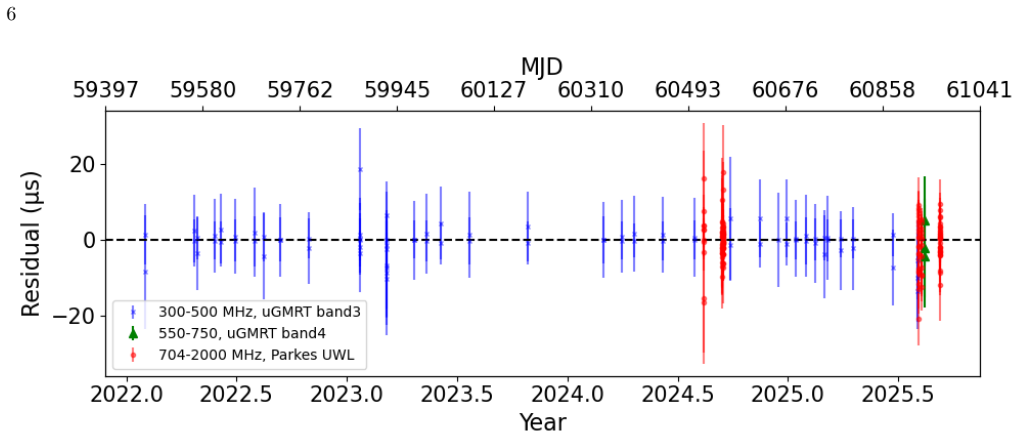


read the original abstract
We present timing and orbital phase-resolved polarimetry of the millisecond pulsar (MSP) J2101$-$4802, having a spin period of 9.48~ms and dispersion measure (DM) $25.05\ \mathrm{pc\ cm^{-3}}$ discovered with the Giant Meter Radio Telescope (GMRT). From the phase-connected timing of this MSP spanning 3.7 years, we identify that PSR J2101-4802 is in a $\sim$1-day binary orbit with a likely helium-white-dwarf (He-WD) companion having a median companion mass of $\simeq0.15\, M_\odot$, consistent with canonical recycling in the Galactic field. The timing solution further reveals an unusually large orbital period derivative, $\dot{P}_b$ ($\sim10^{-11}\,{\rm s\,s}^{-1}$), compared to typical Galactic-field MSP--HeWD binaries, which cannot be explained by the contributions from kinematic effects (Shklovskii and Galactic acceleration) or general-relativistic damping. Using wideband, full-Stokes observations, we also trace the linear and circular polarization variation across the orbital phase and fit a rotating-vector model (RVM) to its position-angle swing across the pulse phase, yielding constraints on the emission geometry (magnetic inclination and impact angle) of this system. The combination of a $\sim$1-day orbit, $\sim0.15\,M_\odot$ companion, modest spin-down power, unusually large $\dot{P}_b$, and phase-locked magnetized intrabinary plasma signatures suggests that PSR~J2101$-$4802 represents a transitional system linking redback-like spiders to detached He--WD MSP binaries.
Editorial analysis
A structured set of objections, weighed in public.
Referee Report
Summary. The manuscript reports timing and full-Stokes polarimetry of the 9.48 ms MSP J2101-4802 (DM = 25.05 pc cm^{-3}) discovered with the GMRT. Phase-connected timing over 3.7 years yields a ~1-day orbit with a median companion mass of ~0.15 M_⊙, consistent with a helium white-dwarf companion. The timing solution shows an unusually large orbital period derivative (~10^{-11} s s^{-1}) that the authors state cannot be accounted for by Shklovskii, Galactic acceleration, or GR damping. Wideband polarimetry is used to fit a rotating-vector model across pulse phase, constraining magnetic inclination and impact angle. The combination of orbital parameters, large Ṗb, modest spin-down power, and phase-locked polarization signatures is interpreted as evidence that the system is transitional between redback-like spiders and detached Galactic-field He-WD MSP binaries.
Significance. If the intrinsic character of the large orbital period derivative is robustly established, the result would strengthen the empirical case for a short-lived transitional phase in MSP binary evolution, linking interacting spider systems to the canonical detached He-WD population. The direct observational constraints (phase-connected timing, RVM geometry, and intrabinary plasma signatures) provide a concrete example that can be compared against population synthesis models. The work also demonstrates the scientific return of the GMRT High-Resolution Southern Sky Survey for identifying rare evolutionary states.
major comments (2)
- [Timing and orbital solution] The central claim that PSR J2101-4802 is transitional rests on the assertion (abstract and timing section) that the measured Ṗb ~10^{-11} s s^{-1} is intrinsic and cannot be explained by kinematic contributions or GR damping. The manuscript must supply the explicit numerical evaluation of the Shklovskii term, Galactic acceleration, and GR quadrupole term together with a full covariance propagation that includes the 20–50 % fractional uncertainty on the DM-derived distance and the proper-motion uncertainties (which scale as T^{-2} for a 3.7 yr baseline). Without this calculation it remains possible that the residual intrinsic Ṗb is consistent with zero or with the GR expectation (~10^{-13} s s^{-1} for a 1-day orbit), undermining the transitional interpretation.
- [Timing and orbital solution] The abstract states that the observed Ṗb “cannot be explained by” the standard contributions, yet no table or equation set quantifies the individual terms or their uncertainties. A dedicated subsection or table comparing the observed Ṗb to the sum of kinematic and GR contributions (with 1σ and 2σ bounds) is required before the claim can be considered load-bearing for the evolutionary conclusion.
minor comments (2)
- [Abstract] The abstract reports the orbital period derivative only as “~10^{-11} s s^{-1}”; the measured value with its formal uncertainty (and any systematic floor) should be stated explicitly.
- [Polarimetry and RVM] The RVM fit is presented as yielding constraints on magnetic inclination and impact angle, but the manuscript does not quote the best-fit angles or their uncertainties; these numbers should be given in the polarimetry section or a table.
Simulated Author's Rebuttal
We thank the referee for their careful and constructive review. The comments highlight the need for greater transparency in our timing analysis, and we have revised the manuscript to address these points directly.
read point-by-point responses
-
Referee: [Timing and orbital solution] The central claim that PSR J2101-4802 is transitional rests on the assertion (abstract and timing section) that the measured Ṗb ~10^{-11} s s^{-1} is intrinsic and cannot be explained by kinematic contributions or GR damping. The manuscript must supply the explicit numerical evaluation of the Shklovskii term, Galactic acceleration, and GR quadrupole term together with a full covariance propagation that includes the 20–50 % fractional uncertainty on the DM-derived distance and the proper-motion uncertainties (which scale as T^{-2} for a 3.7 yr baseline). Without this calculation it remains possible that the residual intrinsic Ṗb is consistent with zero or with the GR expectation (~10^{-13} s s^{-1} for a 1-day orbit), undermining the transitional interpretation.
Authors: We agree that the manuscript requires an explicit, quantitative breakdown to make the claim robust. In the revised version we have added a dedicated subsection (Section 3.4) that evaluates the Shklovskii term, Galactic acceleration, and GR quadrupole damping using the measured proper motion and the DM-derived distance. We include a full covariance propagation that incorporates the 20–50 % distance uncertainty and the proper-motion errors appropriate to the 3.7 yr timing baseline. The calculation shows that the sum of these contributions remains more than an order of magnitude below the observed value even at the 2σ upper bound, confirming that the large orbital-period derivative is intrinsic. revision: yes
-
Referee: [Timing and orbital solution] The abstract states that the observed Ṗb “cannot be explained by” the standard contributions, yet no table or equation set quantifies the individual terms or their uncertainties. A dedicated subsection or table comparing the observed Ṗb to the sum of kinematic and GR contributions (with 1σ and 2σ bounds) is required before the claim can be considered load-bearing for the evolutionary conclusion.
Authors: We have added a new table (Table 3) that lists each contribution (Shklovskii, Galactic acceleration, GR) together with the observed Ṗb, providing both 1σ and 2σ bounds on the total non-intrinsic term. The table is referenced in the abstract and in the timing section. This addition makes the quantitative basis for the intrinsic interpretation explicit and load-bearing for the evolutionary discussion. revision: yes
Circularity Check
No significant circularity: central claim rests on independent timing measurements and external kinematic models
full rationale
The paper's derivation chain consists of direct observational extractions: phase-connected timing over 3.7 years yields P_b, companion mass via mass function, and measured Ṗ_b; wideband polarimetry yields RVM fits for geometry. The key assertion that kinematic (Shklovskii + Galactic acceleration) and GR contributions cannot explain the observed Ṗ_b uses standard external formulas applied to independently estimated distance (from DM) and proper motion (from timing), without any equation in the paper defining those inputs in terms of the transitional interpretation. No self-citation is invoked as load-bearing uniqueness; no parameter is fitted to a data subset and then relabeled a prediction; no ansatz is smuggled via prior work; and no known result is merely renamed. The chain is therefore self-contained against external benchmarks, with any residual uncertainty in distance or PM belonging to correctness rather than circularity.
Axiom & Free-Parameter Ledger
free parameters (1)
- companion mass =
0.15 M_sun
axioms (2)
- domain assumption Standard binary pulsar timing model accurately captures orbital motion and derivatives without unmodeled effects.
- domain assumption Rotating vector model applies to the observed position-angle swing for emission geometry constraints.
Reference graph
Works this paper leans on
-
[1]
2022, ApJS, 260, 53, doi: 10.3847/1538-4365/ac6751
Abdollahi, S., Acero, F., Baldini, L., et al. 2022, ApJS, 260, 53, doi: 10.3847/1538-4365/ac6751
-
[2]
Alam, M. F., Arzoumanian, Z., Baker, P. T., et al. 2021, ApJS, 252, 5, doi: 10.3847/1538-4365/abc6a1
-
[3]
Alpar, M. A., Cheng, A. F., Ruderman, M. A., & Shaham, J. 1982, Nature, 300, 728, doi: 10.1038/300728a0
-
[4]
Antoniadis, J., Kaplan, D. L., Stovall, K., et al. 2016a, ApJ, 830, 36, doi: 10.3847/0004-637X/830/1/36
-
[5]
Antoniadis, J., Tauris, T. M., Ozel, F., et al. 2016b, arXiv e-prints, arXiv:1605.01665, doi: 10.48550/arXiv.1605.01665
-
[6]
Applegate, J. H. 1992, ApJ, 385, 621, doi: 10.1086/170967
-
[7]
Applegate, J. H., & Shaham, J. 1994, ApJ, 436, 312, doi: 10.1086/174906
-
[8]
A., & Thorsett, S
Arzoumanian, Z., Joshi, K., Rasio, F. A., & Thorsett, S. E. 1996, in Astronomical Society of the Pacific Conference
1996
-
[9]
Orbital Parameters of the PSR B1620-26 Triple System
Series, Vol. 105, IAU Colloquium 160: Pulsars: Problems and Progress, ed. S. Johnston, M. A. Walker, & M. Bailes, 525–530, doi: 10.48550/arXiv.astro-ph/9605141
work page internal anchor Pith review doi:10.48550/arxiv.astro-ph/9605141
-
[10]
Atwood, W., Albert, A., Baldini, L., et al. 2013, in eConf C121028, 8, Proc. 4 th FermiSymposium, ed. T.J. Brandt, N. Omodei, & C. Wilson-Hodge. https://arxiv.org/abs/1303.3514
-
[11]
Atwood, W. B., Abdo, A. A., Ackermann, M., et al. 2009, ApJ, 697, 1071, doi: 10.1088/0004-637X/697/2/1071
-
[12]
H., Lott, B., & collaboration, T
Ballet, J., Bruel, P., Burnett, T. H., Lott, B., & The Fermi-LAT collaboration. 2023, , arXiv:2307.12546doi: 10.48550/arXiv.2307.12546
-
[13]
Bassa, C. G., van Kerkwijk, M. H., Koester, D., & Verbunt, F. 2006, A&A, 456, 295, doi: 10.1051/0004-6361:20065181
-
[14]
2009, in Astrophysics and Space Science
Becker, W. 2009, in Astrophysics and Space Science
2009
-
[15]
357, Astrophysics and Space Science Library, ed
Library, Vol. 357, Astrophysics and Space Science Library, ed. W. Becker, 91, doi: 10.1007/978-3-540-76965-1 6
-
[16]
1997, A&A, 326, 682, doi: 10.48550/arXiv.astro-ph/9708169
Becker, W., & Truemper, J. 1997, A&A, 326, 682, doi: 10.48550/arXiv.astro-ph/9708169
-
[17]
Benvenuto, O. G., & Althaus, L. G. 1999, MNRAS, 303, 30, doi: 10.1046/j.1365-8711.1999.02215.x
-
[18]
Benvenuto, O. G., De Vito, M. A., & Horvath, J. E. 2014, ApJL, 786, L7, doi: 10.1088/2041-8205/786/1/L7
-
[19]
2022, in Astrophysics and Space Science Library, Vol
Bhattacharyya, B., & Roy, J. 2022, in Astrophysics and Space Science Library, Vol. 465, Astrophysics and Space Science Library, ed. S. Bhattacharyya, A. Papitto, & D. Bhattacharya, 1–32, doi: 10.1007/978-3-030-85198-9 1
-
[20]
2016, ApJ, 817, 130, doi: 10.3847/0004-637X/817/2/130
Bhattacharyya, B., Cooper, S., Malenta, M., et al. 2016, ApJ, 817, 130, doi: 10.3847/0004-637X/817/2/130
-
[21]
Bhattacharyya, B., Roy, J., Stappers, B. W., et al. 2019, ApJ, 881, 59, doi: 10.3847/1538-4357/ab2bf3
-
[22]
2019, A&A, 622, A108, doi: 10.1051/0004-6361/201834555
Bruel, P. 2019, A&A, 622, A108, doi: 10.1051/0004-6361/201834555
-
[23]
Bruel, P., Burnett, T. H., Digel, S. W., et al. 2018, 8th Internat’l Fermi Symposium, arXiv:1810.11394. https://arxiv.org/abs/1810.11394
-
[24]
Buch, K. D., Kale, R., Naik, K. D., et al. 2022, Journal of Astronomical Instrumentation, 11, 2250008, doi: 10.1142/S2251171722500088
-
[25]
D., Naik, K., Nalawade, S., et al
Buch, K. D., Naik, K., Nalawade, S., et al. 2019, Journal of Astronomical Instrumentation, 8, 1940006, doi: 10.1142/S2251171719400063
-
[26]
Cardelli, J. A., Clayton, G. C., & Mathis, J. S. 1989, ApJ, 345, 245, doi: 10.1086/167900
-
[27]
NE2001.I. A New Model for the Galactic Distribution of Free Electrons and its Fluctuations
Cordes, J. M., & Lazio, T. J. W. 2002, arXiv e-prints, astro, doi: 10.48550/arXiv.astro-ph/0207156
work page Pith review doi:10.48550/arxiv.astro-ph/0207156 2002
-
[28]
A study of multifrequency polarization pulse profiles of millisecond pulsars
Dai, S., Hobbs, G., Manchester, R. N., et al. 2015, MNRAS, 449, 3223, doi: 10.1093/mnras/stv508
-
[29]
Damour, T., & Taylor, J. H. 1991, ApJ, 366, 501, doi: 10.1086/169585
-
[30]
Desvignes, G., Caballero, R. N., Lentati, L., et al. 2016, MNRAS, 458, 3341, doi: 10.1093/mnras/stw483
-
[31]
2001, A&A, 379, 579, doi: 10.1051/0004-6361:20011349
Doroshenko, O., L¨ ohmer, O., Kramer, M., et al. 2001, A&A, 379, 579, doi: 10.1051/0004-6361:20011349
-
[32]
Dutta, A., Freire, P. C. C., Gautam, T., et al. 2025, A&A, 697, A166, doi: 10.1051/0004-6361/202452433
-
[33]
Edwards, R. T., Hobbs, G. B., & Manchester, R. N. 2006, MNRAS, 372, 1549, doi: 10.1111/j.1365-2966.2006.10870.x
-
[34]
2024, ApJ, 965, 64, doi: 10.3847/1538-4357/ad31ab
Ghosh, A., Bhattacharyya, B., Lyne, A., et al. 2024, ApJ, 965, 64, doi: 10.3847/1538-4357/ad31ab
-
[35]
Gupta, Y., Ajithkumar, B., Kale, H. S., et al. 2017, Current Science, 113, 707, doi: 10.18520/cs/v113/i04/707-714
-
[36]
He, C., Ng, C.-Y., & Kaspi, V. M. 2013, ApJ, 768, 64, doi: 10.1088/0004-637X/768/1/64
-
[37]
Hobbs, G., Manchester, R. N., Dunning, A., et al. 2020, PASA, 37, e012, doi: 10.1017/pasa.2020.2
-
[38]
Hobbs, G. B., Edwards, R. T., & Manchester, R. N. 2006, MNRAS, 369, 655, doi: 10.1111/j.1365-2966.2006.10302.x
-
[39]
Holmberg, J., & Flynn, C. 2004, MNRAS, 352, 440, doi: 10.1111/j.1365-2966.2004.07931.x
-
[40]
W., van Straten, W., & Manchester, R
Hotan, A. W., van Straten, W., & Manchester, R. N. 2004, PASA, 21, 302, doi: 10.1071/AS04022
-
[41]
Hui, C. Y., & Li, K. L. 2019, Galaxies, 7, 93, doi: 10.3390/galaxies7040093
-
[42]
Hui, C. Y., Wu, K., Han, Q., Kong, A. K. H., & Tam, P. H. T. 2018, ApJ, 864, 30, doi: 10.3847/1538-4357/aad5ec
-
[43]
Istrate, A. G., Marchant, P., Tauris, T. M., et al. 2016, A&A, 595, A35, doi: 10.1051/0004-6361/201628874 17
-
[44]
Istrate, A. G., Tauris, T. M., & Langer, N. 2014, A&A, 571, A45, doi: 10.1051/0004-6361/201424680
-
[45]
Jacoby, B. A. 2005, in Astronomical Society of the Pacific Conference Series, Vol. 328, Binary Radio Pulsars, ed. F. A. Rasio & I. H. Stairs, 373
2005
-
[46]
Jones, M. L., McLaughlin, M. A., Lam, M. T., et al. 2017, ApJ, 841, 125, doi: 10.3847/1538-4357/aa73df
-
[47]
2021, ApJ, 920, 58, doi: 10.3847/1538-4357/ac19b9
Kansabanik, D., Bhattacharyya, B., Roy, J., & Stappers, B. 2021, ApJ, 920, 58, doi: 10.3847/1538-4357/ac19b9
-
[48]
Kaplan, D. L., Bhalerao, V. B., van Kerkwijk, M. H., et al. 2013, ApJ, 765, 158, doi: 10.1088/0004-637X/765/2/158
-
[49]
Kaplan, D. L., Marsh, T. R., Walker, A. N., et al. 2014, ApJ, 780, 167, doi: 10.1088/0004-637X/780/2/167
-
[50]
1998, PASA, 15, 211, doi: 10.1071/AS98211
Kennett, M., & Melrose, D. 1998, PASA, 15, 211, doi: 10.1071/AS98211
-
[51]
2025, arXiv e-prints, arXiv:2510.05778, doi: 10.48550/arXiv.2510.05778
Kramer, M., & Johnston, S. 2025, arXiv e-prints, arXiv:2510.05778, doi: 10.48550/arXiv.2510.05778
-
[52]
Kramer, M., Lange, C., Lorimer, D. R., et al. 1999, ApJ, 526, 957, doi: 10.1086/308042
-
[53]
Lange, C., Camilo, F., Wex, N., et al. 2001, MNRAS, 326, 274, doi: 10.1046/j.1365-8711.2001.04606.x
-
[54]
Lazaridis, K., Wex, N., Jessner, A., et al. 2009, MNRAS, 400, 805, doi: 10.1111/j.1365-2966.2009.15481.x
-
[55]
Lazaridis, K., Verbiest, J. P. W., Tauris, T. M., et al. 2011, MNRAS, 414, 3134, doi: 10.1111/j.1365-2966.2011.18610.x
-
[56]
Lorimer, D. R. 2008, Living Reviews in Relativity, 11, 8, doi: 10.12942/lrr-2008-8
-
[57]
R., & Kramer, M
Lorimer, D. R., & Kramer, M. 2004, Handbook of Pulsar
2004
-
[58]
M., Demorest, P., et al
Luo, J., Ransom, S. M., Demorest, P., et al. 2018, in American Astronomical Society Meeting Abstracts, Vol. 231, American Astronomical Society Meeting Abstracts #231, 453.09
2018
-
[59]
Madison, D. R., Cordes, J. M., Arzoumanian, Z., et al. 2019, ApJ, 872, 150, doi: 10.3847/1538-4357/ab01fd
-
[60]
Manchester, R. N., Hobbs, G. B., Teoh, A., & Hobbs, M. 2005, AJ, 129, 1993, doi: 10.1086/428488
-
[61]
G., Banerji, M., Gonzalez, E., et al
McMahon, R. G., Banerji, M., Gonzalez, E., et al. 2013, The Messenger, 154, 35
2013
-
[62]
Merloni, A., Lamer, G., Liu, T., et al. 2024, A&A, 682, A34, doi: 10.1051/0004-6361/202347165
work page internal anchor Pith review doi:10.1051/0004-6361/202347165 2024
-
[63]
Michel, F. C. 1994, ApJ, 432, 239, doi: 10.1086/174565
-
[64]
Onken, C. A., Wolf, C., Bessell, M. S., et al. 2019, PASA, 36, e033, doi: 10.1017/pasa.2019.27
-
[65]
Pennucci, T. T. 2019, ApJ, 871, 34, doi: 10.3847/1538-4357/aaf6ef
-
[66]
Petrova, S. A. 2006, MNRAS, 366, 1539, doi: 10.1111/j.1365-2966.2005.09941.x
-
[67]
Phinney, E. S. 1992, Philosophical Transactions of the Royal Society of London Series A, 341, 39, doi: 10.1098/rsta.1992.0084
-
[68]
Phinney, E. S., & Kulkarni, S. R. 1994, ARA&A, 32, 591, doi: 10.1146/annurev.aa.32.090194.003111
-
[69]
Pletsch, H. J., & Clark, C. J. 2015, ApJ, 807, 18, doi: 10.1088/0004-637X/807/1/18
-
[70]
Podsiadlowski, P., Rappaport, S., & Pfahl, E. D. 2002, ApJ, 565, 1107, doi: 10.1086/324686
-
[71]
Polzin, E. J., Breton, R. P., Stappers, B. W., et al. 2019, MNRAS, 490, 889, doi: 10.1093/mnras/stz2579
-
[72]
Predehl, P., & Schmitt, J. H. M. M. 1995, A&A, 293, 889
1995
-
[73]
Radhakrishnan, V., & Cooke, D. J. 1969, Astrophys. Lett., 3, 225
1969
-
[74]
1982, Current Science, 51, 1096
Radhakrishnan, V., & Srinivasan, G. 1982, Current Science, 51, 1096
1982
-
[75]
Fourier Techniques for Very Long Astrophysical Time Series Analysis
Ransom, S. M., Eikenberry, S. S., & Middleditch, J. 2002, AJ, 124, 1788, doi: 10.1086/342285
-
[76]
H., Kudale, S., Gokhale, U., et al
Reddy, S. H., Kudale, S., Gokhale, U., et al. 2017, Journal of Astronomical Instrumentation, 6, 1641011, doi: 10.1142/S2251171716410117
-
[77]
Roberts, M. S. E. 2013, in IAU Symposium, Vol. 291, Neutron Stars and Pulsars: Challenges and Opportunities after 80 years, ed. J. van Leeuwen, 127–132, doi: 10.1017/S174392131202337X
-
[78]
Maps of Dust IR Emission for Use in Estimation of Reddening and CMBR Foregrounds
Schlegel, D. J., Finkbeiner, D. P., & Davis, M. 1998, ApJ, 500, 525, doi: 10.1086/305772
-
[79]
Benvenuto, O. G. 2002, MNRAS, 337, 1091, doi: 10.1046/j.1365-8711.2002.05994.x
-
[80]
S., Roy, J., Kudale, S., et al
Sharma, S. S., Roy, J., Kudale, S., et al. 2023, ApJ, 947, 88, doi: 10.3847/1538-4357/acc10f
discussion (0)
Sign in with ORCID, Apple, or X to comment. Anyone can read and Pith papers without signing in.