Moving Cooling Source Induced Phase Separation in Binary Liquids: an interplay of competing velocities
Pith reviewed 2026-05-07 14:29 UTC · model grok-4.3
The pith
Phase separation patterns in binary liquids depend on both the ratio and absolute values of a moving cooling source's speed and its cooling front speed.
A machine-rendered reading of the paper's core claim, the machinery that carries it, and where it could break.
Core claim
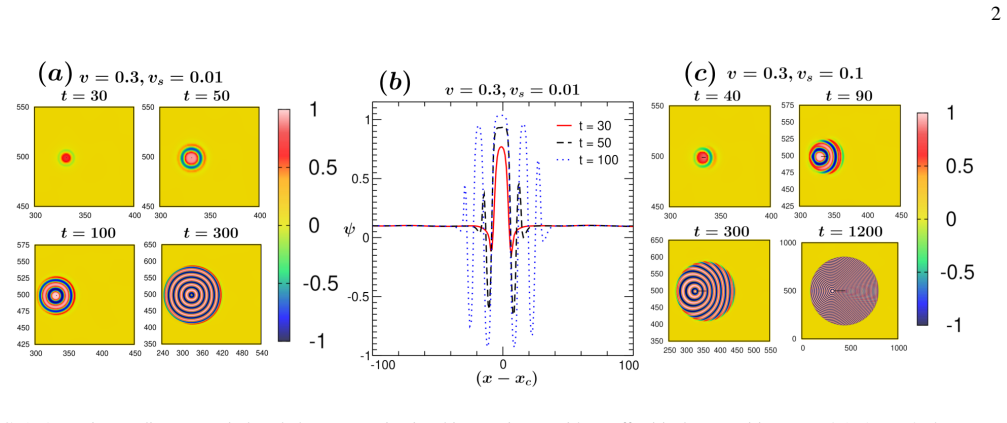
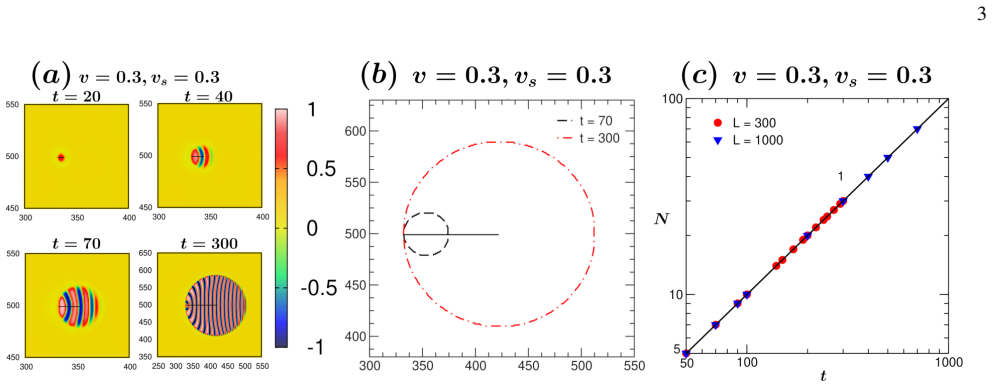
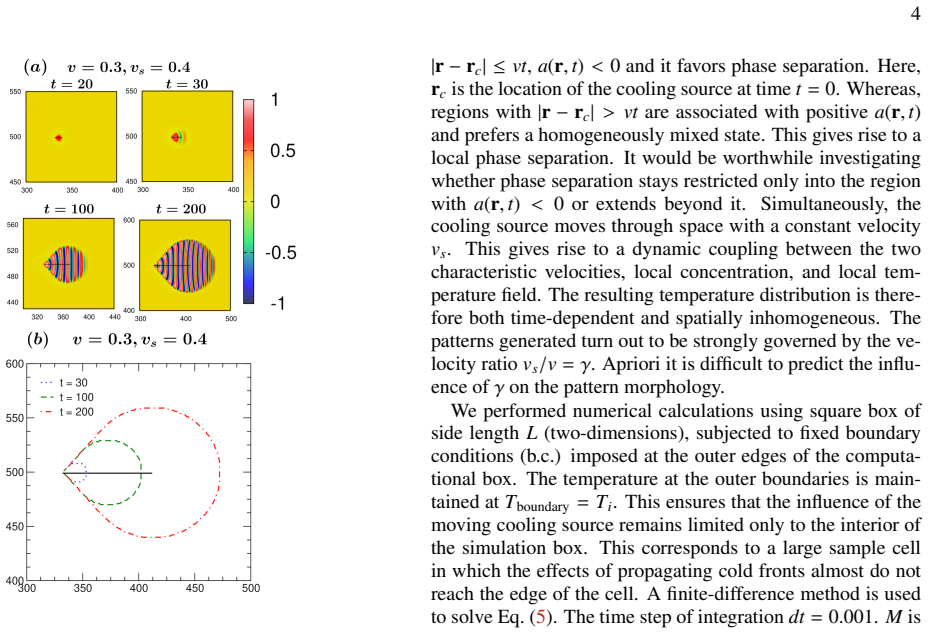
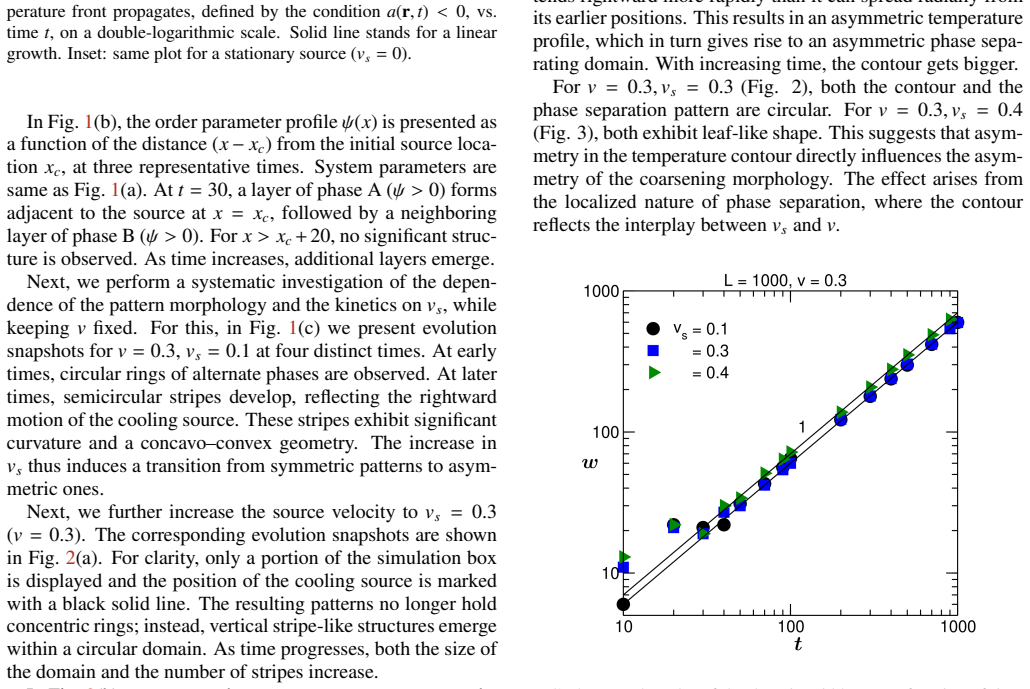
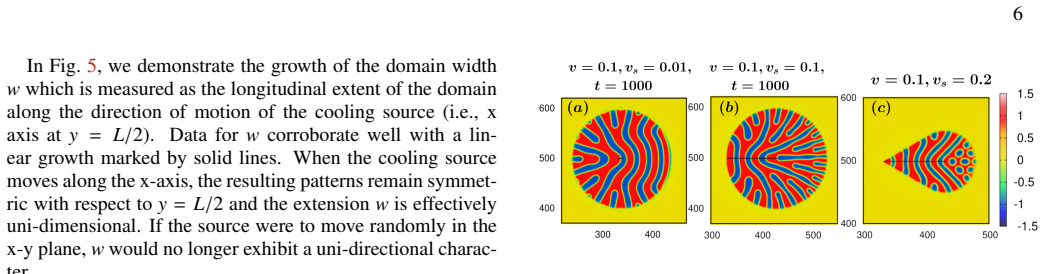
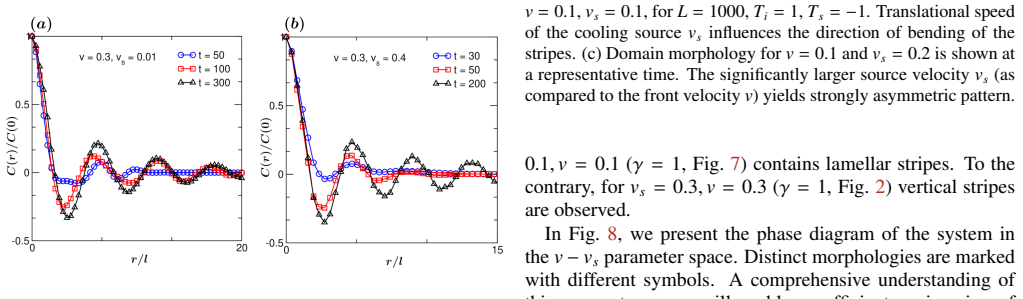
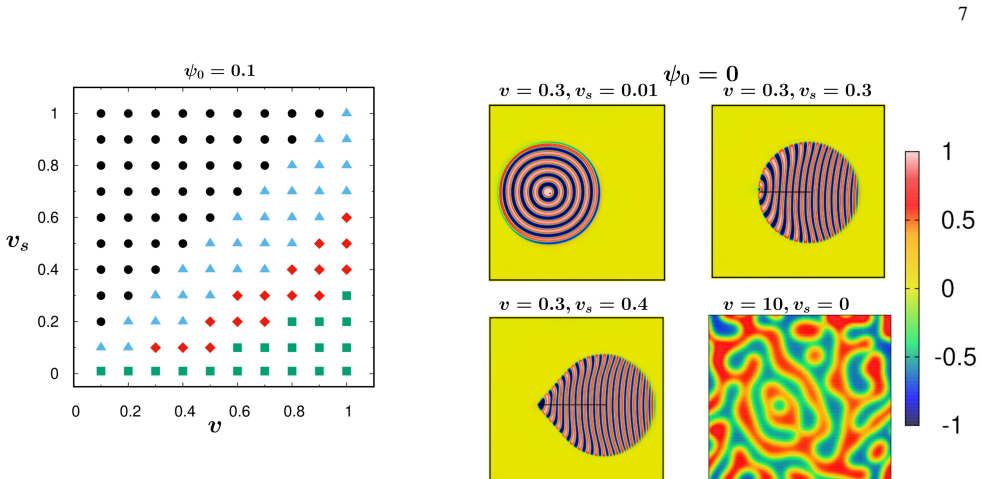
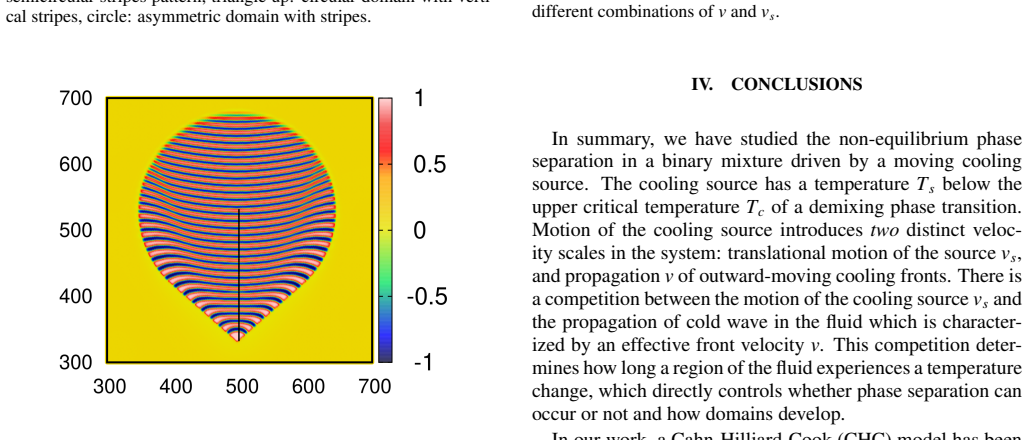
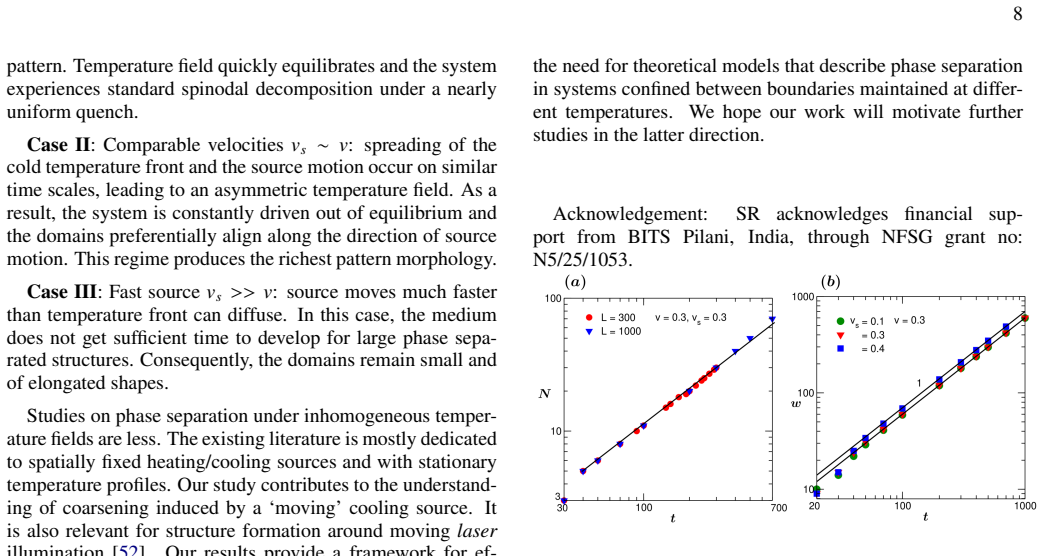
The evolving patterns and kinetics strongly depend on both the ratio and absolute magnitudes of the two competing velocities vs and v. Same value of vs/v yields distinctly different patterns for different v. The temperature profile delineating spatial regions with local temperatures above and below the demixing temperature controls the shape of the patterns formed. A modified Cahn-Hilliard-Cook framework with explicit coupling between the time-dependent temperature and concentration fields is used to capture this.
What carries the argument
Modified Cahn-Hilliard-Cook model with explicit coupling between time-dependent temperature and concentration fields, where competition between source translation velocity vs and cooling front propagation velocity v sets how long regions experience temperatures below the demixing point.
If this is right
- Same ratio vs/v produces distinctly different patterns when the absolute value of v changes.
- The spatial temperature profile above and below the demixing temperature determines the final pattern shapes.
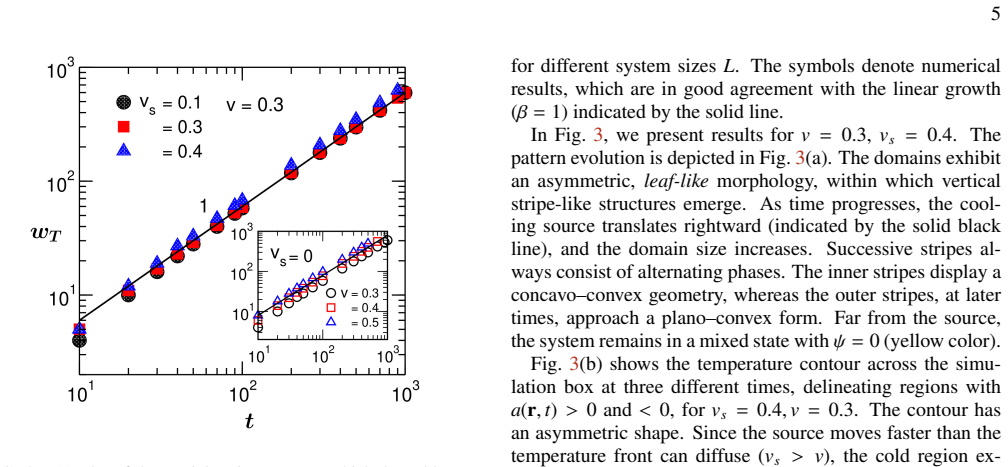
- Kinetics of separation are governed by how long each region spends below the demixing temperature.
- The broad range of possible velocity pairs allows tuning to produce specific desired structures.
Where Pith is reading between the lines
- This velocity-tuning approach might extend to controlling microstructures during industrial cooling of mixtures or in additive manufacturing with moving heat sources.
- Comparable effects could appear in other moving-heat systems such as crystal growth or fluid flows with localized cooling.
- Independent experimental control of vs and v would directly test whether absolute magnitudes matter beyond the ratio.
Load-bearing premise
The modified Cahn-Hilliard-Cook model with explicit temperature-concentration coupling, as implemented numerically, faithfully captures the real dynamics of a moving cooling source.
What would settle it
Laboratory observation of phase separation patterns in a binary liquid mixture using a controlled moving cooling source, tested at fixed vs/v but different absolute v values, to check whether patterns remain distinct.
Figures
read the original abstract
We investigate phase separation dynamics in a binary mixture subjected to a moving cooling source from which cold temperature fronts propagate radially outward into the mixture. The motion of the source introduces two distinct velocity scales: $v_s$ associated with the translation of the source, and $v$ related to the propagation of the cooling thermal fronts. Competition between the two velocities determines how long a region of the fluid experiences a temperature change, which directly controls phase separation. A modified Cahn Hilliard Cook framework is employed, incorporating explicit coupling between the time-dependent temperature and concentration fields. Our numerical simulation results reveal that the evolving patterns and kinetics strongly depend on both the ratio and absolute magnitudes of these two competing velocities. Same value of $v_s/v$ yields distinctly different patterns for different $v$. The temperature profile delineating spatial regions with local temperatures above and below the demixing temperature controls the shape of the patterns formed. The rich parameter space enables one to engineer desired pattern structures by tuning the two velocities.
Editorial analysis
A structured set of objections, weighed in public.
Referee Report
Summary. The manuscript numerically simulates phase separation in a binary liquid mixture driven by a moving cooling source using a modified Cahn-Hilliard-Cook model with explicit temperature-concentration coupling. It reports that pattern morphology and kinetics depend on both the velocity ratio vs/v and the absolute magnitudes of vs (source translation) and v (cooling-front propagation), with the spatial temperature profile (regions above/below the demixing temperature) controlling the resulting structures; the same ratio produces distinct outcomes at different absolute speeds.
Significance. If the reported velocity dependence is robust, the work identifies a controllable mechanism for engineering phase-separation patterns via competing velocities, extending non-equilibrium thermodynamics of binary mixtures and offering a simulation-based route to microstructure design.
major comments (2)
- [Results] Results section (and abstract): the central claim that identical vs/v ratios produce distinctly different patterns at different absolute v rests entirely on the numerical outputs, yet the manuscript provides no grid-convergence tests, time-step independence checks, or error bars on the reported morphologies and kinetic measures; without these, it is unclear whether the observed distinctions survive refinement of the discretization.
- [Model and Methods] Model implementation: the modified Cahn-Hilliard-Cook equations with imposed moving temperature field are solved numerically, but the paper does not report validation against known limiting cases (e.g., stationary source or equilibrium phase separation) or sensitivity to the mobility and noise amplitude parameters that set the intrinsic time scales competing with v and vs.
minor comments (2)
- [Discussion] The abstract states that 'the temperature profile delineating spatial regions... controls the shape,' but the manuscript would benefit from a quantitative metric (e.g., correlation between local temperature and local order-parameter variance) rather than qualitative description.
- [Figures] Figure captions and legends should explicitly state the values of vs, v, and the ratio used in each panel, together with the simulation domain size and total integration time.
Simulated Author's Rebuttal
We thank the referee for their careful reading of our manuscript and for the constructive comments, which have helped us identify areas where additional documentation will strengthen the presentation. We address each major comment below and will incorporate the suggested material in the revised version.
read point-by-point responses
-
Referee: [Results] Results section (and abstract): the central claim that identical vs/v ratios produce distinctly different patterns at different absolute v rests entirely on the numerical outputs, yet the manuscript provides no grid-convergence tests, time-step independence checks, or error bars on the reported morphologies and kinetic measures; without these, it is unclear whether the observed distinctions survive refinement of the discretization.
Authors: We agree that explicit numerical convergence tests are necessary to support the robustness of the reported velocity-dependent patterns. Although the chosen discretization parameters follow conventions established in the Cahn-Hilliard literature, the original submission did not include dedicated convergence or time-step studies. In the revised manuscript we will add a dedicated subsection presenting results from grid-refinement runs (halving and doubling the spatial step size) and time-step independence checks. We will also include statistical error bars obtained from an ensemble of independent realizations that differ only in the random seed of the noise term, thereby quantifying the variability in both morphological descriptors and kinetic measures. revision: yes
-
Referee: [Model and Methods] Model implementation: the modified Cahn-Hilliard-Cook equations with imposed moving temperature field are solved numerically, but the paper does not report validation against known limiting cases (e.g., stationary source or equilibrium phase separation) or sensitivity to the mobility and noise amplitude parameters that set the intrinsic time scales competing with v and vs.
Authors: We acknowledge that the manuscript omitted these standard validation steps. The revised Methods section will contain two new paragraphs: one demonstrating that the code recovers the expected isotropic spinodal decomposition when the source is held stationary (vs = 0) and the expected absence of phase separation when the entire domain remains above the demixing temperature; the second will report a parameter-sensitivity study in which the mobility coefficient and noise amplitude are varied over physically plausible ranges while keeping the velocity scales fixed. These tests will confirm that the qualitative dependence on the ratio vs/v and on the absolute magnitudes of vs and v is insensitive to modest changes in the intrinsic time scales. revision: yes
Circularity Check
No significant circularity detected
full rationale
The paper reports outcomes from direct numerical integration of a modified Cahn-Hilliard-Cook system with an externally imposed moving cooling source. The stated dependence of patterns and kinetics on the ratio vs/v and on the absolute values of vs and v follows immediately from the structure of the coupled PDEs (intrinsic mobility and interfacial time scales versus the imposed velocity scales) without any parameter fitting to the target morphologies, without self-definitional closure, and without load-bearing self-citations. The temperature-profile control of morphology is an observed consequence of the simulation, not an input smuggled in by construction. The derivation chain is therefore self-contained and non-circular.
Axiom & Free-Parameter Ledger
axioms (1)
- domain assumption The modified Cahn-Hilliard-Cook equations with explicit time-dependent temperature coupling accurately describe the phase separation dynamics under a moving cooling source.
Reference graph
Works this paper leans on
-
[1]
In our work, there is a temperature field which depends on both space and time
which obeys the relation⟨η(r,t)η(r ′,t ′)⟩=−2ν(r)∇ 2δ(r− r′)δ(t−t ′),ν(r)characterizing the noise strength. In our work, there is a temperature field which depends on both space and time. In order to incorporate this, we make the parameterain Eq. (7) space dependent:a=a 0(T(r,t)−T c)/Tc,a 0 being a positive constant. By construction,T(r,t)<T c favors phas...
-
[2]
S. Puri and V . Wadhawan, eds.,Kinetics of Phase Transitions (CRC Press, Boca Raton, 2009)
work page 2009
-
[3]
A. J. Bray, Advances in Physics51, 481 (2002)
work page 2002
-
[4]
Onuki,Phase Transition Dynamics(Cambridge University Press, Cambridge, 2002)
A. Onuki,Phase Transition Dynamics(Cambridge University Press, Cambridge, 2002)
work page 2002
- [5]
- [6]
-
[7]
H. Zhou, Z. Jin, Y . Xu, Y . Lu, Z. Xia, F. Yang, Q. Wu, Y . Gao, J. Yin, J. Zhang, C. Ni, B. Zhang, Y . He, H. Yang, and K. Xu, National Science Review12, nwaf136 (2025)
work page 2025
- [8]
-
[9]
K. Jin, W. Yu, Y . Liu, J. Li, G. Du, J. Chen, L. Liu, and X. Lv, Trends in biotechnology43, 1403–1424 (2025)
work page 2025
- [10]
-
[11]
S. Hong and P. K. Chan, Modelling and Simulation in Materials Science and Engineering18, 025013 (2010)
work page 2010
- [12]
- [13]
-
[14]
P. Wirnsberger, D. Frenkel, and C. Dellago, The Journal of Chemical Physics143, 124104 (2015)
work page 2015
-
[15]
N. E. R. Zimmermann, G. Guevara-Carrion, J. Vrabec, and N. Hansen, Advanced Theory and Simulations5, 2200311 (2022)
work page 2022
- [16]
-
[17]
P. K. Jaiswal, S. Puri, and K. Binder, Europhysics Letters103, 66003 (2013)
work page 2013
-
[18]
K.-W. D. Lee, P. K. Chan, and X. Feng, Macromolecular The- ory and Simulations11, 996 (2002)
work page 2002
-
[19]
G. Gonnella, A. Lamura, and A. Piscitelli, Journal of Physics A: Mathematical and Theoretical41, 105001 (2008)
work page 2008
- [20]
-
[21]
S. Roy, A. Bera, S. Majumder, and S. K. Das, Soft Matter15, 4743 (2019)
work page 2019
-
[22]
S. K. Das, S. Roy, S. Majumder, and S. Ahmad, Europhysics Letters97, 66006 (2012)
work page 2012
-
[23]
A. Oprisan, Y . Garrabos, C. Lecoutre, and D. Beysens, Molecules22(2017), 10.3390/molecules22060947
-
[24]
G. Gonnella and A. Lamura, Journal of Physics A: Mathemati- cal and Theoretical53, 305002 (2020)
work page 2020
- [25]
-
[26]
W. Li, J. Hu, and R. Liu, Processes13(2025), 10.3390/pr13093014
-
[27]
G. Sahu, C. Chakraborty, S. Roy, and S. Banerjee, Physica Scripta100, 055931 (2025)
work page 2025
-
[28]
I. M. Lifshitz and V . V . Slyozov, Journal of Physics and Chem- istry of Solids19, 35 (1961). 9
work page 1961
-
[29]
Binder, inPhase Transformations of Materials, Materi- als Science and Technology, V ol
K. Binder, inPhase Transformations of Materials, Materi- als Science and Technology, V ol. 5, edited by R. W. Cahn, P. Haasen, and E. J. Kramer (VCH, Weinheim, 1991) pp. 405– 471
work page 1991
-
[30]
M. Laradji, S. Toxvaerd, and O. G. Mouritsen, Physical Review Letters77, 2253 (1996)
work page 1996
- [31]
-
[32]
A. K. Singh and V . Banerjee, Soft Matter19, 2370 (2023)
work page 2023
- [33]
- [34]
- [35]
-
[36]
Tanaka, Journal of Chemical Physics107, 3734 (1997)
H. Tanaka, Journal of Chemical Physics107, 3734 (1997)
work page 1997
- [37]
- [38]
- [39]
-
[40]
Furukawa, Physica A: Statistical Mechanics and its Applica- tions180, 128 (1992)
H. Furukawa, Physica A: Statistical Mechanics and its Applica- tions180, 128 (1992)
work page 1992
-
[41]
E. M. Foard and A. J. Wagner, Phys. Rev. E79, 056710 (2009)
work page 2009
-
[42]
G. Gonnella, A. Lamura, A. Piscitelli, and A. Tiribocchi, Phys. Rev. E82, 046302 (2010)
work page 2010
-
[43]
E. M. Foard and A. J. Wagner, Phys. Rev. E85, 011501 (2012)
work page 2012
- [44]
- [45]
-
[46]
Fisher,Critical phenomena / edited by M
M. Fisher,Critical phenomena / edited by M. S. Green(Aca- demic Press, London, 1971)
work page 1971
-
[47]
H. Stanley,Introduction to Phase Transitions and Critical Phenom- ena(Oxford University Press, Oxford, 1971)
work page 1971
-
[48]
S. Puri and V . W. (eds.),Kinetics of Phase transitions(CRC Press, Boca Raton, 2009)
work page 2009
-
[49]
M. Plischke and B. Bergersen,Equilibrium Statictical Mechan- ics(World Scientific, Singapore, 2006)
work page 2006
-
[50]
S. K. Das, S. Puri, J. Horbach, and K. Binder, Physical Review Letters96, 016107 (2006)
work page 2006
-
[51]
F. Höfling and S. Dietrich, The Journal of Chemical Physics 160, 104107 (2024)
work page 2024
-
[52]
M. Fayaz-Torshizi, W. Xu, J. R. Vella, B. D. Marshall, P. I. Ravikovitch, and E. A. Müller, The Journal of Physical Chem- istry B126, 1085 (2022), pMID: 35104134
work page 2022
-
[53]
J. R. Gomez-Solano, A. Blokhuis, and C. Bechinger, Phys. Rev. Lett.116, 138301 (2016)
work page 2016
discussion (0)
Sign in with ORCID, Apple, or X to comment. Anyone can read and Pith papers without signing in.