Recognition: unknown
Raman Characterization of Two-Dimensional Quasiperiodic Antiferromagnets on Various Lattices: Spin-Orbit Mechanism
Pith reviewed 2026-05-07 15:01 UTC · model grok-4.3
The pith
First-order Raman spectra in quasiperiodic antiferromagnets split into multiple peaks as anisotropy changes from Ising to Heisenberg, unlike the single peaks on periodic lattices.
A machine-rendered reading of the paper's core claim, the machinery that carries it, and where it could break.
Core claim
The first-order spectra consist only of rotation-invariant and mirror-symmetric magnons. With the exchange anisotropy moving away from the Ising limit toward the Heisenberg isotropic point, every initial delta-function peak bifurcates or divides into more in each individual manner on quasiperiodic lattices, while it remains singly peaked all the way on periodic lattices. Such splittings depend on how many types of isocoordinated sites for each coordination number and relative positions between those of the same type. A perpendicular-space representation of the first-order Raman spectrum serves as a fingerprint of each quasiperiodic tiling.
What carries the argument
The spin-orbit mechanism for indirect electric-dipole coupling that enables first-order single-magnon Raman scattering, combined with the XXZ anisotropy on bipartite quasiperiodic lattices.
Load-bearing premise
The nearest-neighbor antiferromagnetic XXZ Hamiltonian plus indirect electric-dipole coupling via spin-orbit interaction fully captures the first-order Raman process, with no significant contributions from longer-range interactions, disorder, or higher-order scattering channels.
What would settle it
Measuring the Raman spectrum of a quasiperiodic antiferromagnet and finding that the peaks do not split or split in the same way as on a periodic lattice when the anisotropy is varied would contradict the claim.
Figures




read the original abstract
We study first-order (single-magnon) inelastic light scatterings in spin-$\frac{1}{2}$ two-dimensional quasiperiodic antiferromagnets in comparison with those emergent on periodic lattices. Unlike second-order (two-magnon) Raman scatterings based on an exchange interaction between neighboring spins, the present observations involve an indirect electric-dipole coupling which proceeds through a spin-orbit interaction. We discuss the nearest-neighbor antiferromagnetic XXZ Hamiltonian on various quasiperiodic and periodic bipartite lattices. The first-order spectra, of our present interest, consist only of rotation-invariant and mirror-symmetric magnons, while the second-order ones cannot select any particular magnon. With the exchange anisotropy moving away from the Ising limit toward the Heisenberg isotropic point, every initial delta-function peak bifurcates or divides into more in each individual manner on quasiperiodic lattices, while it remains singly peaked all the way on periodic lattices. Such splittings depend on how many types of isocoordinated sites for each coordination number and relative positions between those of the same type. A perpendicular-space representation of the first-order Raman spectrum serves as a fingerprint of each quasiperiodic tiling.
Editorial analysis
A structured set of objections, weighed in public.
Referee Report
Summary. The manuscript examines first-order Raman spectra from single-magnon excitations in spin-1/2 antiferromagnets on two-dimensional quasiperiodic lattices, modeled by the nearest-neighbor XXZ Hamiltonian with an indirect electric-dipole coupling mediated by spin-orbit interaction. It contrasts this with periodic lattices and reports that, as the exchange anisotropy varies from the Ising limit toward the Heisenberg point, delta-function peaks split on quasiperiodic tilings in a manner determined by the multiplicity and relative positions of isocoordinated sites, while remaining unsplit on periodic lattices. A perpendicular-space representation of the spectrum is proposed as a fingerprint for each quasiperiodic tiling. The spectra are restricted to rotation-invariant and mirror-symmetric magnons.
Significance. If the central results hold, the work supplies a concrete spectroscopic signature for distinguishing quasiperiodic from periodic antiferromagnetic order through anisotropy-dependent peak splittings, which could assist experimental characterization of quasicrystalline magnets. The direct computational protocol on the explicit model, the symmetry selection rules, and the parameter-free nature of the splitting mechanism (no fitted parameters) constitute clear strengths that enhance the paper's utility for the field.
minor comments (3)
- [Abstract and §1] The abstract and introduction refer to 'various quasiperiodic and periodic bipartite lattices' without immediately enumerating the specific tilings examined; listing them (e.g., Penrose, Ammann-Beenker) with coordination-number statistics would improve readability.
- [Raman operator construction] The construction of the Raman operator via spin-orbit coupling is described, but the explicit matrix elements or selection rules for the rotation-invariant and mirror-symmetric magnons should be shown in an equation or table for one representative lattice to make the bifurcation mechanism fully transparent.
- [Computational protocol] Numerical details such as system sizes used for diagonalization, convergence checks with respect to cluster size, and any error estimates on peak positions or intensities are not mentioned in the provided summary; adding a short methods paragraph or appendix would strengthen reproducibility.
Simulated Author's Rebuttal
We thank the referee for the positive assessment of our manuscript and the recommendation for minor revision. No specific major comments were raised in the report, so we have no points to address individually at this stage. We will review the manuscript for any minor improvements prior to resubmission.
Circularity Check
No significant circularity
full rationale
The paper constructs the first-order Raman operator from the spin-orbit-mediated electric-dipole mechanism and computes single-magnon spectra by direct diagonalization (or equivalent) of the nearest-neighbor XXZ Hamiltonian on explicitly given quasiperiodic and periodic lattices. Peak splittings are shown to follow from the geometric multiplicity of isocoordinated sites, which is an input property of the tilings rather than a derived or fitted quantity. No parameters are adjusted to match data inside the paper, no self-citations supply the central uniqueness or ansatz, and the perpendicular-space fingerprint is a direct re-expression of the computed spectrum. The model scope is stated explicitly rather than smuggled in.
Axiom & Free-Parameter Ledger
axioms (2)
- domain assumption Nearest-neighbor antiferromagnetic XXZ Hamiltonian describes the quasiperiodic antiferromagnets
- domain assumption First-order Raman scattering proceeds via indirect electric-dipole coupling through spin-orbit interaction
Reference graph
Works this paper leans on
-
[1]
Introduction Quasicrystals are exotic materials that lack translationa l symmetry but exhibit long-range order. 1, 2) Since their first discovery in aluminum-manganese alloys, 3) a wide variety of quasicrystalline materials have been synthesized. 4–11) While early explorations were limited to synthetic intermetalli c compounds,12) recent studies have repor...
work page internal anchor Pith review Pith/arXiv arXiv 2026
-
[2]
The colors of the domains correspond to the vertices shown in (c)
-
[3]
Each of these lattices is bipartite, as it is composed of even - edged prototiles
Two-dimensional Quasiperiodic Lattice We investigate three two-dimensional quasiperiodic lat- tices: the Penrose, Ammann-Beenker, and Socolar lattices. Each of these lattices is bipartite, as it is composed of even - edged prototiles. No sublattice imbalance arises in the the r- modynamic limit. 37–39) For all three lattices, the spatial di- mension d is ...
-
[4]
The pentagonal projection windows are partitioned into compac t regions, each corresponding to one of the eight vertex types [Fig
The vertex sites contained in Z = 0 and Z = 2/ √ 5 layers form the even sublattice, while those in Z = 1/ √ 5 and Z = 3/ √ 5 layers form the odd sublattice. The pentagonal projection windows are partitioned into compac t regions, each corresponding to one of the eight vertex types [Fig. 1(d)]. Their areas and structures can be categorized i nto two classe...
-
[5]
Model and Method We study the spin S = 1 2 nearest-neighbor antiferromag- netic XXZ model on the two-dimensional C5v Penrose, C8v Ammann-Beenker, and C3v Socolar tilings, each consisting of bipartite sublattices A with LA sites and B with LB sites (LA + LB ≡L), whose Hamiltonian reads H = J ∑ ⟨i, j⟩ { ∆ ( S x riS x r j + S y riS y r j ) + S z riS z r j } ...
-
[6]
¾ k¾ /J ¹ 1 2 3 4 0 h! /J I(!) (arb. unit) 1 2 3 1.5 2.5 3.5 4 0.5 (a1) (a2) 4 5 1 2 3 1 2 3 1.5 2.5 3.5 4 0.5
First-Order Spin-Orbit Raman Scattering Single-magnon-mediated Raman scattering is described as a third-order transition, involving a second-order electr ic- dipole coupling and a first-order SO interaction. 49) The matrix element for the Raman scattering process at the magnetic ion on site rl is given by Ml = 1∑ m, n=−1 ℏ √ ωinωsce2λ 2ε0V [ 1 (E0 −ℏωin)2 ...
-
[7]
The peaks associated with z = 6 sites exhibit a sub- tle splitting at ℏω = 2
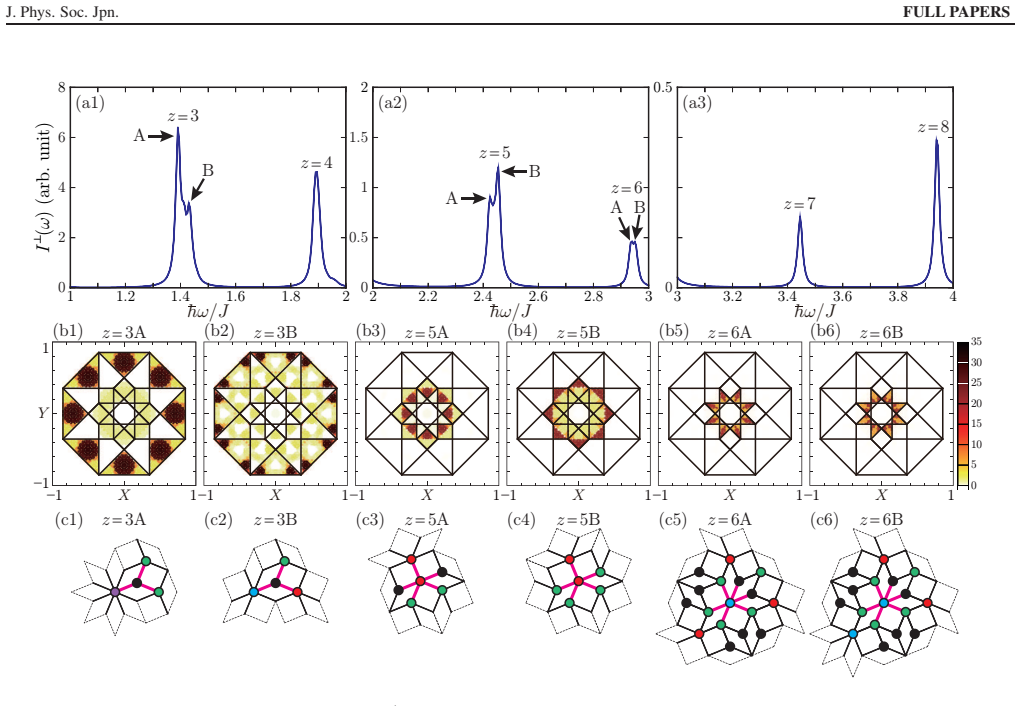
5. The peaks associated with z = 6 sites exhibit a sub- tle splitting at ℏω = 2. 90J and 2 . 92J [Fig. 11(a2)]. The perpendicular-space representations of the site-resolve d Ra- man spectra for each branch are shown in Figs. 11(b1) and 11(b2). The spectral-weight distribution indicates that t he z = 6 domain consists of two major regions, each associated ...
-
[8]
Summary and Discussion We have investigated spin-orbit-interaction-driven mag- netic Raman spectra of two-dimensional bipartite-lattice XXZ 7 J. Phys. Soc. Jpn. FULL PAPERS 1 /g161 Y (b1) (b2) (b3) (b4) (b5) (b6) (c2) (c3) (c4) (c5) (c6) z /g32 3A z /g32 3B z /g32 5A z /g32 5B z /g32 6A z /g32 6B h! /J I┴(!) (arb. unit) 1 1.2 20 z /g32 4 z /g32 3(a1) 1.4 ...
-
[9]
999 for the Penrose lattices of L = 5881 and L = 10351 (a1), for the Ammann-Beenker lattices of L = 6673 and L = 10457 (b1), and for the Socolar lattices of L = 5056 and L = 11566 (c1). Contour plots of site- resolved Raman spectra I⊥(ω)|l (21) multiplied by the number of sites at the peak energy: L = 5881 (a2) and L = 10351 (a3) for the Penrose lattices,...
-
[10]
Levine and P
D. Levine and P . J. Steinhardt, Quasicrystals: A New Class of Ordered Structures, Phys. Rev. Lett. 53, 2477 (1984)
1984
-
[11]
Levine and P
D. Levine and P . J. Steinhardt, Quasicrystals. I. Definiti on and structure, Phys. Rev. B 34, 596 (1986)
1986
-
[12]
Shechtman, I
D. Shechtman, I. Blech, D. Gratias, and J. W. Cahn, Metalli c Phase with Long-Range Orientational Order and No Translational S ymmetry, Phys. Rev. Lett. 53, 1951 (1984)
1951
-
[13]
A. P . Tsai, A. Inoue, T. Masumoto, A Stable Quasicrystal in Al-Cu-Fe System. Jpn. J. Appl. Phys. 26, L1505 (1987)
1987
-
[14]
A. P . Tsai, A. Inoue, T. Masumoto, New Stable Icosahedral A l-Cu-Ru and Al-Cu-Os Alloys. Jpn. J. Appl. Phys. 27, L1587 (1988)
1988
-
[15]
A. P . Tsai, J. Q. Guo, E. Abe, H. Takakura, and T. J. Sato, A stable binary quasicrystal, Nature 480, 537 (2000)
2000
-
[16]
Takakura, C
H. Takakura, C. P . G´ omez, A. Y amamoto, M. de Boissieu, and A. P . Tsai, Atomic structure of the binary icosahedral Yb-Cd quas icrystal, Nat. Mater. 6, 58 (2007)
2007
-
[17]
Deguchi, S
K. Deguchi, S. Matsukawa, N. K. Sato, T. Hattori, K. Ishida , H. Takakura, and T. Ishimasa, Quantum critical state in a magne tic qua- sicrystal, Nat. Mater. 11, 1013 (2012)
2012
-
[18]
Kamiya, T
K. Kamiya, T. Takeuchi, N. Kabeya, N. Wada, T. Ishimasa, A. Ochiai, K. Deguchi, K. Imura, and N. K. Sato, Discovery of supercondu ctivity in quasicrystal, Nat. Commun. 9, 154 (2018)
2018
-
[19]
Tamura, A
R. Tamura, A. Ishikawa, S. Suzuki, T. Kotajima, Y . Tanaka , T. Seki, N. Shibata, T. Y amada, T. Fujii, C.-W. Wang, M. Avdeev, K. Naw a, D. Okuyama, and T. J. Sato, Experimental Observation of Long -Range Magnetic Order in Icosahedral Quasicrystals, J. Am. Chem. S oc. 143, 19938 (2021)
2021
-
[20]
Y amada, A four-dimensional model for the Ba-Ti-O dode cagonal quasicrystal, Acta Cryst
T. Y amada, A four-dimensional model for the Ba-Ti-O dode cagonal quasicrystal, Acta Cryst. B 78, 247 (2022)
2022
-
[21]
A. P . Tsai, Discovery of stable icosahedral quasicrystals: progress in un- derstanding structure and properties, Chem. Soc. Rev. 42, 5352 (2013)
2013
-
[22]
Bindi, P
L. Bindi, P . J. Steinhardt, N. Y ao, and P . J. Lu, Natural Qu asicrystals, Science 324, 1306 (2009)
2009
-
[23]
Bindi, P
L. Bindi, P . J. Steinhardt, N. Y ao, and P . J. Lu, Icosahedr ite, Al63Cu24Fe13, the first natural quasicrystal, Am. Mineral 96, 928 (2011)
2011
-
[24]
Bindi, N
L. Bindi, N. Y ao, C. Lin, L. S. Hollister, C. L. Andronicos , V . V . Distler, M. P . Eddy, A. Kostin, V . Kryachko, G. J. MacPherson, W. M. Ste in- hardt, M. Y udovskaya, and P . J. Steinhardt, Natural quasicr ystal with decagonal symmetry, Sci. Rep. 5, 9111 (2015)
2015
-
[25]
Dotera, Quasicrystals in Soft Matter, Isr
T. Dotera, Quasicrystals in Soft Matter, Isr. J. Chem. 51, 1197 (2011)
2011
-
[26]
X. Zeng, G. Unger, Y . Liu, V . Percec, A. E. Dulcey, and J. K. Hobbs, Supramolecular dendritic liquid quasicrystals, Nature 428, 157 (2004)
2004
-
[27]
Hayashida, T
K. Hayashida, T. Dotera, A. Takano, and Y . Matsushita, Polymeric Qua- sicrystal: Mesoscopic Quasicrystalline Tiling in ABC Star Polymers, Phys. Rev. Lett. 98, 195502 (2007)
2007
-
[28]
S. J. Ahn, P . Moon, T.-H. Kim, H.-W. Kim, H.-C. Shin, E. H. Kim, H. W. Cha, S.-J. Kahng, P . Kim, M. Koshino, Y .-W. Son, C.-W. Y ang, and J. R. Ahn, Dirac electrons in a dodecagonal graphene quasicrysta l, Science 9 J. Phys. Soc. Jpn. FULL PAPERS 361, 782 (2018)
2018
-
[29]
P . Moon, M. Koshino, and Y .-W. Son, Quasicrystalline electronic states in 30 ◦ rotated twisted bilayer graphene, Phys. Rev. B 99, 165430 (2019)
2019
-
[30]
Takesaki, K
Y . Takesaki, K. Kawahara, H. Hibino, S. Okada, M. Tsuji, a nd H. Ago, Highly Uniform Bilayer Graphene on Epitaxial Cu-Ni(111) Al loy, Chem. Mater. 28, 4583 (2016)
2016
-
[31]
W. Y ao, E. Wang, C. Bao, Y . Zhang, K. Zhang, K. Bao, C. K. Cha n, C. Chen, J. Avila, M. C. Asensio, J. Zhu, and S. Zhou, Quasicrystalline 30◦ twisted bilayer graphene as an incommensurate superlattice with strong interlayer coupling, Proc. Natl. Acad. Sci. USA 115, 6928 (2018)
2018
-
[32]
Pezzini, V
S. Pezzini, V . Miseikis, G. Piccinini, S. Forti, S. Pace, R. Engelke, F. Rossella, K. Watanabe, T. Taniguchi, P . Kim, and C. Colett i, 30 ◦- Twisted Bilayer Graphene Quasicrystals from Chemical V apor Deposi- tion, Nano Lett. 20, 3313 (2020)
2020
-
[33]
Guidoni, C
L. Guidoni, C. Trich´ e, P . V erkerk, and G. Grynberg, Quasiperiodic Op- tical Lattices, Phys. Rev. Lett. 79, 3363 (1997)
1997
-
[34]
Viebahn, M
K. Viebahn, M. Sbroscia, E. Carter, J.-C. Y u, and U. Schne ider, Matter- Wave Diffraction from a Quasicrystalline Optical Lattice, Phys. Rev . Lett. 122, 110404 (2019)
2019
-
[35]
Sbroscia, K
M. Sbroscia, K. Viebahn, E. Carter, J.-C. Y u, A. Gaunt, an d U. Schnei- der, Observing Localization in a 2D Quasicrystalline Optic al Lattice, Phys. Rev. Lett. 125, 200604 (2020)
2020
-
[36]
Sanchez-Palencia and L
L. Sanchez-Palencia and L. Santos, Bose-Einstein conde nsates in opti- cal quasicrystal lattices, Phys. Rev. A 72, 053607 (2005)
2005
-
[37]
Jagannathan and M
A. Jagannathan and M. Duneau, An eightfold optical quasi crystal with cold atoms, Europhys. Lett. 104, 66003 (2013)
2013
-
[38]
Jagannathan and M
A. Jagannathan and M. Duneau, The eight-fold way for opti cal qua- sicrystals, Eur. Phys. J. B 87, 149 (2014)
2014
-
[39]
J.-C. Y u, S. Bhave, L. Reeve, B. Song, and U. Schneider, Ob serving the two-dimensional Bose glass in an optical quasicrystal, Nat ure 633, 338 (2024)
2024
-
[40]
Bloch, J
I. Bloch, J. Dalibard, and W. Zwerger, Many-body physics with ultra- cold gases, Rev. Mod. Phys. 80, 885 (2008)
2008
-
[41]
Kohmoto and B
M. Kohmoto and B. Sutherland, Electronic States on a Penr ose Lattice, Phys. Rev. Lett. 56, 2740 (1986)
1986
-
[42]
M. Arai, T. Tokihiro, T. Fujiwara, and M. Kohmoto, Strict ly localized states on a two-dimensional Penrose lattice, Phys. Rev. B 38, 1621 (1988)
1988
-
[43]
Mirzhalilov and M
M. Mirzhalilov and M. ¨O. Oktel, Perpendicular space accounting of lo- calized states in a quasicrystal, Phys. Rev. B 102, 064213 (2020)
2020
-
[44]
M. ¨O. Oktel, Strictly localized states in the octagonal Ammann-Beenker quasicrystal, Phys. Rev. B 104, 014204 (2021)
2021
-
[45]
Akif Keskiner and M
M. Akif Keskiner and M. ¨O. Oktel, Strictly localized states on the So- colar dodecagonal lattice, Phys. Rev. B 106, 064207 (2022)
2022
-
[46]
Koga and H
A. Koga and H. Tsunetsugu, Antiferromagnetic order in th e Hubbard model on the Penrose lattice, Phys. Rev. B 96, 214402 (2017)
2017
-
[47]
Koga, Superlattice structure in the antiferromagnet ically ordered state in the Hubbard model on the Ammann-Beenker tiling, Phy s
A. Koga, Superlattice structure in the antiferromagnet ically ordered state in the Hubbard model on the Ammann-Beenker tiling, Phy s. Rev. B 102, 115125 (2020)
2020
-
[48]
Koga, Antiferromagnetic Ordered State in the Half-Fi lled Hub- bard Model on the Socolar Dodecagonal Tiling, Mater
A. Koga, Antiferromagnetic Ordered State in the Half-Fi lled Hub- bard Model on the Socolar Dodecagonal Tiling, Mater. Trans. 62, 360 (2021)
2021
-
[49]
Johnstone, P
D. Johnstone, P . ¨Ohberg, and C. W. Duncan, Mean-field phases of an ultracold gas in a quasicrystalline potential, Phys. Rev. A 100, 053609 (2019)
2019
-
[50]
Ghadimi, T
R. Ghadimi, T. Sugimoto, and T. Tohyama, Mean-field study of the Bose-Hubbard model in the Penrose lattice, Phys. Rev. B 102, 224201 (2020)
2020
-
[51]
M. Hori, T. Sugimoto, Y . Hashizume, and T. Tohyama, Multi fractality and Hyperuniformity in Quasicrystalline Bose-Hubbard Mod els with and without Disorder, J. Phys. Soc. Jpn. 93, 114005 (2024)
2024
-
[52]
Wessel, A
S. Wessel, A. Jagannathan, and S. Haas, Quantum Antiferr omagnetism in Quasicrystals, Phys. Rev. Lett. 90, 177205 (2003)
2003
-
[53]
Wessel and I
S. Wessel and I. Milat, Quantum fluctuations and excitati ons in antifer- romagnetic quasicrystals, Phys. Rev. B 71, 104427 (2005)
2005
-
[54]
Jagannathan, A
A. Jagannathan, A. Szallas, S. Wessel, and M. Duneau, Pen rose quan- tum antiferromagnet, Phys. Rev. B 75, 212407 (2007)
2007
-
[55]
Szallas and A
A. Szallas and A. Jagannathan, Spin waves and local magne tizations on the Penrose tiling, Phys. Rev. B 77, 104427 (2008)
2008
-
[56]
L.-M. Duan, E. Demler, and M. D. Lukin, Controlling Spin E xchange Interactions of Ultracold Atoms in Optical Lattices, Phys. Rev. Lett.91, 090402 (2003)
2003
-
[57]
Moriya, Theory of Light Scattering by Magnetic Crysta ls, J
T. Moriya, Theory of Light Scattering by Magnetic Crysta ls, J. Phys. Soc. Jpn, 23, 490 (1967)
1967
-
[58]
P . A. Fleury and R. Loudon, Scattering of Light by One- and Two- Magnon Excitations, Phys. Rev. 166, 514 (1968)
1968
-
[59]
B. S. Shastry and B. I. Shraiman, Theory of Raman scatteri ng in Mott- Hubbard systems, Phys. Rev. Lett. 65, 1068 (1990)
1990
-
[60]
B. S. Shastry and B. I. Shraiman, Raman Scattering in Mott -Hubbard Systems, Int. J. Mod. Phys. B 5, 365 (1991)
1991
-
[61]
R. J. Elliot and R. Loudon, The possible observation of el ectric Raman transitions in crystals, Phys. Lett. 3, 189 (1963)
1963
-
[62]
A. F. Khater and M. A. Continentino, Theory of light scatt ering in disor- dered magnetic systems, J. Phys. C: Solid State Phys. 15, 2993 (1982)
1982
-
[63]
Koshizuka and K
N. Koshizuka and K. Hayashi, Raman Scattering from Magno n Excita- tions in RFeO 3, J. Phys. Soc. Jpn. 57, 4418 (1988)
1988
-
[64]
Blumberg, P
G. Blumberg, P . Abbamonte, M. V . Klien, W. C. Lee, D. M. Gin sberg, L. L. Miller, and A. Zibold, Resonant two-magnon Raman scatt ering in cuprate antiferromagnetic insulators, Phys. Rev. B 53, R11930(R) (1996)
1996
-
[65]
Inoue and S
T. Inoue and S. Y amamoto, Optical Observation of Quasipe riodic Heisenberg Antiferromagnets in Two Dimensions, Phys. Stat us Solidi B 257, 2000118 (2020)
2020
-
[66]
Inoue and S
T. Inoue and S. Y amamoto, Polarized Raman Response of Two - Dimensional Quasiperiodic Antiferromagnets: Configurati on- Interaction versus Green’s Function Approaches, J. Phys. S oc. Jpn. 91, 053701 (2022)
2022
-
[67]
D. J. Lockwood, M. G. Cottam, V . C. Y . So, and R. S. Katiyar, Raman scattering from one-magnon excitations in FeF 2, J. Phys. C: Solid State Phys. 17, 6009 (1984)
1984
-
[68]
M. G. Cottam and D. J. Lockwood, One-magnon Raman scatter ing in a S = 5 2 antiferromagnet, Phys. Rev. B 31, 641 (1985)
1985
-
[69]
Gozar, B
A. Gozar, B. S. Dennis, G. Blumberg, S. Komiya, and Y . Ando , Mag- netic Order in Lightly Doped La 2−xSrxCuO4, Phys. Rev. Lett. 93, 027001 (2004)
2004
-
[70]
M. B. Silva Neto and L. Benfatto, One-magnon Raman scatte ring in La2CuO4: The origin of the field-induced mode, Phys. Rev. B 72, 140401(R) (2005)
2005
-
[71]
Benfatto, M
L. Benfatto, M. B. Silva Neto, A. Gozar, B. S. Dennis, G. Bl umberg, L. L. Miller, S. Komiya, and Y . Ando, Field dependence of the mag netic spectrum in anisotropic and Dzyaloshinskii-Moriya antife rromagnets. II. Raman spectroscopy, Phys. Rev. B 74, 024416 (2006)
2006
-
[72]
Y .-J. Lin, K. Jim´ enez-Garc´ ıa, and I. B. Spielman, Spin -orbit-coupled Bose-Einstein condensates, Nature 471, 83 (2011)
2011
-
[73]
Dalibard, F
J. Dalibard, F. Gerbier, G. Juzeli¯ unas, and P . ¨Ohberg, Colloquium: Ar- tificial gauge potentials for neutral atoms, Rev. Mod. Phys. 83, 1523 (2011)
2011
-
[74]
L. W. Cheuk, A. T. Sommer, Z. Hadzibabic, T. Y efsah, W. S. B akr, and M. W. Zwierlein, Spin-Injection Spectroscopy of a Spin-Orb it Coupled Fermi Gas, Phys. Rev. Lett. 109, 095302 (2012)
2012
-
[75]
F. C. Aguilar, A. F. Ho, and J. Ruostekoski, Optical Signa tures of An- tiferromagnetic Ordering of Fermionic Atoms in an Optical L attice, Phys. Rev. X 4, 031036 (2014)
2014
-
[76]
R. A. Hart, P . M. Duarte, T.-L. Y ang, X. Liu, T. Paiva, E. Khatami, R. T. Scalettar, N. Trivedi, D. A. Huse, and R. G. Hulet, Observati on of anti- ferromagnetic correlations in the Hubbard model with ultra cold atoms, Nature 519, 211 (2015)
2015
-
[77]
Bernier, T.-L
J.-S. Bernier, T.-L. Dao, C. Kollath, A. Georges, and P . S . Cornaglia, Thermometry and signatures of strong correlations from Ram an spec- troscopy of fermionic atoms in optical lattices, Phys. Rev. A 81, 063618 (2010)
2010
-
[78]
Penrose, The role of aesthetics in pure and applied mat hematical research, Bull
R. Penrose, The role of aesthetics in pure and applied mat hematical research, Bull. Inst. Math. Appl. 10, 266 (1974)
1974
-
[79]
N. G. de Bruijn, Algebraic theory of Penrose’s non-perio dic tiling of the plane. I, Indag. Math. Proc. Ser. A 84, 39 (1981)
1981
-
[80]
N. G. de Bruijn, Algebraic theory of Penrose’s non-perio dic tiling of the plane. II, Indag. Math. Proc. Ser. A 84, 53 (1981)
1981
discussion (0)
Sign in with ORCID, Apple, or X to comment. Anyone can read and Pith papers without signing in.