Rewiring Perceived Doability in VR: Hand Redirection as a Subtle Cross-Sensory Support for Sustained Practice
Pith reviewed 2026-05-07 15:47 UTC · model grok-4.3
The pith
Conservative VR hand redirection creates micro-success experiences that boost continuation intention for sustained light exercise.
A machine-rendered reading of the paper's core claim, the machinery that carries it, and where it could break.
Core claim
This position paper claims that conservative hand redirection in VR, kept within perceptual limits, can reframe the technique as cross-sensory support that targets perceived doability by producing micro-successes, such as reaching a virtual goal with similar physical effort, thereby increasing continuation intention and early re-engagement in sustained practice of light physical activities.
What carries the argument
Hand redirection (HR) applied conservatively within perceptual limits to generate micro-success experiences that shift perceived doability in VR goal-reaching tasks.
If this is right
- Repeated micro-successes increase continuation intention for light exercises.
- Early re-engagement occurs without overt pressure or intensive coaching.
- Support for positive behavior change in everyday physical activities like stretching.
- Design tensions arise around autonomy, authenticity, trust, and dependence.
- Two research questions guide investigation into when HR supports versus undermines sustained practice.
Where Pith is reading between the lines
- The approach could be tested in VR-based rehabilitation programs where patients repeat movements to build habit.
- Longer-term studies might reveal whether initial VR micro-successes carry over to increased real-world activity outside the headset.
- Integration with other subtle sensory cues could amplify the effect on perceived capability while preserving agency.
- Broader HCI design patterns may emerge for using perceptual shifts to support behavior without explicit instruction.
Load-bearing premise
The micro-success experiences created by hand redirection will reliably translate into increased continuation intention and sustained real-world practice rather than being offset by reduced feelings of authenticity or agency.
What would settle it
A multi-session experiment comparing continuation rates and self-reported agency between VR conditions with and without conservative hand redirection to check whether the redirection group shows higher re-engagement or lower authenticity scores.
Figures
read the original abstract
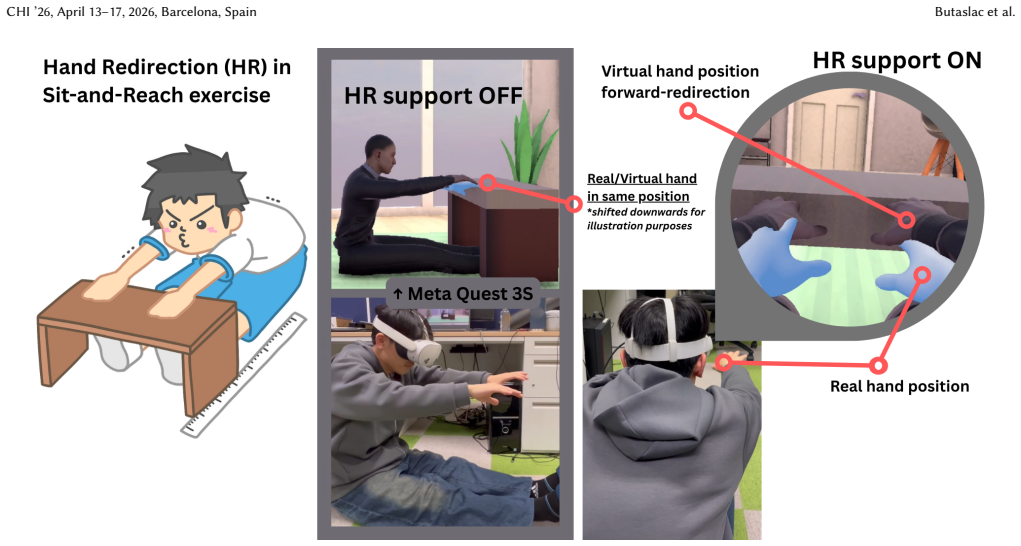
In everyday life, physical effort is often minimized and convenience is prioritized, making it difficult for many people to sustain light exercise and stretching despite well-known long-term benefits. This challenge often arises not from objective movement limitations, but from whether an action feels doable in the moment and, therefore worth continuing. This position paper argues that subtle VR hand redirection (HR) can be reframed as a form of cross-sensory support for sustained practice by targeting perceived doability: a moment-to-moment cognitive appraisal that an action is within one's capability while requiring manageable effort. We propose that conservative HR, applied within known perceptual limits, can create repeated micro-success experiences (e.g., reaching a virtual goal earlier with similar physical movement). These micro-successes may increase continuation intention and early re-engagement without relying on overt pressure or intensive coaching. At the same time, such support raises questions about autonomy and authenticity. We therefore articulate two research questions: (RQ1) how HR shifts perceived doability to support sustained practice and positive behavior change; and (RQ2) when HR functions as acceptable support versus becoming counterproductive by undermining authenticity, agency, trust, or fostering dependence. We present an initial sit-and-reach VR prototype, outline a research plan, and identify key design tensions to spark community discussions on autonomy-preserving cross-sensory futures in HCI.
Editorial analysis
A structured set of objections, weighed in public.
Referee Report
Summary. The manuscript is a position paper in HCI proposing that conservative hand redirection (HR) in VR can be reframed as a subtle cross-sensory support for sustained light exercise and stretching. It targets perceived doability (moment-to-moment appraisal of capability and effort) to generate micro-success experiences (e.g., reaching a virtual goal earlier with similar physical movement), which may increase continuation intention and re-engagement without overt pressure. The paper flags tensions with authenticity, agency, and dependence; articulates two open research questions (RQ1 on how HR shifts perceived doability for positive behavior change; RQ2 on when HR is acceptable support versus counterproductive); presents an initial sit-and-reach VR prototype; and outlines a research plan to guide future work.
Significance. If the proposed mechanisms are borne out by subsequent empirical work, the reframing could contribute to HCI by shifting focus from overt coaching or gamification toward autonomy-preserving perceptual manipulations for health-related behavior change. The manuscript's strengths include its tentative language, explicit identification of design tensions, and clear articulation of two falsifiable research questions that provide a concrete roadmap for future studies on cross-sensory supports.
minor comments (1)
- [Abstract] The abstract does not explicitly label the work as a position paper. Adding this clarification would better manage reader expectations given the absence of empirical data or formal analysis.
Simulated Author's Rebuttal
We thank the referee for their positive and accurate summary of our position paper, as well as their recognition of its tentative language, explicit design tensions, and the two falsifiable research questions. We appreciate the recommendation to accept and the assessment that the reframing could contribute to HCI by shifting focus toward autonomy-preserving perceptual manipulations.
Circularity Check
No significant circularity; purely conceptual position paper
full rationale
The paper is explicitly a position paper proposing a reframing of conservative VR hand redirection as cross-sensory support for perceived doability and sustained practice. It articulates two open research questions (RQ1, RQ2) using tentative language ('may increase', 'raises questions') without any equations, derivations, data fitting, parameter estimation, or self-referential definitions. No load-bearing steps reduce to inputs by construction, self-citation chains, or renamed known results. The argument remains self-contained and independent of fitted quantities or prior author theorems.
Axiom & Free-Parameter Ledger
axioms (1)
- domain assumption Perceived doability is a key moment-to-moment factor that influences whether people continue light exercise or stretching.
Reference graph
Works this paper leans on
-
[1]
Masashi Abe, Takuto Akiyoshi, Isidro Butaslac III, Hangyu Zhou, and Taishi Sawabe. 2022. Hype Live: Biometric-based Sensory Feedback for Improving the Sense of Unity in VR Live Performance. InProceedings of the 2022 IEEE Conference on Virtual Reality and 3D User Interfaces Abstracts and Workshops (VRW ’22). IEEE, Piscataway, NJ, USA, 836–837. doi:10.1109/...
-
[2]
Michael Bressler, Joachim Merk, Tanja Gohlke, Fares Kayali, Adrien Daigeler, Jonas Kolbenschlag, and Cosima Prahm. 2024. A Virtual Reality Serious Game for the Rehabilitation of Hand and Finger Function: Iterative Development and Rewiring Perceived Doability in VR CHI ’26, April 13–17, 2026, Barcelona, Spain Suitability Study.JMIR Serious Games12, Article...
work page 2024
-
[3]
Ana María Cintora-Sanz, Raúl Muñoz-Romo, Helmut Schrom-Feiertag, Alberto Blanco-Lara, Tatiana Vazquéz-Rodriguez, and Maria del Carmen Cardós-Alonso
-
[4]
doi:10.1186/s12909-026-08641-w
Virtual & Mixed Reality Fatigue Questionnaire.BMC Medical Education (2026). doi:10.1186/s12909-026-08641-w
-
[5]
James Clawson, Jessica Pater, Andrew Miller, Elizabeth Mynatt, and Lena Mamyk- ina. 2015. No Longer Wearing: Investigating the Abandonment of Personal Health-Tracking Technologies on Craigslist. InProceedings of the 2015 ACM In- ternational Joint Conference on Pervasive and Ubiquitous Computing (UbiComp ’15). ACM, New York, NY, USA, 647–658. doi:10.1145/2...
-
[6]
Sebastian Cmentowski, Sukran Karaosmanoglu, Lennart Nacke, Frank Steinicke, and Jens Krüger. 2023. Never Skip Leg Day Again: Training the Lower Body with Vertical Jumps in a Virtual Reality Exergame. InProceedings of the 2023 ACM Conference on Human Factors in Computing Systems (CHI ’23). ACM, New York, NY, USA, Article 786, 18 pages. doi:10.1145/3544548.3580973
-
[7]
Qiuxin Du, Zhen Song, Haiyan Jiang, Xiaoying Wei, Dongdong Weng, and Ming- ming Fan. 2024. LightSword: A Customized Virtual Reality Exergame for Long- Term Cognitive Inhibition Training in Older Adults. InProceedings of the 2024 ACM Conference on Human Factors in Computing Systems (CHI ’24). ACM, New York, NY, USA, Article 462, 17 pages. doi:10.1145/36139...
-
[8]
Daniel Epstein, Monica Caraway, Chuck Johnston, An Ping, James Fogarty, and Sean Munson. 2016. Beyond Abandonment to Next Steps: Understanding and Designing for Life after Personal Informatics Tool Use. InProceedings of the 2016 ACM Conference on Human Factors in Computing Systems (CHI ’16). ACM, New York, NY, USA, 1109–1113. doi:10.1145/2858036.2858045
-
[9]
Martin Feick, Kora Persephone Regitz, and André Zenner. 2025. Delusionized? Potential Harms of Proprioceptive Manipulations through Hand Redirection in Virtual Reality. InProceedings of the 38th Annual ACM Symposium on User Interface Software and Technology (UIST ’25). ACM, New York, NY, USA, Article 78, 9 pages. doi:10.1145/3746059.3747754
-
[10]
Martin Feick, André Zenner, Simon Seibert, Anthony Tang, and Antonio Krüger
-
[11]
InProceedings of the 2024 ACM Conference on Human Factors in Computing Systems (CHI ’24)
The Impact of Avatar Completeness on Embodiment and the Detectability of Hand Redirection in Virtual Reality. InProceedings of the 2024 ACM Conference on Human Factors in Computing Systems (CHI ’24). ACM, New York, NY, USA, Article 548, 9 pages. doi:10.1145/3613904.3641933
-
[12]
Antti Granqvist, Tapio Takala, Jari Takatalo, and Perttu Hämäläinen. 2018. Exag- geration of Avatar Flexibility in Virtual Reality. InProceedings of the 2018 Annual Symposium on Computer-Human Interaction in Play (CHI PLAY ’18). ACM, New York, NY, USA, 201–209. doi:10.1145/3242671.3242694
-
[13]
Matilda Haneling, Jesper Lundqvist, and Andrii Matviienko. 2025. Beyond Con- trollers: Exploring On-Body Micro-Gestures for Mixed Reality Adventure Game- play. InProceedings of the 31st ACM Symposium on Virtual Reality Software and Technology (VRST ’25). ACM, New York, NY, USA, 1–11. doi:10.1145/3756884. 3766008
-
[14]
Judith Hartfill, Jenny Gabel, Lucie Kruse, Susanne Schmidt, Kevin Riebandt, Simone Kühn, and Frank Steinicke. 2021. Analysis of Detection Thresholds for Hand Redirection during Mid-Air Interactions in Virtual Reality. InProceedings of the 27th ACM Symposium on Virtual Reality Software and Technology (VRST ’21). ACM, New York, NY, USA, Article 35, 10 pages...
-
[15]
Isidro Butaslac III, Yuichiro Fujimoto, Taishi Sawabe, Masayuki Kanbara, and Hirokazu Kato. 2023. Systematic Review of Augmented Reality Training Systems. IEEE Transactions on Visualization and Computer Graphics29, 12 (2023), 5062–
work page 2023
-
[16]
doi:10.1109/TVCG.2022.3201120
-
[17]
Tetsunari Inamura, Nanami Takahashi, and Kouhei Nagata. 2025. Enhancing Self- Efficacy in VR Kendama Juggling Task Through Intervention and Adjustment of Virtual Success Experience.Journal of Robotics and Mechatronics37, 3 (2025), 614–626. doi:10.20965/jrm.2025.p0614
-
[18]
Zhipeng Li, Yishu Ji, Ruijia Chen, Tianqi Liu, Yuntao Wang, Yuanchun Shi, and Yukang Yan. 2025. Modeling the Impact of Visual Stimuli on Redirection No- ticeability with Gaze Behavior in Virtual Reality. InProceedings of the 2025 ACM Conference on Human Factors in Computing Systems (CHI ’25). ACM, New York, NY, USA, Article 38, 18 pages. doi:10.1145/37065...
-
[19]
Kai Lun Liao, Mengjie Huang, Jiajia Shi, Min Chen, and Rui Yang. 2025. Focus- Driven Augmented Feedback: Enhancing Focus and Maintaining Engagement in Upper Limb Virtual Reality Rehabilitation.IEEE Transactions on Visualization and Computer Graphics31, 5 (2025), 2653–2663. doi:10.1109/TVCG.2025.3549543
-
[20]
Anna Lisa Martin-Niedecken, Katja Rogers, Laia Turmo Vidal, Elisa Mekler, and Elena Márquez Segura. 2019. ExerCube vs. Personal Trainer: Evaluating a Holistic, Immersive, and Adaptive Fitness Game Setup. InProceedings of the 2019 ACM Conference on Human Factors in Computing Systems (CHI ’19). ACM, New York, NY, USA, Article 88, 15 pages. doi:10.1145/32906...
-
[21]
Emese Mayhew, Bryony Beresford, Alison Laver-Fawcett, Fiona Aspinal, Rachel Mann, Kathleen Bechtold, and Mona Kanaan. 2019. The Hopkins Rehabilitation Engagement Rating Scale - Reablement Version (HRERS-RV): Development and psychometric properties.Health & Social Care in the Community27, 3 (2019), 777–787. doi:10.1111/hsc.12696
-
[22]
Edward McAuley, Curt Lox, and Terry Duncan. 1993. Long-term maintenance of exercise, self-efficacy, and physiological change in older adults.The Journals of Gerontology: Series A, Biological Sciences and Medical Sciences48, 4 (1993), P218–P224. doi:10.1093/geronj/48.4.p218
-
[23]
Edward McAuley, Amanda Szabo, Neha Gothe, and Erin Olson. 2011. Self-efficacy: Implications for Physical Activity, Function, and Functional Limitations in Older Adults.American Journal of Lifestyle Medicine5, 4 (2011), 361–369. doi:10.1177/ 1559827610392704
work page 2011
-
[24]
Alexander Michael and Christof Lutteroth. 2020. Race Yourselves: A Longitudinal Exploration of Self-Competition Between Past, Present, and Future Performances in a VR Exergame. InProceedings of the 2020 ACM Conference on Human Factors in Computing Systems (CHI ’20). ACM, New York, NY, USA, 1–17. doi:10.1145/ 3313831.3376256
-
[25]
Amy Silva-Smith, Coral Hanson, Lis Neubeck, Anne Rowat, and Sheona McHale
-
[26]
doi:10.1007/s12529-024-10305- 2
Physical Activity Interventions Framed by the Health Action Process Approach for Adults with Long-Term Conditions: A Scoping Review.International Journal of Behavioral Medicine31 (2024), 987–1017. doi:10.1007/s12529-024-10305- 2
-
[27]
Keishi Tainaka, Tetsuya Kodama, Isidro Butaslac III, Hiroya Kawase, Taishi Sawabe, and Masayuki Kanbara. 2021. TSUNDERE Interaction: Behavior Modifi- cation by the Integrated Interaction of Cold and Kind Actions. InCompanion of the 2021 ACM/IEEE International Conference on Human-Robot Interaction (HRI ’21 Companion). ACM, New York, NY, USA, 153–156. doi:1...
-
[28]
Kiyu Tanaka, Takuto Nakamura, Keigo Matsumoto, Hideaki Kuzuoka, and Takuji Narumi. 2025. Detection Thresholds for Replay and Real-Time Discrepancies in VR Hand Redirection.IEEE Transactions on Visualization and Computer Graphics 31, 5 (2025), 2767–2775. doi:10.1109/TVCG.2025.3549571
-
[29]
Carolee Winstein, Patricia Pohl, and Rebecca Lewthwaite. 1994. Effects of Physical Guidance and Knowledge of Results on Motor Learning: Support for the Guidance Hypothesis.Research Quarterly for Exercise and Sport65, 4 (1994), 316–323. doi:10.1080/02701367.1994.10607635
-
[30]
Peixuan Xiong, Yukai Zhang, Nandi Zhang, Shihan Fu, Xin Li, Yadan Zheng, Jinni Zhou, Xiquan Hu, and Mingming Fan. 2024. To Reach the Unreachable: Exploring the Potential of VR Hand Redirection for Upper Limb Rehabilitation. In Proceedings of the 2024 ACM Conference on Human Factors in Computing Systems (CHI ’24). ACM, New York, NY, USA, Article 242, 11 pa...
-
[31]
André Zenner and Antonio Krüger. 2019. Estimating Detection Thresholds for Desktop-Scale Hand Redirection in Virtual Reality. InProceedings of the 2019 IEEE Conference on Virtual Reality and 3D User Interfaces (VR ’19). IEEE, Piscataway, NJ, USA, 47–55. doi:10.1109/VR.2019.8798143
-
[32]
Yuqi Zhou and Voicu Popescu. 2025. Dynamic Redirection for Safe Interaction with ETHD-Simulated Virtual Objects.IEEE Transactions on Visualization and Computer Graphics31, 5 (2025), 2923–2932. doi:10.1109/TVCG.2025.3549169
-
[33]
Fatin Shamimi Mohd Zuki, Suziah Sulaiman, Frédéric Mériénne, Aylen Ricca, Christophe Guillet, and Mohamad Naufal Mohamad Saad. 2024. Assessing the Impact of Enriched Virtual Reality on Motivation and Engagement in Stroke Rehabilitation.IEEE Access12 (2024), 143585–143598. doi:10.1109/ACCESS.2024. 3461473
discussion (0)
Sign in with ORCID, Apple, or X to comment. Anyone can read and Pith papers without signing in.