Image Compression with Bubble-Aware Frame Rate Adaptation for Energy-Efficient Video Capsule Endoscopy
Pith reviewed 2026-05-07 16:39 UTC · model grok-4.3
The pith
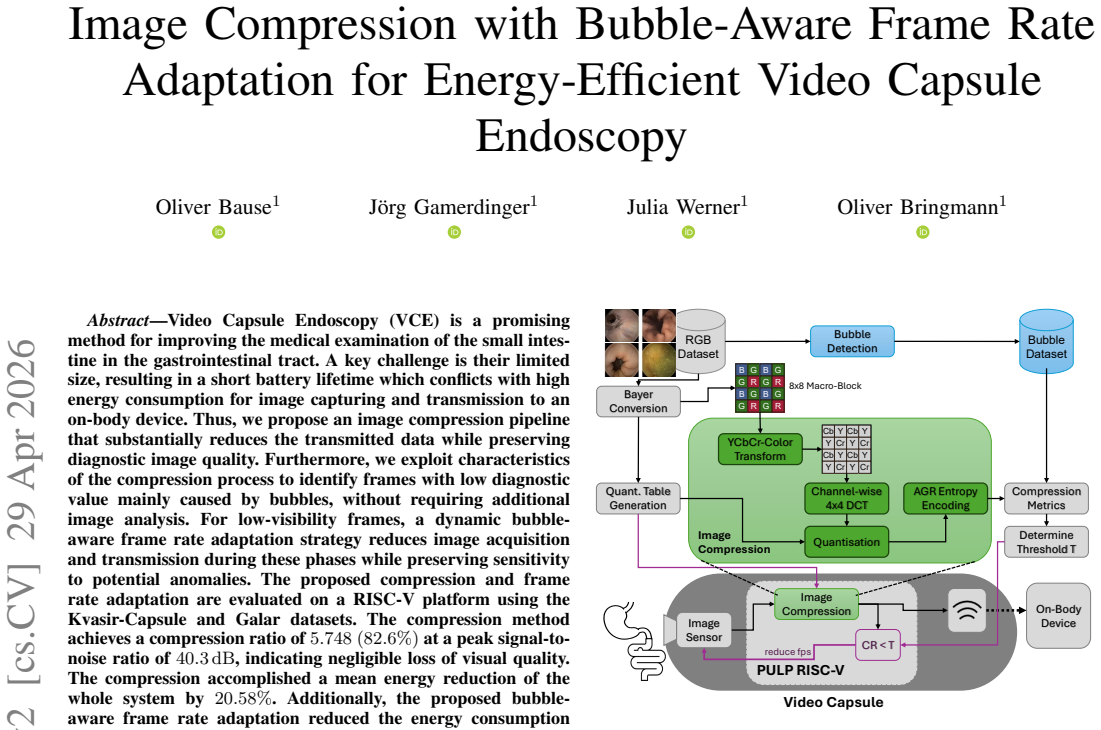
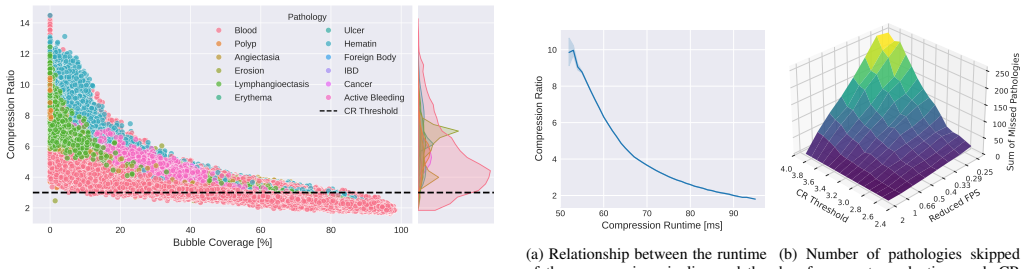
A compression pipeline for video capsule endoscopy uses its own artifacts to flag bubble-obscured frames and drops the frame rate during those intervals, cutting energy use by up to 40 percent while preserving diagnostic quality.
A machine-rendered reading of the paper's core claim, the machinery that carries it, and where it could break.
Core claim
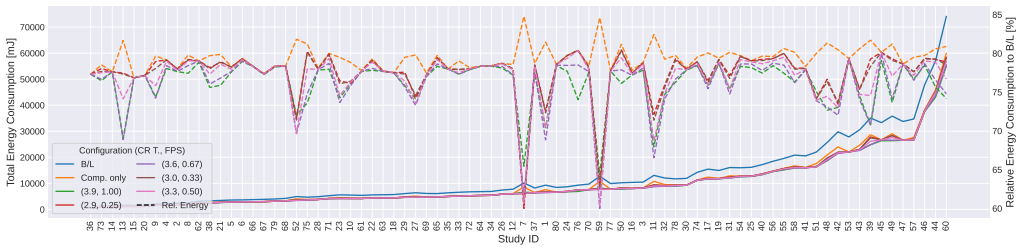
The authors demonstrate a compression scheme that delivers a ratio of 5.748 at 40.3 dB PSNR on Kvasir-Capsule and Galar data, yielding a mean 20.58 percent reduction in whole-system energy on a RISC-V platform. The same compression process supplies an indicator of bubble presence that drives a dynamic frame-rate adaptation, producing up to 40 percent further energy savings while the quality metric indicates negligible loss of visual information.
What carries the argument
Bubble-aware frame rate adaptation that exploits compression artifacts to identify low-diagnostic-value frames without any additional image analysis step.
If this is right
- Compression alone reduces mean system energy by 20.58 percent.
- Bubble-aware adaptation adds up to 40 percent energy reduction.
- Image quality remains high at 40.3 dB PSNR, indicating negligible diagnostic loss.
- The approach runs on a RISC-V platform and was tested on standard VCE datasets.
Where Pith is reading between the lines
- Longer battery life could allow capsules to image the full length of the small intestine more consistently.
- The same artifact-based detection idea might apply to other battery-constrained wireless cameras where obstructions create low-value frames.
- A practical next test would be to quantify whether the adaptive mode changes the time to first detection of bleeding or ulcers in real procedures.
Load-bearing premise
Frames that the compression process marks as low-visibility because of bubbles truly contain negligible diagnostic information, so lowering the frame rate in those intervals will not cause clinically relevant anomalies to be missed.
What would settle it
A side-by-side clinical comparison on the same patients that measures the anomaly detection rate when the adaptive low-frame-rate periods are used versus when every frame is captured at the full rate.
Figures
read the original abstract
Video Capsule Endoscopy (VCE) is a promising method for improving the medical examination of the small intestine in the gastrointestinal tract. A key challenge is their limited size, resulting in a short battery lifetime which conflicts with high energy consumption for image capturing and transmission to an on-body device. Thus, we propose an image compression pipeline that substantially reduces the transmitted data while preserving diagnostic image quality. Furthermore, we exploit characteristics of the compression process to identify frames with low diagnostic value mainly caused by bubbles, without requiring additional image analysis. For low-visibility frames, a dynamic bubble-aware frame rate adaptation strategy reduces image acquisition and transmission during these phases while preserving sensitivity to potential anomalies. The proposed compression and frame rate adaptation are evaluated on a RISC-V platform using the Kvasir-Capsule and Galar datasets. The compression method achieves a compression ratio of 5.748 (82.6%) at a peak signal-to-noise ratio of 40.3 dB, indicating negligible loss of visual quality. The compression accomplished a mean energy reduction of the whole system by 20.58%. Additionally, the proposed bubble-aware frame rate adaptation reduced the energy consumption by up to 40%. These results demonstrate the potential of our method to increase the applicability of VCE.
Editorial analysis
A structured set of objections, weighed in public.
Referee Report
Summary. The paper proposes an image compression pipeline for Video Capsule Endoscopy (VCE) that reduces transmitted data while preserving diagnostic quality, and exploits compression artifacts to identify low-visibility frames (primarily due to bubbles) without additional analysis. A dynamic bubble-aware frame rate adaptation then lowers acquisition and transmission rates during these intervals. Evaluations on the Kvasir-Capsule and Galar datasets using a RISC-V platform report a compression ratio of 5.748 (82.6%) at 40.3 dB PSNR, 20.58% mean system energy reduction from compression, and up to 40% further reduction from frame-rate adaptation.
Significance. If the safety assumption holds, the work could extend VCE battery life by 20-40% while maintaining diagnostic utility, addressing a core hardware constraint. Strengths include concrete, reproducible empirical measurements (compression ratio, PSNR, energy figures) on named public datasets and a real RISC-V platform rather than simulation alone; the parameter-free reuse of compression artifacts for bubble detection is an efficient design choice.
major comments (1)
- [Evaluation] Evaluation section (Kvasir-Capsule and Galar results): The claim that low-visibility frames identified via compression artifacts contain negligible diagnostic information and can safely have frame rate reduced without missing anomalies is load-bearing for the 40% energy-reduction result, yet no quantitative validation is provided. No sensitivity/specificity analysis, expert-labeled anomaly masks, or comparison of flagged vs. unflagged frames for clinically relevant events is reported, leaving open the possibility that the energy savings trade off diagnostic safety.
minor comments (1)
- [Method] The description of how compression artifacts are thresholded to flag bubbles could be expanded with pseudocode or a precise decision rule to improve reproducibility.
Simulated Author's Rebuttal
We thank the referee for their insightful comments on our manuscript. We provide a point-by-point response to the major comment below and outline the revisions we will make.
read point-by-point responses
-
Referee: [Evaluation] Evaluation section (Kvasir-Capsule and Galar results): The claim that low-visibility frames identified via compression artifacts contain negligible diagnostic information and can safely have frame rate reduced without missing anomalies is load-bearing for the 40% energy-reduction result, yet no quantitative validation is provided. No sensitivity/specificity analysis, expert-labeled anomaly masks, or comparison of flagged vs. unflagged frames for clinically relevant events is reported, leaving open the possibility that the energy savings trade off diagnostic safety.
Authors: The referee correctly identifies that our evaluation does not include a sensitivity or specificity analysis using expert-labeled anomaly masks for the frame-rate adaptation component. This omission stems from the fact that the public datasets employed (Kvasir-Capsule and Galar) lack the detailed per-frame clinical annotations required for such a study. Instead, the bubble-aware adaptation is motivated by prior medical literature indicating that bubbles in VCE images substantially reduce visibility and diagnostic content. By detecting these frames via compression artifacts, we reduce acquisition and transmission rates only during periods of inherently low diagnostic value. In the revised manuscript, we will add a dedicated paragraph in the discussion section to elaborate on these assumptions, reference relevant VCE studies on bubble effects, and acknowledge that comprehensive clinical validation would be necessary to fully confirm the safety of the energy savings. This revision will better contextualize the reported up to 40% additional energy reduction. revision: yes
Circularity Check
No circularity: empirical measurements on external datasets with no self-referential derivations
full rationale
The paper reports measured compression ratios, PSNR values, and energy savings from running the proposed pipeline on the Kvasir-Capsule and Galar datasets. The bubble-aware frame-rate logic is described as exploiting existing compression artifacts rather than introducing a fitted model or self-defined prediction. No equations, uniqueness theorems, or ansatzes are presented that reduce by construction to the paper's own inputs or prior self-citations. The central claims remain falsifiable external measurements; the noted limitation (lack of expert-labeled anomaly checks) is a correctness concern, not a circularity in the derivation chain.
Axiom & Free-Parameter Ledger
Reference graph
Works this paper leans on
-
[1]
G. Iddan, G. Meron, A. Glukhovsky, and P. Swain, “Wireless capsule endoscopy,” Nature, vol. 405, no. 6785, pp. 417–417, 2000
work page 2000
-
[2]
Wireless capsule endoscopy of the small bowel: development, testing, and first human trials,
P. Swain, G. J. Iddan, G. Meron, and A. Glukhovsky, “Wireless capsule endoscopy of the small bowel: development, testing, and first human trials,” in Biomonitoring and Endoscopy Technologies, vol. 4158. SPIE, 2001, pp. 19–23
work page 2001
-
[3]
G. Costamagna, S. K. Shah, M. E. Riccioni, F. Foschia, M. Mutignani, V . Perri, A. Vecchioli, M. G. Brizi, A. Picciocchi, and P. Marano, “A prospective trial comparing small bowel radiographs and video capsule endoscopy for suspected small bowel disease,” Gastroenterology, vol. 123, no. 4, pp. 999–1005, 2002
work page 2002
-
[4]
Medtronic, “PillCam™ SB3 System,” https://www.medtronic.com/covidien/en-nz/ products/capsule-endoscopy/pillcam-sb-3-system.html/, 2025, [Online; accessed 7- May-2025]
work page 2025
-
[5]
Adaptive variable-length coding for efficient compression of spacecraft television data,
R. Rice and J. Plaunt, “Adaptive variable-length coding for efficient compression of spacecraft television data,” IEEE Transactions on Communication Technology , vol. 19, no. 6, pp. 889–897, 1971
work page 1971
-
[6]
H. S. Malvar, “Adaptive run-length/golomb-rice encoding of quantized generalized gaussian sources with unknown statistics,” in Data Compression Conference (DCC’06). IEEE, 2006, pp. 23–32
work page 2006
-
[7]
Kvasir-capsule, a video capsule endoscopy dataset,
P. H. Smedsrud, V . Thambawita, S. A. Hicks, H. Gjestang, O. O. Nedrejord, E. Næss, H. Borgli, D. Jha, T. J. D. Berstad, S. L. Eskeland et al., “Kvasir-capsule, a video capsule endoscopy dataset,” Scientific Data, vol. 8, no. 1, p. 142, 2021
work page 2021
-
[8]
Galar-a large multi-label video capsule endoscopy dataset,
M. Le Floch, F. Wolf, L. McIntyre, C. Weinert, A. Palm, K. V olk, P. Herzog, S. H. Kirk, J. L. Steinh ¨auser, C. Stopp et al. , “Galar-a large multi-label video capsule endoscopy dataset,” Scientific Data, vol. 12, no. 1, p. 828, 2025
work page 2025
-
[9]
Recent developments in wireless capsule endoscopy imaging: Compression and summarization techniques,
B. Sushma and P. Aparna, “Recent developments in wireless capsule endoscopy imaging: Compression and summarization techniques,” Computers in Biology and Medicine, vol. 149, p. 106087, 2022
work page 2022
-
[10]
An improved yef-dct based compression algorithm for video capsule endoscopy,
A. Mostafa, T. Khan, and K. Wahid, “An improved yef-dct based compression algorithm for video capsule endoscopy,” in 2014 36th Annual International Con- ference of the IEEE Engineering in Medicine and Biology Society . IEEE, 2014, pp. 2452–2455
work page 2014
-
[11]
An ultra-low-power image compressor for capsule endoscope,
M.-C. Lin, L.-R. Dung, and P.-K. Weng, “An ultra-low-power image compressor for capsule endoscope,” Biomedical engineering online , vol. 5, no. 1, p. 14, 2006
work page 2006
-
[12]
Lossless and low-power image compressor for wireless capsule endoscopy,
T. H. Khan and K. A. Wahid, “Lossless and low-power image compressor for wireless capsule endoscopy,” VLSI design, vol. 2011, no. 1, p. 343787, 2011
work page 2011
-
[13]
Hardware-efficient low-power image processing system for wireless capsule endoscopy,
P. Turcza and M. Duplaga, “Hardware-efficient low-power image processing system for wireless capsule endoscopy,” IEEE journal of biomedical and health informatics, vol. 17, no. 6, pp. 1046–1056, 2013
work page 2013
-
[14]
S. Harshitha, U. Mahadevaswamy, and M. Srikantaswamy, “Energy-efficient image compression for capsule endoscopy using a cnn-based feature learning algorithm,” Engineering, Technology & Applied Science Research , vol. 15, no. 5, pp. 26 217– 26 223, 2025
work page 2025
-
[15]
Automatic detection of informative frames from wireless capsule endoscopy images,
M. K. Bashar, T. Kitasaka, Y . Suenaga, Y . Mekada, and K. Mori, “Automatic detection of informative frames from wireless capsule endoscopy images,” Medical Image Analysis, vol. 14, no. 3, pp. 449–470, 2010
work page 2010
-
[16]
Categorization and segmentation of intestinal content frames for wireless capsule endoscopy,
S. Segui, M. Drozdzal, F. Vilarino, C. Malagelada, F. Azpiroz, P. Radeva, and J. Vitria, “Categorization and segmentation of intestinal content frames for wireless capsule endoscopy,”IEEE Transactions on Information Technology in Biomedicine, vol. 16, no. 6, pp. 1341–1352, 2012
work page 2012
-
[17]
Identification of circular patterns in capsule endoscopy bubble frames,
H. Mir, V . Sadeghi, A. Vard, and A. M. Dehnavi, “Identification of circular patterns in capsule endoscopy bubble frames,” Journal of Medical Signals & Sensors , vol. 14, no. 5, p. 15, 2024
work page 2024
-
[18]
V . Sadeghi, A. Vard, M. Sharifi, H. Mir, and A. Mehridehnavi, “Segmentation and region quantification of bubbles in small bowel capsule endoscopy images using wavelet transform,” Informatics in Medicine Unlocked , vol. 42, p. 101364, 2023
work page 2023
-
[19]
Method and means for recognizing complex patterns,
P. V . Hough, “Method and means for recognizing complex patterns,” Dec. 18 1962, uS Patent 3,069,654
work page 1962
-
[20]
Edge artificial intelligence wireless video capsule endoscopy,
A. Sahafi, Y . Wang, C. Rasmussen, P. Bollen, G. Baatrup, V . Blanes-Vidal, J. Herp, and E. Nadimi, “Edge artificial intelligence wireless video capsule endoscopy,” Scientific reports, vol. 12, no. 1, p. 13723, 2022
work page 2022
-
[21]
Smart video cap- sule endoscopy: Raw image-based localization for enhanced gi tract investigation,
O. Bause, J. Werner, P. Palomero Bernardo, and O. Bringmann, “Smart video cap- sule endoscopy: Raw image-based localization for enhanced gi tract investigation,” in Neural Information Processing . Singapore: Springer Nature Singapore, 2026, pp. 33–47
work page 2026
-
[22]
capsule colonoscopy—a concise clinical overview of current status,
D. E. Yung, E. Rondonotti, and A. Koulaouzidis, “capsule colonoscopy—a concise clinical overview of current status,”Annals of translational medicine, vol. 4, no. 20, p. 398, 2016
work page 2016
-
[23]
A scalable risc-v hardware platform for intelligent sensor processing,
P. P. Bernardo, P. Schmid, O. Bringmann, M. Iftekhar, B. Sadiye, W. Mueller, A. Koch, E. Jentzsch, A. Sauer, I. Feldner et al. , “A scalable risc-v hardware platform for intelligent sensor processing,” in 2024 Design, Automation & Test in Europe Conference & Exhibition (DATE) . IEEE, 2024, pp. 1–5
work page 2024
discussion (0)
Sign in with ORCID, Apple, or X to comment. Anyone can read and Pith papers without signing in.