Recognition: unknown
Phase Transitions and Chaos Bound in Horava Lifshitz Black Holes using Lyapunov Exponents
Pith reviewed 2026-05-07 15:49 UTC · model grok-4.3
The pith
In Horava-Lifshitz black holes the Lyapunov exponent jumps at first-order phase transitions with critical exponent 1/2 and violates the chaos bound below a threshold horizon radius in stable phases.
A machine-rendered reading of the paper's core claim, the machinery that carries it, and where it could break.
Core claim
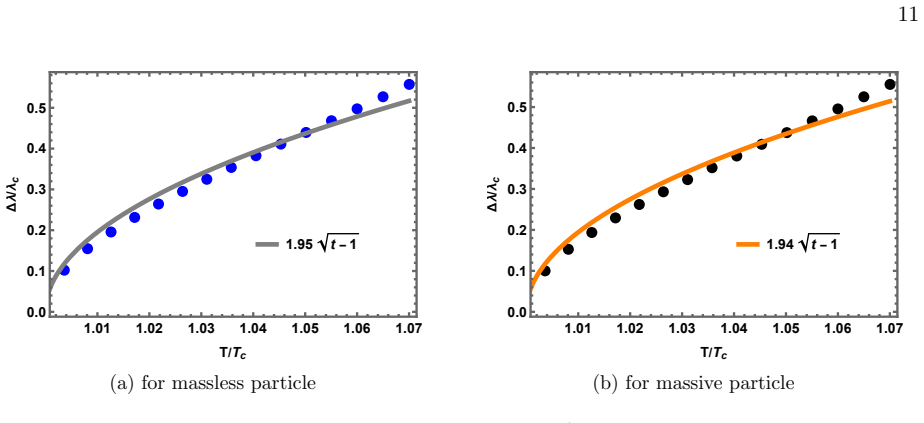
The Lyapunov exponent computed from geodesic deviation for test particles around four-dimensional Horava-Lifshitz black holes displays a multivalued dependence on temperature during first-order phase transitions, corresponding to distinct small, intermediate, and large black hole phases. The discontinuity in this exponent functions as an effective order parameter with a critical exponent of δ=1/2, aligning with mean-field universality. Furthermore, the chaos bound is violated for horizon radii below a certain threshold, and this violation occurs within the thermodynamically stable phase, even when no phase transition is present.
What carries the argument
Lyapunov exponent obtained from the geodesic deviation equation in the Horava-Lifshitz metric, which quantifies the rate of separation of nearby geodesics and links particle dynamics to thermodynamic phase structure.
If this is right
- Distinct branches of the Lyapunov exponent correspond to the small, intermediate, and large black hole phases during first-order transitions.
- The multivalued dependence on temperature vanishes at the critical point, marking the change to a continuous transition.
- The chaos bound violation is generic below a threshold radius and occurs independently inside stable thermodynamic phases.
- The critical exponent of the order parameter equals 1/2 for both massless and massive test particles.
Where Pith is reading between the lines
- The same Lyapunov-based diagnostic could be applied to other higher-derivative or alternative gravity models to test whether mean-field exponents and bound violations appear generically.
- If the geodesic deviation result holds without dispersion corrections, it separates the chaos bound issue from the presence of phase transitions themselves.
- The independence of the violation from phase transitions implies that small black holes in this theory may exhibit chaotic behavior as a baseline feature rather than a transition-driven effect.
Load-bearing premise
That the Lyapunov exponent computed from geodesic deviation directly encodes the thermodynamic phase structure without additional corrections from modified dispersion relations or higher-derivative terms in the theory.
What would settle it
A direct computation showing that the Lyapunov exponent varies continuously with temperature across the expected first-order phase transition, or that the chaos bound holds for all horizon radii inside the stable phase.
Figures




read the original abstract
We probe the thermodynamic phase structure of four dimensional Horava Lifshitz black holes by Lyapunov exponent analysis. For both massless and massive test particles, the Lyapunov exponent exhibits a multivalued dependence on temperature in regimes with a first-order phase transition, with distinct branches corresponding to small, intermediate, and large black hole phases, and this behaviour disappears at the critical point. The discontinuity in the Lyapunov exponent acts as an effective order parameter with critical exponent $\delta=1/2$, consistent with mean-field universality. We also find that the chaos bound is generically violated below a threshold horizon radius, with the violation occurring within the thermodynamically stable phase and persisting even in the absence of a phase transition. These results establish the robustness and universality of Lyapunov exponents as probes of black hole thermodynamics in alternative theories of gravity.
Editorial analysis
A structured set of objections, weighed in public.
Referee Report
Summary. The manuscript claims that the Lyapunov exponent, computed from geodesic deviation for both massless and massive test particles in four-dimensional Horava-Lifshitz black holes, exhibits a multivalued dependence on temperature in the presence of first-order phase transitions, with distinct branches corresponding to small, intermediate, and large black hole phases. This multivalued behavior disappears at the critical point. The discontinuity in the Lyapunov exponent is interpreted as an effective order parameter with critical exponent δ=1/2, consistent with mean-field universality. The paper also reports that the chaos bound is violated below a threshold horizon radius, with the violation occurring inside the thermodynamically stable phase and persisting even without a phase transition.
Significance. If the results hold after addressing the noted concerns, the work would extend Lyapunov-exponent methods for probing black-hole thermodynamics from Einstein gravity to Horava-Lifshitz gravity, demonstrating that the mean-field critical exponent remains robust under anisotropic scaling. The reported chaos-bound violation inside stable phases would challenge the generality of such bounds in modified gravity and could motivate further studies of dynamical probes in Lorentz-violating theories.
major comments (2)
- [Lyapunov exponent calculation section] The derivation of the Lyapunov exponent (described in the section computing geodesic deviation from the HL metric) employs the standard GR form of the deviation equation without incorporating corrections from the modified dispersion relations that arise due to Lorentz violation and higher spatial derivatives in Horava-Lifshitz gravity. This assumption is load-bearing for the central claims of multivalued branches, the extracted δ=1/2, and the chaos-bound violation inside the stable phase, yet the manuscript provides no explicit justification or comparison with corrected equations of motion.
- [Results and abstract] The abstract and results section state that the discontinuity acts as an order parameter with δ=1/2 and that the chaos bound is violated in the stable phase, but the manuscript supplies no explicit derivation steps, error analysis, or numerical checks confirming how the multivalued LE(T) curves and the critical exponent are obtained from the metric. This absence prevents independent verification of the reported phase-structure correspondence.
minor comments (2)
- The distinction between results for massless and massive test particles is mentioned in the abstract but could be presented more clearly in the main text, including any differences in the resulting LE branches or critical behavior.
- Notation for the critical exponent is given as δ=1/2; a brief reminder of the thermodynamic definition (e.g., how the jump scales with the reduced temperature or chemical potential) would aid readability.
Simulated Author's Rebuttal
We thank the referee for the careful reading and constructive comments, which help clarify the presentation of our results on Lyapunov exponents as probes of phase structure in Horava-Lifshitz black holes. We address each major comment below and indicate the revisions that will be incorporated.
read point-by-point responses
-
Referee: [Lyapunov exponent calculation section] The derivation of the Lyapunov exponent (described in the section computing geodesic deviation from the HL metric) employs the standard GR form of the deviation equation without incorporating corrections from the modified dispersion relations that arise due to Lorentz violation and higher spatial derivatives in Horava-Lifshitz gravity. This assumption is load-bearing for the central claims of multivalued branches, the extracted δ=1/2, and the chaos-bound violation inside the stable phase, yet the manuscript provides no explicit justification or comparison with corrected equations of motion.
Authors: In Horava-Lifshitz gravity the modified dispersion relations and higher spatial derivatives primarily govern high-energy UV modes. The Lyapunov exponent analysis in our work is performed in the IR regime using the effective metric for timelike and null geodesics of test particles, where the standard geodesic deviation equation derived from the spacetime geometry remains the appropriate leading-order description. This is consistent with the effective-field-theory treatment of black-hole thermodynamics in modified gravity. We will add an explicit paragraph in the revised manuscript justifying this approximation, including a brief discussion of the scale separation between IR geodesic motion and UV corrections, to make the assumption transparent. revision: yes
-
Referee: [Results and abstract] The abstract and results section state that the discontinuity acts as an order parameter with δ=1/2 and that the chaos bound is violated in the stable phase, but the manuscript supplies no explicit derivation steps, error analysis, or numerical checks confirming how the multivalued LE(T) curves and the critical exponent are obtained from the metric. This absence prevents independent verification of the reported phase-structure correspondence.
Authors: We agree that greater explicitness will aid independent verification. The Lyapunov exponent is computed from the second derivative of the effective potential at the unstable circular orbit radius, λ = √(-V_eff''(r_0)/2), evaluated along the small, intermediate, and large black-hole branches obtained from the thermodynamic equation of state. The multivalued LE(T) curves are generated by numerical root-finding of the orbit condition for each temperature, and the exponent δ = 1/2 is extracted from a log-log fit of the discontinuity amplitude versus reduced temperature near the critical point. In the revised manuscript we will expand the relevant sections with the full analytic expression for V_eff, tabulated numerical values with estimated uncertainties, and additional plots confirming the scaling exponent. revision: yes
Circularity Check
No circularity: Lyapunov exponent derived independently from geodesic deviation on HL metric
full rationale
The derivation begins with the Horava-Lifshitz line element, derives the effective potential for radial geodesics of test particles (massless and massive), and computes the Lyapunov exponent via the geodesic deviation equation. The resulting multivalued λ(T) curves, their discontinuities, and the scaling of the discontinuity near the critical point (yielding δ=1/2) are obtained directly from this dynamical calculation and then compared to the separately computed thermodynamic phase diagram. No step reduces the output to a fitted thermodynamic input by construction, no self-citation supplies a load-bearing uniqueness theorem or ansatz, and the chaos-bound violation is reported as a numerical finding from the same geodesic analysis. The chain is self-contained against external benchmarks.
Axiom & Free-Parameter Ledger
axioms (2)
- domain assumption The four-dimensional Horava-Lifshitz black-hole metric is given by the standard form in the literature.
- standard math Lyapunov exponent is obtained from the largest eigenvalue of the geodesic deviation matrix.
Reference graph
Works this paper leans on
-
[1]
In what follows, we shall consider the spatial dimension to be 3 (d= 3) andk= 1 - the spherical horizon case
andkcan take the values +1,0,−1 corresponding to spherical, flat and hyperbolic horizons respectively. In what follows, we shall consider the spatial dimension to be 3 (d= 3) andk= 1 - the spherical horizon case. Imposing those, and settingf(r +) = 0, we get the mass of the black hole, M= 16πP r2 + + 3 2 −9ϵ 2 48πP r+ (19) The Hawking temperature is given...
-
[2]
Gravitational radiation from colliding black holes,
S. W. Hawking, “Gravitational radiation from colliding black holes,” Phys. Rev. Lett.26, 1344-1346 (1971) doi:10.1103/PhysRevLett.26.1344
-
[3]
J. Bekenstein, “Bekenstein-Hawking entropy,” Scholarpedia3, no.10, 7375 (2008) doi:10.4249/scholarpedia.7375
-
[4]
S. W. Hawking, “Black hole explosions,” Nature248, 30-31 (1974) doi:10.1038/248030a0
-
[5]
S. W. Hawking, “Particle Creation by Black Holes,” Commun. Math. Phys.43, 199-220 (1975) [erratum: Commun. Math. Phys.46, 206 (1976)] doi:10.1007/BF02345020
-
[6]
Communications in Mathematical Physics31(2), 161–170 (1973) https://doi
J. M. Bardeen, B. Carter and S. W. Hawking, “The Four laws of black hole mechanics,” Commun. Math. Phys.31, 161-170 (1973) doi:10.1007/BF01645742
-
[7]
Thermodynamics of Black Holes,
P. C. W. Davies, “Thermodynamics of Black Holes,” Proc. Roy. Soc. Lond. A353, 499-521 (1977) doi:10.1098/rspa.1977.0047
-
[8]
Charged black holes and phase transitions,
P. Hut,“Charged black holes and phase transitions,” Monthly Notices of the Royal Astronomical Society, vol. 180, pp. 379–389, 10 1977
1977
-
[9]
The LargeNlimit of superconformal field the- ories and supergravity,
J. M. Maldacena, “The Large N limit of superconformal field theories and supergravity,” Adv. Theor. Math. Phys.2, 231-252 (1998) doi:10.4310/ATMP.1998.v2.n2.a1 [arXiv:hep-th/9711200 [hep-th]]
-
[10]
P − V criticality of charged AdS black holes
D. Kubiznak and R. B. Mann, “P-V criticality of charged AdS black holes,” JHEP07, 033 (2012) doi:10.1007/JHEP07(2012)033 [arXiv:1205.0559 [hep-th]]
-
[11]
Thermodynamics of Black Holes in anti-De Sitter Space,
S. W. Hawking and D. N. Page, “Thermodynamics of Black Holes in anti-De Sitter Space,” Commun. Math. Phys.87, 577 (1983) doi:10.1007/BF01208266 15
-
[12]
P-V criticality in the extended phase space of Gauss-Bonnet black holes in AdS space,
R. G. Cai, L. M. Cao, L. Li and R. Q. Yang, “P-V criticality in the extended phase space of Gauss-Bonnet black holes in AdS space,” JHEP09, 005 (2013) doi:10.1007/JHEP09(2013)005 [arXiv:1306.6233 [gr-qc]]
-
[13]
Enthalpy and the Mechanics of AdS Black Holes
D. Kastor, S. Ray and J. Traschen, “Enthalpy and the Mechanics of AdS Black Holes,” Class. Quant. Grav.26, 195011 (2009) doi:10.1088/0264-9381/26/19/195011 [arXiv:0904.2765 [hep-th]]
work page Pith review doi:10.1088/0264-9381/26/19/195011 2009
-
[14]
The cosmological constant and the black hole equation of state,
B. P. Dolan, “The cosmological constant and the black hole equation of state,” Class. Quant. Grav. 28, 125020 (2011) doi:10.1088/0264-9381/28/12/125020 [arXiv:1008.5023 [gr-qc]]
-
[15]
Pressure and volume in the first law of black hole thermodynamics,
B. P. Dolan, “Pressure and volume in the first law of black hole thermodynamics,” Class. Quant. Grav. 28, 235017 (2011) doi:10.1088/0264-9381/28/23/235017 [arXiv:1106.6260 [gr-qc]]
-
[16]
Compressibility of rotating black holes,
B. P. Dolan, “Compressibility of rotating black holes,” Phys. Rev. D84, 127503 (2011) doi:10.1103/PhysRevD.84.127503 [arXiv:1109.0198 [gr-qc]]
-
[17]
Black hole chem- istry: thermodynamics with Lambda,
D. Kubiznak, R. B. Mann and M. Teo, “Black hole chemistry: thermodynamics with Lambda,” Class. Quant. Grav.34, no.6, 063001 (2017) doi:10.1088/1361-6382/aa5c69 [arXiv:1608.06147 [hep-th]]
-
[18]
Gauss-Bonnet coupling constant as a free thermodynamical variable and the associated criticality,
W. Xu, H. Xu and L. Zhao, “Gauss-Bonnet coupling constant as a free thermodynamical variable and the associated criticality,” Eur. Phys. J. C74, 2970 (2014) doi:10.1140/epjc/s10052-014-2970-8 [arXiv:1311.3053 [gr-qc]]
-
[19]
Critical phenomena of static charged AdS black holes in conformal gravity,
W. Xu and L. Zhao, “Critical phenomena of static charged AdS black holes in conformal gravity,” Phys. Lett. B736, 214-220 (2014) doi:10.1016/j.physletb.2014.07.019 [arXiv:1405.7665 [gr-qc]]
-
[20]
M. Zhang, D. C. Zou and R. H. Yue, “Reentrant phase transitions and triple points of topologi- cal AdS black holes in Born-Infeld-massive gravity,” Adv. High Energy Phys.2017, 3819246 (2017) doi:10.1155/2017/3819246 [arXiv:1707.04101 [hep-th]]
-
[21]
Ruppeiner, Thermodynamic curvature: pure fluids to black holes, J
G. Ruppeiner, Thermodynamic curvature: pure fluids to black holes, J. Phys. Conf. Ser.410, 012138 (2013) doi:10.1088/1742-6596/410/1/012138 [arXiv:1210.2011 [gr-qc]]
-
[22]
Y. G. Miao and Z. M. Xu, Microscopic structures and thermal stability of black holes con- formally coupled to scalar fields in five dimensions, Nucl. Phys. B942, 205-220 (2019) doi:10.1016/j.nuclphysb.2019.03.015 [arXiv:1711.01757 [hep-th]]
-
[23]
X. Y. Guo, H. F. Li, L. C. Zhang and R. Zhao, Microstructure and continuous phase transition of a Reissner-Nordstrom-AdS black hole, Phys. Rev. D100, no.6, 064036 (2019) doi:10.1103/PhysRevD.100.064036 [arXiv:1901.04703 [gr-qc]]
-
[24]
S. W. Wei, Y. X. Liu and R. B. Mann, Ruppeiner Geometry, Phase Transitions, and the Microstructure of Charged AdS Black Holes, Phys. Rev. D100, no.12, 124033 (2019) doi:10.1103/PhysRevD.100.124033 [arXiv:1909.03887 [gr-qc]]
-
[25]
P. Wang, H. Wu and H. Yang, Thermodynamic Geometry of AdS Black Holes and Black Holes in a Cavity, Eur. Phys. J. C80, no.3, 216 (2020) doi:10.1140/epjc/s10052-020-7776-2 [arXiv:1910.07874 [gr-qc]]
-
[26]
P. K. Yerra and C. Bhamidipati, Ruppeiner Geometry, Phase Transitions and Microstruc- tures of Black Holes in Massive Gravity, Int. J. Mod. Phys. A35, no.22, 2050120 (2020) doi:10.1142/S0217751X20501201 [arXiv:2006.07775 [hep-th]]
-
[27]
P. K. Yerra and C. Bhamidipati, Novel relations in massive gravity at Hawking-Page transition, Phys. Rev. D104, no.10, 104049 (2021) doi:10.1103/PhysRevD.104.104049 [arXiv:2107.04504 [gr-qc]]
-
[28]
Wu, Topological classes of rotating black holes, Phys
D. Wu, Topological classes of rotating black holes, Phys. Rev. D107, no.2, 024024 (2023) doi:10.1103/PhysRevD.107.024024 [arXiv:2211.15151 [gr-qc]]
-
[29]
Topological natures of the Gauss-Bonnet black hole in AdS space
C. Liu and J. Wang, Topological natures of the Gauss-Bonnet black hole in AdS space, Phys. Rev. D 107, no.6, 064023 (2023) doi:10.1103/PhysRevD.107.064023 [arXiv:2211.05524 [gr-qc]]
-
[30]
Z. Y. Fan, Topological interpretation for phase transitions of black holes, Phys. Rev. D107, no.4, 044026 (2023) doi:10.1103/PhysRevD.107.044026 [arXiv:2211.12957 [gr-qc]]
-
[31]
N. J. Gogoi and P. Phukon, Thermodynamic topology of 4D dyonic AdS black holes in different en- sembles, Phys. Rev. D108, no.6, 066016 (2023) doi:10.1103/PhysRevD.108.066016 [arXiv:2304.05695 [hep-th]]
- [32]
-
[33]
M. A. Saleem and A. Taani, The chaotic behavior of black holes: Investigating a topological retraction in anti-de Sitter spaces, New Astron.107, 102149 (2024) doi:10.1016/j.newast.2023.102149
-
[34]
M. U. Shahzad, A. Mehmood, S. Sharif and A. ¨Ovg¨ un, Criticality and topological classes 16 of neutral Gauss–Bonnet AdS black holes in 5D, Annals Phys.458, no.3, 169486 (2023) doi:10.1016/j.aop.2023.169486
-
[35]
Z. Q. Chen and S. W. Wei, Thermodynamics, Ruppeiner geometry, and topology of Born-Infeld black hole in asymptotic flat spacetime, Nucl. Phys. B996, 116369 (2023) doi:10.1016/j.nuclphysb.2023.116369
-
[36]
N. C. Bai, L. Li and J. Tao, Topology of black hole thermodynamics in Lovelock gravity, Phys. Rev. D 107, no.6, 064015 (2023) doi:10.1103/PhysRevD.107.064015 [arXiv:2208.10177 [gr-qc]]
-
[37]
P. K. Yerra and C. Bhamidipati, Topology of black hole thermodynamics in Gauss-Bonnet gravity, Phys. Rev. D105, no.10, 104053 (2022) doi:10.1103/PhysRevD.105.104053 [arXiv:2202.10288 [gr-qc]]
-
[38]
B. Hazarika and P. Phukon, Thermodynamic Topology ofD= 4,5 Horava Lifshitz Black Hole in Two Ensembles, [arXiv:2312.06324 [hep-th]]
-
[39]
Y. Liu, D. C. Zou and B. Wang, Signature of the Van der Waals like small-large charged AdS black hole phase transition in quasinormal modes, JHEP09, 179 (2014) doi:10.1007/JHEP09(2014)179 [arXiv:1405.2644 [hep-th]]
-
[40]
D. C. Zou, Y. Liu and R. H. Yue, Behavior of quasinormal modes and Van der Waals-like phase transition of charged AdS black holes in massive gravity, Eur. Phys. J. C77, no.6, 365 (2017) doi:10.1140/epjc/s10052-017-4937-z [arXiv:1702.08118 [gr-qc]]
-
[41]
M. Zhang, C. M. Zhang, D. C. Zou and R. H. Yue, Phase transition and Quasinormal modes for Charged black holes in 4D Einstein-Gauss-Bonnet gravity, Chin. Phys. C45, no.4, 045105 (2021) doi:10.1088/1674-1137/abe19a [arXiv:2009.03096 [hep-th]]
-
[42]
S. Mahapatra, Thermodynamics, Phase Transition and Quasinormal modes with Weyl corrections, JHEP04, 142 (2016) doi:10.1007/JHEP04(2016)142 [arXiv:1602.03007 [hep-th]]
-
[43]
M. Chabab, H. El Moumni, S. Iraoui and K. Masmar, Behavior of quasinormal modes and high dimension RN–AdS black hole phase transition, Eur. Phys. J. C76, no.12, 676 (2016) doi:10.1140/epjc/s10052-016-4518-6 [arXiv:1606.08524 [hep-th]]
-
[44]
S. W. Wei and Y. X. Liu, Photon orbits and thermodynamic phase transition ofd-dimensional charged AdS black holes, Phys. Rev. D97, no.10, 104027 (2018) doi:10.1103/PhysRevD.97.104027 [arXiv:1711.01522 [gr-qc]]
-
[45]
S. W. Wei, Y. X. Liu and Y. Q. Wang, Probing the relationship between the null geodesics and thermodynamic phase transition for rotating Kerr-AdS black holes, Phys. Rev. D99, no.4, 044013 (2019) doi:10.1103/PhysRevD.99.044013 [arXiv:1807.03455 [gr-qc]]
-
[46]
M. Zhang, S. Z. Han, J. Jiang and W. B. Liu, Phys. Rev. D99, no.6, 065016 (2019) doi:10.1103/PhysRevD.99.065016 [arXiv:1903.08293 [hep-th]]
-
[47]
M. Zhang and M. Guo, Can shadows reflect phase structures of black holes?, Eur. Phys. J. C80, no.8, 790 (2020) doi:10.1140/epjc/s10052-020-8389-5 [arXiv:1909.07033 [gr-qc]]
-
[48]
A. Belhaj, L. Chakhchi, H. El Moumni, J. Khalloufi and K. Masmar, Thermal Image and Phase Transitions of Charged AdS Black Holes using Shadow Analysis, Int. J. Mod. Phys. A35, no.27, 2050170 (2020) doi:10.1142/S0217751X20501705 [arXiv:2005.05893 [gr-qc]]
-
[49]
A.M Lyapunov, The general problem of the stability of motion Int. J. Control 55, 531 (1992). doi:https://doi.org/10.1080/00207179208934253
-
[50]
Sandri, Numerical calculation of lyapunov exponents, Math
M. Sandri, Numerical calculation of lyapunov exponents, Math. J. 6, 78 (1996)
1996
-
[51]
Phase transition and chaos in charged SYK model,
N. Sorokhaibam, “Phase transition and chaos in charged SYK model,” JHEP07, 055 (2020) doi:10.1007/JHEP07(2020)055 [arXiv:1912.04326 [hep-th]]
-
[52]
Quantum chaos and phase transition in the Yukawa–Sachdev-Ye-Kitaev model,
A. Davis and Y. Wang, “Quantum chaos and phase transition in the Yukawa–Sachdev-Ye-Kitaev model,” Phys. Rev. B107, no.20, 205122 (2023) doi:10.1103/PhysRevB.107.205122 [arXiv:2212.03265 [cond-mat.str-el]]
-
[53]
Chaos and the quantum phase transition in the Dicke model,
C. Emary and T. Brandes, “Chaos and the quantum phase transition in the Dicke model,” Phys. Rev. E67, 066203 (2003) doi:10.1103/PhysRevE.67.066203 [arXiv:cond-mat/0301273 [cond-mat]]
-
[54]
Phase Transitions and Chaos in Long-Range Models of Coupled Oscillators,
G. Miritello, A. Pluchino and A. Rapisarda, “Phase Transitions and Chaos in Long-Range Models of Coupled Oscillators,” EPL85, no.1, 10007 (2009) doi:10.1209/0295-5075/85/10007 [arXiv:0807.1870 [cond-mat.stat-mech]]
-
[55]
Transitional regions of finite Fermi systems and quantum chaos,
W. D. Heiss and A. L. Sannino, “Transitional regions of finite Fermi systems and quantum chaos,” Phys. Rev. A43, 4159-4166 (1991) doi:10.1103/PhysRevA.43.4159
-
[56]
Chaos in static axisymmetric space-times. 1: Vacuum case,
Y. Sota, S. Suzuki and K. i. Maeda, “Chaos in static axisymmetric space-times. 1: Vacuum case,” Class. 17 Quant. Grav.13, 1241-1260 (1996) doi:10.1088/0264-9381/13/5/034 [arXiv:gr-qc/9505036 [gr-qc]]
-
[57]
Chaos in static axisymmetric space-times. 2. Nonvacuum case,
Y. Sota, S. Suzuki and K. i. Maeda, “Chaos in static axisymmetric space-times. 2. Nonvacuum case,” [arXiv:gr-qc/9610065 [gr-qc]]
-
[58]
Bound on the Lyapunov exponent in Kerr-Newman black holes via a charged particle,
N. Kan and B. Gwak, “Bound on the Lyapunov exponent in Kerr-Newman black holes via a charged particle,” Phys. Rev. D105, no.2, 026006 (2022) doi:10.1103/PhysRevD.105.026006 [arXiv:2109.07341 [gr-qc]]
-
[60]
Chaotic motion in multi-black hole spacetimes and holographic screens,
W. Hanan and E. Radu, “Chaotic motion in multi-black hole spacetimes and holographic screens,” Mod. Phys. Lett. A22, 399-406 (2007) doi:10.1142/S0217732307022815 [arXiv:gr-qc/0610119 [gr-qc]]
-
[61]
Minimal Length Effects on Chaotic Motion of Particles around Black Hole Horizon,
F. Lu, J. Tao and P. Wang, “Minimal Length Effects on Chaotic Motion of Particles around Black Hole Horizon,” JCAP12, 036 (2018) doi:10.1088/1475-7516/2018/12/036 [arXiv:1811.02140 [gr-qc]]
-
[62]
Chaotic Motion around a Black Hole under Minimal Length Effects,
X. Guo, K. Liang, B. Mu, P. Wang and M. Yang, “Chaotic Motion around a Black Hole under Minimal Length Effects,” Eur. Phys. J. C80, no.8, 745 (2020) doi:10.1140/epjc/s10052-020-8335-6 [arXiv:2002.05894 [gr-qc]]
-
[63]
J. Maldacena, S. H. Shenker and D. Stanford, “A bound on chaos,” JHEP08, 106 (2016) doi:10.1007/JHEP08(2016)106 [arXiv:1503.01409 [hep-th]]
-
[65]
Presence of horizon makes particle motion chaotic,
S. Dalui, B. R. Majhi and P. Mishra, “Presence of horizon makes particle motion chaotic,” Phys. Lett. B788, 486-493 (2019) doi:10.1016/j.physletb.2018.11.050 [arXiv:1803.06527 [gr-qc]]
-
[66]
Static Equilibria of Charged Particles Around Charged Black Holes: Chaos Bound and Its Violations,
Q. Q. Zhao, Y. Z. Li and H. Lu, “Static Equilibria of Charged Particles Around Charged Black Holes: Chaos Bound and Its Violations,” Phys. Rev. D98, no.12, 124001 (2018) doi:10.1103/PhysRevD.98.124001 [arXiv:1809.04616 [gr-qc]]
-
[67]
Minimal Length Effects on Motion of a Particle in Rindler Space,
X. Guo, K. Liang, B. Mu, P. Wang and M. Yang, “Minimal Length Effects on Motion of a Particle in Rindler Space,” Chin. Phys. C45, no.2, 023115 (2021) doi:10.1088/1674-1137/abcf20 [arXiv:2007.07744 [gr-qc]]
-
[68]
Violation of bound on chaos for charged probe in Kerr- Newman-AdS black hole,
B. Gwak, N. Kan, B. H. Lee and H. Lee, “Violation of bound on chaos for charged probe in Kerr- Newman-AdS black hole,” JHEP09, 026 (2022) doi:10.1007/JHEP09(2022)026 [arXiv:2203.07298 [gr- qc]]
-
[69]
Bound on Lyapunov exponent in Kerr-Newman-de Sitter black holes by a charged particle,
J. Park and B. Gwak, “Bound on Lyapunov exponent in Kerr-Newman-de Sitter black holes by a charged particle,” JHEP04, 023 (2024) doi:10.1007/JHEP04(2024)023 [arXiv:2312.13075 [gr-qc]]
-
[70]
Probing phase structure of black holes with Lyapunov exponents,
X. Guo, Y. Lu, B. Mu and P. Wang, “Probing phase structure of black holes with Lyapunov exponents,” JHEP08, 153 (2022) doi:10.1007/JHEP08(2022)153 [arXiv:2205.02122 [gr-qc]]
-
[71]
Lyapunov exponents and phase transitions of Born-Infeld AdS black holes,
S. Yang, J. Tao, B. Mu and A. He, “Lyapunov exponents and phase transitions of Born-Infeld AdS black holes,” JCAP07, 045 (2023) doi:10.1088/1475-7516/2023/07/045 [arXiv:2304.01877 [gr-qc]]
-
[72]
Probing the thermodynamics of charged Gauss Bonnet AdS black holes with the Lyapunov exponent,
X. Lyu, J. Tao and P. Wang, “Probing the thermodynamics of charged Gauss Bonnet AdS black holes with the Lyapunov exponent,” Eur. Phys. J. C84, no.9, 974 (2024) doi:10.1140/epjc/s10052-024-13354- 9 [arXiv:2312.11912 [gr-qc]]
-
[73]
Lyapunov exponents and phase structure of Lifshitz and hyperscaling violating black holes,
A. N. Kumara, S. Punacha and M. S. Ali, “Lyapunov exponents and phase structure of Lifshitz and hyperscaling violating black holes,” JCAP07, 061 (2024) doi:10.1088/1475-7516/2024/07/061 [arXiv:2401.05181 [gr-qc]]
-
[74]
Y. Z. Du, H. F. Li, Y. B. Ma and Q. Gu, “Phase structure and optical properties of the de Sitter Spacetime with KR field based on the Lyapunov exponent,” Eur. Phys. J. C85, no.1, 78 (2025) doi:10.1140/epjc/s10052-025-13809-7 [arXiv:2403.20083 [hep-th]]
-
[75]
Lyapunov exponents and phase transition of Hay- ward AdS black hole,
N. J. Gogoi, S. Acharjee and P. Phukon, “Lyapunov exponents and phase transition of Hay- ward AdS black hole,” Eur. Phys. J. C84, no.11, 1144 (2024) doi:10.1140/epjc/s10052-024-13520-z [arXiv:2404.03947 [hep-th]]
-
[76]
Interplay between the Lyapunov expo- nents and phase transitions of charged AdS black holes,
B. Shukla, P. P. Das, D. Dudal and S. Mahapatra, “Interplay between the Lyapunov expo- nents and phase transitions of charged AdS black holes,” Phys. Rev. D110, no.2, 024068 (2024) doi:10.1103/PhysRevD.110.024068 [arXiv:2404.02095 [hep-th]]
-
[77]
Lyapunov exponents as probes for a phase transition of a Kerr-AdS black hole,
D. Chen, C. Yang and Y. Liu, “Lyapunov exponents as probes for a phase transition of a Kerr-AdS black hole,” Phys. Lett. B865, 139463 (2025) doi:10.1016/j.physletb.2025.139463 [arXiv:2501.16999 18 [hep-th]]
-
[78]
Euclidean Thermodynamics and Lyapunov Exponents of Einstein-Power-Yang-Mills AdS Black Holes,
K. R., D. D., K. M. Ajith, K. Hegde, S. Punacha and A. N. Kumara, “Euclidean Thermodynamics and Lyapunov Exponents of Einstein-Power-Yang-Mills AdS Black Holes,” [arXiv:2504.12890 [gr-qc]]
-
[79]
Probing Thermodynamic Phase Transitions of 4D R-Charged Black Holes via Lyapunov Exponent,
M. B. Awal and P. Phukon, “Probing Thermodynamic Phase Transitions of 4D R-Charged Black Holes via Lyapunov Exponent,” [arXiv:2505.20800 [gr-qc]]
-
[80]
Lyapunov exponents, phase transition and chaos bound in Kerr-Newman AdS spacetime,
C. Yang, C. Gao, D. Chen and X. Zeng, “Lyapunov exponents, phase transition and chaos bound in Kerr-Newman AdS spacetime,” [arXiv:2506.21882 [hep-th]]
-
[81]
Lyapunov exponents and phase transition of charged Ads black hole in quintessence,
X. Guo, R. Yang, Y. Liang and J. Tao, “Lyapunov exponents and phase transition of charged Ads black hole in quintessence,” [arXiv:2508.03519 [gr-qc]]
-
[82]
Direct measurement of the 39Ar half- life from 3.4 years of data with the DEAP-3600 detector,
G. Bezboruah, M. B. Awal and P. Phukon, “Lyapunov exponents, phase transitions, and Chaos bound of ModMax AdS black holes,” Eur. Phys. J. C85(2025) no.10, 1169 doi:10.1140/epjc/s10052-025- 14920-5 [arXiv:2508.07832 [gr-qc]]
discussion (0)
Sign in with ORCID, Apple, or X to comment. Anyone can read and Pith papers without signing in.