Simon's Algorithm for the Even-Mansour Cipher on Quantum Hardware
Pith reviewed 2026-05-07 16:56 UTC · model grok-4.3
The pith
Simon's algorithm recovers secret keys from the Even-Mansour cipher on real NISQ hardware for 3-bit and 4-bit keys.
A machine-rendered reading of the paper's core claim, the machinery that carries it, and where it could break.
Core claim
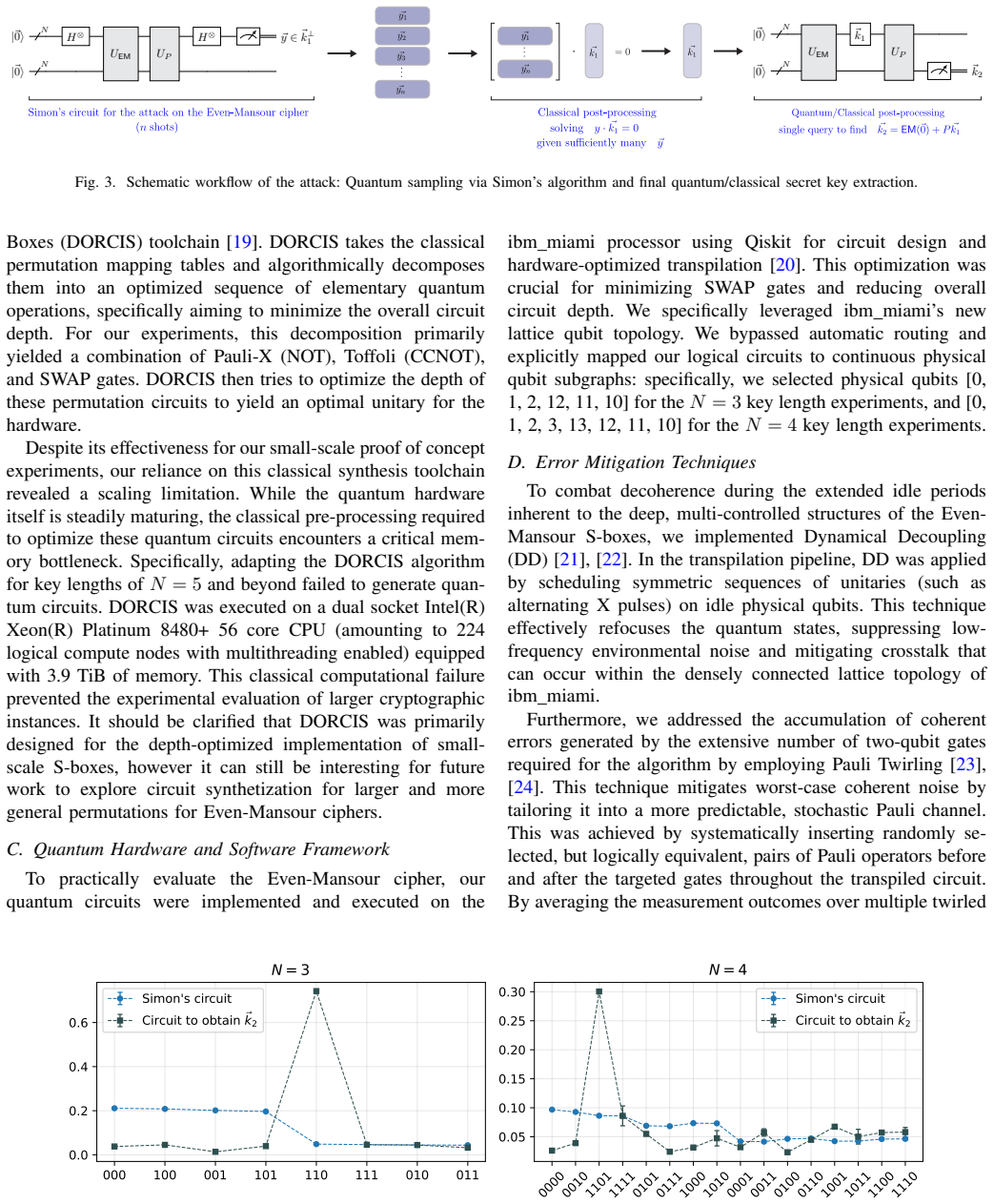
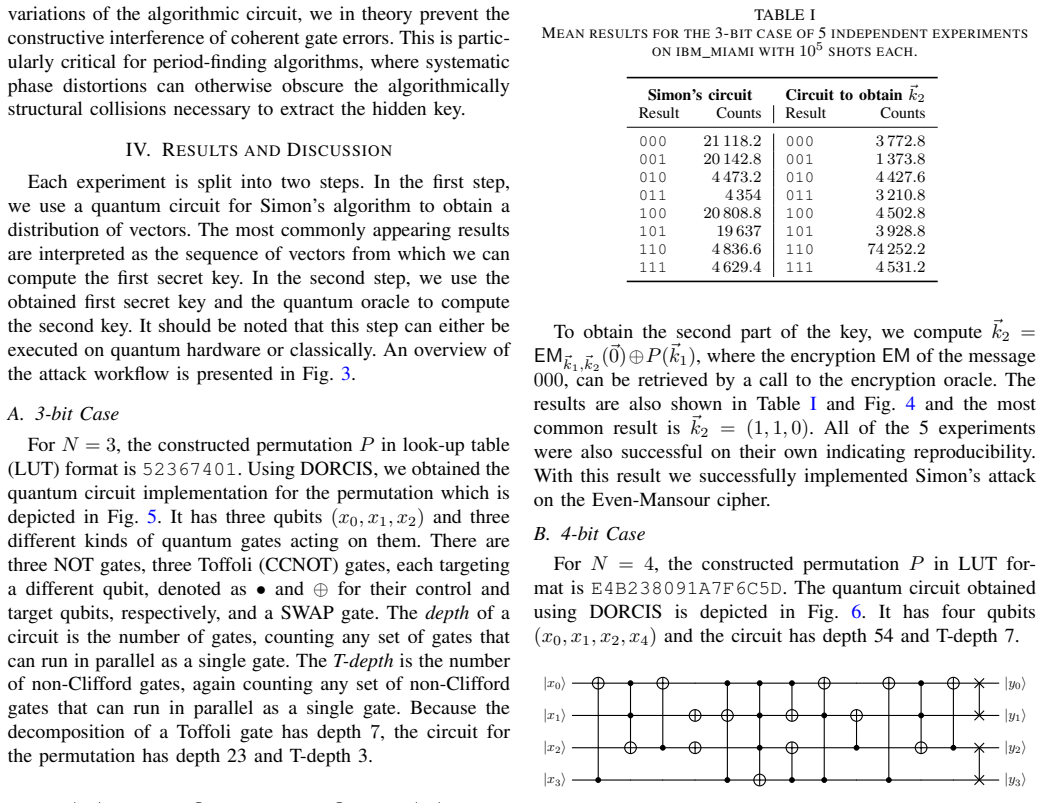
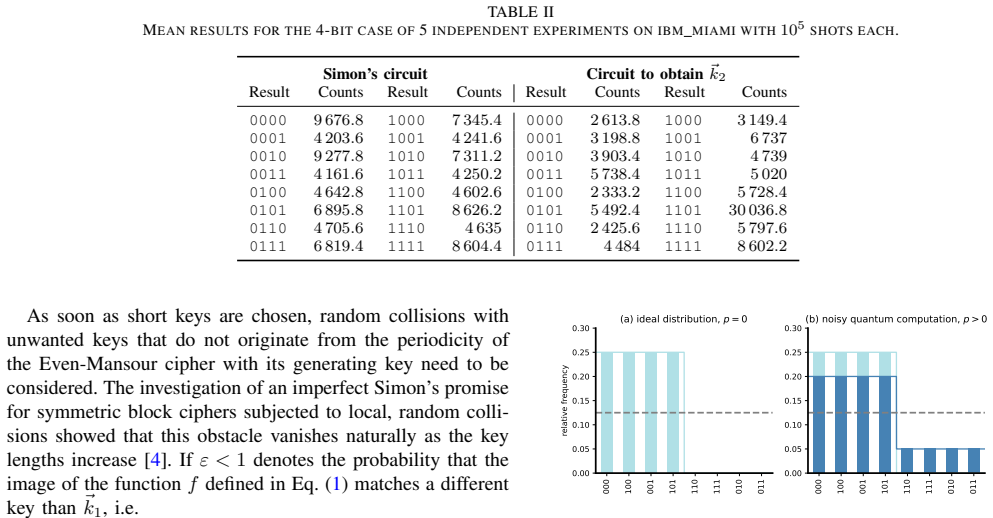
For N=3 and N=4, the secret key of the Even-Mansour construction is recovered by executing Simon's algorithm on the ibm_miami quantum processor using circuits optimized by DORCIS.
What carries the argument
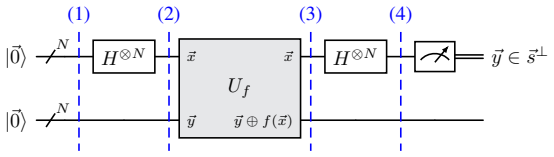
Simon's algorithm applied to an oracle that encodes the Even-Mansour encryption function, which returns a period revealing the secret key after a polynomial number of queries.
If this is right
- The Even-Mansour cipher with small key lengths can be broken in polynomial time on current quantum processors.
- Circuit optimization tools limit scaling of the attack beyond N=4 for this construction.
- Quantum period finding provides a practical route to attack symmetric ciphers whose structure hides a linear relation.
Where Pith is reading between the lines
- Improvements in quantum error rates or better error correction would be needed to test the attack on keys larger than 4 bits.
- The same oracle-construction approach could be tried on other block ciphers that admit a hidden period or linear structure.
- New classical synthesis methods are required before the quantum attack can be prepared for ciphers using larger permutations.
Load-bearing premise
The noise levels and circuit depths on the ibm_miami processor allow reliable extraction of the period that encodes the secret key.
What would settle it
Repeated runs of the N=4 circuit on ibm_miami that fail to output the correct secret key with high probability would show the attack does not succeed on the hardware as claimed.
Figures
read the original abstract
Simon's algorithm is a polynomial period-finding algorithm that has been used to exploit the algebraic structure of specific symmetric ciphers, showing that exponential speedups in their cryptanalysis are theoretically possible. While the theoretical framework for an attack using Simon's algorithm on the Even-Mansour cipher is well-established, practical implementations on noisy intermediate-scale quantum (NISQ) hardware remain limited. This paper presents a proof of concept quantum cryptanalysis of the Even-Mansour cipher using Simon's period-finding algorithm on NISQ hardware. For N = 3 and N = 4, we successfully demonstrate secret key recovery for N-bit constructions on the ibm_miami processor. Our experiments also identify a scaling limitation in the classical pre-processing stage: The DORCIS circuit optimization tool encountered a memory bottleneck at N = 5, preventing the generation of optimized circuits for larger key lengths. Our results suggest firstly that Simon's algorithm is effective for the Even-Mansour cipher for short bit lengths on current quantum hardware. Secondly, while DORCIS is effective for the small-scale S-boxes for which it was designed, there remains a need for the investigation of more scalable and efficient synthesis tools capable of handling larger and more general permutations in the context of Even-Mansour ciphers.
Editorial analysis
A structured set of objections, weighed in public.
Referee Report
Summary. The manuscript presents a proof-of-concept experimental demonstration of Simon's algorithm applied to recover the secret key of the Even-Mansour cipher on NISQ hardware. It reports successful key recovery for N=3 and N=4 constructions on the ibm_miami processor and identifies a memory bottleneck in the DORCIS classical circuit optimizer that prevents scaling to N=5.
Significance. If the experimental results hold, the work provides concrete evidence that Simon's period-finding can be executed on current quantum processors to attack small instances of a symmetric cipher, illustrating both the theoretical exponential speedup in cryptanalysis and the immediate practical barriers posed by classical preprocessing tools. This is relevant for assessing the near-term feasibility of quantum attacks on Even-Mansour-like constructions.
major comments (2)
- [Abstract] Abstract: the assertion of successful secret key recovery for N=3 and N=4 supplies no quantitative data on success rates, shot counts, error mitigation techniques, or the verification method used to confirm the recovered key matches the secret. This information is load-bearing for substantiating the central experimental claim on noisy hardware.
- [Results] Results (or equivalent experimental section): without reported details on how the period was extracted from measurement outcomes, how many runs were performed, or how the key was reconstructed, it is impossible to evaluate whether the DORCIS-optimized circuits actually enabled reliable period finding or whether noise on ibm_miami invalidated the attack for these small N.
minor comments (1)
- [Abstract] The abstract could briefly note the qubit count or post-optimization gate depth for the N=3 and N=4 cases to give immediate scale context.
Simulated Author's Rebuttal
We thank the referee for their careful review and constructive feedback. We agree that the experimental claims require additional quantitative and methodological details to be fully substantiated. We respond to each major comment below and will revise the manuscript to address them.
read point-by-point responses
-
Referee: [Abstract] Abstract: the assertion of successful secret key recovery for N=3 and N=4 supplies no quantitative data on success rates, shot counts, error mitigation techniques, or the verification method used to confirm the recovered key matches the secret. This information is load-bearing for substantiating the central experimental claim on noisy hardware.
Authors: We agree that the abstract would be strengthened by including quantitative indicators of experimental success. In the revised manuscript we will update the abstract to report the observed success rates for key recovery at N=3 and N=4, the number of shots used per experiment, and a concise statement of the error-mitigation and verification procedures employed. These additions will make the central claim more transparent while remaining within abstract length constraints. revision: yes
-
Referee: [Results] Results (or equivalent experimental section): without reported details on how the period was extracted from measurement outcomes, how many runs were performed, or how the key was reconstructed, it is impossible to evaluate whether the DORCIS-optimized circuits actually enabled reliable period finding or whether noise on ibm_miami invalidated the attack for these small N.
Authors: The referee is correct that the current manuscript omits essential procedural details. We will expand the Results section to describe: (i) the precise method used to extract the period from the measurement histogram, (ii) the total number of circuit executions (shots) performed for each N, (iii) any error-mitigation techniques applied, and (iv) the step-by-step reconstruction of the secret key from the recovered period together with the verification against the known secret. These clarifications will allow readers to assess the reliability of the period-finding step on the hardware. revision: yes
Circularity Check
No significant circularity in experimental demonstration
full rationale
The paper is a proof-of-concept experimental demonstration of Simon's algorithm applied to the Even-Mansour cipher on NISQ hardware (ibm_miami) for N=3 and N=4, with explicit reporting of failure at N=5 due to classical optimizer limits. No mathematical derivation chain, predictions, or first-principles results are claimed that could reduce to inputs by construction. The theoretical attack framework is described as well-established (external citations), and results consist of direct hardware measurements rather than fitted parameters or self-referential equations. No self-citation load-bearing steps, ansatzes, or renamings appear in the central claims.
Axiom & Free-Parameter Ledger
axioms (2)
- standard math Simon's algorithm correctly finds the period of the function defined by the Even-Mansour construction
- domain assumption The ibm_miami processor can execute the generated circuits with sufficient fidelity for N=3 and N=4
Reference graph
Works this paper leans on
-
[1]
A fast quantum mechanical algorithm for database search,
L. K. Grover, “A fast quantum mechanical algorithm for database search,” inProceedings of the 28th Annual ACM Symposium on Theory of Computing, ser. STOC ’96. New York, NY , USA: Association for Computing Machinery, 1996, p. 212–219
work page 1996
-
[2]
Quantum distinguisher between the 3-round feistel cipher and the random permutation,
H. Kuwakado and M. Morii, “Quantum distinguisher between the 3-round feistel cipher and the random permutation,” in2010 IEEE International Symposium on Information Theory, 2010, pp. 2682–2685
work page 2010
-
[3]
Security on the quantum-type even-mansour cipher,
——, “Security on the quantum-type even-mansour cipher,” in2012 International Symposium on Information Theory and its Applications, 2012, pp. 312–316
work page 2012
-
[4]
Breaking symmetric cryptosystems using quantum period finding,
M. Kaplan, G. Leurent, A. Leverrier, and M. Naya-Plasencia, “Breaking symmetric cryptosystems using quantum period finding,” inAdvances in Cryptology – CRYPTO 2016. Berlin, Heidelberg: Springer Berlin Heidelberg, 2016, pp. 207–237
work page 2016
-
[5]
Using simon’s algorithm to attack symmetric-key cryptographic primitives,
T. Santoli and C. Schaffner, “Using simon’s algorithm to attack symmetric-key cryptographic primitives,”Quantum Info. Comput., vol. 17, no. 1–2, p. 65–78, 2017
work page 2017
-
[6]
On quantum related-key attacks on iterated even-mansour ciphers,
A. Hosoyamada and A. K., “On quantum related-key attacks on iterated even-mansour ciphers,”IEICE Transactions on Fundamentals of Elec- tronics, Communications and Computer Sciences, vol. E102.A, no. 1, pp. 27–34, 2019
work page 2019
-
[7]
Secure signatures and chosen ciphertext security in a quantum computing world,
D. Boneh and M. Zhandry, “Secure signatures and chosen ciphertext security in a quantum computing world,” inAdvances in Cryptology – CRYPTO 2013. Springer Berlin Heidelberg, 2013, pp. 361–379
work page 2013
-
[8]
Post-quantum security of the cbc, cfb, ofb, ctr, and xts modes of operation,
M. V . Anand, E. E. Targhi, G. N. Tabia, and D. Unruh, “Post-quantum security of the cbc, cfb, ofb, ctr, and xts modes of operation,” inPost- Quantum Cryptography. Cham: Springer International Publishing, 2016, pp. 44–63
work page 2016
-
[9]
Grover meets simon – quantumly attacking the fx-construction,
G. Leander and A. May, “Grover meets simon – quantumly attacking the fx-construction,” inAdvances in Cryptology – ASIACRYPT 2017. Springer International Publishing, 2017, pp. 161–178
work page 2017
-
[10]
Quantum attacks without superposition queries: The offline simon’s algorithm,
X. Bonnetain, A. Hosoyamada, M. Naya-Plasencia, Y . Sasaki, and A. Schrottenloher, “Quantum attacks without superposition queries: The offline simon’s algorithm,” inAdvances in Cryptology – ASIACRYPT
-
[11]
Springer International Publishing, 2019, pp. 552–583
work page 2019
-
[12]
Quantum period finding against symmetric primitives in practice,
X. Bonnetain and S. Jaques, “Quantum period finding against symmetric primitives in practice,”IACR Transactions on Cryptographic Hardware and Embedded Systems, pp. 1–27, 2022
work page 2022
-
[13]
Beyond quadratic speedups in quantum attacks on symmetric schemes,
X. Bonnetain, A. Schrottenloher, and F. Sibleyras, “Beyond quadratic speedups in quantum attacks on symmetric schemes,” inAdvances in Cryptology – EUROCRYPT 2022. Springer International Publishing, 2022, pp. 315–344
work page 2022
-
[14]
On the power of quantum computation,
D. R. Simon, “On the power of quantum computation,” inProceedings 35th Annual Symposium on F oundations of Computer Science, 1994, pp. 116–123
work page 1994
-
[15]
On the power of quantum computation,
——, “On the power of quantum computation,”SIAM Journal on Computing, vol. 26, no. 5, pp. 1474–1483, 1997
work page 1997
-
[16]
A construction of a cipher from a single pseudorandom permutation,
S. Even and Y . Mansour, “A construction of a cipher from a single pseudorandom permutation,” inAdvances in Cryptology — ASIACRYPT ’91. Berlin, Heidelberg: Springer Berlin Heidelberg, 1993, pp. 210–224
work page 1993
-
[17]
A construction of a cipher from a single pseudorandom permu- tation,
——, “A construction of a cipher from a single pseudorandom permu- tation,”J. Cryptology, vol. 10, p. 151–161, 1997
work page 1997
-
[18]
Minimalism in cryptography: The even-mansour scheme revisited,
O. Dunkelman, N. Keller, and A. Shamir, “Minimalism in cryptography: The even-mansour scheme revisited,” inAdvances in Cryptology – EUROCRYPT 2012. Springer Berlin Heidelberg, 2012, pp. 336–354
work page 2012
-
[19]
Advanced encryption standard (aes),
NIST, “Advanced encryption standard (aes),” FIPS 197, 2001
work page 2001
-
[20]
Dorcis: Depth optimized quantum implementation of substitution boxes,
M. Chun, A. Baksi, and A. Chattopadhyay, “Dorcis: Depth optimized quantum implementation of substitution boxes,” Cryptology ePrint Archive, Paper 2023/286, 2023
work page 2023
-
[21]
Quantum computing with Qiskit,
A. Javadi-Abhari, M. Treinish, K. Krsulich, C. J. Wood, J. Lishman, J. Gacon, S. Martiel, P. D. Nation, L. S. Bishop, A. W. Cross, B. R. Johnson, and J. M. Gambetta, “Quantum computing with Qiskit,” 2024
work page 2024
-
[22]
Dynamical suppression of decoherence in two- state quantum systems,
L. Viola and S. Lloyd, “Dynamical suppression of decoherence in two- state quantum systems,”Phys. Rev. A, vol. 58, no. 4, pp. 2733–2744, oct 1998
work page 1998
-
[23]
Dy- namical decoupling for superconducting qubits: A performance survey,
N. Ezzell, B. Pokharel, L. Tewala, G. Quiroz, and D. A. Lidar, “Dy- namical decoupling for superconducting qubits: A performance survey,” Phys. Rev. Appl., vol. 20, no. 6, dec 2023
work page 2023
-
[24]
Noise tailoring for scalable quantum computation via randomized compiling,
J. J. Wallman and J. Emerson, “Noise tailoring for scalable quantum computation via randomized compiling,”Phys. Rev. A, vol. 94, no. 5, nov 2016
work page 2016
-
[25]
Twiddle: Twirling and dynamical decoupling, and crosstalk noise modeling,
H. Safi, C. Niedermeier, and W. Mauerer, “Twiddle: Twirling and dynamical decoupling, and crosstalk noise modeling,” in2025 IEEE International Conference on Quantum Computing and Engineering (QCE), vol. 02, 2025, pp. 162–168
work page 2025
-
[26]
Modeling and simulating the noisy behavior of near-term quantum computers,
K. Georgopoulos, C. Emary, and P. Zuliani, “Modeling and simulating the noisy behavior of near-term quantum computers,”Physical Review A, vol. 104, no. 6, p. 062432, 2021
work page 2021
-
[27]
M. A. Nielsen and I. L. Chuang,Quantum Computation and Quantum Information: 10th Anniversary Edition. Cambridge University Press, 2010
work page 2010
discussion (0)
Sign in with ORCID, Apple, or X to comment. Anyone can read and Pith papers without signing in.