Recognition: unknown
Defect-Adaptive Lattice Surgery on Irregular Boundary Surface-Code Patches
Pith reviewed 2026-05-07 16:51 UTC · model grok-4.3
The pith
A compact GF(2) synthesis problem reconstructs joint logical parity for lattice surgery on irregular surface-code patches with defects.
A machine-rendered reading of the paper's core claim, the machinery that carries it, and where it could break.
Core claim
We introduce a defect-adaptive lattice-surgery method that reconstructs the target joint logical parity from the seam-related measurements available on the irregular merged patch, together with constraints inherited from the separated pre-merge code space. The reconstruction is expressed as a compact GF(2) binary-support synthesis problem. If the requested parity is realizable, the solution gives an executable parity-extraction rule over raw, schedule-tagged gauge outcomes; otherwise, it certifies a parity-synthesis failure rather than conflating it with patch invalidity. The framework accommodates boundary data-qubit defects, seam-check ancilla defects, and gauge-inferred seam super-checks.
What carries the argument
The GF(2) binary-support synthesis problem that reconstructs the joint logical parity from seam measurements and pre-merge constraints on an irregular merged patch.
If this is right
- Improved compile yield for logical operations performed on defective hardware.
- Preserved effective distance after the merge operation.
- Only modest success-conditioned logical-error overhead compared with defect-free references.
- Single synthesis layer that simultaneously handles boundary qubit defects, ancilla defects, and super-checks.
- Explicit confirmation of expected transposed-geometry behavior in ZZ-merge sampling.
Where Pith is reading between the lines
- The separation of parity synthesis from patch validity could let compilers treat synthesis failure as a distinct, recoverable outcome rather than a hard error.
- The same synthesis style might be applied to other logical operations such as braiding or state teleportation on irregular patches.
- Hardware tests with controlled defects could directly measure whether the predicted overhead remains modest under realistic noise.
- The method points toward a compilation stack in which defect handling is modularized between patch construction and operation scheduling.
Load-bearing premise
All constraints arising from disabled checks, gauge-inferred super-stabilizers, and boundary deformations can be captured inside the GF(2) synthesis without missing error-propagation paths or logical correlations.
What would settle it
Run the synthesized extraction circuit on an irregular patch and check whether the extracted observable matches the true joint logical parity in the zero-error case, or whether an unaccounted logical error appears that the synthesis did not model.
Figures


read the original abstract
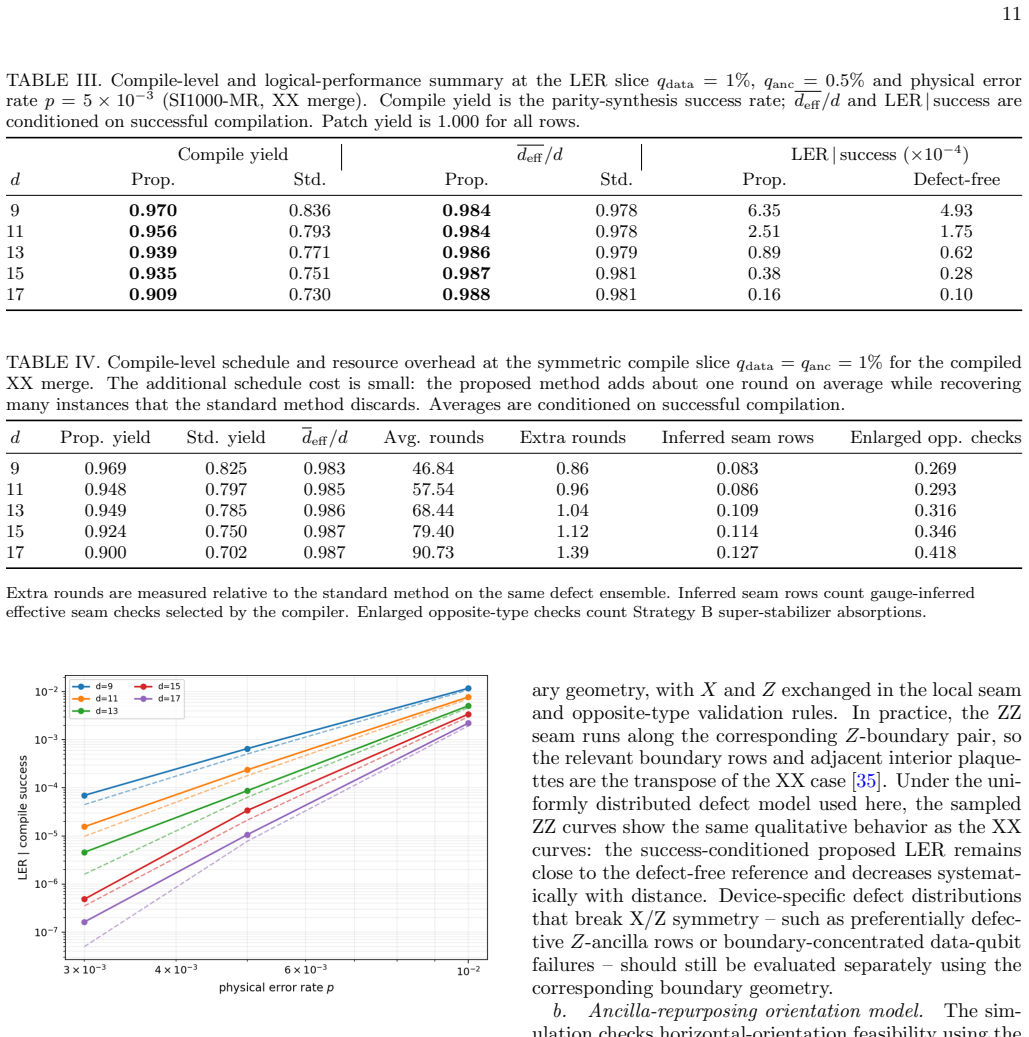
Defect-adaptive surface-code methods have substantially advanced the construction of valid logical patches on imperfect hardware, but fault-tolerant computation also requires executable logical oper ations on the resulting irregular geometries. We formulate the seam-boundary defect problem: how to perform a lattice-surgery merge when the intended seam intersects deformed boundaries, disabled checks, and gauge-inferred super-stabilizers. We introduce a defect-adaptive lattice-surgery method that reconstructs the target joint logical parity from the seam-related measurements available on the irregular merged patch, together with constraints inherited from the separated pre-merge code space. The reconstruction is expressed as a compact GF(2) binary-support synthesis problem. If the requested parity is realizable, the solution gives an executable parity-extraction rule over raw, schedule-tagged gauge outcomes; otherwise, it certifies a parity-synthesis failure rather than conflat ing it with patch invalidity. The framework accommodates boundary data-qubit defects, seam-check ancilla defects, and gauge-inferred seam super-checks within a single synthesis layer. Circuit-level samples of the synthesized merge operation show improved compile yield, preserved effective dis tance, and only modest success-conditioned logical-error overhead relative to the defect-free merge reference; an explicit ZZ-merge sampling check confirms the expected transposed-geometry behav ior under the same success-conditioned observable construction. More broadly, the results identify certified parity synthesis as a compilation layer between defect-adaptive patch construction and executable fault-tolerant logical operations on imperfect surface-code hardware.
Editorial analysis
A structured set of objections, weighed in public.
Referee Report
Summary. The paper claims to formulate the seam-boundary defect problem for lattice surgery on irregular surface-code patches and introduces a defect-adaptive method that uses a compact GF(2) binary-support synthesis problem to reconstruct the target joint logical parity from seam-related measurements and pre-merge constraints. It certifies parity-synthesis failures and provides circuit-level sampling results indicating improved compile yield, preserved effective distance, and modest success-conditioned logical-error overhead compared to defect-free merges.
Significance. If the central construction holds, this work is significant for enabling fault-tolerant logical operations on defective quantum hardware. It provides a systematic way to handle defects in lattice surgery without invalidating patches, with the GF(2) synthesis offering a certifiable and compact approach. The empirical validation through sampling is a strength, suggesting practical applicability with limited overhead.
major comments (2)
- [Formulation of the seam-boundary defect problem] The claim that the GF(2) binary-support synthesis problem fully captures all relevant constraints from disabled checks, boundary deformations, and gauge-inferred super-stabilizers is load-bearing for the method's correctness. The manuscript does not provide the explicit set of linear equations or a verification that no schedule-dependent or higher-weight relations from the time-dependent circuit on the irregular patch are missed, which could lead to extracting an operator differing from the intended logical parity.
- [Circuit-level sampling outcomes] The positive results on yield, distance preservation, and error overhead are reported, but without details on the synthesis algorithm implementation, the number of samples, error model parameters, or raw data. This undermines the ability to verify the claims of 'improved compile yield' and 'modest success-conditioned logical-error overhead'.
minor comments (2)
- [Abstract] There appear to be typographical spacing errors in the abstract, such as 'oper ations', 'dist ance', and 'behav ior'. These should be corrected for professional presentation.
- The paper would benefit from including a small explicit example of the GF(2) synthesis problem with the corresponding matrix and solution to illustrate the method.
Simulated Author's Rebuttal
We thank the referee for their careful reading and constructive feedback, including their recognition of the work's potential significance. We address each major comment below and indicate the revisions planned for the manuscript.
read point-by-point responses
-
Referee: [Formulation of the seam-boundary defect problem] The claim that the GF(2) binary-support synthesis problem fully captures all relevant constraints from disabled checks, boundary deformations, and gauge-inferred super-stabilizers is load-bearing for the method's correctness. The manuscript does not provide the explicit set of linear equations or a verification that no schedule-dependent or higher-weight relations from the time-dependent circuit on the irregular patch are missed, which could lead to extracting an operator differing from the intended logical parity.
Authors: We agree that the explicit linear equations were not provided in the manuscript and that this omission weakens the verifiability of the central claim. The GF(2) synthesis is assembled from the parity-check matrix of the merged irregular patch (disabled checks contribute zero rows, boundary deformations modify row supports, and gauge-inferred super-stabilizers are added as linear combinations inherited from the pre-merge stabilizers), with the target joint parity as the right-hand side. Schedule-tagged gauge outcomes are intended to incorporate the measurement schedule. To address the concern directly, we will add an appendix containing the explicit matrix construction together with a worked example on a small irregular patch that verifies the extracted operator matches the intended logical parity and that no additional schedule-dependent or higher-weight relations are required. This revision will make the completeness argument explicit. revision: yes
-
Referee: [Circuit-level sampling outcomes] The positive results on yield, distance preservation, and error overhead are reported, but without details on the synthesis algorithm implementation, the number of samples, error model parameters, or raw data. This undermines the ability to verify the claims of 'improved compile yield' and 'modest success-conditioned logical-error overhead'.
Authors: We concur that the absence of these implementation and sampling details prevents independent verification of the empirical claims. In the revised manuscript we will expand the relevant section to describe the synthesis algorithm (including pseudocode), state the number of samples used, specify the full error model and its parameters, and provide a link or supplementary file containing the raw data and analysis code. These additions will allow readers to reproduce and confirm the reported improvements in compile yield and the modest success-conditioned logical-error overhead. revision: yes
Circularity Check
No circularity: new GF(2) synthesis defined directly from measurements and constraints
full rationale
The paper defines a defect-adaptive lattice-surgery reconstruction as a compact GF(2) binary-support synthesis problem that combines seam-related measurements with inherited pre-merge constraints. This formulation is presented as an independent compilation layer without any reduction to fitted parameters, self-referential definitions, or load-bearing self-citations. No equations or steps in the provided abstract or description equate the output parity rule to the input by construction, and the method is explicitly distinguished from patch invalidity certification. The derivation remains self-contained against external benchmarks of surface-code stabilizer linearity.
Axiom & Free-Parameter Ledger
axioms (2)
- domain assumption Surface codes remain fault-tolerant when adapted to defects via gauge fixing and super-stabilizers
- domain assumption Logical parity can be extracted from a linear combination of gauge outcomes without introducing new logical errors when the combination respects the code space
invented entities (2)
-
Seam-boundary defect problem
no independent evidence
-
GF(2) binary-support synthesis problem
no independent evidence
Reference graph
Works this paper leans on
-
[1]
The relevant damaged same-type local rows are xA =X A46XA47XA56XA57, x B =X B42XB41XB52XB51
Ideal seam family and damaged local rows For the local seam neighborhood, the defect-freeX- type seam family for theX L ⊗X L merge is e1 =X A17XA27XB11XB21,(B2) e2 =X A37XA47XB31XB41,(B3) e3 =X A57XA67XB51XB61,(B4) e4 =X A77XB71.(B5) The three-defect clusterD={A47, A57, B41}destroys both native seam rowse 2 ande 3. The relevant damaged same-type local row...
-
[2]
The physical execution of the fused row is given by the gauge decomposition in Eq
Accepted fused seam super-check and reduced opposite-type constraint We define the fused defect-adapted seam row by ˜e23 ≡e 2e3xAxB.(B12) This equation is a binary-support identity rather than a prescription to measure the damaged native rows di- rectly. The physical execution of the fused row is given by the gauge decomposition in Eq. (B32). Expanding an...
-
[3]
For this worked local witness, we use the active X-basis qX = (A17, A27, B11, B21, A37, A46, A56, A67, B31, B42, B52, B61, A77, B71)
Certified seam-parity synthesis for Section III C We now instantiate the binary synthesis step of Sec- tion III C. For this worked local witness, we use the active X-basis qX = (A17, A27, B11, B21, A37, A46, A56, A67, B31, B42, B52, B61, A77, B71). (B20) On this basis, the defect-adapted effective seam family is Eeff X ={e 1,˜e23, e4},(B21) with binary ma...
-
[4]
Executable parity extraction for Section III D We now descend from the seam-level operator ˜e 23 to raw measured gauge outcomes. Assuming the following local gauge primitives are source-admissible under the chosen measurement schedule, one valid decomposition of the fused seam row is g1 =X A37XB31,(B28) g2 =X A46XA56,(B29) g3 =X B42XB52,(B30) g4 =X A67XB6...
-
[5]
Stabilizer Codes and Quantum Error Correction
D. Gottesman,Stabilizer Codes and Quantum Error Cor- rection, Ph.D. thesis, California Institute of Technology (1997), quant-ph/9705052
work page internal anchor Pith review arXiv 1997
-
[6]
A. Y. Kitaev, Annals of Physics303, 2 (2003)
2003
-
[7]
Dennis, A
E. Dennis, A. Kitaev, A. Landahl, and J. Preskill, Jour- nal of Mathematical Physics43, 4452 (2002)
2002
-
[8]
A. G. Fowler, M. Mariantoni, J. M. Martinis, and A. N. Cleland, Physical Review A86, 032324 (2012)
2012
-
[9]
Raussendorf and J
R. Raussendorf and J. Harrington, Physical Review Let- ters98, 190504 (2007)
2007
-
[10]
C. Wang, J. Harrington, and J. Preskill, Annals of Physics303, 31 (2003)
2003
-
[11]
Google Quantum AI, Nature614, 676 (2023)
2023
-
[12]
Krinner, N
S. Krinner, N. Lacroix, A. Remm, A. Di Paolo, E. Genois, C. Leroux, C. Hellings, S. Lazar, F. Swiadek, J. Her- rmann, G. J. Norris, C. K. Andersen, M. M¨ uller, A. Blais, C. Eichler, and A. Wallraff, Nature605, 669 (2022)
2022
-
[13]
Acharyaet al., Nature638, 920 (2024)
R. Acharyaet al., Nature638, 920 (2024)
2024
-
[14]
T. M. Stace, S. D. Barrett, and A. C. Doherty, Physical Review Letters102, 200501 (2009)
2009
-
[15]
Bombin, Physical Review Letters105, 030403 (2010)
H. Bombin, Physical Review Letters105, 030403 (2010)
2010
-
[16]
B. J. Brown, K. Laubscher, M. S. Kesselring, and J. R. Wootton, Physical Review X7, 021029 (2017)
2017
-
[17]
J. M. Auger, H. Anwar, M. Gimeno-Segovia, T. M. Stace, and D. E. Browne, Physical Review A96, 042316 (2017)
2017
-
[18]
Strikis, S
A. Strikis, S. C. Benjamin, and B. J. Brown, Physical Review Applied19, 064081 (2023)
2023
-
[19]
Nagayama, A
S. Nagayama, A. G. Fowler, D. Horsman, S. J. Devitt, and R. Van Meter, New Journal of Physics19, 023050 (2017)
2017
-
[20]
S. Heng, D. Kim, and Y. Han, Physical Review A109, 012420 (2024)
2024
-
[21]
Z. Wei, T. He, Y. Ye, D. Wu, Y. Zhang, Y. Zhao, W. Lin, H.-L. Huang, X. Zhu, and J.-W. Pan, npj Quantum In- formation11, 75 (2025)
2025
-
[22]
E. T. Campbell, B. M. Terhal, and C. Vuillot, Nature 549, 172 (2017)
2017
-
[23]
Horsman, A
D. Horsman, A. G. Fowler, S. Devitt, and R. Van Meter, New Journal of Physics14, 123011 (2012)
2012
-
[24]
Litinski, Quantum3, 128 (2019)
D. Litinski, Quantum3, 128 (2019)
2019
- [25]
-
[26]
Chamberland and E
C. Chamberland and E. T. Campbell, PRX Quantum3, 010331 (2022)
2022
-
[27]
S. D. Barrett and T. M. Stace, Physical Review Letters 15 105, 200502 (2010)
2010
-
[28]
Bombin, New Journal of Physics17, 083002 (2015)
H. Bombin, New Journal of Physics17, 083002 (2015)
2015
-
[29]
Paetznick and B
A. Paetznick and B. W. Reichardt, Physical Review Let- ters111, 090505 (2013)
2013
-
[30]
Vuillot, L
C. Vuillot, L. Lao, B. Criger, C. G. Almud´ ever, K. Ber- tels, and B. M. Terhal, New Journal of Physics21, 033028 (2019)
2019
-
[31]
Leroux, S
C. Leroux, S. F. Lin, P. Bienias, K. R. Sankar, A. Ben- hemou, A. Kubica, and J. K. Iverson, PRX Quantum6, 040302 (2025)
2025
-
[32]
Litinski and F
D. Litinski and F. von Oppen, Quantum2, 62 (2018)
2018
- [33]
-
[34]
Siegel, A
A. Siegel, A. Strikis, T. Flatters, and S. Benjamin, Quan- tum7, 1065 (2023)
2023
-
[35]
F. J. MacWilliams and N. J. A. Sloane,The Theory of Error-Correcting Codes(North-Holland, Amsterdam, 1977)
1977
-
[36]
Gidney, M
C. Gidney, M. Newman, A. Fowler, and M. Broughton, Quantum6, 683 (2022)
2022
-
[37]
Gidney, Quantum5, 497 (2021)
C. Gidney, Quantum5, 497 (2021)
2021
-
[38]
Higgott and C
O. Higgott and C. Gidney, Quantum9, 1600 (2025)
2025
-
[39]
Chamberland and E
C. Chamberland and E. T. Campbell, Physical Review Research4, 023090 (2022)
2022
-
[40]
S. F. Lin, E. C. Peterson, K. Sankar, and P. Sivarajah, Quantum Science and Technology10, 035007 (2025)
2025
discussion (0)
Sign in with ORCID, Apple, or X to comment. Anyone can read and Pith papers without signing in.