Recognition: unknown
Simultaneous measurements of N-subjettiness observables in jets from gluons and light-flavour quarks, and in decays of boosted W bosons and top quarks
Pith reviewed 2026-05-07 14:19 UTC · model grok-4.3
The pith
CMS simultaneously measures 25 N-subjettiness observables in jets from gluons, quarks, W bosons and top quarks.
A machine-rendered reading of the paper's core claim, the machinery that carries it, and where it could break.
Core claim
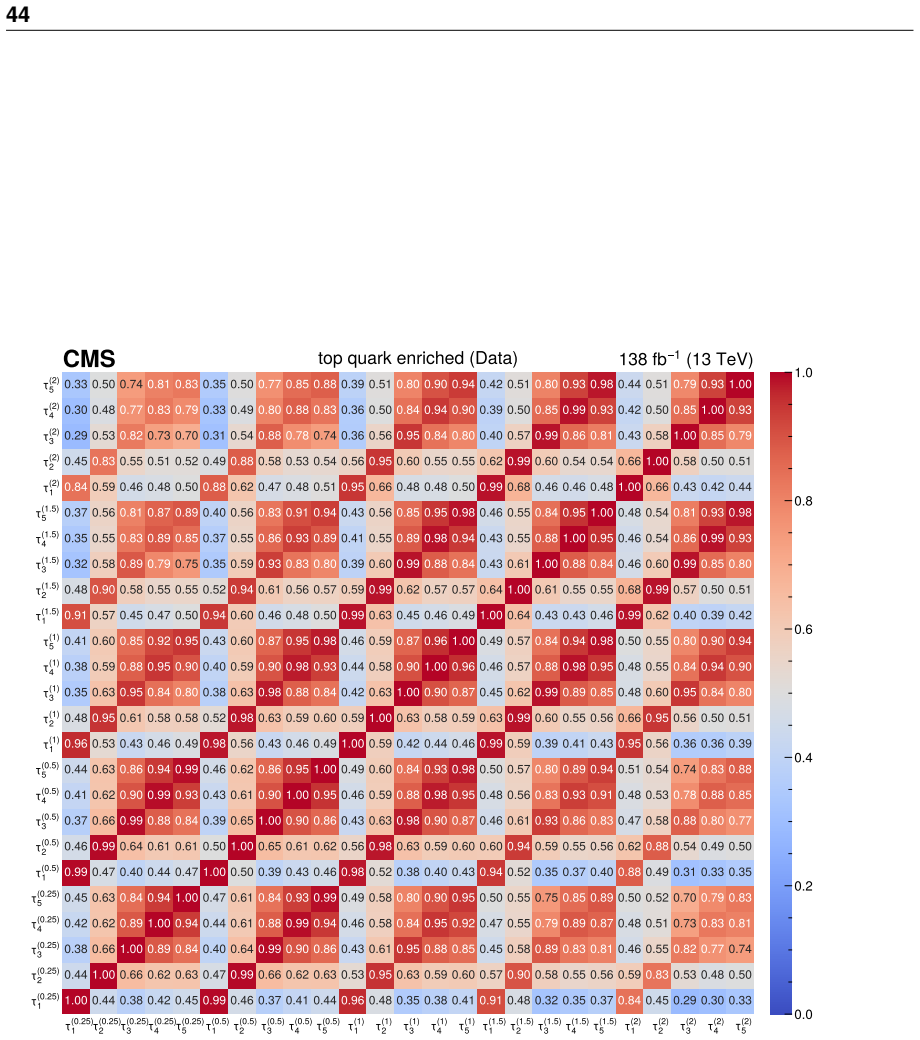
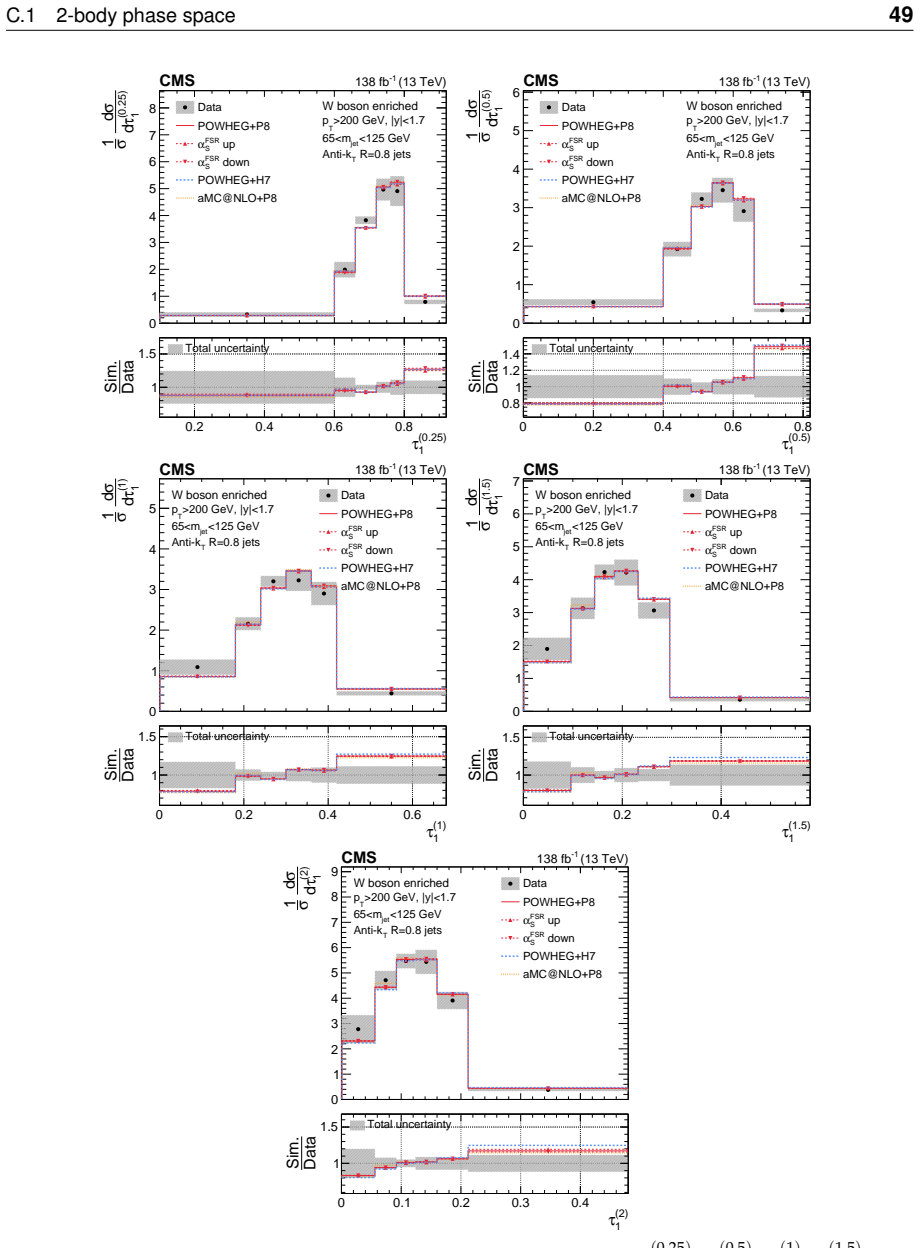
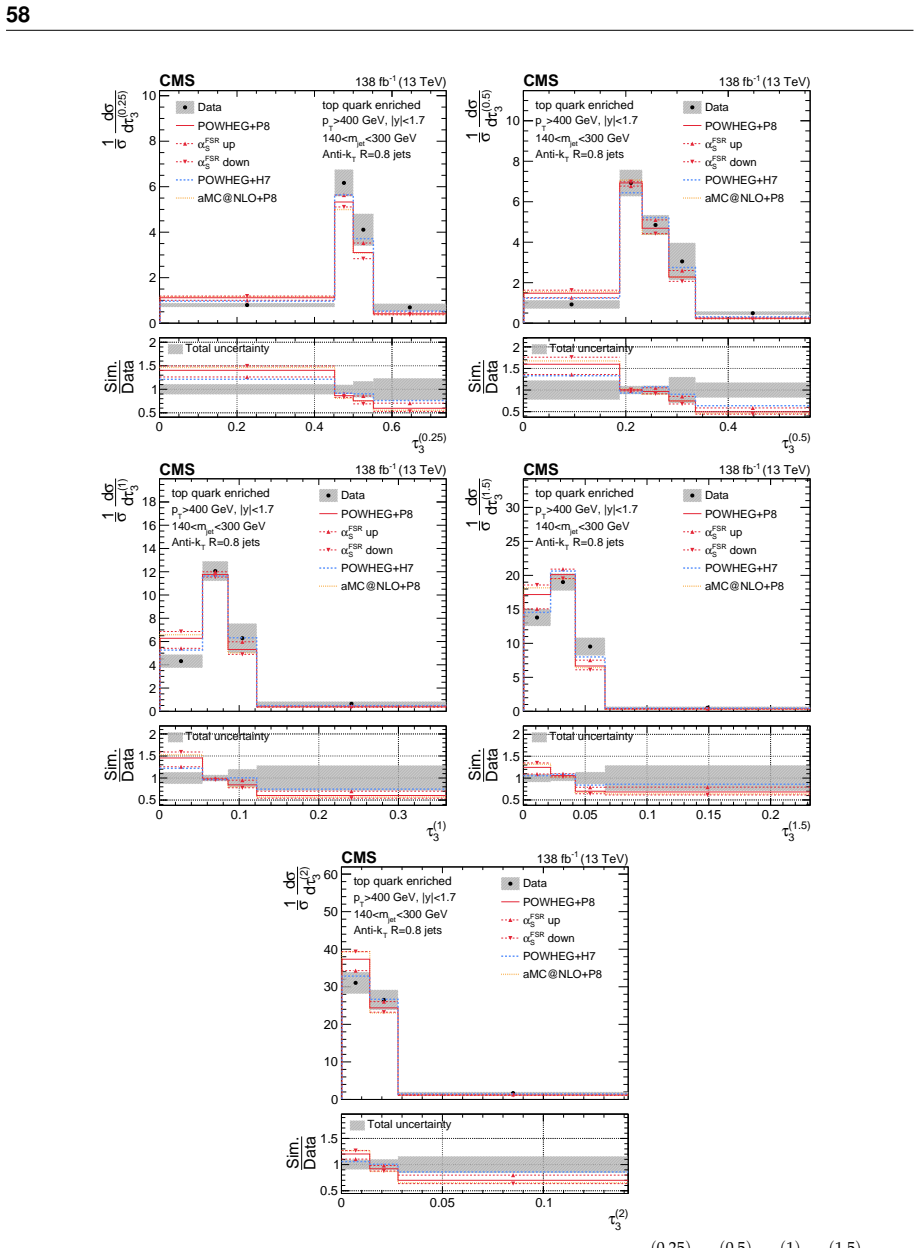
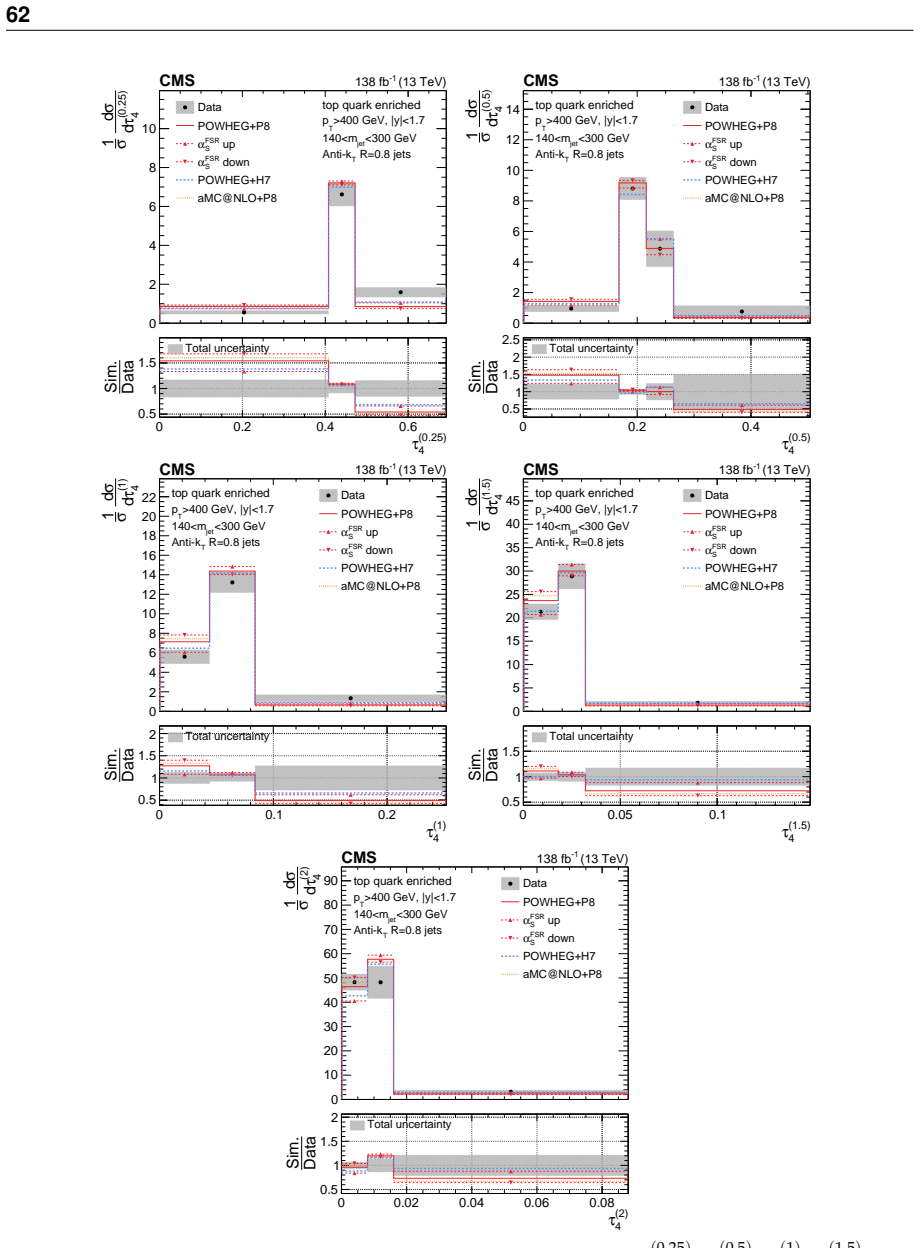
The central claim is a detailed characterization of jet substructure through simultaneous measurement of 25 N-subjettiness observables in jets initiated by gluons or light quarks (one prong), two quarks from boosted W bosons (two prongs), and three quarks from boosted top quarks (three prongs). Using data from 138 fb^{-1} recorded in 2016-2018, the measurements are unfolded to the level of stable particles, and an estimate of the particle-level correlations between the observables is provided.
What carries the argument
The 6-body basis of N-subjettiness observables that overconstrains the phase space of resolved emissions in the jet.
If this is right
- The results can be used to systematically assess and refine the modelling of radiation in jets.
- Particle-level distributions and correlations are provided for direct use in Monte Carlo generator tuning.
- The measurements characterize substructure differences across one-, two- and three-prong jet topologies.
- Data from gluon/light-quark, W-boson and top-quark initiated jets allow comparative studies of radiation patterns.
Where Pith is reading between the lines
- These unfolded results with correlations could be used to develop or validate machine-learning-based jet tagging methods.
- The data set may help diagnose specific deficiencies in current parton-shower algorithms for multi-prong jets.
- Higher-order perturbative QCD calculations could be compared directly to the reported particle-level observables and correlations.
Load-bearing premise
The unfolding procedure and Monte Carlo simulations used for correction and background subtraction accurately capture detector effects and jet substructure without introducing significant biases.
What would settle it
A significant discrepancy between the unfolded particle-level distributions or their reported correlations and independent theoretical calculations or additional experimental measurements would indicate that the results do not accurately reflect the true jet substructure.
Figures















read the original abstract
A simultaneous measurement of 25 substructure observables is presented using large-radius jets with high transverse momentum from proton-proton collisions at $\sqrt{s}$ = 13 TeV. The measurement is carried out on dijet events and $\mathrm{t\bar{t}}$ events enriched in Lorentz-boosted W bosons and top quarks decaying hadronically. The three data samples consist of jets with one, two, or three prongs from the showering and hadronization of a gluon or light-flavour quark, two quarks, or three quarks, respectively. The data correspond to an integrated luminosity of 138 fb$^{-1}$, recorded by the CMS experiment in 2016$-$2018. A detailed characterization of the jet substructure is provided using a 6-body basis of $N$-subjettiness observables that overconstrains the phase space of the resolved emissions in the jet. The measurements are unfolded to the level of stable particles, and an estimate of the particle-level correlations between observables is provided, ensuring that the results can be used to systematically assess and refine the modelling of radiation in jets.
Editorial analysis
A structured set of objections, weighed in public.
Referee Report
Summary. The manuscript reports a simultaneous measurement of 25 N-subjettiness observables in high-pT large-radius jets from 13 TeV proton-proton collisions recorded by CMS. Measurements are performed in three topologies using dijet events (1-prong gluon/light-quark jets) and ttbar events enriched in boosted hadronic W decays (2-prong) and top decays (3-prong). The observables are unfolded to stable-particle level with an estimate of the particle-level correlation matrix provided to support QCD modeling studies.
Significance. If the results hold, the work supplies a high-dimensional, unfolded dataset with correlations that can be used to systematically test and tune Monte Carlo generators for jet radiation patterns across different parton origins and multi-prong structures. The simultaneous treatment and explicit correlation provision are strengths that go beyond single-observable measurements and directly aid precision modeling for boosted-object and jet-substructure analyses at the LHC.
major comments (2)
- [§4.2] §4.2 (Unfolding section): The response matrix for the 25-dimensional observable space is derived from simulation; the manuscript should include explicit closure-test results and pull distributions for the full set of observables plus the extracted correlation matrix to demonstrate that the iterative unfolding does not introduce biases that would affect the reported particle-level values or correlations.
- [§5.1] §5.1 (Results): The claim that the 6-body N-subjettiness basis overconstrains the resolved-emission phase space is central to the measurement strategy, yet the text does not quantify the degree of overconstraint or show how the specific 25 observables map onto this basis; this information is needed to assess whether the chosen set is sufficient to characterize the jet substructure without redundancy or gaps.
minor comments (2)
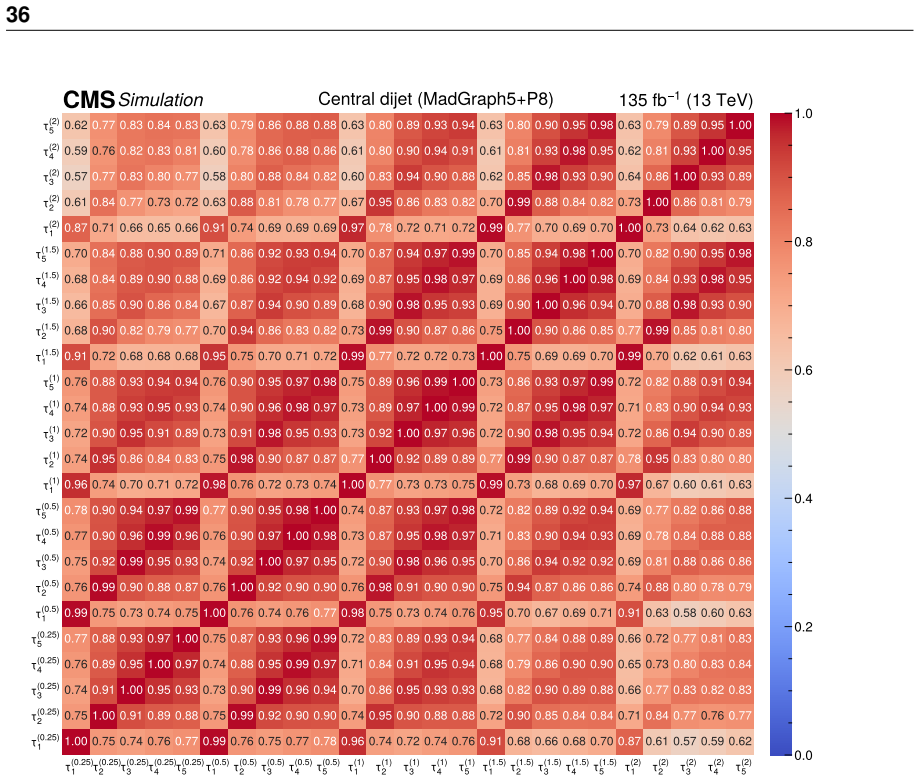
- [Figure 4] Figure 4 (correlation matrices): the color scale and axis labels are difficult to read at the printed size; enlarging the panels or adding numerical annotations on the diagonal would improve clarity.
- The integrated luminosity is stated as 138 fb^{-1} in the abstract but the per-sample breakdown and corresponding statistical uncertainties on the unfolded distributions are not tabulated; adding a summary table would aid reproducibility.
Simulated Author's Rebuttal
We thank the referee for the positive assessment of our work and the recommendation for minor revision. We address the two major comments below and will incorporate the requested clarifications and additional material into the revised manuscript.
read point-by-point responses
-
Referee: [§4.2] §4.2 (Unfolding section): The response matrix for the 25-dimensional observable space is derived from simulation; the manuscript should include explicit closure-test results and pull distributions for the full set of observables plus the extracted correlation matrix to demonstrate that the iterative unfolding does not introduce biases that would affect the reported particle-level values or correlations.
Authors: We agree that explicit validation of the unfolding is essential for a high-dimensional measurement. In the revised manuscript we will add a new subsection (or appendix) presenting closure tests performed on simulated samples. These will include pull distributions for all 25 observables individually and for the full correlation matrix at particle level, confirming that the iterative Bayesian unfolding procedure introduces no statistically significant biases beyond those already accounted for in the systematic uncertainties. revision: yes
-
Referee: [§5.1] §5.1 (Results): The claim that the 6-body N-subjettiness basis overconstrains the resolved-emission phase space is central to the measurement strategy, yet the text does not quantify the degree of overconstraint or show how the specific 25 observables map onto this basis; this information is needed to assess whether the chosen set is sufficient to characterize the jet substructure without redundancy or gaps.
Authors: The 6-body basis is formed by the set of τ_N^β observables with N = 1…6 and β = 1, 2; the 25 measured observables are a carefully chosen subset of these that together overconstrain the resolved-emission phase space while remaining experimentally accessible. In the revised version we will insert a short paragraph (with an accompanying table or diagram) that explicitly lists which of the 25 observables correspond to each (N, β) pair and quantifies the overconstraint by noting that the 25-dimensional space is spanned by a lower-dimensional manifold of resolved parton emissions (approximately 12–15 independent directions after accounting for energy-momentum conservation and clustering). This addition will make the mapping and the degree of overconstraint transparent without altering the measurement strategy. revision: yes
Circularity Check
No circularity: direct experimental measurement unfolded from data
full rationale
The paper reports a simultaneous unfolded measurement of 25 N-subjettiness observables in three jet topologies from 13 TeV pp collision data. The analysis chain consists of event selection, jet reconstruction, detector-level to particle-level unfolding via response matrices derived from simulation, and correlation estimation. These steps follow standard CMS practices with closure tests and do not contain any self-definitional equations, fitted inputs renamed as predictions, or load-bearing self-citations that reduce the reported observables or correlations to the inputs by construction. The results remain grounded in observed data after correction, with no derivation that is equivalent to its own inputs.
Axiom & Free-Parameter Ledger
Reference graph
Works this paper leans on
-
[1]
G. P . Salam, “Towards jetography”,Eur. Phys. J. C67(2010) 637, doi:10.1140/epjc/s10052-010-1314-6,arXiv:0906.1833
-
[2]
A. J. Larkoski, I. Moult, and B. Nachman, “Jet substructure at the Large Hadron Collider: A review of recent advances in theory and machine learning”,Phys. Rept.841 (2020) 1,doi:10.1016/j.physrep.2019.11.001,arXiv:1709.04464
-
[3]
Kogleret al.,Jet Substructure at the Large Hadron Collider: Experimental Review, Rev
R. Kogler et al., “Jet substructure at the Large Hadron Collider”,Rev. Mod. Phys.91 (2019) 045003,doi:10.1103/RevModPhys.91.045003,arXiv:1803.06991
-
[4]
Looking inside jets: an introduction to jet substructure and boosted-object phenomenology
S. Marzani, G. Soyez, and M. Spannowsky, “Looking inside jets: an introduction to jet substructure and boosted-object phenomenology”,Lect. Notes Phys.958(2019) 1, doi:10.1007/978-3-030-15709-8,arXiv:1901.10342
work page internal anchor Pith review Pith/arXiv arXiv doi:10.1007/978-3-030-15709-8 2019
-
[5]
J. Thaler and K. Van Tilburg, “Identifying boosted objects withN-subjettiness”,JHEP 03(2011) 015,doi:10.1007/JHEP03(2011)015,arXiv:1011.2268
-
[6]
J. Thaler and K. Van Tilburg, “Maximizing boosted top identification by minimizing N-subjettiness”,JHEP02(2012) 093,doi:10.1007/JHEP02(2012)093, arXiv:1108.2701
-
[7]
Machine learning in high energy physics: A review of heavy-flavor jet tagging at the LHC
S. Mondal and L. Mastrolorenzo, “Machine learning in high energy physics: A review of heavy-flavor jet tagging at the LHC”,Eur. Phys. J. Spec. T op.233(2024) 2657, doi:10.1140/epjs/s11734-024-01234-y,arXiv:2404.01071
-
[8]
How much information is in a jet?
K. Datta and A. Larkoski, “How much information is in a jet?”,JHEP06(2017) 073, doi:10.1007/JHEP06(2017)073,arXiv:1704.08249
-
[9]
ATLAS Collaboration, “Measurement of jet fragmentation in 5.02 TeV proton-lead and proton-proton collisions with the ATLAS detector”,Nucl. Phys. A978(2018) 65, doi:10.1016/j.nuclphysa.2018.07.006,arXiv:1706.02859
-
[10]
Measurement of the soft-drop jet mass in pp collisions at√s=13 TeV with the ATLAS detector
ATLAS Collaboration, “Measurement of the soft-drop jet mass in pp collisions at√s=13 TeV with the ATLAS detector”,Phys. Rev. Lett.121(2018) 092001, doi:10.1103/PhysRevLett.121.092001,arXiv:1711.08341
-
[11]
Measurement of jet fragmentation in Pb+Pb and pp collisions at√sNN =5.02 TeV with the ATLAS detector
ATLAS Collaboration, “Measurement of jet fragmentation in Pb+Pb and pp collisions at√sNN =5.02 TeV with the ATLAS detector”,Phys. Rev. C98(2018) 024908, doi:10.1103/PhysRevC.98.024908,arXiv:1805.05424
-
[12]
ATLAS Collaboration, “Measurement of colour flow using jet-pull observables in t t events with the ATLAS experiment at √s=13 TeV”,Eur. Phys. J. C78(2018) 847, doi:10.1140/epjc/s10052-018-6290-2,arXiv:1805.02935. 28
-
[13]
Properties ofg→b b at small opening angles in pp collisions with the ATLAS detector at √s=13 TeV
ATLAS Collaboration, “Properties ofg→b b at small opening angles in pp collisions with the ATLAS detector at √s=13 TeV”,Phys. Rev. D99(2019) 052004, doi:10.1103/PhysRevD.99.052004,arXiv:1812.09283
-
[14]
Measurement of soft-drop jet observables in pp collisions with the ATLAS detector at √s=13 TeV
ATLAS Collaboration, “Measurement of soft-drop jet observables in pp collisions with the ATLAS detector at √s=13 TeV”,Phys. Rev. D101(2020) 052007, doi:10.1103/PhysRevD.101.052007,arXiv:1912.09837
-
[15]
ATLAS Collaboration, “Properties of jet fragmentation using charged particles measured with the ATLAS detector in pp collisions at √s=13 TeV”,Phys. Rev. D100 (2019) 052011,doi:10.1103/PhysRevD.100.052011,arXiv:1906.09254
-
[16]
ATLAS Collaboration, “Measurement of jet-substructure observables in top quark, W boson and light jet production in proton-proton collisions at √s=13 TeV with the ATLAS detector”,JHEP08(2019) 033,doi:10.1007/JHEP08(2019)033, arXiv:1903.02942
-
[17]
ATLAS Collaboration, “Measurement of the jet mass in high transverse momentum Z(→b b)γproduction at √s=13 TeV using the ATLAS detector”,Phys. Lett. B812 (2021) 135991,doi:10.1016/j.physletb.2020.135991,arXiv:1907.07093
-
[18]
ATLAS Collaboration, “Comparison of fragmentation functions for jets dominated by light quarks and gluons from pp and Pb+Pb collisions in ATLAS”,Phys. Rev. Lett.123 (2019) 042001,doi:10.1103/PhysRevLett.123.042001,arXiv:1902.10007
-
[19]
ATLAS Collaboration, “Measurement of the Lund jet plane using charged particles in 13 TeV proton-proton collisions with the ATLAS detector”,Phys. Rev. Lett.124(2020) 222002,doi:10.1103/PhysRevLett.124.222002,arXiv:2004.03540
-
[20]
ATLAS Collaboration, “Measurement of b-quark fragmentation properties in jets using the decay B± →J/ψK ± in pp collisions at √s=13 TeV with the ATLAS detector”, JHEP12(2021) 131,doi:10.1007/JHEP12(2021)131,arXiv:2108.11650
-
[21]
ATLAS Collaboration, “Measurement of jet substructure in boosted t t events with the ATLAS detector using 140 fb−1 of 13 TeV p p collisions”,Phys. Rev. D109(2024) 112016, doi:10.1103/PhysRevD.109.112016,arXiv:2312.03797
-
[22]
ATLAS Collaboration, “Measurement of the lund jet plane in hadronic decays of top quarks and W bosons with the ATLAS detector”,Eur. Phys. J. C85(2025) 416, doi:10.1140/epjc/s10052-025-13924-5,arXiv:2407.10879
-
[23]
Measurement of the splitting function in pp and PbPb collisions at√sNN =5.02 TeV
CMS Collaboration, “Measurement of the splitting function in pp and PbPb collisions at√sNN =5.02 TeV”,Phys. Rev. Lett.120(2018) 142302, doi:10.1103/PhysRevLett.120.142302,arXiv:1708.09429
-
[24]
Measurement of jet substructure observables in t t events from proton-proton collisions at √s=13 TeV
CMS Collaboration, “Measurement of jet substructure observables in t t events from proton-proton collisions at √s=13 TeV”,Phys. Rev. D98(2018) 092014, doi:10.1103/PhysRevD.98.092014,arXiv:1808.07340
-
[25]
CMS Collaboration, “Measurements of the differential jet cross section as a function of the jet mass in dijet events from proton-proton collisions at √s=13 TeV”,JHEP11 (2018) 113,doi:10.1007/JHEP11(2018)113,arXiv:1807.05974. References 29
-
[26]
Measurement of the groomed jet mass in PbPb and pp collisions at√sNN =5.02 TeV
CMS Collaboration, “Measurement of the groomed jet mass in PbPb and pp collisions at√sNN =5.02 TeV”,JHEP10(2018) 161,doi:10.1007/JHEP10(2018)161, arXiv:1805.05145
-
[27]
Jet shapes of isolated photon-tagged jets in PbPb and pp collisions at √sNN =5.02 TeV
CMS Collaboration, “Jet shapes of isolated photon-tagged jets in PbPb and pp collisions at √sNN =5.02 TeV”,Phys. Rev. Lett.122(2019) 152001, doi:10.1103/PhysRevLett.122.152001,arXiv:1809.08602
-
[28]
Study of quark and gluon jet substructure in Z+jet and dijet events from pp collisions
CMS Collaboration, “Study of quark and gluon jet substructure in Z+jet and dijet events from pp collisions”,JHEP01(2022) 188,doi:10.1007/JHEP01(2022)188, arXiv:2109.03340
-
[29]
Measurement of energy correlators inside jets and determination of the strong couplingα S(mZ)
CMS Collaboration, “Measurement of energy correlators inside jets and determination of the strong couplingα S(mZ)”,Phys. Rev. Lett.133(2024) 071903, doi:10.1103/PhysRevLett.133.071903,arXiv:2402.13864
-
[30]
Measurement of the primary Lund jet plane density in proton-proton collisions at √s=13 TeV
CMS Collaboration, “Measurement of the primary Lund jet plane density in proton-proton collisions at √s=13 TeV”,JHEP05(2024) 116, doi:10.1007/JHEP05(2024)116,arXiv:2312.16343
-
[31]
First measurement of jet mass in Pb–Pb and p–Pb collisions at the LHC
ALICE Collaboration, “First measurement of jet mass in Pb–Pb and p–Pb collisions at the LHC”,Phys. Lett. B776(2018) 249,doi:10.1016/j.physletb.2017.11.044, arXiv:1702.00804
-
[32]
ALICE Collaboration, “Exploration of jet substructure using iterative declustering in pp and Pb–Pb collisions at LHC energies”,Phys. Lett. B802(2020) 135227, doi:10.1016/j.physletb.2020.135227,arXiv:1905.02512
-
[33]
Jet fragmentation transverse momentum distributions in pp and p–Pb collisions at √sNN =5.02 TeV
ALICE Collaboration, “Jet fragmentation transverse momentum distributions in pp and p–Pb collisions at √sNN =5.02 TeV”,JHEP09(2021) 211, doi:10.1007/JHEP09(2021)211,arXiv:2011.05904
-
[34]
Measurements of the groomed and ungroomed jet angularities in pp collisions at √s=5.02 TeV
ALICE Collaboration, “Measurements of the groomed and ungroomed jet angularities in pp collisions at √s=5.02 TeV”,JHEP05(2022) 061, doi:10.1007/JHEP05(2022)061,arXiv:2107.11303
-
[35]
ALICE Collaboration, “Measurement of the groomed jet radius and momentum splitting fraction in pp and Pb–Pb collisions at √sNN =5.02 TeV”,Phys. Rev. Lett.128 (2022) 102001,doi:10.1103/PhysRevLett.128.102001,arXiv:2107.12984
-
[36]
Direct observation of the dead-cone effect in quantum chromodynamics
ALICE Collaboration, “Direct observation of the dead-cone effect in quantum chromodynamics”,Nature605(2022) 440,doi:10.1038/s41586-022-04572-w, arXiv:2106.05713
-
[37]
First measurements ofN-subjettiness in central Pb–Pb collisions at √sNN =2.76 TeV
ALICE Collaboration, “First measurements ofN-subjettiness in central Pb–Pb collisions at √sNN =2.76 TeV”,JHEP10(2021) 003,doi:10.1007/JHEP10(2021)003, arXiv:2105.04936
-
[38]
Aaij et al., Study of J /ψ Production in Jets, Phys
LHCb Collaboration, “Study of J/ψproduction in jets”,Phys. Rev. Lett.118(2017) 192001,doi:10.1103/PhysRevLett.118.192001,arXiv:1701.05116
-
[39]
Measurement of charged hadron production in Z-tagged jets in proton-proton collisions at √s=8 TeV
LHCb Collaboration, “Measurement of charged hadron production in Z-tagged jets in proton-proton collisions at √s=8 TeV”,Phys. Rev. Lett.123(2019) 232001, doi:10.1103/PhysRevLett.123.232001,arXiv:1904.08878. 30
-
[40]
Precision luminosity measurement in proton-proton collisions at√s=13 TeV in 2015 and 2016 at CMS
CMS Collaboration, “Precision luminosity measurement in proton-proton collisions at√s=13 TeV in 2015 and 2016 at CMS”,Eur. Phys. J. C81(2021) 800, doi:10.1140/epjc/s10052-021-09538-2,arXiv:2104.01927
-
[41]
CMS luminosity measurement for the 2017 data-taking period at√s=13 TeV
CMS Collaboration, “CMS luminosity measurement for the 2017 data-taking period at√s=13 TeV”, CMS Physics Analysis Summary CMS-PAS-LUM-17-004, 2018
2017
-
[42]
CMS luminosity measurement for the 2018 data-taking period at√s=13 TeV
CMS Collaboration, “CMS luminosity measurement for the 2018 data-taking period at√s=13 TeV”, CMS Physics Analysis Summary CMS-PAS-LUM-18-002, 2019
2018
-
[43]
HEPData record for this analysis., 2025.doi:10.17182/hepdata.166442
-
[44]
Njettiness: An inclusive event shape to veto jets
I. W. Stewart, F. J. Tackmann, and W. J. Waalewijn, “Njettiness: An inclusive event shape to veto jets”,Phys. Rev. Lett.105(2010) 092002, doi:10.1103/PhysRevLett.105.092002,arXiv:1004.2489
-
[45]
S. Catani, Y. L. Dokshitzer, M. H. Seymour, and B. R. Webber, “Longitudinally invariant kT clustering algorithms for hadron hadron collisions”,Nucl. Phys. B406(1993) 187, doi:10.1016/0550-3213(93)90166-M
-
[46]
Successive combination jet algorithm for hadron collisions
S. D. Ellis and D. E. Soper, “Successive combination jet algorithm for hadron collisions”, Phys. Rev. D48(1993) 3160,doi:10.1103/PhysRevD.48.3160
-
[47]
G. C. Blazey et al., “Run II jet physics”, inPhysics at Run II: QCD and weak boson physics workshop: Final general meeting, p. 47. 2000.arXiv:hep-ex/0005012
-
[48]
M. Cacciari, G. P . Salam, and G. Soyez, “FASTJETuser manual”,Eur. Phys. J. C72(2012) 1896,doi:10.1140/epjc/s10052-012-1896-2,arXiv:1111.6097
-
[49]
Jet observables without jet algorithms
D. Bertolini, T. Chan, and J. Thaler, “Jet observables without jet algorithms”,JHEP04 (2014) 013,doi:10.1007/JHEP04(2014)013,arXiv:1310.7584
-
[50]
Jet shapes with the broadening axis
A. J. Larkoski, D. Neill, and J. Thaler, “Jet shapes with the broadening axis”,JHEP04 (2014) 017,doi:10.1007/JHEP04(2014)017,arXiv:1401.2158
-
[51]
A. J. Larkoski and J. Thaler, “Aspects of jets at 100 TeV”,Phys. Rev. D90(2014) 034010, doi:10.1103/PhysRevD.90.034010,arXiv:1406.7011
-
[52]
The CMS experiment at the CERN LHC
CMS Collaboration, “The CMS experiment at the CERN LHC”,JINST3(2008) S08004, doi:10.1088/1748-0221/3/08/S08004
-
[53]
Development of the CMS detector for the CERN LHC Run 3
CMS Collaboration, “Development of the CMS detector for the CERN LHC Run 3”, JINST19(2024) P05064,doi:10.1088/1748-0221/19/05/P05064, arXiv:2309.05466
-
[54]
Performance of the CMS Level-1 trigger in proton-proton collisions at √s=13 TeV
CMS Collaboration, “Performance of the CMS Level-1 trigger in proton-proton collisions at √s=13 TeV”,JINST15(2020) P10017, doi:10.1088/1748-0221/15/10/P10017,arXiv:2006.10165
-
[55]
CMS Collaboration, “The CMS trigger system”,JINST12(2017) P01020, doi:10.1088/1748-0221/12/01/P01020,arXiv:1609.02366
-
[56]
Performance of the CMS high-level trigger during LHC Run 2
CMS Collaboration, “Performance of the CMS high-level trigger during LHC Run 2”, JINST19(2024) P11021,doi:10.1088/1748-0221/19/11/P11021, arXiv:2410.17038. References 31
-
[57]
Electron and photon reconstruction and identification with the CMS experiment at the CERN LHC
CMS Collaboration, “Electron and photon reconstruction and identification with the CMS experiment at the CERN LHC”,JINST16(2021) P05014, doi:10.1088/1748-0221/16/05/P05014,arXiv:2012.06888
-
[58]
CMS Collaboration, “Performance of the CMS muon detector and muon reconstruction with proton-proton collisions at √s=13 TeV”,JINST13(2018) P06015, doi:10.1088/1748-0221/13/06/P06015,arXiv:1804.04528
work page internal anchor Pith review doi:10.1088/1748-0221/13/06/p06015 2018
-
[59]
Description and performance of track and primary-vertex reconstruction with the CMS tracker
CMS Collaboration, “Description and performance of track and primary-vertex reconstruction with the CMS tracker”,JINST9(2014) P10009, doi:10.1088/1748-0221/9/10/P10009,arXiv:1405.6569
-
[60]
The CMS phase-1 pixel detector upgrade
CMS Tracker Group Collaboration, “The CMS Phase-1 pixel detector upgrade”,JINST 16(2021) P02027,doi:10.1088/1748-0221/16/02/P02027,arXiv:2012.14304
-
[61]
Track impact parameter resolution for the full pseudo rapidity coverage in the 2017 dataset with the CMS Phase-1 pixel detector
CMS Collaboration, “Track impact parameter resolution for the full pseudo rapidity coverage in the 2017 dataset with the CMS Phase-1 pixel detector”, CMS Detector Performance Note CMS-DP-2020-049, 2020
2017
-
[62]
2017 tracking performance plots
CMS Collaboration, “2017 tracking performance plots”, CMS Detector Performance Note CMS-DP-2017-015, 2017
2017
-
[63]
Particle-flow reconstruction and global event description with the CMS detector
CMS Collaboration, “Particle-flow reconstruction and global event description with the CMS detector”,JINST12(2017) P10003,doi:10.1088/1748-0221/12/10/P10003, arXiv:1706.04965
work page internal anchor Pith review doi:10.1088/1748-0221/12/10/p10003 2017
-
[64]
M. Cacciari, G. P . Salam, and G. Soyez, “The anti-kT jet clustering algorithm”,JHEP04 (2008) 063,doi:10.1088/1126-6708/2008/04/063,arXiv:0802.1189
-
[65]
Pileup mitigation at CMS in 13 TeV data
CMS Collaboration, “Pileup mitigation at CMS in 13 TeV data”,JINST15(2020) P09018, doi:10.1088/1748-0221/15/09/P09018,arXiv:2003.00503
-
[66]
Pileup per particle identification
D. Bertolini, P . Harris, M. Low, and N. Tran, “Pileup per particle identification”,JHEP 10(2014) 059,doi:10.1007/JHEP10(2014)059,arXiv:1407.6013
-
[67]
Pileup removal algorithms
CMS Collaboration, “Pileup removal algorithms”, CMS Physics Analysis Summary CMS-PAS-JME-14-001, 2014
2014
-
[68]
Jet energy scale and resolution in the CMS experiment in pp collisions at 8 TeV
CMS Collaboration, “Jet energy scale and resolution in the CMS experiment in pp collisions at 8 TeV”,JINST12(2017) P02014, doi:10.1088/1748-0221/12/02/P02014,arXiv:1607.03663
-
[69]
Technical proposal for the Phase-II upgrade of the Compact Muon Solenoid
CMS Collaboration, “Technical proposal for the Phase-II upgrade of the Compact Muon Solenoid”, CMS Technical Proposal CERN-LHCC-2015-010, CMS-TDR-15-02, 2015
2015
-
[70]
CMS Collaboration, “Performance of missing transverse momentum reconstruction in proton-proton collisions at √s=13 TeV using the CMS detector”,JINST14(2019) P07004,doi:10.1088/1748-0221/14/07/P07004,arXiv:1903.06078
-
[71]
Performance of the CMS muon trigger system in proton-proton collisions at √s=13 TeV
CMS Collaboration, “Performance of the CMS muon trigger system in proton-proton collisions at √s=13 TeV”,JINST16(2021) P07001, doi:10.1088/1748-0221/16/07/P07001,arXiv:2102.04790
-
[72]
GEANT4 Collaboration, “GEANT4—a simulation toolkit”,Nucl. Instrum. Meth. A506 (2003) 250,doi:10.1016/S0168-9002(03)01368-8. 32
-
[73]
J. Allison et al., “GEANT4 developments and applications”,IEEE T rans. Nucl. Sci.53 (2006) 270,doi:10.1109/TNS.2006.869826
-
[74]
T. Sj ¨ostrand et al., “An introduction toPYTHIA8.2”,Comput. Phys. Commun.191(2015) 159,doi:10.1016/j.cpc.2015.01.024,arXiv:1410.3012
-
[75]
Extraction and validation of a new set of CMS PYTHIA8 tunes from underlying-event measurements
CMS Collaboration, “Extraction and validation of a new set of CMSPYTHIA8 tunes from underlying-event measurements”,Eur. Phys. J. C80(2020) 4, doi:10.1140/epjc/s10052-019-7499-4,arXiv:1903.12179
-
[76]
Bahr et al., Herwig++ Physics and Manual , Eur
M. B ¨ahr et al., “HERWIG++ physics and manual”,Eur. Phys. J. C58(2008) 639, doi:10.1140/epjc/s10052-008-0798-9,arXiv:0803.0883
-
[77]
Bellm et al., Herwig 7.0/Herwig++ 3.0 release note , Eur
J. Bellm et al., “HERWIG7.0/HERWIG++ 3.0 release note”,Eur. Phys. J. C76(2016) 196, doi:10.1140/epjc/s10052-016-4018-8,arXiv:1512.01178
-
[78]
Development and validation ofHERWIG7 tunes from CMS underlying-event measurements
CMS Collaboration, “Development and validation ofHERWIG7 tunes from CMS underlying-event measurements”,Eur. Phys. J. C81(2021) 312, doi:10.1140/epjc/s10052-021-08949-5,arXiv:2011.03422
-
[79]
J. Alwall et al., “The automated computation of tree-level and next-to-leading order differential cross sections, and their matching to parton shower simulations”,JHEP07 (2014) 079,doi:10.1007/JHEP07(2014)079,arXiv:1405.0301
-
[80]
J. Alwall et al., “Comparative study of various algorithms for the merging of parton showers and matrix elements in hadronic collisions”,Eur. Phys. J. C53(2008) 473, doi:10.1140/epjc/s10052-007-0490-5,arXiv:0706.2569
discussion (0)
Sign in with ORCID, Apple, or X to comment. Anyone can read and Pith papers without signing in.