Recognition: unknown
Towards interpretable AI with quantum annealing feature selection
Pith reviewed 2026-05-07 16:29 UTC · model grok-4.3
The pith
Encoding feature map selection as a quantum optimization problem solved by annealing produces more transparent explanations for CNN predictions than gradient-based methods.
A machine-rendered reading of the paper's core claim, the machinery that carries it, and where it could break.
Core claim
By formulating the problem of selecting important feature maps as a quantum constrained optimization problem and solving it with quantum annealing, the approach achieves improved class disentanglement, where the model's decision boundaries are more distinct and its reasoning more transparent than when using GradCAM or GradCAM++.
What carries the argument
Quantum annealing used to solve the combinatorial optimization of selecting the most contributory feature maps in a CNN for a given prediction.
If this is right
- The explanations become more transparent by highlighting distinct features the model uses for specific classes.
- Model biases or incorrect pattern learning can be identified more easily through the clearer reasoning.
- Improved model design is possible by focusing development on the key feature maps identified.
- Trust in the AI system increases because users can better understand the basis for predictions.
- Analysis of the energy gap and success probability provides insight into why the quantum method performs well in practice.
Where Pith is reading between the lines
- If the quantum solution scales, it could enable feature selection for deeper networks or larger images where classical solvers struggle.
- Similar optimization encodings might apply to interpreting other architectures like transformers by selecting key attention heads.
- The lack of quantitative metrics suggests that future work could measure disentanglement with explicit scores to confirm the visual improvements.
- Testing on datasets with known biases would show whether the method reliably detects those biases.
Load-bearing premise
That the quantum annealing solution to the feature selection problem yields explanations that are superior in transparency and class separation compared to classical methods, even though the comparison relies on qualitative observation rather than numerical benchmarks.
What would settle it
Running the method and GradCAM on the same set of images and finding that the quantum-derived explanations do not show visibly clearer class boundaries or that the selected feature maps overlap more across classes.
Figures




read the original abstract
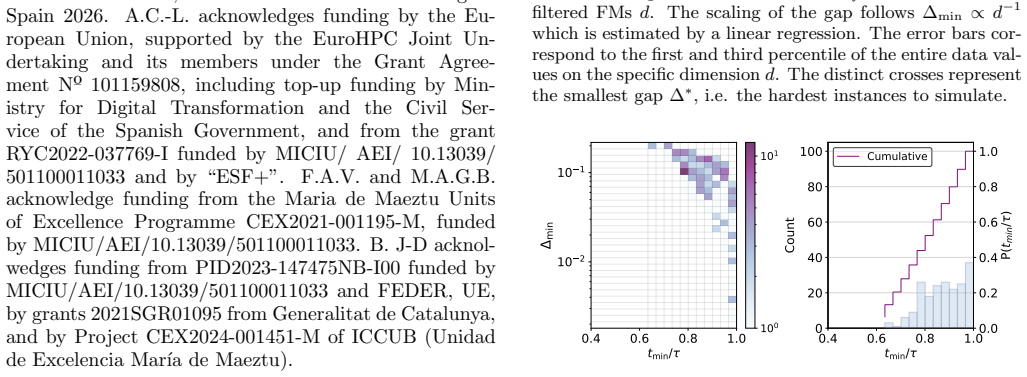
Deep learning models are used in critical applications, in which mistakes can have serious consequences. Therefore, it is crucial to understand how and why models generate predictions. This understanding provides useful information to check whether the model is learning the right patterns, detect biases in the data, improve model design, and build systems that can be trusted. This work proposes a new method for interpreting Convolutional Neural Networks in image classification tasks. The approach works by selecting the most important feature maps that contribute to each prediction. To solve this combinatorial problem, we encode it into a quantum constrained optimization problem and propose to solve it using quantum annealing. We evaluate our method against the state-of-the-art explainable AI techniques, specifically GradCAM and GradCAM++, and observe an improved class disentanglement, i.e. the model's decision boundaries become more distinct and its reasoning more transparent. This demonstrates that our approach enhances the quality of explanations, making it easier to understand which features the model relies on for specific predictions. In addition, we study the computational behavior of the quantum annealing algorithm. Specifically, we analyze the minimum energy gap of the system during computation and the probability that the algorithm finds the correct solution. These analyses provide theoretical insight into why the method works effectively in practice.
Editorial analysis
A structured set of objections, weighed in public.
Referee Report
Summary. The manuscript proposes a method for interpreting CNNs in image classification by framing the selection of important feature maps as a combinatorial optimization problem, which is encoded as a quantum constrained optimization task and solved via quantum annealing. It claims this yields improved class disentanglement relative to GradCAM and GradCAM++, resulting in more distinct decision boundaries and transparent reasoning, and supplements the approach with an analysis of the quantum annealing process including the minimum energy gap and solution-finding probability.
Significance. If the superiority in interpretability is rigorously quantified, the work could meaningfully advance quantum-enhanced explainable AI by showing how quantum solvers handle combinatorial feature selection in deep models. The theoretical analysis of annealing dynamics provides a useful methodological contribution that goes beyond purely empirical claims.
major comments (2)
- [Abstract] Abstract and evaluation section: The central claim of 'improved class disentanglement' (more distinct decision boundaries and transparent reasoning) versus GradCAM/GradCAM++ is presented without any defined quantitative metric (e.g., per-class feature overlap, mutual information with logits, or faithfulness score), error bars, dataset details, or statistical tests. This renders the observation unverifiable and prevents assessment of effect size.
- [Evaluation] Evaluation section: No ablation is reported comparing the quantum-annealing solution against a classical solver (e.g., simulated annealing or integer programming) applied to the identical combinatorial objective. Without this, it is impossible to isolate whether any observed improvement stems from the quantum hardware, the encoding itself, or the feature-map selection formulation.
minor comments (1)
- [Method] The encoding of the feature-map selection objective into the quantum Ising or QUBO form would benefit from an explicit equation or small worked example to clarify the penalty terms and constraints.
Simulated Author's Rebuttal
We thank the referee for the constructive feedback, which highlights important areas for strengthening the rigor of our claims. We address each major comment below and have prepared revisions to the manuscript.
read point-by-point responses
-
Referee: [Abstract] Abstract and evaluation section: The central claim of 'improved class disentanglement' (more distinct decision boundaries and transparent reasoning) versus GradCAM/GradCAM++ is presented without any defined quantitative metric (e.g., per-class feature overlap, mutual information with logits, or faithfulness score), error bars, dataset details, or statistical tests. This renders the observation unverifiable and prevents assessment of effect size.
Authors: We agree that the original presentation relied on qualitative observations of more distinct decision boundaries. In the revised manuscript we will introduce an explicit quantitative metric for class disentanglement (average pairwise Jaccard overlap of selected feature maps across classes) together with a faithfulness score obtained by measuring prediction degradation after ablating the selected maps. The evaluation section will also report error bars over repeated runs, name the datasets explicitly, and include statistical significance tests to quantify effect sizes. revision: yes
-
Referee: [Evaluation] Evaluation section: No ablation is reported comparing the quantum-annealing solution against a classical solver (e.g., simulated annealing or integer programming) applied to the identical combinatorial objective. Without this, it is impossible to isolate whether any observed improvement stems from the quantum hardware, the encoding itself, or the feature-map selection formulation.
Authors: We concur that an ablation against classical solvers on the identical objective is necessary to isolate contributions. The revised version will add results from simulated annealing on the same QUBO formulation for all problem sizes that remain computationally feasible, along with a discussion of why exact integer programming does not scale to the instance sizes solved by quantum annealing. This will clarify the respective roles of the solver and the feature-selection encoding. revision: yes
Circularity Check
No circularity: independent encoding and external baseline comparison
full rationale
The paper proposes encoding feature-map selection as a quantum constrained optimization problem solved by annealing, then evaluates the resulting explanations against independent GradCAM/GradCAM++ baselines. No equations, fitted parameters, or self-citations are shown that reduce the claimed improvement in class disentanglement to a tautology or construction from the inputs themselves. The derivation chain remains self-contained against external methods and does not invoke uniqueness theorems or ansatzes from prior author work.
Axiom & Free-Parameter Ledger
Reference graph
Works this paper leans on
-
[1]
As a CNN architecture, we use a pretrained ResNet-18
dataset that contains 5000 images in total that belong to 10 distinct classes (for more details, check the IV A section). As a CNN architecture, we use a pretrained ResNet-18. An important point in our benchmarks is that we need to constrain the maximum number of FMs in the last convolutional layer,N f, to simulate the QA protocol. If we had access QA har...
-
[2]
to extract the eigenvalues and eigenstates of ˆH(s) at each time steps= τ 0.01. F. Complexity of the QA protocol Following the approximate adiabatic theorem [37, 55], the time evolutionτneeded to end in the ground state at the end of the protocol, scales asτ∝∆ −2 min. Therefore, one needs to prove that ∆min does not decrease exponen- tially with the syste...
-
[3]
Arceci, S
L. Arceci, S. Barbarino, R. Fazio, and G. E. Santoro. Dissipative landau-zener problem and thermally assisted quantum annealing. Physical Review B, 96(5):054301, 2017
2017
-
[4]
Azad et al
R. Azad et al. Advances in medical image analysis with vision transformers: A comprehensive review. Medical Image Analysis, 91:103000, 2024
2024
-
[5]
Barahona
F. Barahona. On the computational complexity of ising spin glass models. Journal of Physics A: Mathematical and General, 15(10):3241, oct 1982
1982
-
[6]
Bhagawati and T
R. Bhagawati and T. Subramanian. An approach of a quantum-inspired document ranking algorithm by using feature selection methodology. International Journal of Information Technology, 15(8):4041–4053, 2023
2023
-
[7]
Bharti, A
K. Bharti, A. Cervera-Lierta, T. H. Kyaw, T. Haug, S. Alperin-Lea, A. Anand, M. Degroote, H. Heimonen, J. S. Kottmann, T. Menke, et al. Noisy intermediate- scale quantum algorithms. Reviews of Modern Physics, 94(1):015004, 2022
2022
-
[8]
Buhrmester, D
V. Buhrmester, D. M¨ unch, and M. Arens. Analysis of explainers of black box deep neural networks for com- puter vision: A survey. Machine Learning and Knowledge Extraction, 3(4):966–989, 2021
2021
-
[9]
Chattopadhay, A
A. Chattopadhay, A. Sarkar, P. Howlader, and V. N. Balasubramanian. Grad-cam++: Generalized gradient- based visual explanations for deep convolutional net- works. In 2018 IEEE Winter Conference on Applications of Computer Vision, pages 839–847, 2018
2018
-
[10]
J. Chen, L. Song, M. J. Wainwright, and M. I. Jordan. Learning to explain: An information-theoretic perspec- tive on model interpretation. In International Conference on Machine Learning, pages 883–892. PMLR, 2018
2018
-
[11]
Coates, A
A. Coates, A. Y. Ng, and H. Lee. An analysis of single-layer networks in unsupervised feature learning. In Proceedings of the Fourteenth International Conference on Artificial Intelligence and Statistics, pages 215–223. JMLR Workshop and Conference Proceedings, 2011
2011
-
[12]
Croitoru, V
F.-A. Croitoru, V. Hondru, R. T. Ionescu, and M. Shah. Diffusion models in vision: A survey. IEEE Transactions on Pattern Analysis and Machine Intelligence, 45(9):10850–10869, 2023
2023
-
[13]
Das and B
A. Das and B. K. Chakrabarti. Quantum annealing and related optimization methods, volume 679. Springer Sci- ence & Business Media, 2005
2005
-
[14]
J. S. Dehesa. Lanczos method of tridiagonalization, ja- cobi matrices and physics. Journal of Computational and Applied Mathematics, 7(4):249–259, 1981
1981
-
[15]
J. Deng, W. Dong, R. Socher, et al. Imagenet: A large-scale hierarchical image database. In 2009 IEEE Conference on Computer Vision and Pattern Recognition, pages 248–255. IEEE, 2009
2009
-
[16]
Towards A Rigorous Science of Interpretable Machine Learning
F. Doshi-Velez and B. Kim. Towards a rigorous sci- ence of interpretable machine learning. arXiv preprint arXiv:1702.08608, 2017
work page internal anchor Pith review arXiv 2017
-
[17]
An Image is Worth 16x16 Words: Transformers for Image Recognition at Scale
A. Dosovitskiy, L. Beyer, A. Kolesnikov, D. Weissenborn, X. Zhai, T. Unterthiner, M. Dehghani, M. Minderer, G. Heigold, S. Gelly, et al. An image is worth 16x16 words: Transformers for image recognition at scale.arXiv preprint arXiv:2010.11929, 2020
work page internal anchor Pith review arXiv 2010
-
[18]
Ferrari Dacrema, F
M. Ferrari Dacrema, F. Moroni, R. Nembrini, N. Ferro, G. Faggioli, and P. Cremonesi. Towards feature selection for ranking and classification exploiting quantum anneal- ers. In Proceedings of the 45th International ACM SIGIR Conference on Research and Development in Information Retrieval, pages 2814–2824, 2022
2022
-
[19]
J. B. Ghosh. Computational aspects of the maximum di- versity problem. Operations research letters, 19(4):175– 181, 1996
1996
-
[20]
Goodfellow, J
I. Goodfellow, J. Pouget-Abadie, M. Mirza, et al. Gener- ative adversarial nets. In Advances in Neural Information Processing Systems, volume 27, 2014
2014
-
[21]
X.-F. Han, H. Laga, and M. Bennamoun. Image-based 3d object reconstruction: State-of-the-art and trends in the deep learning era. IEEE transactions on pattern analysis and machine intelligence, 43(5):1578–1604, 2019
2019
-
[22]
K. He, X. Zhang, S. Ren, and J. Sun. Deep residual learn- ing for image recognition. In Proceedings of the IEEE conference on computer vision and pattern recognition, pages 770–778, 2016
2016
-
[23]
Hellstern, V
G. Hellstern, V. Dehn, and M. Zaefferer. Quantum com- puter based feature selection in machine learning. IET Quantum Communication, 5(3):232–252, 2024
2024
-
[24]
J. Ho, A. Jain, and P. Abbeel. Denoising diffusion probabilistic models. Advances in Neural Information Processing Systems, 33:6840–6851, 2020
2020
-
[25]
Jovi´ c, K
A. Jovi´ c, K. Brki´ c, and N. Bogunovi´ c. A re- view of feature selection methods with applica- tions. In 2015 38th international convention on information and communication technology, electronics and microelectronics (MIPRO), pages 1200–1205. Ieee, 2015
2015
-
[26]
A. Khan, A. Sohail, U. Zahoora, and A. S. Qureshi. A survey of the recent architectures of deep convolu- tional neural networks. Artificial Intelligence Review, 53(8):5455–5516, 2020
2020
-
[27]
D. P. Kingma and J. Ba. Adam: A method for stochas- tic optimization. International Conference on Learning Representations, 2015
2015
-
[28]
Krizhevsky, I
A. Krizhevsky, I. Sutskever, and G. E. Hinton. Imagenet classification with deep convolutional neural networks. In Advances in Neural Information Processing Systems, volume 25, 2012
2012
-
[29]
C.-C. Kuo, F. Glover, and K. S. Dhir. Analyzing and modeling the maximum diversity problem by zero-one programming. Decision Sciences, 24(6):1171–1185, 1993
1993
-
[30]
LeCun and Y
Y. LeCun and Y. Bengio. Convolutional networks for images, speech, and time series. The handbook of brain theory and neural networks, 1998
1998
-
[31]
S. M. Lundberg and S.-I. Lee. A unified approach to interpreting model predictions. In Advances in Neural Information Processing Systems, volume 30, pages 4765– 4774, 2017
2017
-
[32]
Mart´ ı, M
R. Mart´ ı, M. Gallego, A. Duarte, and E. G. Pardo. Heuristics and metaheuristics for the maximum diversity problem. Journal of Heuristics, 19(4):591–615, 2013
2013
-
[33]
M¨ ucke, R
S. M¨ ucke, R. Heese, S. M¨ uller, M. Wolter, and N. Pi- atkowski. Feature selection on quantum computers. Quantum Machine Intelligence, 5(1):11, 2023
2023
- [34]
-
[35]
Panchenko
D. Panchenko. The sherrington-kirkpatrick model. 15 Springer Science & Business Media, 2013
2013
-
[36]
Paszke, S
A. Paszke, S. Gross, F. Massa, et al. Pytorch: An im- perative style, high-performance deep learning library. In Advances in Neural Information Processing Systems, vol- ume 32, 2019
2019
-
[37]
B. K. Patra, R. Launonen, V. Ollikainen, and S. Nandi. A new similarity measure using bhattacharyya co- efficient for collaborative filtering in sparse data. Knowledge-Based Systems, 82:163–177, 2015
2015
-
[38]
Qamar and N
T. Qamar and N. Z. Bawany. Understanding the black- box: towards interpretable and reliable deep learning models. PeerJ Computer Science, 9:e1629, 2023
2023
-
[39]
Rajak, S
A. Rajak, S. Suzuki, A. Dutta, and B. K. Chakrabarti. Quantum annealing: An overview. Philosophical Transactions of the Royal Society A, 381(2241):20210417, 2023
2023
-
[40]
J. C. Rangel et al. A survey on convolutional neural net- works and their performance limitations in image recog- nition tasks. Journal of Sensors, 2024:2797320, 2024
2024
-
[41]
M. E. Rayed, S. S. Islam, S. I. Niha, J. R. Jim, M. M. Kabir, and M. Mridha. Deep learning for medical image segmentation: State-of-the-art advancements and chal- lenges. Informatics in medicine unlocked, 47:101504, 2024
2024
-
[42]
M. T. Ribeiro, S. Singh, and C. Guestrin. ” why should i trust you?” explaining the predictions of any classifier. In Proceedings of the 22nd ACM SIGKDD International Conference on Knowledge Discovery and Data Mining, pages 1135–1144, 2016
2016
-
[43]
Rombach, A
R. Rombach, A. Blattmann, D. Lorenz, P. Esser, and B. Ommer. High-resolution image synthesis with latent diffusion models. In Proceedings of the IEEE/CVF Conference on Computer Vision and Pattern Recognition, pages 10684–10695, 2022
2022
-
[44]
Romero, S
S. Romero, S. Gupta, V. Gatlin, R. S. Chapkin, and J. J. Cai. Quantum annealing for enhanced feature selec- tion in single-cell rna sequencing data analysis. Quantum Machine Intelligence, 7(2):114, 2025
2025
-
[45]
Ronneberger, P
O. Ronneberger, P. Fischer, and T. Brox. U-net: Convolutional networks for biomedical image segmen- tation. In International Conference on Medical image computing and computer-assisted intervention, pages 234–241. Springer, 2015
2015
-
[46]
Russakovsky, J
O. Russakovsky, J. Deng, H. Su, J. Krause, S. Satheesh, S. Ma, Z. Huang, A. Karpathy, A. Khosla, M. Bernstein, et al. Imagenet large scale visual recognition challenge. International journal of computer vision, 115(3):211–252, 2015
2015
-
[47]
A. M. Salih, Z. Raisi-Estabragh, I. B. Galazzo, P. Radeva, S. E. Petersen, K. Lekadir, and G. Menegaz. A perspec- tive on explainable artificial intelligence methods: Shap and lime. Advanced Intelligent Systems, 7(1):2400304, 2025
2025
-
[48]
R. R. Selvaraju, M. Cogswell, A. Das, et al. Grad- cam: Visual explanations from deep networks via gradient-based localization. In Proceedings of the IEEE International Conference on Computer Vision, pages 618–626, 2017
2017
-
[49]
Very Deep Convolutional Networks for Large-Scale Image Recognition
K. Simonyan and A. Zisserman. Very deep convolutional networks for large-scale image recognition.arXiv preprint arXiv:1409.1556, 2014
work page internal anchor Pith review arXiv 2014
-
[50]
Sohl-Dickstein, E
J. Sohl-Dickstein, E. Weiss, N. Maheswaranathan, and S. Ganguli. Deep unsupervised learning using nonequi- librium thermodynamics. In International conference on machine learning, pages 2256–2265. pmlr, 2015
2015
-
[51]
Trigka, E
M. Trigka, E. Dritsas, and N. D. Lagaros. A comprehen- sive survey of deep learning approaches in image process- ing. Sensors, 25(2):531, 2025
2025
-
[52]
Vaswani, N
A. Vaswani, N. Shazeer, N. Parmar, J. Uszkoreit, L. Jones, A. N. Gomez, L. Kaiser, and I. Polosukhin. Attention is all you need. In Advances in Neural Information Processing Systems, volume 30, pages 5998– 6008, 2017
2017
-
[53]
Virtanen, R
P. Virtanen, R. Gommers, T. E. Oliphant, M. Haber- land, T. Reddy, D. Cournapeau, E. Burovski, P. Pe- terson, W. Weckesser, J. Bright, S. J. van der Walt, M. Brett, J. Wilson, K. J. Millman, N. Mayorov, A. R. J. Nelson, E. Jones, R. Kern, E. Larson, C. J. Carey, ˙I. Po- lat, Y. Feng, E. W. Moore, J. VanderPlas, D. Laxalde, J. Perktold, R. Cimrman, I. Henr...
2020
-
[54]
Vonder Haar, T
L. Vonder Haar, T. Elvira, and O. Ochoa. An analysis of explainability methods for convolutional neural net- works. Engineering Applications of Artificial Intelligence, 117:105606, 2023
2023
-
[55]
J. Yoon, J. Jordon, and M. van der Schaar. Invase: Instance-wise variable selection using neural networks. In International Conference on Learning Representations, 2019
2019
-
[56]
Zhang, Y
Q. Zhang, Y. N. Wu, and S.-C. Zhu. Interpretable con- volutional neural networks. In Proceedings of the IEEE conference on computer vision and pattern recognition, pages 8827–8836, 2018
2018
-
[57]
ˇZnidariˇ c
M. ˇZnidariˇ c. Scaling of the running time of the quan- tum adiabatic algorithm for propositional satisfiability. Physical Review A—Atomic, Molecular, and Optical Physics, 71(6):062305, 2005
2005
discussion (0)
Sign in with ORCID, Apple, or X to comment. Anyone can read and Pith papers without signing in.