Residual-loss Anomaly Analysis of Physics-Informed Neural Networks: An Inverse Method for Change-point Detection in Nonlinear Dynamical Systems with Regime Switching
Pith reviewed 2026-05-07 14:31 UTC · model grok-4.3
The pith
Physics-informed neural networks jointly detect change points and recover piecewise parameters in regime-switching dynamical systems by flagging elevations in local residual losses.
A machine-rendered reading of the paper's core claim, the machinery that carries it, and where it could break.
Core claim
The residual-loss anomaly analysis of physics-informed neural networks jointly infers piecewise parameters and transition points under a single set of constraints. It proceeds in two stages: overlapping subinterval decomposition first identifies potential transition intervals by the structural elevation that appears in the local physical residual whenever a subinterval contains a true parameter jump, an elevation that possesses a non-zero lower bound under noise-free conditions; the second stage folds the candidate locations and the piecewise parameters into one unified physical loss that is minimized simultaneously, thereby solving the coupled inverse problem without decoupling the tasks.
What carries the argument
Overlapping subinterval decomposition of the local physical residual inside a physics-informed neural network, where any subinterval that spans a true regime transition produces a structural elevation whose lower bound remains strictly positive in the absence of noise.
If this is right
- Change-point localization and parameter estimation both become more accurate than in methods that treat the two tasks separately.
- The same set of physical constraints suffices for simultaneous recovery of transition times and piecewise coefficients.
- The approach applies directly to standard nonlinear benchmarks including logistic growth, Van der Pol, Lotka-Volterra, and Lorenz systems.
- Because the elevation is guaranteed to have a positive lower bound in noise-free data, candidate intervals can be screened before the joint optimization step.
Where Pith is reading between the lines
- The two-stage procedure might be iterated to locate multiple transitions by successively refining the subintervals around each detected jump.
- The same residual-elevation signature could be monitored during training to decide when to split an interval and introduce an additional parameter piece.
- If the lower-bound property holds approximately under moderate noise, the framework could be extended to experimental time series by adding a statistical threshold on the observed residuals.
Load-bearing premise
When a subinterval contains a true transition point, the local physical residual exhibits a distinct structural elevation that has a non-zero lower bound even without measurement noise.
What would settle it
On a noise-free simulation of the Lotka-Volterra model with a known jump at a chosen time, the residual computed over the subinterval that straddles the jump remains at the same level as residuals from intervals that lie entirely inside one regime.
Figures


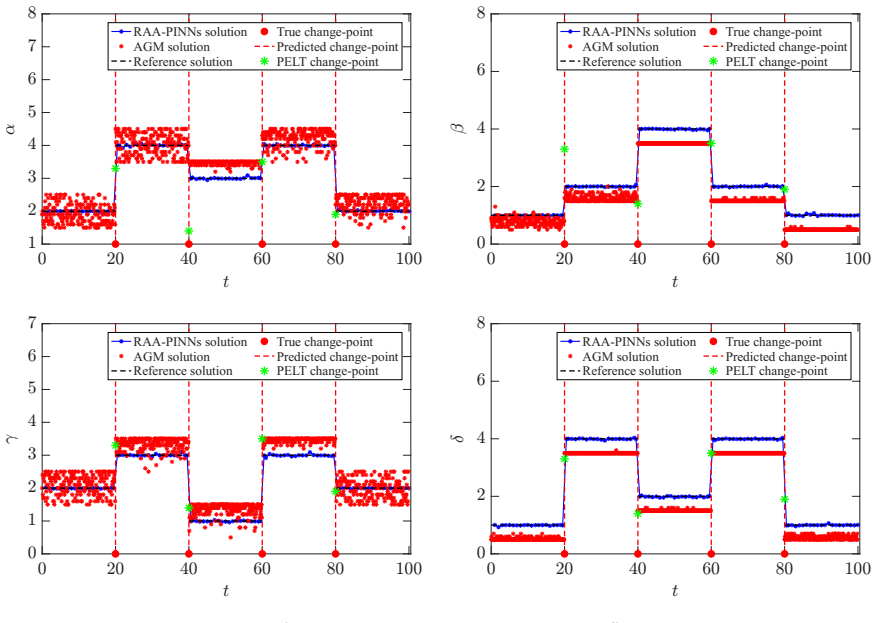

read the original abstract
Nonlinear dynamical systems with regime transitions are typically described by ordinary differential equations with jumping parameters parameters. Traditional methods often treat change-point detection and parameter estimation as separate tasks, ignoring the inherent coupling between them. To address this, we propose residual-loss anomaly analysis of physics-informed neural networks, a unified framework that leverages dynamical consistency within the physics-informed learning paradigm. This approach jointly infers piecewise parameters and transition points under a single set of constraints. The method follows a two-stage strategy: First, local physical residuals are analyzed through overlapping subinterval decomposition. When a subinterval spans a true transition point, the residual exhibits a distinct structural elevation in noise-free conditions, which has a non-zero lower bound, enabling effective localization of potential transition intervals. Second, within our framework, change-point locations and piecewise parameters are integrated into a unified physical loss function for joint optimization, enabling simultaneous identification. Experiments on benchmark nonlinear dynamical systems, including Malthusian and logistic growth models, Van der Pol oscillator, Lotka-Volterra model and Lorenz system, demonstrate that the proposed method outperforms traditional decoupled approaches in both change-point localization and parameter estimation accuracy. This study provides an efficient, unified solution for structurally coupled inverse problems in nonlinear dynamical systems with regime switching.
Editorial analysis
A structured set of objections, weighed in public.
Referee Report
Summary. The manuscript proposes residual-loss anomaly analysis of physics-informed neural networks (PINNs) as a unified two-stage framework for jointly detecting change points and estimating piecewise parameters in nonlinear dynamical systems with regime switching. Stage 1 decomposes trajectories into overlapping subintervals and localizes candidate transitions by identifying structural elevations in the local physical residual, which the authors claim possesses a non-zero lower bound in noise-free conditions. Stage 2 folds the detected intervals and parameters into a single physics-informed loss for simultaneous optimization. Experiments on the Malthusian and logistic growth models, Van der Pol oscillator, Lotka-Volterra system, and Lorenz equations are reported to outperform traditional decoupled change-point and parameter-estimation pipelines.
Significance. If the non-zero lower-bound claim on straddling residuals can be rigorously established and the method demonstrably improves localization and estimation accuracy, the work would constitute a meaningful contribution to inverse problems for hybrid dynamical systems. It offers a principled way to exploit dynamical consistency rather than treating detection and identification as independent tasks, which could benefit applications in ecology, neuroscience, and fluid dynamics where regime switches are common. The use of PINNs for joint inference is a natural extension of existing physics-informed learning techniques.
major comments (2)
- [Abstract] Abstract (and the first-stage localization strategy): The central claim that any subinterval containing a true parameter jump produces a physical residual with a 'distinct structural elevation' and 'non-zero lower bound' in noise-free conditions is load-bearing for the entire pipeline, yet the manuscript provides no derivation, explicit lower bound, or analysis of its dependence on jump magnitude, window length, or the approximation capacity of the PINN. Without such a guarantee, it is unclear whether the elevation reliably exceeds optimizer error or can be driven arbitrarily close to zero for small jumps or edge cases.
- [Experiments] Experiments section: The abstract asserts superior performance in both change-point localization and parameter estimation on standard benchmarks, but the description supplies no quantitative metrics, error bars, ablation studies on window size or overlap, or direct comparisons against specific baseline algorithms. This absence prevents assessment of whether the joint-optimization stage actually improves upon the decoupled approaches it criticizes.
minor comments (1)
- [Abstract] The abstract would benefit from a concise statement of the precise conditions (e.g., noise level, jump size relative to window) under which the non-zero lower bound is asserted to hold.
Simulated Author's Rebuttal
We thank the referee for the constructive and detailed comments. We address each major point below and indicate the revisions planned for the next version of the manuscript.
read point-by-point responses
-
Referee: [Abstract] Abstract (and the first-stage localization strategy): The central claim that any subinterval containing a true parameter jump produces a physical residual with a 'distinct structural elevation' and 'non-zero lower bound' in noise-free conditions is load-bearing for the entire pipeline, yet the manuscript provides no derivation, explicit lower bound, or analysis of its dependence on jump magnitude, window length, or the approximation capacity of the PINN. Without such a guarantee, it is unclear whether the elevation reliably exceeds optimizer error or can be driven arbitrarily close to zero for small jumps or edge cases.
Authors: We acknowledge that the manuscript presents the non-zero lower bound as an observed property arising from the dynamical inconsistency when a single-regime PINN is applied across a true switch, but does not supply a formal derivation. In the revised version we will add a dedicated theoretical paragraph deriving an explicit lower bound on the integrated residual for straddling intervals. The bound will be expressed in terms of the squared parameter jump magnitude, the overlap length, and the Lipschitz constant of the vector field; we will also include a brief discussion of its sensitivity to small jumps and to the residual approximation error of the PINN. revision: yes
-
Referee: [Experiments] Experiments section: The abstract asserts superior performance in both change-point localization and parameter estimation on standard benchmarks, but the description supplies no quantitative metrics, error bars, ablation studies on window size or overlap, or direct comparisons against specific baseline algorithms. This absence prevents assessment of whether the joint-optimization stage actually improves upon the decoupled approaches it criticizes.
Authors: We agree that the experimental presentation is insufficiently quantitative. Although the manuscript contains visual results on the listed benchmark systems, it lacks tabulated error statistics and systematic comparisons. In the revision we will expand the Experiments section with tables reporting mean localization error and parameter RMSE together with standard deviations over repeated runs, ablation tables for window length and overlap ratio, and head-to-head numerical comparisons against concrete baselines (PELT + separate PINN fitting, Bayesian online change-point detection + least-squares, and a two-stage residual-threshold method). Error bars will be added to all figures. revision: yes
Circularity Check
No significant circularity in derivation chain
full rationale
The paper proposes a two-stage residual-loss anomaly analysis within the PINN framework for joint change-point detection and parameter estimation in regime-switching ODEs. The core claim—that straddling subintervals produce structurally elevated residuals with a non-zero lower bound—is presented as a direct consequence of dynamical inconsistency when a single parameter set is applied across a true transition, rather than being defined in terms of the subsequent optimization outputs or fitted values. The unified loss function integrates the localized intervals but does not equate the final piecewise parameters or transition points to quantities already determined by construction in the first stage. No self-citation load-bearing steps, ansatz smuggling, or renaming of known results appear in the provided text; the method adds independent content via the anomaly-based localization prior to joint inference. Experimental comparisons on benchmark systems further indicate external validation rather than tautological reduction.
Axiom & Free-Parameter Ledger
axioms (2)
- domain assumption Nonlinear dynamical systems with regime transitions are described by ordinary differential equations with jumping parameters.
- ad hoc to paper Local physical residuals exhibit a distinct structural elevation with non-zero lower bound when a subinterval spans a true transition point in noise-free conditions.
Reference graph
Works this paper leans on
-
[1]
J. Bian, T. Huang, X. Zhang, C. Wang, Y. Zhang, C. Zeng, Fluctuation-variable correlation as early warning signals of non-equilibrium critical transitions, Physica A: Statistical Mechanics and Its Applications 661 (2025) 130401
work page 2025
- [2]
- [3]
-
[4]
A. Dmitriev, V. Kornilov, V. Dmitriev, N. Abbas, Early warning signals for critical transitions in sandpile cellular automata, Frontiers in Physics 10 (2022) 839383
work page 2022
-
[5]
V. Dakos, C. A. Boulton, J. E. Buxton, J. F. Abrams, B. Arellano-Nava, D. I. Armstrong McKay, S. Bathiany, L. Blaschke, N. Boers, D. Dylewsky, et al., Tipping point detection and early warnings in climate, ecological, and human systems, Earth System Dynamics 15 (4) (2024) 1117–1135
work page 2024
-
[6]
E. Southall, T. S. Brett, M. J. Tildesley, L. Dyson, Early warning signals of infectious disease transitions: a review, Journal of the Royal Society Interface 18 (182) (2021) 20210555
work page 2021
- [7]
-
[8]
L. Bettini, M. Cenedese, G. Haller, Model reduction to spectral submanifolds in piecewise smooth dynamical systems, International Journal of Non-Linear Mechanics 163 (2024) 104753
work page 2024
-
[9]
X. Pan, H. Shu, L. Wang, X.-S. Wang, J. Yu, On the periodic solutions of switching scalar dynamical systems, Journal of Differential Equations 415 (2025) 365–382
work page 2025
- [10]
-
[11]
K. Egan, W. Li, R. Carvalho, Automatically discovering ordinary differential equations from data with sparse regression, Communications Physics 7 (1) (2024) 20
work page 2024
-
[12]
O. Strebel, Preprocessing algorithms for the estimation of ordinary differential equation models with polynomial nonlinearities, Nonlinear Dynamics 111 (8) (2023) 7495–7510
work page 2023
-
[13]
W. Zhai, D. Tao, Y. Bao, Parameter estimation and modeling of nonlinear dynamical systems based on runge–kutta physics-informed neural network, Nonlinear Dynamics 111 (22) (2023) 21117–21130
work page 2023
-
[14]
B. Peherstorfer, K. Willcox, Data-driven operator inference for nonintrusive projection-based model reduction, Computer Methods in Applied Mechanics and Engineering 306 (2016) 196–215
work page 2016
-
[15]
S. Panahi, Y.-C. Lai, Global phase-space approach to rate-induced tipping: A brief review, Chaos: An Interdisciplinary Journal of Nonlinear Science 35 (4) (2025) 043139. 42
work page 2025
-
[16]
Z. Liu, X. Zhang, X. Ru, T.-T. Gao, J. M. Moore, G. Yan, Early predictor for the onset of critical transitions in networked dynamical systems, Physical Review X 14 (3) (2024) 031009
work page 2024
-
[17]
S. L. Brunton, J. L. Proctor, J. N. Kutz, Discovering governing equations from data by sparse identification of nonlinear dynamical systems, Proceedings of the National Academy of Sciences 113 (15) (2016) 3932–3937
work page 2016
-
[18]
S. H. Rudy, S. L. Brunton, J. L. Proctor, J. N. Kutz, Data-driven discovery of partial differential equations, Science Advances 3 (4) (2017) e1602614
work page 2017
- [19]
-
[20]
P. Fryzlewicz, Wild binary segmentation for multiple change-point detection, The Annals of Statistics 42 (6) (2014)
work page 2014
- [21]
-
[22]
R. Baranowski, Y. Chen, P. Fryzlewicz, Narrowest-over-threshold detection of multiple change points and change-point-like features, Journal of the Royal Statistical Society Series B: Statistical Method- ology 81 (3) (2019) 649–672
work page 2019
- [23]
-
[24]
P. J. Green, D. I. Hastie, Reversible jump mcmc, Genetics 155 (3) (2009) 1391–1403
work page 2009
-
[25]
J. Wang, E. Zivot, A bayesian time series model of multiple structural changes in level, trend, and variance, Journal of Business & Economic Statistics 18 (3) (2000) 374–386
work page 2000
-
[26]
A. T. Levin, J. Piger, Bayesian model selection for structural break models, Available at SSRN 1132463 (2008)
work page 2008
-
[27]
N. A. Heard, M. J. Turcotte, Adaptive sequential monte carlo for multiple changepoint analysis, Journal of Computational and Graphical Statistics 26 (2) (2017) 414–423
work page 2017
-
[28]
X. Xiu, Y. Yang, L. Kong, W. Liu, Laplacian regularized robust principal component analysis for process monitoring, Journal of Process Control 92 (2020) 212–219
work page 2020
-
[29]
L. Birg´ e, Model selection via testing: an alternative to (penalized) maximum likelihood estimators, Annales de l’IHP Probabilit´ es et Statistiques 42 (3) (2006) 273–325
work page 2006
-
[30]
G. E. Karniadakis, I. G. Kevrekidis, L. Lu, P. Perdikaris, S. Wang, L. Yang, Physics-informed machine learning, Nature Reviews Physics 3 (6) (2021) 422–440
work page 2021
-
[31]
N. Kovachki, Z. Li, B. Liu, K. Azizzadenesheli, K. Bhattacharya, A. Stuart, A. Anandkumar, Neural operator: Learning maps between function spaces with applications to pdes, Journal of Machine Learning Research 24 (89) (2023) 1–97
work page 2023
- [32]
-
[33]
G. Kissas, Y. Yang, E. Hwuang, W. R. Witschey, J. A. Detre, P. Perdikaris, Machine learning in cardiovascular flows modeling: Predicting arterial blood pressure from non-invasive 4d flow mri data using physics-informed neural networks, Computer Methods in Applied Mechanics and Engineering 358 (2020) 112623
work page 2020
-
[34]
E. O. Oluwasakin, A. Q. Khaliq, Optimizing physics-informed neural network in dynamic system simulation and learning of parameters, Algorithms 16 (12) (2023) 547. 43
work page 2023
-
[35]
G. Zhang, Y. Duan, G. Pan, Q. Chen, H. Yang, Z. Zhang, Data-driven discovery of state-changes in underlying system from hidden change-points in partial differential equations with spatiotemporal varying coefficients, Journal of Computational and Applied Mathematics (2025) 116962
work page 2025
-
[36]
T. Lux, Estimation of regime-switching diffusions via fourier transforms, Statistics and Computing 34 (2) (2024) 88
work page 2024
-
[37]
N. Niknejad, H. Modares, Physics-informed data-driven safe and optimal control design, IEEE Con- trol Systems Letters 8 (2023) 285–290
work page 2023
-
[38]
Y.-J. Huang, C.-W. Chang, C.-h. Hsieh, Detecting shifts in nonlinear dynamics using empirical dy- namic modeling with nested-library analysis, PLOS Computational Biology 20 (1) (2024) e1011759
work page 2024
- [39]
- [40]
-
[41]
M. Farid, Unsupervised data-driven response regime exploration and identification for dynamical systems, Chaos: An Interdisciplinary Journal of Nonlinear Science 34 (12) (2024)
work page 2024
-
[42]
J. Stiasny, G. S. Misyris, S. Chatzivasileiadis, Physics-informed neural networks for non-linear system identification for power system dynamics, in: 2021 IEEE Madrid PowerTech, IEEE, 2021, pp. 1–6
work page 2021
- [43]
-
[44]
Z. Lin, Y. Li, F. Yin, J. Maro˜ nas, A. H. Thi´ ery, Efficient transformed gaussian process state- space models for non-stationary high-dimensional dynamical systems, IEEE Transactions on Signal Processing 73 (2025) 5229–5243
work page 2025
-
[45]
Teschl, Ordinary differential equations and dynamical systems, Vol
G. Teschl, Ordinary differential equations and dynamical systems, Vol. 140, American Mathematical Soc., 2012
work page 2012
-
[46]
J. J. Huerta y Munive, G. Struth, Predicate transformer semantics for hybrid systems: Verification components for isabelle/hol, Journal of Automated Reasoning 66 (1) (2022) 93–139
work page 2022
-
[47]
A. Quarteroni, R. Sacco, F. Saleri, Numerical mathematics, Vol. 37, Springer Science & Business Media, 2006
work page 2006
- [48]
- [49]
-
[50]
Y. Qian, Y. Zhang, Y. Huang, S. Dong, Physics-informed neural networks for approximating dynamic (hyperbolic) pdes of second order in time: Error analysis and algorithms, Journal of Computational Physics 495 (2023) 112527
work page 2023
-
[51]
F. Dondelinger, D. Husmeier, S. Rogers, M. Filippone, Ode parameter inference using adaptive gradient matching with gaussian processes, in: Artificial Intelligence and Statistics, PMLR, 2013, pp. 216–228
work page 2013
-
[52]
R. Killick, P. Fearnhead, I. A. Eckley, Optimal detection of changepoints with a linear computational cost, Journal of the American Statistical Association 107 (500) (2012) 1590–1598. 44
work page 2012
discussion (0)
Sign in with ORCID, Apple, or X to comment. Anyone can read and Pith papers without signing in.