Nanoscale Sensing of Solid-State Samples with High Frequency Resolution
Pith reviewed 2026-05-07 16:37 UTC · model grok-4.3
The pith
Synchronizing a slowly rotating magnetic field with RF decoupling and microwave control lets NV centers isolate isotropic chemical shifts in solid-state samples at the nanoscale.
A machine-rendered reading of the paper's core claim, the machinery that carries it, and where it could break.
Core claim
The authors claim that synchronizing a slowly rotating magnetic field with tailored RF decoupling sequences and microwave control of the NV sensors mitigates anisotropy and dipole-dipole interactions sufficiently to allow direct detection of isotropic chemical shifts, with the measured spectrum linked to the control features and system parameters through an explicit analytical mapping.
What carries the argument
Synchronization of a slowly rotating magnetic field with tailored RF decoupling pulses and microwave drives on the NV sensors, together with the derived analytical mapping from the resulting spectrum to the sample's isotropic shifts and control parameters.
If this is right
- The protocol supplies a direct route to extract isotropic chemical shifts from the measured spectrum without iterative fitting.
- High-frequency resolution becomes available for samples where the sensor can be placed in immediate proximity.
- Solid-state materials that were previously inaccessible to NV-based chemical-shift sensing become measurable once the rotation and decoupling are synchronized.
- Sample characterization reduces to reading off parameters from the analytical formula rather than simulating the full many-body dynamics.
Where Pith is reading between the lines
- The same synchronization principle might be adapted to other spin-based sensors that suffer from similar interaction broadening.
- Testing the method on a calibrated crystal with known isotropic and anisotropic shift tensors would provide a direct experimental check.
- If the rotation rate can be made faster while preserving the analytical mapping, the technique could extend to faster dynamical processes inside the sample.
Load-bearing premise
The chosen synchronization of the rotating field with the RF and microwave controls can suppress anisotropy and dipole-dipole effects enough in actual solid samples to leave only the isotropic chemical shifts visible in the spectrum.
What would settle it
Measuring the spectrum on a test solid sample whose anisotropy and dipolar couplings are independently known and finding that the observed peaks deviate from the frequencies predicted by the analytical mapping for the chosen rotation rate and pulse timings.
Figures
read the original abstract
To meet the growing demand for nanoscale surface analysis, nitrogen-vacancy (NV) centers offer a high-sensitivity alternative by leveraging their ability to operate in immediate proximity to the sample. In this work, we propose a quantum control protocol designed to overcome the inherent challenges of solid-state environments, specifically by mitigating anisotropy and strong dipole-dipole interactions to enable the detection of isotropic chemical shifts at the nanoscale. To achieve this, our scheme synchronizes a slowly rotating magnetic field with tailored RF decoupling and MW control of the NV sensors. We provide an analytical mapping that explicitly links the measured spectrum to the control sequence features and the underlying system parameters, enabling a straightforward characterization of the sample.
Editorial analysis
A structured set of objections, weighed in public.
Referee Report
Summary. The manuscript proposes a quantum control protocol for NV-center-based nanoscale sensing of solid-state samples. A slowly rotating magnetic field is synchronized with tailored RF decoupling sequences and microwave control of the NV sensors to suppress anisotropy and strong dipole-dipole couplings, thereby isolating isotropic chemical shifts. An explicit analytical mapping is derived that relates features of the measured spectrum directly to the control-sequence parameters and the underlying sample Hamiltonian, enabling parameter extraction without numerical fitting.
Significance. If the averaging procedure and the invertibility of the analytical map hold under realistic conditions, the protocol would constitute a concrete advance in solid-state nanoscale NMR by removing the dominant broadening mechanisms that currently limit frequency resolution. The provision of a closed-form mapping is a genuine strength, as it supplies a falsifiable, parameter-light route to sample characterization rather than a black-box fit.
minor comments (3)
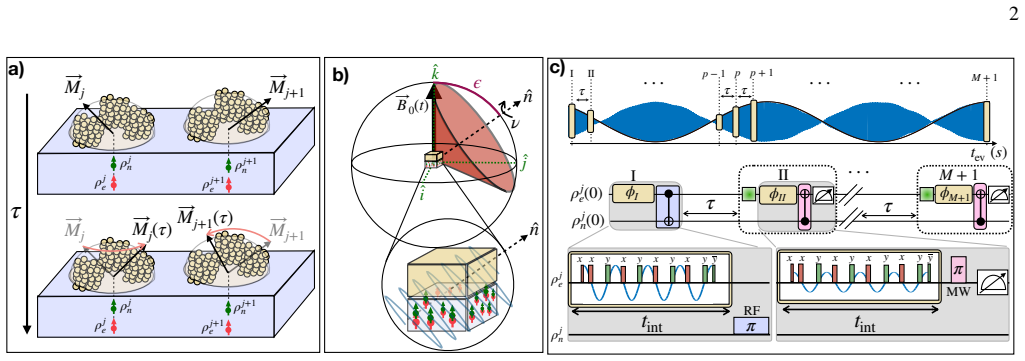
- A figure showing the timing diagram of the rotating-field synchronization with the RF and MW pulse blocks would greatly improve readability of the protocol description.
- The manuscript should state the range of rotation frequencies and decoupling strengths for which the averaging approximation remains valid; this is currently only implicit in the derivation.
- Notation for the effective Hamiltonian after averaging (e.g., the symbols used for the residual isotropic shift term) should be introduced once and used consistently throughout the analytical-mapping section.
Simulated Author's Rebuttal
We thank the referee for the positive assessment of our manuscript, the recognition of the protocol's potential to advance solid-state nanoscale NMR, and the recommendation for minor revision. We appreciate the emphasis on the closed-form analytical mapping as a strength.
Circularity Check
No significant circularity detected
full rationale
The paper proposes a synchronized rotating-field protocol with RF/MW control and derives an explicit analytical mapping from the measured spectrum to control features and sample parameters. This mapping is presented as a first-principles derivation that averages out anisotropy and dipolar couplings to isolate isotropic shifts. No self-definitional loops, fitted parameters renamed as predictions, or load-bearing self-citations appear in the provided text. The central claim remains a theoretical protocol design whose validity rests on the correctness of the averaging derivation rather than on re-using its own outputs as inputs.
Axiom & Free-Parameter Ledger
Reference graph
Works this paper leans on
-
[1]
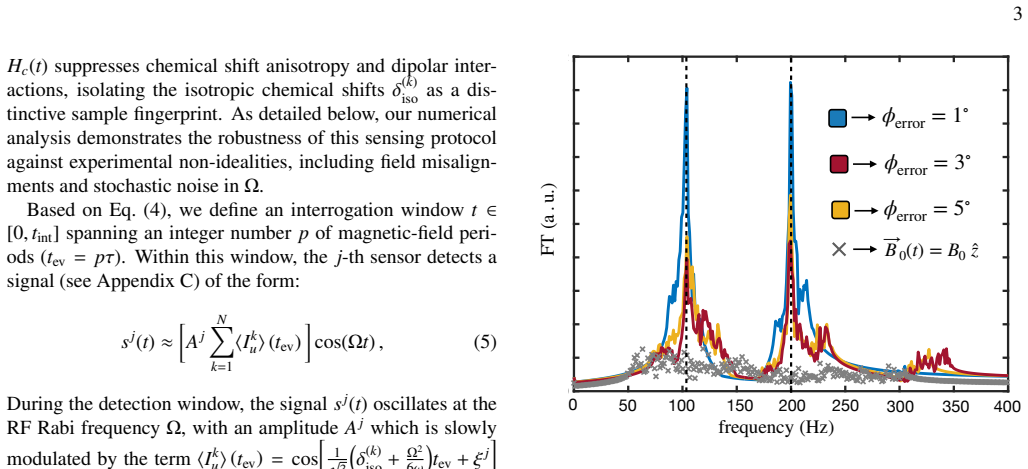
To ensure protocol stability, we alternate the sign ofΩto emulate a frequency-switched Lee-Goldburg (fsLG) scheme [41, 42]. This approach pro- vides resilience against various error sources, as demonstrated in the numerical results below. As shown in Appendix A, after a periodτ=1/νof ⃗B0(t), and under the action ofH c(t) the dynamics of the sample is gove...
work page 2089
-
[2]
R. D. allert, K. D. Briegel and D. B. Bucher.Advances in nano- and microscale NMR spectroscopy using diamond quantum sensors, Chemical Communications58(59), 8165–8181 (2022)
work page 2022
-
[3]
R. Rizzato, N. R. von Grafenstein and D. B. Bucher.Quan- tum sensors in diamonds for magnetic resonance spectroscopy: Current applications and future prospects, Applied Physics Letters123(26), (2023)
work page 2023
-
[4]
J. Du, F. Shi, X. Kong, F. Jelezko and J. Wrachtrup.Single- molecule scale magnetic resonance spectroscopy using quan- tum diamond sensors, Reviews of Modern Physics96(2), 025001 (2024)
work page 2024
-
[5]
L. Cerefolini, M. Fragai, E. Ravera, C. A. Diebolder, L. Re- nault and V . Calderone.Integrative Approaches in Structural Biology: A More Complete Picture from the Combination of Individual Techniques, Biomolecules9(8), 370 (2019)
work page 2019
-
[6]
S. J. Ziegler, S. J. Mallinson, P. C. S. John and Y . J. Bomble.Ad- vances in integrative structural biology: Towards understand- ing protein complexes in their cellular context, Computational and Structural Biotechnology Journal19, 214–225 (2021)
work page 2021
- [7]
- [8]
-
[9]
M. W. Doherty, N. B. Manson, P. Delaney, F. Jelezko, J. Wrachtrup and L. C. L. Hollenberg.The nitrogen-vacancy colour centre in diamond, Physics Reports528(1), 1–45 (2013)
work page 2013
-
[10]
D. R. Glenn, D. B. Bucher, J. Lee, M. D. Lukin, H. Park and R. L. Walsworth.High-resolution magnetic resonance spec- troscopy using a solid-state spin sensor, Nature555(7696), 351–354 (2018)
work page 2018
-
[11]
D. B. Bucher, D. R. Glenn, H. Park, M. D. Lukin and R. L. Walsworth.Hyperpolarization-enhanced NMR spectroscopy with femtomole sensitivity using quantum defects in diamond., Physical Review X10(2), 021053 (2020)
work page 2020
-
[12]
N. Arunkumar, D. B. Bucher, M. J. Turner, P. TomHon, D. Glenn, S. Lehmkuhl, M. D. Lukin, H. Park, M. S. Rosen, T. Theis and R. L. Walsworth.Micron-scale NV-NMR spec- troscopy with signal amplification by reversible exchange, PRX Quantum2(1), 010305 (2021)
work page 2021
-
[13]
H. J. Mamin, M. Kim, M. H. Sherwood, C. T. Rettner, K. Ohno, D. D. Awschalom and D. Rugnar.Nanoscale nuclear magnetic resonance with a nitrogen-vacancy spin sensor, Sci- ence339(6119), 557–560 (2013)
work page 2013
-
[14]
T. Staudacher, F. Shi, S. Pezzagna, J. Meijer, J. Du, C. A. Meriles, F. Reinhard and J. Wrachtrup.Nuclear magnetic res- onance spectroscopy on a (5-nanometer)3 sample volume, Sci- ence339(6119), 561–563 (2013). 5
work page 2013
-
[15]
C. Munuera-Javaloy, A. Tobalina and J. Casanova.High- resolution nmr spectroscopy at large fields with nitrogen vacancy centers, Physical Review Letters130(13), 133603 (2023)
work page 2023
-
[16]
S. Schmitt, T. Gefen, F. M. St ¨urner, T. Unden, G. Wolff, C. M¨uller, J. Scheuer, B. Naydenov, M. Markham, S. Pezzagna, J. Meijer, I. Schwarz, M. B. Plenio, A. Retker, L. P. McGuinness and F. Jelezko.Submillihertz magnetic spectroscopy performed with a nanoscale quantum sensor, Science356(6340), 832–837 (2017)
work page 2017
-
[17]
J. M. Boss, K. S. Cuija, J. Zopes and C. L. Degen.Quan- tum sensing with arbitrary frequency resolution, Science 356(6340), 837–840 (2017)
work page 2017
- [18]
-
[19]
C. Munuera-Javaloy, R. Puebla, B. D’Anjou, M. B. Plenio and J. Casanova.Detection of molecular transitions with nitrogen- vacancy centers and electron-spin labels, npj Quantum Infor- mation8(1), 140 (2022)
work page 2022
-
[20]
A. Biteri-Uribarren, P. Alsina-Bolivar, C. Munuera-Javaloy, R. Puebla and J. Casanova.Amplified nanoscale detection of la- beled molecules via surface electrons on diamond, Communi- cations Physics6(1), 359 (2023)
work page 2023
-
[21]
O. T. Whaites, J. G. Oliv ˜A¡n and J. Casanova.Enhanced sen- sitivity in microscale high-field NMR via nuclear-spin lock- ing with N-V centers, Physical Review Applied25(1), 014062 (2026)
work page 2026
-
[22]
P. Alsina-Bolivar, A. Biteri-Uribarren, C. Munuera-Javaloy and J. Casanova.J-coupling NMR spectroscopy with nitrogen va- cancy centers at high fields, Physical Review Rsearch6(4), 043017 (2024)
work page 2024
-
[23]
I. Schwartz, J. Rosskopf, S. Schmitt, B. Tratzmiller, Q. Chen, L. P. McGuiness, F. Jelezko and M. B. Plenio.Blueprint for nanoscale NMR, Science Reports9(1), 6938 (2019)
work page 2019
- [24]
-
[25]
I. Lovchinski, J. D. Sanchez-Yamagishi, E. K. Urbach, S. Choi, S. Fang, T. I. Anderson, K. Watanabi, T. Taniguchi, A. Bylin- skii, E. Kaxiras, P. Kim, H. Park and M. D. Lukin.Magnetic resonance spectroscopy of an atomically thin material using a single-spin qubit, Science355(6324), 503–507 (2017)
work page 2017
- [26]
-
[27]
N. Staudenmaier, A. Vijayakumar-Sreeja, S. Oviedo-Casado, G. Genov, D. Cohen, D. Dulog, T. Unden, N. Striegler, A. Mar- shall, J. Scheuer, C. Findler, J. Lang, I. Schwartz, P. Neumann, A. Retzker and F. Jelezko.Power-law scaling of correlations in statistically polarised nano-NMR, npj Quantum Information 8(1), 120 (2022)
work page 2022
-
[28]
K. S. Liu, X. Ma, R. Rizzato, A. L. Semrau, A. Henning, I. D. Sharp, R. A. Fischer and D. B. Bucher.Using metal-organic frameworks to confine liquid samples for nanoscale NV-NMR, Nano Letters22(24), 9876–9882 (2022)
work page 2022
-
[29]
R. Tycko.Solid-state NMR studies of amyloid fibril structure, Annual review of physical chemistry62(1), 279-299 (2011)
work page 2011
-
[30]
A. Marchetti, J. Yin, Y . Su and X. Kong.Solid-state NMR in the field of drug delivery: State of the art and new perspectives, Magnetic Resonance Letters1(1), 28-70 (2021)
work page 2021
-
[31]
D. M. Pislak, M. A. Zieli ´nska-Piskla, Ł. Szeleszczuk, I. Wawer. 13C solid-state NMR analysis of the most common pharmaceu- tical excipients used in solid drug formulations, Part I: Chemi- cal shifts assignment, Journal of Pharmaceutical and Biomedi- cal Analysis122, 81–89 (2016)
work page 2016
-
[32]
K. S. Liu, A. Henning, M. W. Heindl, R. D. Allert, J. D. Bartl, I. D. Sharp, R. Rizzato and D. B. Bucher.Surface NMR us- ing quantum sensors in diamond, Proceedings of the National Academy of Sciences119(5), e2111607119 (2022)
work page 2022
- [33]
-
[34]
B. Addison, M. C. Dickwella Widange, Y . Pu, A. J. Ragauskas and A. E. Harman-Ware.Solid-state NMR at natural isotopic abundance for bioenergy applications, Biotechnology for Bio- fuels and Bioproducts18(1), 1–38 (2025)
work page 2025
-
[35]
E. R. Andrew, A. Bradbury and R. G. Eades.Nuclear magnetic resonance spectra from a crystal rotated at high speed, Nature 182(4650), 1659–1659 (1958)
work page 1958
-
[36]
M. J. Duer.Solid state NMR spectroscopy: principles and ap- plications, (John Wiley & Sons, 2008)
work page 2008
-
[37]
Y . Nishiyama, G. Hou, V . Agarwal, Y . Su and A. Ramamoorthy. Ultrafast magic angle spinning solid-state NMR spectroscopy: Advances in methodology and applications, Chemical Reviews 123(3), 918–988 (2022)
work page 2022
- [38]
-
[39]
C. Munuera-Javaloy, A. Tobalina and J. Casanova.Pulse se- quence design for high field NMR with NV centers in dipolarly coupled samples, Scientific Reports15(1), 30956 (2025)
work page 2025
-
[40]
D. Sakellariou, C. A. Meriles, R. W. Martin and A. Pines.NMR in rotating magnetic fields: Magic-angle field spinning, Mag- netic resonance imaging23(2), 295-299 (2005)
work page 2005
-
[41]
M. H. Levitt.Spin Dynamics: Basics of Nuclear Magnetic Res- onance, 2nd ed. (Wiley, 2008)
work page 2008
-
[42]
A. Bielecki, A. C. Kolbert and M. H. Levitt.Frequency- switched pulse sequences: homonuclear decoupling and dilute spin NMR in solids, Chemical Physics Letters155(4-5), 341– 346 (1989)
work page 1989
-
[43]
M. E. Halse and L. Emsley.Improved phase-modulated homonuclear dipolar decoupling for solid-state NMR spec- troscopy from symmetry considerations, The Journal of Phys- ical Chemistry A117(25), 5280-5290 (2013) 6 Appendix A: Theory of the ensemble The Hamiltonian is given by Eq. (1) H= NX k h γk ⃗Ik · 1+σ (k) · ⃗B0(t) i + NX k<l Hk,l dd +H c(t).(A1) Each C...
work page 2013
discussion (0)
Sign in with ORCID, Apple, or X to comment. Anyone can read and Pith papers without signing in.