Benders Cut Filtering for Affine Potential-Based Flow Problems with Robustness Scenarios and Topology Switching
Pith reviewed 2026-05-07 15:32 UTC · model grok-4.3
The pith
Benders cut filtering via violation and k-medoids clustering cuts solve time by 57 percent on affine flow problems.
A machine-rendered reading of the paper's core claim, the machinery that carries it, and where it could break.
Core claim
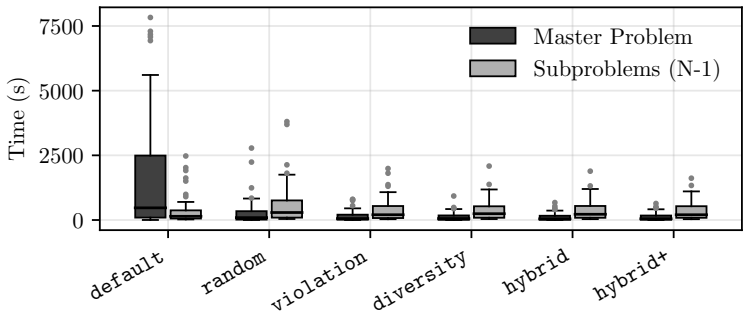
For Benders decomposition applied to affine potential-based flow problems with robustness scenarios and topology switching, filtering the cuts generated in each iteration by retaining the most-violated cuts, by selecting diverse cuts through k-medoids clustering on pairwise cosine distances, or by a hybrid of the two approaches, optionally augmented with an aggregated cut, allows the algorithm to solve at least 125 of 149 test instances compared with 91 for the unfiltered baseline and reduces the shifted geometric mean solve time from 629.34 s to 271.89 s under the hybrid strategy.
What carries the argument
Violation-based, diversity-based (k-medoids on cosine distance), and hybrid Benders cut filtering strategies, optionally augmented with an aggregated cut that preserves information from discarded cuts.
If this is right
- Adding fewer cuts per iteration reduces the total number of constraints in the master problem even if the iteration count rises slightly.
- Informed filtering strategies solve at least 34 more instances than adding every generated cut.
- The hybrid strategy that combines violation and diversity criteria produces the largest reduction in geometric mean solve time.
- An aggregated cut can be added alongside filtered cuts to retain information without increasing master-problem size proportionally.
Where Pith is reading between the lines
- The same filtering logic could be applied to Benders decompositions arising in other network design or robust optimization settings.
- Embedding these filters directly inside commercial MIP solvers might automate cut management for users who employ decomposition.
- Alternative clustering algorithms or distance measures on the cut space might yield further reductions in solve time.
- The approach may interact productively with other acceleration techniques such as cut strengthening or warm-starting of the master problem.
Load-bearing premise
The 149 instances of the affine potential-based flow problem with topology switching and robustness scenarios are representative enough that the observed speedups will generalize to other problem classes or larger real-world instances.
What would settle it
Running the same filtering strategies on a different family of Benders-decomposable problems or on substantially larger instances and finding that the number of solved instances or the geometric mean solve time shows no improvement or becomes worse than the unfiltered baseline.
Figures


read the original abstract
Many large-scale optimization problems decompose into a master problem and scenario subproblems, a structure that can be exploited by Benders decomposition. In Benders decomposition, each iteration may generate many cuts from scenario subproblems, and adding all of them as constraints then causes the master problem to grow rapidly. These are constraints that may need to be added to the master problem to guarantee optimality and feasibility of solutions, but we can avoid adding those constraints that are never violated. Adding fewer cuts per iteration can reduce the number of cuts added in total, but increase the number of iterations. In contrast, the cuts filtered for regular cut selection in mixed-integer programming solvers are optional and added exclusively to improve runtime behavior. We study Benders cut filtering: given the Benders cuts produced in an iteration, which subset should be added to the master problem? To our knowledge, few prior works have studied this question. We propose violation-based filtering (retaining the most-violated cuts), diversity-based filtering via k-medoids clustering on pairwise cosine distances (adding an original cut closest to the cluster centroid), and a hybrid that selects a most-violated cut per cluster. Each strategy can be augmented with an aggregated cut that retains discarded information. Computational experiments on 149 instances of an affine potential-based flow problem with topology switching and robustness scenarios -- solved via Benders decomposition -- show that all informed filtering strategies solve at least 125 instances (vs. 91 for the unfiltered baseline), reducing shifted geometric mean solve time by 55-57%. The hybrid strategy attains the best geometric mean (271.89 s vs. 629.34 s, a 57% reduction, p < 0.001).
Editorial analysis
A structured set of objections, weighed in public.
Referee Report
Summary. The manuscript proposes violation-based, diversity-based (k-medoids clustering on pairwise cosine distances), and hybrid Benders cut filtering strategies for affine potential-based flow problems with robustness scenarios and topology switching. Each strategy can be augmented with an aggregated cut. Computational experiments on 149 instances show that all informed filters solve at least 125 instances (vs. 91 for the unfiltered baseline), with the hybrid yielding the lowest shifted geometric mean time of 271.89 s (57% reduction, p < 0.001).
Significance. If the empirical results hold, the work provides concrete, statistically supported evidence that informed cut filtering can substantially improve Benders decomposition performance on this class of network flow problems by limiting master-problem growth while preserving solution quality. The use of shifted geometric means, solved-instance counts, and p-value testing on a fixed test set strengthens the practical contribution for similar decomposable problems.
minor comments (2)
- [Abstract] Abstract: the statement that 'few prior works have studied this question' would benefit from 1-2 citations to existing Benders cut management or cut selection literature to better situate the novelty.
- [Computational Experiments] Computational experiments section: more detail on how the 149 instances were generated or selected would help readers assess the scope of the observed speedups.
Simulated Author's Rebuttal
We thank the referee for the positive summary of our manuscript on Benders cut filtering strategies and for recognizing its practical significance in improving decomposition performance on affine potential-based flow problems. We appreciate the recommendation for minor revision and will incorporate any editorial suggestions in the revised version.
Circularity Check
No circularity: direct empirical comparison on fixed instances
full rationale
The paper proposes three Benders cut filtering strategies (violation-based, k-medoids diversity, hybrid) plus optional aggregation, then reports concrete runtime and solvability results on a fixed collection of 149 instances. These outcomes are obtained by direct execution of the algorithms inside a standard Benders loop; they do not rely on any fitted parameter renamed as a prediction, any self-definitional equation, or any load-bearing self-citation chain. The abstract and skeptic analysis confirm that the reported geometric-mean speedups and instance counts follow immediately from applying the described filters to the given test set, with no hidden derivation that reduces to its own inputs.
Axiom & Free-Parameter Ledger
Reference graph
Works this paper leans on
-
[1]
PhD thesis, Technische Universität Berlin, 2007
Tobias Achterberg.Constraint integer programming. PhD thesis, Technische Universität Berlin, 2007
2007
-
[2]
Mathematical Programming Computation , volume =
Tobias Achterberg. SCIP: solving constraint integer programs.Mathematical Programming Computation, 1(1):1–41, 2009.doi:10.1007/s12532-008-0001-1
-
[3]
Giovanni Andreello, Alberto Caprara, and Matteo Fischetti. Embedding cuts in a branch&cut framework: a computational study with {0, 1 2}-cuts.INFORMS Journal on Computing, 19(2):229–238, 2007.doi:10.1287/ijoc.1050.0162
-
[4]
Sogol Babaeinejadsarookolaee, Adam Birchfield, Richard D. Christie, Carleton Coffrin, Christopher DeMarco, Ruisheng Diao, Michael Ferris, Stephane Fliscounakis, Scott Greene, Renke Huang, Cedric Josz, Roman Korab, Bernard Lesieutre, Jean Maeght, Terrence W. K. Mak, Daniel K. Molzahn, Thomas J. Overbye, Patrick Panciatici, Byungkwon Park, Jonathan Snodgras...
-
[5]
Jacques F. Benders. Partitioning procedures for solving mixed-variables programming problems.Numerische Mathematik, 4(1):238–252, 1962.doi:10.1007/BF01386316
-
[6]
Dimitris Bertsimas, Ryan Cory-Wright, Jean Pauphilet, and Periklis Petridis. A stochastic Benders decomposition scheme for large-scale stochastic network design.INFORMS Journal on Computing, 37(5):1163–1181, 2025.doi:10.1287/ijoc.2023.0074
-
[7]
John R. Birge and François V Louveaux. A multicut algorithm for two-stage stochastic linear programs.European Journal of Operational Research, 34(3):384–392, 1988.doi: 10.1016/0377-2217(88)90159-2
-
[8]
Xavier Blanchot, François Clautiaux, Boris Detienne, Aurélien Froger, and Manuel Ruiz. The Benders by batch algorithm: Design and stabilization of an enhanced algorithm to solve multicut Benders reformulation of two-stage stochastic programs.European Journal of Operational Research, 309(1):202–216, 2023.doi:10.1016/j.ejor.2023.01.004
-
[9]
René Brandenberg and Paul Stursberg. Refined cut selection for Benders decomposition: applied to network capacity expansion problems.Mathematical Methods of Operations Research, 94(3):383–412, 2021.doi:10.1007/s00186-021-00762-w
-
[10]
Partial Ben- ders decomposition: general methodology and application to stochastic network design
Teodor Gabriel Crainic, Mike Hewitt, Francesca Maggioni, and Walter Rei. Partial Ben- ders decomposition: general methodology and application to stochastic network design. Transportation Science, 55(2):414–435, 2021.doi:10.1287/trsc.2020.1022
-
[11]
Antoine Deza and Elias B. Khalil. Machine learning for cutting planes in integer pro- gramming: A survey. InProceedings of the Thirty-Second International Joint Con- ference on Artificial Intelligence (IJCAI-23), Survey Track, pages 6592–6600, 2023. doi:10.24963/ijcai.2023/740
-
[12]
Tim Donkiewicz. Adaptive subproblem selection in Benders decomposition for survivable network design problems. In Martin Aumüller and Irene Finocchi, editors,24th International Symposium on Experimental Algorithms (SEA 2026), 2026.doi:10.48550/arXiv.2604. 09031
-
[13]
Efficient subproblem solving in Benders decomposition for potential-based flow problems
Tim Donkiewicz and Oliver Gaul. Efficient subproblem solving in Benders decomposition for potential-based flow problems. Not available online yet, but will be added when the paper is published., 2026. 12
2026
-
[14]
A density-based algorithm for discovering clusters in large spatial databases with noise
Martin Ester, Hans-Peter Kriegel, Jörg Sander, and Xiaowei Xu. A density-based algorithm for discovering clusters in large spatial databases with noise. InProceedings of the Second International Conference on Knowledge Discovery and Data Mining (KDD-96), pages 226–231. AAAI Press, 1996.doi:10.5555/3001460.3001507
-
[15]
A note on the selection of Benders’ cuts.Mathematical Programming, 124(1–2):175–182, 2010.doi:10.1007/ s10107-010-0351-0
Matteo Fischetti, Domenico Salvagnin, and Arrigo Zanette. A note on the selection of Benders’ cuts.Mathematical Programming, 124(1–2):175–182, 2010.doi:10.1007/ s10107-010-0351-0
2010
-
[16]
Thomas M. J. Fruchterman and Edward M. Reingold. Graph drawing by force-directed placement.Software: Practice and Experience, 21(11):1129–1164, 1991.doi:10.1002/spe. 4380211102
work page doi:10.1002/spe 1991
-
[17]
Lukas Glomb, Frauke Liers, and Florian Rösel. A novel Pareto-optimal cut selection strategy for Benders decomposition.Mathematical Programming Computation, 18(1):211–257, 2026. doi:10.1007/s12532-025-00291-1
-
[18]
Gurobi Optimizer Reference Manual, 2024
Gurobi Optimization, LLC. Gurobi Optimizer Reference Manual, 2024. URL: https: //www.gurobi.com
2024
-
[19]
Fouad Hasan and Amin Kargarian. Accelerating L-shaped two-stage stochastic SCUC with learning integrated Benders decomposition.arXiv preprint arXiv:2311.10835, 2023. doi:10.48550/arXiv.2311.10835
-
[20]
Mojtaba Hosseini and John Turner. Deepest cuts for Benders decomposition.Operations Research, 73(5):2591–2609, 2025.doi:10.1287/opre.2021.0503
-
[21]
Huiwen Jia and Siqian Shen. Benders cut classification via support vector machines for solving two-stage stochastic programs.INFORMS Journal on Optimization, 3(3):278–297, 2021.doi:10.1287/ijoo.2020.0045
-
[22]
Timoleon Kaltis and Georgios K. D. Saharidis. Literature review on Benders cut selection and a multiple cut generation scheme.INFOR: Information Systems and Operational Research, 64(1):244–270, 2025.doi:10.1080/03155986.2025.2540205
-
[23]
Rousseeuw
Leonard Kaufman and Peter J. Rousseeuw. Clustering by means of medoids. InStatistical Data Analysis Based on the L1-Norm and Related Methods, pages 405–416. North-Holland, 1987
1987
-
[24]
Mathematical Programming Computation (2023)
Miles Lubin, Oscar Dowson, Joaquim Dias Garcia, Joey Huchette, Benoît Legat, and Juan Pablo Vielma. JuMP 1.0: Recent improvements to a modeling language for math- ematical optimization.Mathematical Programming Computation, 15(3):581–589, 2023. doi:10.1007/s12532-023-00239-3
-
[25]
Thomas L. Magnanti and Richard T. Wong. Accelerating Benders decomposition: Algorith- mic enhancement and model selection criteria.Operations Research, 29(3):464–484, 1981. doi:10.1287/opre.29.3.464
-
[26]
Nikolaos Papadakos. Practical enhancements to the Magnanti–Wong method.Operations Research Letters, 36(4):444–449, 2008.doi:10.1016/j.orl.2007.08.005
-
[27]
The surprising performance of random partial Benders decomposition.Optimization Online, 2025
Jean Pauphilet and Yupeng Wu. The surprising performance of random partial Benders decomposition.Optimization Online, 2025. 32181
2025
-
[28]
Pfetsch, Martin Schmidt, Martin Skutella, and Johannes Thürauf
Marc E. Pfetsch, Martin Schmidt, Martin Skutella, and Johannes Thürauf. Potential-based flows – an overview, 2026. 13
2026
-
[29]
Ragheb Rahmaniani, Teodor Gabriel Crainic, Michel Gendreau, and Walter Rei. The Benders decomposition algorithm: A literature review.European Journal of Operational Research, 259(3):801–817, 2017.doi:10.1016/j.ejor.2016.12.005
-
[30]
Cristian Ramírez-Pico, Ivana Ljubić, and Eduardo Moreno. Benders adaptive-cuts method for two-stage stochastic programs.Transportation Science, 57(5):1252–1275, 2023.doi: 10.1287/trsc.2022.0073
-
[31]
Kiho Seo, Seulgi Joung, Chungmok Lee, and Sungsoo Park. A closest Benders cut selection scheme for accelerating the Benders decomposition algorithm.INFORMS Journal on Computing, 34(5):2804–2827, 2022.doi:10.1287/ijoc.2022.1207
-
[32]
Yongjia Song and James R. Luedtke. An adaptive partition-based approach for solving two- stage stochastic programs with fixed recourse.SIAM Journal on Optimization, 25(3):1344– 1367, 2015.doi:10.1137/140967337
-
[33]
Reinforcement learning for integer programming: Learning to cut
Yunhao Tang, Shipra Agrawal, and Yuri Faenza. Reinforcement learning for integer programming: Learning to cut. InInternational Conference on Machine Learning, pages 9367–9376. PMLR, 2020
2020
-
[34]
Svyatoslav Trukhanov, Lewis Ntaimo, and Andrew Schaefer. Adaptive multicut aggregation for two-stage stochastic linear programs with recourse.European Journal of Operational Research, 206(2):395–406, 2010.doi:10.1016/j.ejor.2010.02.025
-
[35]
Mark Turner, Thorsten Koch, Felipe Serrano, and Michael Winkler. Adaptive cut selection in mixed-integer linear programming.Open Journal of Mathematical Optimization, 4:1–28, 2023.doi:10.5802/ojmo.25
-
[36]
Richard M. Van Slyke and Roger Wets. L-shaped linear programs with applications to optimal control and stochastic programming.SIAM Journal on Applied Mathematics, 17(4):638–663, 1969.doi:10.1137/0117061
-
[37]
Biometrics Bulletin 1, 80- 83,10.2307/3001968
Frank Wilcoxon. Individual comparisons by ranking methods.Biometrics Bulletin, 1(6):80– 83, 1945.doi:10.2307/3001968
-
[38]
Christian Wolf and Achim Koberstein. Dynamic sequencing and cut consolidation for the parallel hybrid-cut nested L-shaped method.European Journal of Operational Research, 230(1):143–156, 2013.doi:10.1016/j.ejor.2013.04.033. 14 A Detailed Results Table 2: Per-instance solve times (seconds), part 1 of 3.†=solved by all configurations. Statistics summary in ...
discussion (0)
Sign in with ORCID, Apple, or X to comment. Anyone can read and Pith papers without signing in.