Recognition: unknown
Pulse Quality Optimisation in Quantum Optimal Control
Pith reviewed 2026-05-07 16:25 UTC · model grok-4.3
The pith
A geometric method refines quantum control pulses for better experimental properties while keeping gate fidelity unchanged to first order.
A machine-rendered reading of the paper's core claim, the machinery that carries it, and where it could break.
Core claim
The central claim is that the Riemannian geometry of the special unitary group supplies tangent directions in pulse space that leave the implemented unitary unchanged to first order; traversing these directions lets one optimize any chosen differentiable pulse-quality function without leaving the high-fidelity level set of the landscape, and numerical tests on Ising Hamiltonians confirm substantially improved pulses for several quality criteria.
What carries the argument
Tangent vectors to the level set of the fidelity landscape on the special unitary group, which identify first-order neutral directions in pulse space.
Load-bearing premise
First-order tangent directions on the unitary manifold remain accurate enough during finite optimization steps to keep the implemented gate close to the original high-fidelity solution.
What would settle it
Numerical or experimental application of the refined pulses yields gate fidelities measurably below those of the starting high-fidelity solutions.
Figures




read the original abstract
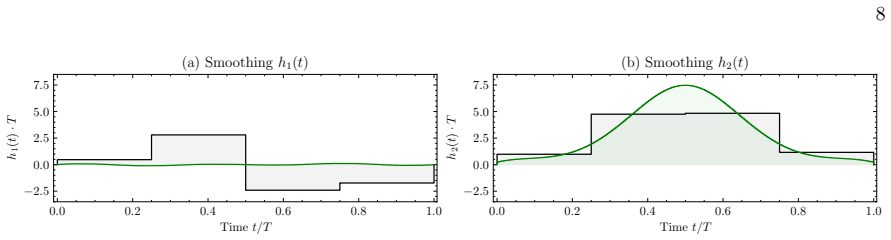
Quantum optimal control methods are widely used to design experimental control pulses such as laser amplitudes, phases, or detunings, that implement a target unitary evolution. In practice, what makes a pulse "good" depends not only on its fidelity, but also on the experimental setting and the relevant hardware constraints. Here, we introduce geometric quantum control with kernel optimisation (GECKO), a model-agnostic method for improving control pulses after a high-fidelity solution has been found. GECKO uses the Riemannian geometry of the special unitary group to identify directions in pulse space that leave the implemented unitary unchanged to first order, allowing one to traverse level sets of the control landscape while optimising a chosen differentiable pulse-quality function. We demonstrate GECKO on a transverse-field Ising Hamiltonian implementing CZ and CNOT gates, optimising pulse properties including spectral filtering, smoothness, robustness to parameter deviations, and pulse duration. In all cases, GECKO finds substantially improved pulse solutions.
Editorial analysis
A structured set of objections, weighed in public.
Referee Report
Summary. The manuscript introduces Geometric Quantum Control with Kernel Optimisation (GECKO), which exploits the Riemannian geometry of the special unitary group to construct directions in pulse-parameter space lying in the kernel of the differential of the control-to-unitary map. These directions permit traversal of fidelity level sets while optimizing a secondary differentiable pulse-quality objective. The method is demonstrated on a transverse-field Ising Hamiltonian for CZ and CNOT gates, with reported improvements in spectral filtering, smoothness, robustness to parameter deviations, and pulse duration.
Significance. If the first-order approximation is shown to hold with quantifiable fidelity preservation, GECKO would offer a practical, model-agnostic post-processing step for refining control pulses to meet experimental constraints without re-optimizing fidelity from scratch. The geometric construction is clean and could generalize across control landscapes.
major comments (3)
- [Method section (geometric construction)] The central construction identifies directions v such that the first-order change in U vanishes, but the manuscript supplies no bound on the quadratic term (1/2) Hess(U)(v,v) or on admissible step sizes ε. Without this, it is unclear whether finite optimization steps along the reported kernel directions keep the final unitary sufficiently close to the original level set.
- [Results / demonstration section] In the Ising-model demonstrations, the paper states that GECKO 'finds substantially improved pulse solutions' for CZ and CNOT but reports no numerical fidelity values, error bars, or distance-to-level-set metrics before versus after optimization. This absence prevents verification that the first-order nullspace condition remains effective under the chosen step sizes and quality functions.
- [Pulse-quality functions subsection] The differentiability assumption on the pulse-quality objectives (e.g., spectral filtering) is invoked to justify gradient-based optimization in the kernel, yet no explicit verification or regularization is provided to ensure these functions remain differentiable along the entire optimization trajectory.
minor comments (2)
- [Abstract] The abstract and introduction would benefit from a short table summarizing quantitative before/after metrics for at least one gate and one quality metric.
- [Geometric construction] Notation for the projection operator onto the kernel of dU/dp could be introduced with an explicit equation to improve readability.
Simulated Author's Rebuttal
We thank the referee for their constructive and detailed report. We address each major comment below with point-by-point responses. Revisions have been made to strengthen the theoretical discussion, add quantitative metrics, and clarify assumptions, improving the manuscript without altering its core claims.
read point-by-point responses
-
Referee: [Method section (geometric construction)] The central construction identifies directions v such that the first-order change in U vanishes, but the manuscript supplies no bound on the quadratic term (1/2) Hess(U)(v,v) or on admissible step sizes ε. Without this, it is unclear whether finite optimization steps along the reported kernel directions keep the final unitary sufficiently close to the original level set.
Authors: We acknowledge the absence of an explicit bound on the quadratic term or general step-size limits in the original manuscript. The GECKO construction is intentionally first-order and local, with step sizes selected empirically to remain small. In the revised manuscript we will add a dedicated paragraph in the Methods section deriving a local estimate of the quadratic contribution using the Riemannian Hessian on SU(N) and include numerical plots of infidelity growth versus ε for the Ising demonstrations. This provides practical guidance on admissible steps while preserving the method's model-agnostic character. revision: yes
-
Referee: [Results / demonstration section] In the Ising-model demonstrations, the paper states that GECKO 'finds substantially improved pulse solutions' for CZ and CNOT but reports no numerical fidelity values, error bars, or distance-to-level-set metrics before versus after optimization. This absence prevents verification that the first-order nullspace condition remains effective under the chosen step sizes and quality functions.
Authors: We agree that explicit numerical verification is necessary. The revised results section will include tables reporting initial and final gate infidelities (typically remaining below 10^{-3}), standard deviations over multiple random initializations, and the Frobenius distance ||U_final - U_initial|| to quantify level-set adherence. These metrics will be shown for each pulse-quality objective, directly confirming that the kernel directions preserve fidelity to high accuracy under the employed step sizes. revision: yes
-
Referee: [Pulse-quality functions subsection] The differentiability assumption on the pulse-quality objectives (e.g., spectral filtering) is invoked to justify gradient-based optimization in the kernel, yet no explicit verification or regularization is provided to ensure these functions remain differentiable along the entire optimization trajectory.
Authors: Each objective used (spectral penalty via smooth Fourier weighting, smoothness via ∫|dΩ/dt|^2 dt, robustness via averaged infidelity over parameter samples, and duration via a differentiable penalty) is analytically differentiable by construction. The revised subsection will explicitly state the functional form of every objective, confirm C^1 regularity, and note that the projected gradient steps remain within the differentiable regime for the step sizes employed. No additional regularization proved necessary in the reported trajectories. revision: partial
Circularity Check
No circularity: GECKO is a direct geometric construction on the SU manifold.
full rationale
The paper's core derivation defines directions in pulse space via the kernel of the differential dU/dp (equivalently, the Riemannian gradient of fidelity) using standard differential geometry on the special unitary group. This construction is applied to traverse level sets while optimizing an independent differentiable secondary objective. No equation reduces a claimed result to a fitted parameter, self-citation, or input by definition; the first-order nullspace is computed directly from the control-to-unitary map without presupposing the quality-function improvements. Demonstrations on the transverse-field Ising model for CZ/CNOT are concrete applications rather than tautological verifications. The method therefore remains self-contained against external benchmarks.
Axiom & Free-Parameter Ledger
axioms (1)
- domain assumption Directions tangent to the level set of the fidelity functional on SU(N) leave the implemented unitary unchanged to first order.
Reference graph
Works this paper leans on
-
[1]
The first is the controlled-Z gate: CZ = diag(1, i, i,1)
+ 1 2 σz 2.(16) We consider two target unitaries. The first is the controlled-Z gate: CZ = diag(1, i, i,1). The second is the CNOT gate: CNOT = 1 0 0 0 0 1 0 0 0 0 0 1 0 0 1 0 . A. Frequency-domain filtering Limited bandwidth is a common experimental constraint in quantum optimal control. Spectral constraints can be enforced directly during opti...
-
[2]
In this section, we set the timescale of the evolution by fixing the coupling termg, such that the time is given in units 1/g
Previously, we setg∆t= 1. In this section, we set the timescale of the evolution by fixing the coupling termg, such that the time is given in units 1/g. The total pulse duration isT=L∆tand we now have an additional pulse parameter, ∆t. We consider both the geometric and drift-term time optimality. 10 0.0 2.5 5.0 7.5 10.0 12.5 15.0 17.5 Time 0.0 0.2 0.4h1(...
-
[3]
Thus, the total Hamiltonian norm must be minimised
Minimum path length The minimum path length is the case for which there is limited experimental capability for the Hamiltonian control terms. Thus, the total Hamiltonian norm must be minimised. There is an equivalence between path length on the SU(N) manifold and the duration of the pulse [15]. A time- independent Hamiltonian gives a path length on the ma...
-
[4]
Experimentally, this interacting drift term often cannot be changed, and determines the timescale of the pulse
Timescale determined by drift term The timescale can be determined by the strength of a single Hamiltonian term: the strength of the constant drift. Experimentally, this interacting drift term often cannot be changed, and determines the timescale of the pulse. In this case,gis fixed to determine the timescale. We then minimise the ∆tand the other control ...
-
[5]
Koch, Ugo Boscain, Tommaso Calarco, Gunther Dirr, Stefan Filipp, Steffen J
Christiane P. Koch, Ugo Boscain, Tommaso Calarco, Gunther Dirr, Stefan Filipp, Steffen J. Glaser, Ronnie Kosloff, Simone Montangero, Thomas Schulte-Herbr¨ uggen, Dominique Sugny, and Frank K. Wilhelm. Quantum optimal control in quantum technologies. Strategic report on current status, visions and goals for research in Europe.EPJ Quantum Technology, 9(1):1...
2022
-
[6]
Control of quantum phenomena: past, present and future.New Journal of Physics, 12(7):075008, July 2010
Constantin Brif, Raj Chakrabarti, and Herschel Rabitz. Control of quantum phenomena: past, present and future.New Journal of Physics, 12(7):075008, July 2010
2010
-
[7]
Kelly, R
J. Kelly, R. Barends, B. Campbell, Y. Chen, Z. Chen, B. Chiaro, A. Dunsworth, A.G. Fowler, I.-C. Hoi, E. Jeffrey, A. Megrant, J. Mutus, C. Neill, P.J.J. O’Malley, C. Quintana, P. Roushan, D. Sank, A. Vainsencher, J. Wenner, T.C. White, A.N. Cleland, and John M. Martinis. Optimal Quantum Control Using Randomized Benchmarking.Physical Review Letters, 112(24...
2014
-
[8]
Krantz, M
P. Krantz, M. Kjaergaard, F. Yan, T. P. Orlando, S. Gustavsson, and W. D. Oliver. A quantum engineer’s guide to superconducting qubits.Applied Physics Reviews, 6(2):021318, June 2019
2019
-
[9]
Bruzewicz, John Chiaverini, Robert McConnell, and Jeremy M
Colin D. Bruzewicz, John Chiaverini, Robert McConnell, and Jeremy M. Sage. Trapped-ion quantum computing: Progress and challenges.Applied Physics Reviews, 6(2):021314, May 2019
2019
-
[10]
High-fidelity parallel entangling gates on a neutral-atom quantum computer
Simon J. Evered, Dolev Bluvstein, Marcin Kalinowski, Sepehr Ebadi, Tom Manovitz, Hengyun Zhou, Sophie H. Li, Alexandra A. Geim, Tout T. Wang, Nishad Maskara, Harry Levine, Giulia Semeghini, Markus Greiner, Vladan Vuletic, and Mikhail D. Lukin. High-fidelity parallel entangling gates on a neutral atom quantum computer.Nature, 622(7982):268–272, October 202...
-
[11]
Navin Khaneja, Timo Reiss, Cindie Kehlet, Thomas Schulte-Herbr¨ uggen, and Steffen J. Glaser. Optimal control of coupled spin dynamics: design of NMR pulse sequences by gradient ascent algorithms.Journal of Magnetic Resonance, 172(2):296–305, February 2005
2005
-
[12]
V. F. Krotov. Global Methods in Optimal Control Theory. In Alexander B. Kurzhanski, editor,Advances in Nonlinear Dynamics and Control: A Report from Russia, pages 74–121. Birkh¨ auser, Boston, MA, 1993
1993
-
[13]
Palao and Ronnie Kosloff
Jos´ e P. Palao and Ronnie Kosloff. Optimal control theory for unitary transformations.Physical Review A, 68(6):062308, December 2003
2003
-
[14]
Monotonically convergent optimization in quantum control using krotov’s method.The Journal of chemical physics, 136(10), 2012
Daniel M Reich, Mamadou Ndong, and Christiane P Koch. Monotonically convergent optimization in quantum control using krotov’s method.The Journal of chemical physics, 136(10), 2012
2012
-
[15]
Krotov Method for Optimal Control in Closed Quantum Systems
Oleg Morzhin and Alexander Pechen. Krotov Method for Optimal Control in Closed Quantum Systems. Russian Mathematical Surveys, 74(5):851–908, October 2019. arXiv:1809.09562 [quant-ph]
-
[16]
Chopped random-basis quantum opti- mization.Physical Review A, 84(2):022326, August 2011
Tommaso Caneva, Tommaso Calarco, and Simone Montangero. Chopped random-basis quantum opti- mization.Physical Review A, 84(2):022326, August 2011
2011
-
[17]
One decade of quantum optimal control in the chopped random basis.Reports on Progress in Physics, 85(7):076001, June 2022
Matthias M M¨ uller, Ressa S Said, Fedor Jelezko, Tommaso Calarco, and Simone Montangero. One decade of quantum optimal control in the chopped random basis.Reports on Progress in Physics, 85(7):076001, June 2022
2022
-
[18]
Geodesic algorithm for unitary gate design with time-independent Hamiltonians.Physical Review A, 111(5):052618, May 2025
Dylan Lewis, Roeland Wiersema, Juan Carrasquilla, and Sougato Bose. Geodesic algorithm for unitary gate design with time-independent Hamiltonians.Physical Review A, 111(5):052618, May 2025
2025
-
[19]
Quantum optimal control with geodesic pulse engi- neering.arXiv preprint arXiv:2508.16029, 2025
Dylan Lewis, Roeland Wiersema, and Sougato Bose. Quantum optimal control with geodesic pulse engi- neering.arXiv preprint arXiv:2508.16029, 2025
-
[20]
Are there traps in quantum control landscapes?Physical review letters, 106(12):120402, 2011
Alexander N Pechen and David J Tannor. Are there traps in quantum control landscapes?Physical review letters, 106(12):120402, 2011
2011
-
[21]
Quantum control landscape for aλ-atom in the vicinity of second-order traps.Israel Journal of Chemistry, 52(5):467–472, 2012
Alexander N Pechen and David J Tannor. Quantum control landscape for aλ-atom in the vicinity of second-order traps.Israel Journal of Chemistry, 52(5):467–472, 2012
2012
-
[22]
Trap-free manipulation in the landau-zener system.Physical Review A—Atomic, Molecular, and Optical Physics, 86(5):052117, 2012
Alexander Pechen and Nikolay Il’in. Trap-free manipulation in the landau-zener system.Physical Review A—Atomic, Molecular, and Optical Physics, 86(5):052117, 2012
2012
-
[23]
Role of control constraints in quantum optimal control.Physical Review A, 92(5):052109, 2015
Dmitry V Zhdanov and Tamar Seideman. Role of control constraints in quantum optimal control.Physical Review A, 92(5):052109, 2015
2015
-
[24]
Quantum control landscapes.International Reviews in Physical Chemistry, 26(4):671–735, 2007
Raj Chakrabarti and Herschel Rabitz. Quantum control landscapes.International Reviews in Physical Chemistry, 26(4):671–735, 2007
2007
-
[25]
Laboratory observation of quantum control level sets.Physical Review A—Atomic, Molecular, and Optical Physics, 74(4):043414, 2006
Jonathan Roslund, Matthias Roth, and Herschel Rabitz. Laboratory observation of quantum control level sets.Physical Review A—Atomic, Molecular, and Optical Physics, 74(4):043414, 2006
2006
-
[26]
Quantum control landscape for a two-level system near the quantum speed limit.Journal of Physics A: Mathematical and Theoretical, 51(38):385305, 2018
Mart´ ın Larocca, Pablo M Poggi, and Diego A Wisniacki. Quantum control landscape for a two-level system near the quantum speed limit.Journal of Physics A: Mathematical and Theoretical, 51(38):385305, 2018
2018
-
[27]
Observable-preserving control of quantum dy- namics over a family of related systems.Physical Review A—Atomic, Molecular, and Optical Physics, 72(2):023416, 2005
Adam Rothman, Tak-San Ho, and Herschel Rabitz. Observable-preserving control of quantum dy- namics over a family of related systems.Physical Review A—Atomic, Molecular, and Optical Physics, 72(2):023416, 2005
2005
-
[28]
Exploring the top and bottom of the quantum control landscape.The Journal of chemical physics, 134(19), 2011
Vincent Beltrani, Jason Dominy, Tak-San Ho, and Herschel Rabitz. Exploring the top and bottom of the quantum control landscape.The Journal of chemical physics, 134(19), 2011. 13
2011
-
[29]
Top manifold connectedness of quantum control landscapes.Physical Review A, 112(2):022608, 2025
Yidian Fan, Re-Bing Wu, Tak-San Ho, Gaurav Bhole, and Herschel Rabitz. Top manifold connectedness of quantum control landscapes.Physical Review A, 112(2):022608, 2025
2025
-
[30]
Exploring the level sets of quantum control landscapes
Adam Rothman, Tak-San Ho, and Herschel Rabitz. Exploring the level sets of quantum control landscapes. Physical Review A—Atomic, Molecular, and Optical Physics, 73(5):053401, 2006
2006
-
[31]
Exploiting landscape geometry to enhance quantum optimal control.Physical Review A, 101(2):023410, 2020
Mart´ ın Larocca, Esteban Calzetta, and Diego A Wisniacki. Exploiting landscape geometry to enhance quantum optimal control.Physical Review A, 101(2):023410, 2020
2020
-
[32]
John Wiley & Sons, Ltd, 2010
Gerhard Venter.Review of Optimization Techniques. John Wiley & Sons, Ltd, 2010
2010
-
[33]
A unified approach for motion and force control of robot manipulators: The operational space formulation.IEEE Journal on Robotics and Automation, 3(1):43–53, 2003
Oussama Khatib. A unified approach for motion and force control of robot manipulators: The operational space formulation.IEEE Journal on Robotics and Automation, 3(1):43–53, 2003
2003
-
[34]
An overview of null space projections for redundant, torque-controlled robots.The International Journal of Robotics Research, 34(11):1385–1400, 2015
Alexander Dietrich, Christian Ott, and Alin Albu-Sch¨ affer. An overview of null space projections for redundant, torque-controlled robots.The International Journal of Robotics Research, 34(11):1385–1400, 2015
2015
-
[35]
Null space gradient flows for constrained optimiza- tion with applications to shape optimization.ESAIM: Control, Optimisation and Calculus of Variations, 26:90, 2020
Florian Feppon, Gr´ egoire Allaire, and Charles Dapogny. Null space gradient flows for constrained optimiza- tion with applications to shape optimization.ESAIM: Control, Optimisation and Calculus of Variations, 26:90, 2020
2020
-
[36]
Density-based topology optimization with the null space optimizer: a tutorial and a comparison.Structural and Multidisciplinary Optimization, 67(1):4, 2024
Florian Feppon. Density-based topology optimization with the null space optimizer: a tutorial and a comparison.Structural and Multidisciplinary Optimization, 67(1):4, 2024
2024
-
[37]
Nullspace sampling with holonomic constraints reveals molecular mechanisms of protein gαs.PLoS Computational Biology, 11(7):e1004361, 2015
Dimitar V Pachov and Henry van den Bedem. Nullspace sampling with holonomic constraints reveals molecular mechanisms of protein gαs.PLoS Computational Biology, 11(7):e1004361, 2015
2015
-
[38]
The gradient projection method along geodesics.Management Science, 18(11):620– 631, 1972
David G Luenberger. The gradient projection method along geodesics.Management Science, 18(11):620– 631, 1972
1972
-
[39]
Constrained optimization: projected gradient flows.Journal of optimization theory and applications, 140(1):117–130, 2009
Vladimir Shikhman and Oliver Stein. Constrained optimization: projected gradient flows.Journal of optimization theory and applications, 140(1):117–130, 2009
2009
-
[40]
Gradient projection method for constrained quantum control
Oleg V Morzhin and Alexander N Pechen. Gradient projection method for constrained quantum control. Journal of Physics A: Mathematical and Theoretical, 58(13):135302, 2025
2025
-
[41]
Cambridge university press, 2004
Stephen P Boyd and Lieven Vandenberghe.Convex optimization. Cambridge university press, 2004
2004
-
[42]
Geodesic Pulse Engineering, 2026.https://github.com/dyylan/ geope
Dylan Lewis and Roeland Wiersema. Geodesic Pulse Engineering, 2026.https://github.com/dyylan/ geope
2026
-
[43]
Monroe, W.C
C. Monroe, W.C. Campbell, L.-M. Duan, Z.-X. Gong, A.V. Gorshkov, P.W. Hess, R. Islam, K. Kim, N.M. Linke, G. Pagano, P. Richerme, C. Senko, and N.Y. Yao. Programmable quantum simulations of spin systems with trapped ions.Reviews of Modern Physics, 93(2):025001, April 2021
2021
-
[44]
Morgado and S
M. Morgado and S. Whitlock. Quantum simulation and computing with Rydberg-interacting qubits.A VS Quantum Science, 3(2):023501, May 2021
2021
-
[45]
M Lapert, R Tehini, G Turinici, and D Sugny. Monotonically convergent optimal control theory of quantum systems with spectral constraints on the control field.Physical Review A—Atomic, Molecular, and Optical Physics, 79(6):063411, 2009
2009
-
[46]
Steering the optimization pathway in the control landscape using constraints.Physical Review A—Atomic, Molecular, and Optical Physics, 88(5):053409, 2013
Jos´ e P Palao, Daniel M Reich, and Christiane P Koch. Steering the optimization pathway in the control landscape using constraints.Physical Review A—Atomic, Molecular, and Optical Physics, 88(5):053409, 2013
2013
-
[47]
Optimal control under spectral constraints: enforcing multi-photon absorption pathways.Journal of Modern Optics, 61(10):822–827, 2014
Daniel M Reich, Jos´ e P Palao, and Christiane P Koch. Optimal control under spectral constraints: enforcing multi-photon absorption pathways.Journal of Modern Optics, 61(10):822–827, 2014
2014
-
[48]
Reducing the duration of broadband excitation pulses using optimal control with limited rf amplitude.Journal of Magnetic Resonance, 167(1):68–74, 2004
Thomas E Skinner, Timo O Reiss, Burkhard Luy, Navin Khaneja, and Steffen J Glaser. Reducing the duration of broadband excitation pulses using optimal control with limited rf amplitude.Journal of Magnetic Resonance, 167(1):68–74, 2004
2004
-
[49]
Exploring the limits of broadband excitation and inversion: Ii
Kyryl Kobzar, Thomas E Skinner, Navin Khaneja, Steffen J Glaser, and Burkhard Luy. Exploring the limits of broadband excitation and inversion: Ii. rf-power optimized pulses.Journal of Magnetic Resonance, 194(1):58–66, 2008
2008
-
[50]
Optimal pulse design in quantum control: A unified computational method.Proceedings of the National Academy of Sciences, 108(5):1879–1884, 2011
Jr-Shin Li, Justin Ruths, Tsyr-Yan Yu, Haribabu Arthanari, and Gerhard Wagner. Optimal pulse design in quantum control: A unified computational method.Proceedings of the National Academy of Sciences, 108(5):1879–1884, 2011
2011
-
[51]
Optimizing quantum control pulses with complex constraints and few variables through autodifferentiation.Physical Review A, 105(1):012616, 2022
Yao Song, Junning Li, Yong-Ju Hai, Qihao Guo, and Xiu-Hao Deng. Optimizing quantum control pulses with complex constraints and few variables through autodifferentiation.Physical Review A, 105(1):012616, 2022
2022
-
[52]
Motzoi, J
F. Motzoi, J. M. Gambetta, P. Rebentrost, and F. K. Wilhelm. Simple Pulses for Elimination of Leakage in Weakly Nonlinear Qubits.Physical Review Letters, 103(11):110501, September 2009
2009
-
[53]
J. M. Gambetta, F. Motzoi, S. T. Merkel, and F. K. Wilhelm. Analytic control methods for high-fidelity unitary operations in a weakly nonlinear oscillator.Physical Review A, 83(1):012308, January 2011
2011
-
[54]
Motzoi, J
F. Motzoi, J. M. Gambetta, S. T. Merkel, and F. K. Wilhelm. Optimal control methods for rapidly time-varying Hamiltonians.Physical Review A, 84(2):022307, August 2011
2011
-
[55]
Liebermann, Elie Ass´ emat, Shai Machnes, Felix Motzoi, and Frank K
Susanna Kirchhoff, Torsten Keßler, Per J. Liebermann, Elie Ass´ emat, Shai Machnes, Felix Motzoi, and Frank K. Wilhelm. Optimized cross-resonance gate for coupled transmon systems.Physical Review A, 97(4):042348, April 2018
2018
-
[56]
Spivey, Jungsang Kim, and Kenneth R
Zhubing Jia, Shilin Huang, Mingyu Kang, Ke Sun, Robert F. Spivey, Jungsang Kim, and Kenneth R. Brown. Angle-robust two-qubit gates in a linear ion crystal.Physical Review A, 107(3):032617, March 14 2023
2023
-
[57]
Mingyu Kang, Ye Wang, Chao Fang, Bichen Zhang, Omid Khosravani, Jungsang Kim, and Kenneth R. Brown. Designing Filter Functions of Frequency-Modulated Pulses for High-Fidelity Two-Qubit Gates in Ion Chains.Physical Review Applied, 19(1):014014, January 2023
2023
-
[58]
Dynamically corrected gates from geometric space curves.Quantum Science & Technology, 7(2):023001, 2022
Edwin Barnes, Fernando A Calderon-Vargas, Wenzheng Dong, Bikun Li, Junkai Zeng, and Fei Zhuang. Dynamically corrected gates from geometric space curves.Quantum Science & Technology, 7(2):023001, 2022
2022
-
[59]
Quantum robust control using geometric optimal control theory.arXiv preprint arXiv:2603.27894, 2026
Francesca Albertini and Domenico D’Alessandro. Quantum robust control using geometric optimal control theory.arXiv preprint arXiv:2603.27894, 2026
-
[60]
Time optimization and state-dependent constraints in the quantum optimal control of molecular orientation.Journal of Modern Optics, 61(10):857–863, 2014
M Ndong, CP Koch, and D Sugny. Time optimization and state-dependent constraints in the quantum optimal control of molecular orientation.Journal of Modern Optics, 61(10):857–863, 2014
2014
-
[61]
Time-Optimal Two- and Three-Qubit Gates for Rydberg Atoms.Quan- tum, 6:712, May 2022
Sven Jandura and Guido Pupillo. Time-Optimal Two- and Three-Qubit Gates for Rydberg Atoms.Quan- tum, 6:712, May 2022. arXiv:2202.00903 [quant-ph]
- [62]
-
[63]
Adam R. Brown. A quantum complexity lower bound from differential geometry.Nature Physics, 19(3):401–406, March 2023
2023
-
[64]
Adam R. Brown. Polynomial Equivalence of Complexity Geometries.Quantum, 8:1391, July 2024
2024
-
[65]
Here comes the SU(N): multivariate quantum gates and gradients.Quantum, 8:1275, March 2024
Roeland Wiersema, Dylan Lewis, David Wierichs, Juan Carrasquilla, and Nathan Killoran. Here comes the SU(N): multivariate quantum gates and gradients.Quantum, 8:1275, March 2024
2024
-
[66]
Cambridge University Press, 2019
Andrei Agrachev, Davide Barilari, and Ugo Boscain.A comprehensive introduction to sub-Riemannian geometry, volume 181. Cambridge University Press, 2019
2019
-
[67]
Nielsen, Mark R
Michael A. Nielsen, Mark R. Dowling, Mile Gu, and Andrew C. Doherty. Quantum Computation as Geometry.Science, 311(5764):1133–1135, February 2006
2006
-
[68]
Dowling and Michael A
Mark R. Dowling and Michael A. Nielsen. The geometry of quantum computation.Quantum Information & Computation, 8(10):861–899, November 2008. 15 Appendix A: Discrete Sine Transform of type I The discrete sine transform of type I (DST-I) is implemented by embedding the signal into an odd extension and then applying a real Fourier transform. For a fixed chan...
2008
discussion (0)
Sign in with ORCID, Apple, or X to comment. Anyone can read and Pith papers without signing in.