Quantum limit cycles with continuous symmetries from coherent parametric driving: exact solutions and many-body extensions
Pith reviewed 2026-05-07 16:23 UTC · model grok-4.3
The pith
Coherent parametric driving in multi-mode bosonic systems with O(N) symmetry allows exact solutions for quantum dissipative steady states that form limit cycles.
A machine-rendered reading of the paper's core claim, the machinery that carries it, and where it could break.
Core claim
In these models the full quantum dissipative steady state can be found exactly. They exhibit rich physics, including steady state entanglement, reduced phase diffusion and the possibility of realizing quantum limit tori. The basic mechanism provides a unified way to understand how coherent parametric driving can yield symmetry-enriched limit cycles, and also helps understand related models where the relevant symmetries are weakly broken.
What carries the argument
Coherent parametric driving that fully preserves the O(N) continuous symmetry, which enables exact solvability of the dissipative steady state while supporting limit-cycle dynamics.
If this is right
- The steady state exhibits entanglement between different bosonic modes.
- Phase diffusion is reduced relative to cases without the continuous symmetry.
- Quantum limit tori become realizable as a many-body extension.
- The same mechanism supplies a unified description of symmetry-enriched limit cycles and models with weakly broken symmetries.
- The models remain compatible with existing quantum-optical and superconducting-circuit platforms.
Where Pith is reading between the lines
- The exact solvability could serve as an analytical benchmark for testing numerical methods on open quantum many-body systems.
- Extensions to other continuous symmetry groups might generate additional classes of time-crystalline or monochromatic quantum oscillators.
- Reduced phase diffusion in these states could be tested for improved stability in quantum metrology or oscillator applications.
Load-bearing premise
Coherent parametric driving must be realizable in multi-mode bosonic systems while completely preserving the O(N) continuous symmetry and without introducing extra uncontrolled noise or dissipation.
What would settle it
Prepare the proposed multi-mode bosonic system in an experiment and measure its steady-state density matrix to check whether it matches the exact analytical form derived in the paper.
Figures
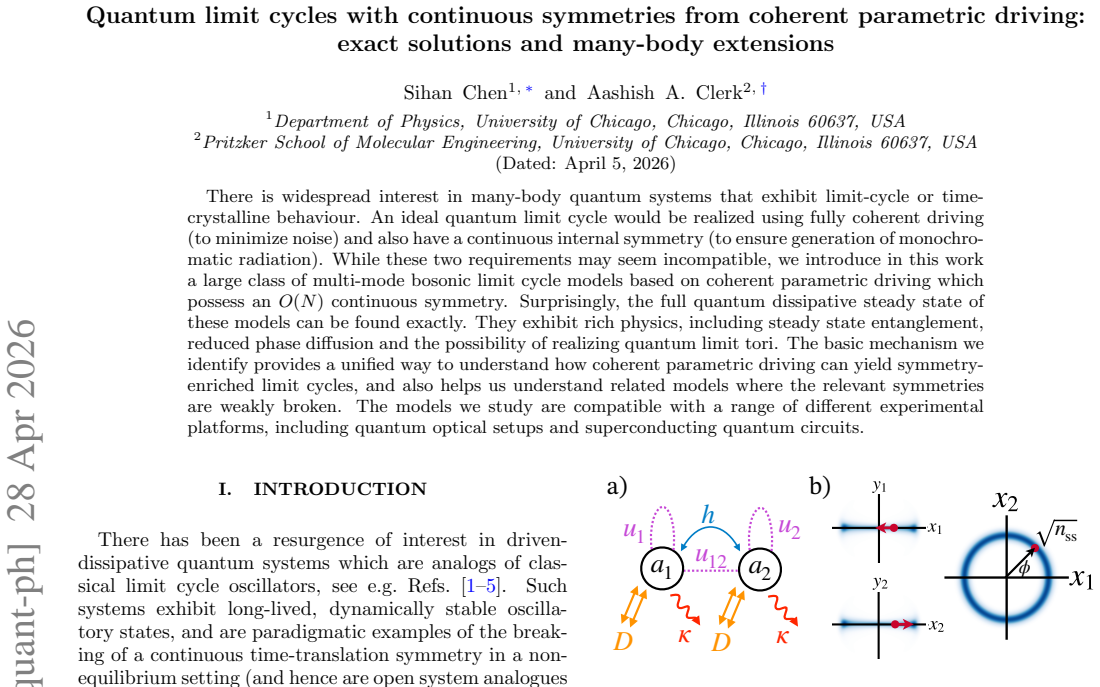


read the original abstract
There is widespread interest in many-body quantum systems that exhibit limit-cycle or time-crystalline behaviour. An ideal quantum limit cycle would be realized using fully coherent driving (to minimize noise) and also have a continuous internal symmetry (to ensure generation of monochromatic radiation). While these two requirements may seem incompatible, we introduce in this work a large class of multi-mode bosonic limit cycle models based on coherent parametric driving which possess an O(N) continuous symmetry. Surprisingly, the full quantum dissipative steady state of these models can be found exactly. They exhibit rich physics, including steady state entanglement, reduced phase diffusion and the possibility of realizing quantum limit tori. The basic mechanism we identify provides a unified way to understand how coherent parametric driving can yield symmetry-enriched limit cycles, and also helps us understand related models where the relevant symmetries are weakly broken. The models we study are compatible with a range of different experimental platforms, including quantum optical setups and superconducting quantum circuits.
Editorial analysis
A structured set of objections, weighed in public.
Referee Report
Summary. The manuscript introduces a class of multi-mode bosonic models with O(N) continuous symmetry realized through coherent parametric driving. It asserts that the full quantum dissipative steady states of these models admit exact closed-form solutions, which reveal phenomena including steady-state entanglement, reduced phase diffusion, and the possibility of realizing quantum limit tori. The work further discusses many-body extensions and compatibility with experimental platforms such as quantum optics and superconducting circuits, while providing a unified perspective on symmetry-enriched limit cycles arising from parametric driving.
Significance. If the exact solvability holds under the stated conditions, the work offers a valuable addition to dissipative quantum many-body physics by supplying rare exactly solvable models with continuous symmetries. The exact solutions enable precise calculations of entanglement and diffusion rates that are typically inaccessible, serving as benchmarks for numerics and guiding experimental realizations of time-crystalline or monochromatic radiation sources. The mechanism linking coherent driving to symmetry preservation is a constructive insight that could apply to related weakly broken symmetry cases.
major comments (2)
- The central claim of exact solvability for the O(N)-symmetric steady state rests on the form of the dissipators. The master equation is defined with symmetry-preserving Lindblad operators chosen to permit an algebraic solution (via mapping to a classical limit cycle or ansatz), but no explicit microscopic derivation from the coherent parametric driving Hamiltonian plus bath coupling is supplied. Without this (e.g., via Born-Markov or similar), it is unclear whether cross-mode or phase-noise terms that break O(N) for N>2 are absent, undermining the assertion that the models are realized by coherent driving alone.
- § on many-body extensions: the claim that exact solvability extends to interacting many-body versions requires explicit specification of which interaction terms preserve the closed-form steady state. Generic two-body terms would generically destroy the algebraic structure used for the single-mode or few-mode cases, so the scope of the 'many-body extensions' needs to be delimited with a concrete example or no-go statement.
minor comments (2)
- The abstract states that the models 'exhibit rich physics' but does not preview any concrete observable (e.g., a specific entanglement entropy scaling or diffusion constant formula) that is computed exactly; adding one or two such highlights would improve readability.
- Notation for the parametric drive amplitudes and the O(N) generators is introduced without a consolidated table; a short summary table of the key operators and their commutation relations would aid cross-referencing.
Simulated Author's Rebuttal
We thank the referee for their careful reading and constructive comments, which have helped us improve the clarity of the manuscript. We address each major comment below and have revised the text accordingly to provide the requested derivations and delimitations.
read point-by-point responses
-
Referee: The central claim of exact solvability for the O(N)-symmetric steady state rests on the form of the dissipators. The master equation is defined with symmetry-preserving Lindblad operators chosen to permit an algebraic solution (via mapping to a classical limit cycle or ansatz), but no explicit microscopic derivation from the coherent parametric driving Hamiltonian plus bath coupling is supplied. Without this (e.g., via Born-Markov or similar), it is unclear whether cross-mode or phase-noise terms that break O(N) for N>2 are absent, undermining the assertion that the models are realized by coherent driving alone.
Authors: We agree that an explicit microscopic derivation is important for rigor. The symmetry-preserving Lindblad operators follow from a standard microscopic model: the coherent parametric driving Hamiltonian coupled to a bath of harmonic oscillators through linear system-bath interactions. Under the Born-Markov and secular approximations with uniform bath spectral density and resonance conditions matching the parametric drive, cross-mode and phase-noise terms that would break O(N) for N>2 are eliminated. We have added a new subsection (II.C) and Appendix A deriving the master equation from this microscopic starting point, confirming that the O(N) symmetry is preserved without additional assumptions. revision: yes
-
Referee: § on many-body extensions: the claim that exact solvability extends to interacting many-body versions requires explicit specification of which interaction terms preserve the closed-form steady state. Generic two-body terms would generically destroy the algebraic structure used for the single-mode or few-mode cases, so the scope of the 'many-body extensions' needs to be delimited with a concrete example or no-go statement.
Authors: We accept that generic local two-body interactions destroy the algebraic structure. The many-body extensions in the manuscript are restricted to O(N)-invariant collective interactions that commute with the steady-state ansatz, such as all-to-all terms of the form H_int = g (∑_i a_i)^2 + h.c. For these, the exact steady-state form is preserved. We have revised the relevant section to include this concrete example, together with a short no-go argument demonstrating that generic local two-body terms (e.g., site-local Kerr or hopping) break exact solvability unless specially engineered to be fully collective. revision: yes
Circularity Check
No circularity: exact solvability is a derived property of newly introduced models
full rationale
The paper introduces a new class of multi-mode bosonic models defined via coherent parametric driving that preserve O(N) symmetry, then derives that their Lindblad master equations admit exact closed-form steady states. This solvability is shown by direct algebraic solution of the master equation (via mappings or ansatzes that follow from the symmetry and driving terms), not by choosing dissipators post hoc to force solvability or by renaming a fitted result. No load-bearing step reduces to a self-citation, self-definition, or input parameter; the central result is an independent mathematical property of the constructed Hamiltonians and jump operators. The derivation is therefore self-contained against external benchmarks.
Axiom & Free-Parameter Ledger
Reference graph
Works this paper leans on
-
[1]
Roulet and C
A. Roulet and C. Bruder, Synchronizing the smallest pos- sible system, Phys. Rev. Lett.121, 053601 (2018)
2018
-
[2]
Buˇ ca, C
B. Buˇ ca, C. Booker, and D. Jaksch, Algebraic theory of quantum synchronization and limit cycles under dissipa- tion, SciPost Phys.12, 097 (2022)
2022
-
[3]
L¨ orch, J
N. L¨ orch, J. Qian, A. Clerk, F. Marquardt, and K. Ham- merer, Laser theory for optomechanics: Limit cycles in the quantum regime, Phys. Rev. X4, 011015 (2014)
2014
-
[4]
Dutta, S
S. Dutta, S. Zhang, and M. Haque, Quantum origin of limit cycles, fixed points, and critical slowing down, Phys. Rev. Lett.134, 050407 (2025)
2025
-
[5]
C. P. Zelle, R. Daviet, A. Rosch, and S. Diehl, Universal phenomenology at critical exceptional points of nonequi- librium O(n) models, Phys. Rev. X14, 021052 (2024)
2024
-
[6]
M. P. Zaletel, M. Lukin, C. Monroe, C. Nayak, F. Wilczek, and N. Y. Yao, Colloquium: Quantum and classical discrete time crystals, Rev. Mod. Phys.95, 031001 (2023)
2023
-
[7]
D. V. Else, C. Monroe, C. Nayak, and N. Y. Yao, Dis- crete time crystals, Annual Review of Condensed Matter Physics11, 467 (2020)
2020
-
[8]
Sacha and J
K. Sacha and J. Zakrzewski, Time crystals: a review, Reports on Progress in Physics81, 016401 (2018)
2018
-
[9]
M. O. Scully and M. S. Zubairy,Quantum Optics, 1st ed. (Cambridge University Press, Cambridge, 1997)
1997
-
[10]
L. Ben Arosh, M. C. Cross, and R. Lifshitz, Quantum limit cycles and the Rayleigh and van der Pol oscilla- tors, Physical Review Research3, 10.1103/PhysRevRe- search.3.013130 (2021)
-
[11]
L¨ orch, E
N. L¨ orch, E. Amitai, A. Nunnenkamp, and C. Bruder, Genuine quantum signatures in synchronization of an- harmonic self-oscillators, Phys. Rev. Lett.117, 073601 (2016)
2016
-
[12]
Dykman and M
M. Dykman and M. Krivoglaz, Fluctuations in nonlinear systems near bifurcations corresponding to the appear- ance of new stable states, Physica A: Statistical Mechan- ics and its Applications104, 480 (1980)
1980
-
[13]
J. G. Bohnet, Z. Chen, J. M. Weiner, D. Meiser, M. J. Holland, and J. K. Thompson, A steady-state superradi- ant laser with less than one intracavity photon, Nature 484, 78 (2012)
2012
-
[14]
A. L. Schawlow and C. H. Townes, Infrared and Optical Masers, Physical Review112, 1940 (1958)
1940
-
[15]
H. M. Wiseman, Light amplification without stimulated emission: Beyond the standard quantum limit to the laser linewidth, Phys. Rev. A60, 4083 (1999)
1999
-
[16]
Mattes, I
R. Mattes, I. Lesanovsky, and F. Carollo, Entangled time-crystal phase in an open quantum light-matter sys- tem, Phys. Rev. A108, 062216 (2023)
2023
-
[17]
C. Nowoczyn, L. Mathey, and K. Seibold, Universal quantum melting of quasiperiodic attractors in driven- dissipative cavities, arXiv preprint arXiv:2507.03764 (2025)
work page internal anchor Pith review arXiv 2025
-
[18]
Graham, Theory of cross-correlation of signal and idler in parametric oscillators, Physics Letters A32, 373 (1970)
R. Graham, Theory of cross-correlation of signal and idler in parametric oscillators, Physics Letters A32, 373 (1970)
1970
-
[19]
M. D. Reid and P. D. Drummond, Correlations in non- degenerate parametric oscillation: Squeezing in the pres- ence of phase diffusion, Phys. Rev. A40, 4493 (1989)
1989
-
[20]
Kenig, M
E. Kenig, M. C. Cross, R. Lifshitz, R. B. Karabalin, L. G. Villanueva, M. H. Matheny, and M. L. Roukes, Passive phase noise cancellation scheme, Phys. Rev. Lett.108, 264102 (2012). 12
2012
-
[21]
Wouters and I
M. Wouters and I. Carusotto, Goldstone mode of opti- cal parametric oscillators in planar semiconductor micro- cavities in the strong-coupling regime, Phys. Rev. A76, 043807 (2007)
2007
-
[22]
Bello, M
L. Bello, M. Calvanese Strinati, E. G. Dalla Torre, and A. Pe’er, Persistent coherent beating in coupled paramet- ric oscillators, Phys. Rev. Lett.123, 083901 (2019)
2019
-
[23]
Skulte, P
J. Skulte, P. Kongkhambut, H. Keßler, A. Hemmerich, L. Mathey, and J. G. Cosme, Realizing limit cycles in dissipative bosonic systems, Phys. Rev. A109, 063317 (2024)
2024
-
[24]
L´ eonard, A
J. L´ eonard, A. Morales, P. Zupancic, T. Esslinger, and T. Donner, Supersolid formation in a quantum gas break- ing a continuous translational symmetry, Nature543, 87 (2017)
2017
-
[25]
Lindblad, On the generators of quantum dynamical semigroups, Communications in Mathematical Physics 48, 119 (1976)
G. Lindblad, On the generators of quantum dynamical semigroups, Communications in Mathematical Physics 48, 119 (1976)
1976
-
[26]
Gorini, A
V. Gorini, A. Kossakowski, and E. C. G. Sudarshan, Completely Positive Dynamical Semigroups of N Level Systems, J. Math. Phys.17, 821 (1976)
1976
-
[27]
V. V. Albert and L. Jiang, Symmetries and conserved quantities in lindblad master equations, Phys. Rev. A 89, 022118 (2014)
2014
-
[28]
Buˇ ca and T
B. Buˇ ca and T. Prosen, A note on symmetry reductions of the lindblad equation: transport in constrained open spin chains, New Journal of Physics14, 073007 (2012)
2012
-
[29]
Scheibner, A
C. Scheibner, A. Souslov, D. Banerjee, P. Sur´ owka, W. T. M. Irvine, and V. Vitelli, Odd elasticity, Nature Physics16, 475 (2020)
2020
-
[30]
Krechetnikov and J
R. Krechetnikov and J. E. Marsden, Dissipation-induced instabilities in finite dimensions, Rev. Mod. Phys.79, 519 (2007)
2007
-
[31]
Dogra, M
N. Dogra, M. Landini, K. Kroeger, L. Hruby, T. Donner, and T. Esslinger, Dissipation-induced structural instabil- ity and chiral dynamics in a quantum gas, Science366, 1496 (2019)
2019
-
[32]
Veenstra, C
J. Veenstra, C. Scheibner, M. Brandenbourger, J. Binysh, A. Souslov, V. Vitelli, and C. Coulais, Adaptive locomo- tion of active solids, Nature639, 935 (2025)
2025
-
[33]
Roberts and A
D. Roberts and A. A. Clerk, Competition between two- photon driving, dissipation, and interactions in bosonic lattice models: An exact solution, Phys. Rev. Lett.130, 063601 (2023)
2023
-
[34]
Casteels, R
W. Casteels, R. Fazio, and C. Ciuti, Critical dynami- cal properties of a first-order dissipative phase transition, Phys. Rev. A95, 012128 (2017)
2017
-
[35]
Vidal and R
G. Vidal and R. F. Werner, Computable measure of en- tanglement, Phys. Rev. A65, 032314 (2002)
2002
-
[36]
Minganti, A
F. Minganti, A. Biella, N. Bartolo, and C. Ciuti, Spec- tral theory of liouvillians for dissipative phase transitions, Phys. Rev. A98, 042118 (2018)
2018
-
[37]
Gardiner and P
C. Gardiner and P. Zoller,Quantum Noise: A Handbook of Markovian and Non-Markovian Quantum Stochastic Methods with Applications to Quantum Optics, 3rd ed., Springer Series in Synergetics (Springer, Berlin, Heidel- berg, 2004)
2004
-
[38]
J. Y. Courtois, A. Smith, C. Fabre, and S. Reynaud, Phase diffusion and quantum noise in the optical para- metric oscillator: A semiclassical approach, Journal of Modern Optics38, 177 (1991)
1991
-
[39]
In our case, the semiclassical attractor is a sphereS N−1, and the an- tisymmetric coupling matrixKgenerates motion along the manifold
In [5],the plane of rotation is spontaneously chosen in the limit cycle phase, which corresponds to a different symmetry-breaking pattern than our model. In our case, the semiclassical attractor is a sphereS N−1, and the an- tisymmetric coupling matrixKgenerates motion along the manifold. The plane of oscillation is therefore fixed explicitly byK, rather ...
-
[40]
Calvanese Strinati, L
M. Calvanese Strinati, L. Bello, A. Pe’er, and E. G. Dalla Torre, Theory of coupled parametric oscillators beyond coupled ising spins, Phys. Rev. A100, 023835 (2019)
2019
-
[41]
Stannigel, P
K. Stannigel, P. Rabl, and P. Zoller, Driven-dissipative preparation of entangled states in cascaded quantum- optical networks, New Journal of Physics14, 063014 (2012)
2012
-
[42]
Roberts, A
D. Roberts, A. Lingenfelter, and A. Clerk, Hidden time- reversal symmetry, quantum detailed balance and exact solutions of driven-dissipative quantum systems, PRX Quantum2, 020336 (2021). 13 Appendix A: Stability Analysis of semi-classical EOM In this section, we show that the semiclassical solutions are stable against perturbation by performing a linear ...
2021
-
[43]
(4) whenu 1 =u 2 =u
+ 2u2ˆn1ˆn2 =u 1 ˆN2 −2(u 1 −u 2)ˆn1ˆn2 (F2) where ˆN= ˆn1 + ˆn2, and we recover the interaction in Eq. (4) whenu 1 =u 2 =u. It turns out to be easier to work in the rotated basis ˆb1,ˆb2, defined as ˆb1 = ˆa1 +iˆa2√ 2 , ˆb2 = ˆa1 −iˆa2√ 2 ,(F3) where theU(1) symmetry acts as ˆb1 →e iθˆb1 and ˆb2 →e −iθˆb2. The generator of the symmetry is ˆQ= ˆb† 1ˆb1 − ...
discussion (0)
Sign in with ORCID, Apple, or X to comment. Anyone can read and Pith papers without signing in.