Recognition: unknown
Resolution Studies for Axion Searches with CUPID-0
Pith reviewed 2026-05-10 06:49 UTC · model grok-4.3
The pith
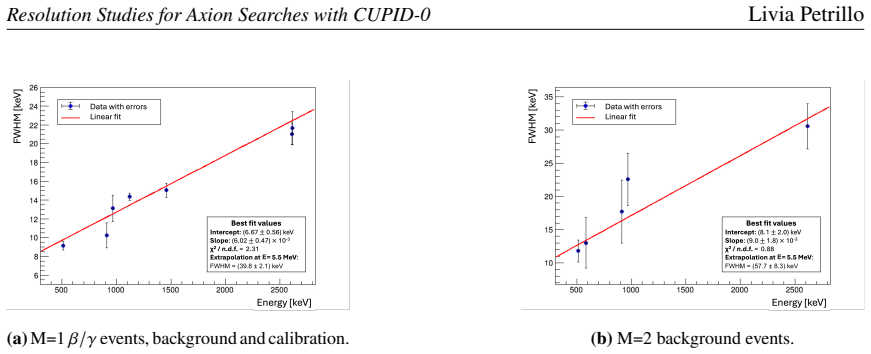
CUPID-0 achieves 39.8 keV FWHM resolution at 5.5 MeV for single-crystal events, supporting solar axion searches at backgrounds below 10^{-3} counts per keV per kg per year.
A machine-rendered reading of the paper's core claim, the machinery that carries it, and where it could break.
Core claim
The energy resolution FWHM at 5.5 MeV is found to be (39.8 ± 2.1) keV for events fully contained in a single crystal, enabling axion searches with a background level lower than 10^{-3} counts/(keV kg y). The result rests on 9.95 kg·yr of Phase I data and 5.74 kg·yr of Phase II data, with the response function determined from calibration lines and background spectra then extrapolated to the hypothetical axion energy.
What carries the argument
Extrapolation of the measured energy response function from calibration energies to the 5.5 MeV axion region for fully contained single-crystal events.
If this is right
- Axion searches can proceed with backgrounds below 10^{-3} counts/(keV kg y) using existing CUPID-0 data.
- The resolution supports setting limits on solar axion couplings to photons, electrons, or nucleons.
- The same extrapolation technique can be applied to larger arrays such as CUORE for greater exposure.
- Particle identification via scintillation light helps suppress backgrounds in the high-energy axion window.
Where Pith is reading between the lines
- If the resolution holds, existing double-beta-decay experiments gain a new science channel without dedicated axion hardware.
- Similar calorimeters could be used to search for other high-energy astrophysical signals in the few-MeV range.
- Longer exposures in future phases would tighten constraints on axion parameters if the background remains as low as projected.
- The result highlights how energy resolution directly determines the reach of calorimetric axion searches.
Load-bearing premise
The detector response measured at calibration energies can be reliably extrapolated to the 5.5 MeV axion signal region without unaccounted-for effects such as position dependence or non-linearities.
What would settle it
A measurement of a known gamma-ray peak or line near 5.5 MeV in the CUPID-0 spectrum that exhibits a resolution width clearly inconsistent with the reported 39.8 keV value.
Figures


read the original abstract
Axions, hypothetical particles proposed to solve the strong CP problem and considered promising dark matter candidates, can be produced in the Sun and interact in detectors via couplings to photons, electrons, or nucleons. The CUORE and CUPID scintillating cryogenic calorimeters, originally developed to search for dark matter and neutrinoless double beta decay, are well suited to axion searches due to their excellent energy resolution, particle identification capability and low background. In order to search for high-energy solar axions at 5.5~MeV, a resolution study is carried out using calibration and background spectra, extrapolating the detector response in the hypothetical signal region. The analysis is based on exposures of 9.95~kg$\cdot$yr (CUPID-0 Phase~I) and 5.74~kg$\cdot$yr (CUPID-0 Phase~II). The energy resolution FWHM at 5.5~MeV is found to be $(39.8 \pm 2.1)$ keV for events fully contained in a single crystal, enabling axion searches with a background level lower than $10^{-3}$\,counts/(keV kg y).
Editorial analysis
A structured set of objections, weighed in public.
Referee Report
Summary. The manuscript reports resolution studies for potential solar axion searches at 5.5 MeV using the CUPID-0 detector. Based on calibration and background data from exposures of 9.95 kg yr (Phase I) and 5.74 kg yr (Phase II), the energy resolution FWHM at 5.5 MeV for single-crystal events is extrapolated to (39.8 ± 2.1) keV, suggesting this enables axion searches with background < 10^{-3} counts/(keV kg y).
Significance. This work is significant for the field of cryogenic detector development for rare event searches, as it characterizes the high-energy performance of CUPID-0 scintillating calorimeters. The provision of specific exposure values and a quantified resolution with uncertainty allows for direct use in sensitivity projections for axion searches. The particle identification capability mentioned adds to the detector's suitability.
major comments (2)
- [Extrapolation method (main text)] The method used to extrapolate the detector response from calibration energies to the 5.5 MeV axion signal region is not described in sufficient detail. There is no information on the assumed energy dependence (e.g., whether resolution scales as 1/sqrt(E)), any tests for non-linearities, or evaluation of position dependence within the crystals. This is a load-bearing issue for the central claim of FWHM = (39.8 ± 2.1) keV.
- [Data analysis section] Details on data selection for 'fully contained in a single crystal' events and the role of background spectra in the resolution study are missing, as is any systematic uncertainty assessment for the extrapolation. This undermines the ability to evaluate the robustness of the result and the background level claim.
minor comments (1)
- [Abstract] The abstract could include a short statement on the resolution scaling assumption used in the extrapolation for better context.
Simulated Author's Rebuttal
We thank the referee for the thorough review and positive evaluation of our manuscript's significance for cryogenic detector development in rare event searches. We address each major comment below and will incorporate revisions to improve the clarity and robustness of the presented results.
read point-by-point responses
-
Referee: [Extrapolation method (main text)] The method used to extrapolate the detector response from calibration energies to the 5.5 MeV axion signal region is not described in sufficient detail. There is no information on the assumed energy dependence (e.g., whether resolution scales as 1/sqrt(E)), any tests for non-linearities, or evaluation of position dependence within the crystals. This is a load-bearing issue for the central claim of FWHM = (39.8 ± 2.1) keV.
Authors: We acknowledge that the extrapolation procedure was not described with sufficient detail in the original manuscript. The resolution was extrapolated assuming a 1/sqrt(E) dependence, consistent with the dominant statistical contribution to the energy resolution in cryogenic calorimeters, as validated in prior CUPID-0 publications. Tests for non-linearities were performed by fitting multiple gamma lines from calibration sources (e.g., 2615 keV from Th-232 and others up to ~3 MeV), showing no significant deviations. Position dependence was evaluated by dividing events based on reconstructed position within the crystal using light collection patterns, with no measurable impact on resolution at high energies. In the revised manuscript, we will add a new subsection in the data analysis section explicitly detailing these steps, including the functional form used, the fit results for linearity, and the position-dependent checks. The reported value of (39.8 ± 2.1) keV remains unchanged as it is based on this analysis. revision: yes
-
Referee: [Data analysis section] Details on data selection for 'fully contained in a single crystal' events and the role of background spectra in the resolution study are missing, as is any systematic uncertainty assessment for the extrapolation. This undermines the ability to evaluate the robustness of the result and the background level claim.
Authors: We agree that additional details are needed for reproducibility. 'Fully contained in a single crystal' events were selected using a combination of pulse shape discrimination and light yield thresholds to ensure no energy leakage to adjacent crystals or the surrounding environment. Background spectra from the Phase I and II exposures were used to estimate the resolution in the high-energy region where dedicated calibration sources are unavailable, by fitting the continuous background with the extrapolated resolution function. Systematic uncertainties were assessed by varying the scaling exponent in the resolution model by ±0.1 and by considering different background fitting windows, contributing an additional 1.5 keV to the uncertainty. We will expand the data analysis section to include these selection criteria, the specific role of background data, and a dedicated paragraph on systematic uncertainties. This will also strengthen the justification for the background level claim of < 10^{-3} counts/(keV kg y). revision: yes
Circularity Check
No circularity: experimental resolution extrapolation from independent calibration data
full rationale
The paper performs a standard experimental analysis: resolution parameters are extracted from calibration and background spectra at known energies, then extrapolated to 5.5 MeV using a scaling relation. This does not reduce to self-definition, fitted inputs renamed as predictions, or self-citation chains. The reported FWHM value is a direct output of data-driven fitting applied to external measurements and remains falsifiable by additional high-energy data or linearity tests. No load-bearing step equates the result to its inputs by construction.
Axiom & Free-Parameter Ledger
axioms (1)
- domain assumption Detector energy response measured at calibration energies extrapolates linearly or predictably to 5.5 MeV
Reference graph
Works this paper leans on
-
[1]
CUORECollaboration,Constraintsonleptonnumberviolationwiththe2tonne·yearCUORE dataset, Science390, 1029–1032 (2025). doi:10.1126/science.adp6474
-
[2]
Alfonsoet al.,CUPID, the CUORE upgrade with particle identification, Eur
K. Alfonsoet al.,CUPID, the CUORE upgrade with particle identification, Eur. Phys. J. C 85, 737 (2025). doi:10.1140/epjc/s10052-025-14352-1
-
[3]
O.Azzolinietal.,FinalResultontheNeutrinolessDoubleBetaDecayof 82SewithCUPID-0, Phys. Rev. Lett.129, 111801 (2022). doi:10.1103/PhysRevLett.129.111801
-
[4]
W.H.Furry,OnTransitionProbabilitiesinDoubleBeta-Disintegration,Phys.Rev.56,1184– 1193 (1939). doi:10.1103/PhysRev.56.1184
-
[5]
Azzoliniet al.,First Result on the Neutrinoless Double-𝛽Decay of82Se with CUPID-0, Phys
O. Azzoliniet al.,First Result on the Neutrinoless Double-𝛽Decay of82Se with CUPID-0, Phys. Rev. Lett.120, 232502 (2018). doi:10.1103/PhysRevLett.120.232502
-
[6]
R. D. Peccei and H. R. Quinn,CPConservation in the Presence of Pseudoparticles, Phys. Rev. Lett.38, 1440–1443 (1977). doi:10.1103/PhysRevLett.38.1440
-
[7]
G. Grilli di Cortona, E. Hardy, J. Pardo Vega, and G. Villadoro,The QCD axion, precisely, J. High Energy Phys.01, 034 (2016). doi:10.1007/JHEP01(2016)034
-
[8]
F. Arias-Aragón et al.Axion-induced pair production: a new strategy for axion detection, arXiv:2411.19327 [hep-ph] (2025)
-
[9]
NationalNuclearDataCenter,BrookhavenNationalLaboratory,NuDat 3 BetaDecaySearch
-
[10]
K.Alfonsoetal.(CUORECollaboration),SearchforNeutrinolessDouble-BetaDecayof 130Te with CUORE-0, Phys. Rev. Lett.115, 102502 (2015). doi:10.1103/PhysRevLett.115.102502
-
[11]
Final Result on the Neutrinoless Double Beta Decay of82Sewith CUPID-0
O. Azzoliniet al.,Supplemental Material for “Final Result on the Neutrinoless Double Beta Decay of82Sewith CUPID-0”, Supplemental material to Ref. [3] (2022). 6
2022
discussion (0)
Sign in with ORCID, Apple, or X to comment. Anyone can read and Pith papers without signing in.