Recognition: unknown
SWAN: World-Aware Adaptive Multimodal Networks for Runtime Variations
Pith reviewed 2026-05-07 16:03 UTC · model grok-4.3
The pith
SWAN is the first adaptive multimodal network that meets a variable user budget while scaling layers to sample complexity and dropping irrelevant tokens.
A machine-rendered reading of the paper's core claim, the machinery that carries it, and where it could break.
Core claim
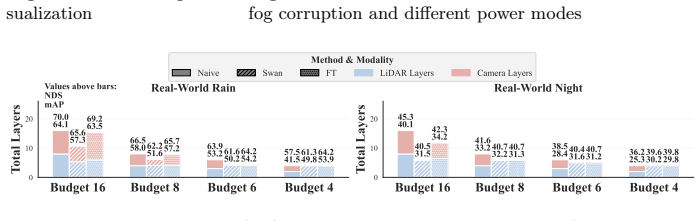
SWAN employs a quality-aware controller to assign resources among modalities according to a variable user-specified maximum budget. Within this budget, an adaptive gating module further optimizes efficiency by scaling layer utilization according to sample complexity. For further gains, SWAN also employs a token dropping module that masks semantically irrelevant multimodal features before performing detections, reducing FLOPs by up to 49 percent with minimal degradation in complex multi-object 3D detection.
What carries the argument
The integrated quality-aware controller that allocates compute across modalities under a user-set budget, together with adaptive gating that matches layer use to per-sample complexity and token dropping that discards irrelevant features.
Load-bearing premise
The three modules can be trained and run together without adding unacceptable latency, training instability, or accuracy loss when runtime conditions differ from the tested autonomous-driving cases.
What would settle it
A controlled test that changes modality quality or scene complexity outside the training distribution and measures whether accuracy stays within the claimed small degradation while the compute budget is still respected.
Figures



read the original abstract
Multimodal deep neural networks deployed in realistic environments must contend with runtime variations: changes in modality quality, overall input complexity, and available platform resources. Current networks struggle with such fluctuations -- adaptive networks cannot adhere to a strict compute budget, controller-based networks neglect to consider input complexity, and statically provisioned networks fail at all the above. Consequently, they do not extract maximum utility from the expended computational resources. We present SWAN (Sample and World-Aware Multimodal Network), the first adaptive multimodal network that accomplishes all three goals. SWAN employs a quality-aware controller to assign resources among modalities according to a variable user-specified maximum budget. Within this budget, an adaptive gating module further optimizes efficiency by scaling layer utilization according to sample complexity. For further gains, SWAN also employs a token dropping module that masks semantically irrelevant multimodal features before performing detections. We evaluate SWAN in the domain of autonomous driving with complex multi-object 3D detection, reducing FLOPs by up to 49% with minimal degradation.
Editorial analysis
A structured set of objections, weighed in public.
Referee Report
Summary. The paper introduces SWAN, a multimodal DNN for runtime variations in autonomous driving. It claims to be the first adaptive network achieving three goals simultaneously: a quality-aware controller that assigns resources across modalities under a variable user-specified maximum budget; an adaptive gating module that scales per-layer utilization according to sample complexity; and a token-dropping module that masks semantically irrelevant multimodal features. The central empirical claim is a reduction of up to 49% FLOPs with minimal degradation on complex multi-object 3D detection.
Significance. If the joint mechanisms can be shown to preserve the strict budget constraint while delivering the reported efficiency gains, the work would address a genuine gap between controller-based and input-adaptive networks. The combination of budget-aware assignment, complexity-driven gating, and semantic dropping is a plausible route to higher resource utility in dynamic environments. However, the absence of any formulation demonstrating budget preservation under the combined dynamics limits the immediate impact.
major comments (2)
- [Abstract / §3] Abstract (and §3, the method description): the claim that the quality-aware controller 'assigns resources among modalities according to a variable user-specified maximum budget' is load-bearing for the central contribution, yet no equation, algorithm, or constraint is supplied showing how the subsequent adaptive gating and token-dropping decisions remain inside that budget at inference time. If gating or dropping occurs after the controller's assignment or if their overhead is not subtracted from the budget, the strict-adherence guarantee fails.
- [§4] §4 (experiments): the reported 49% FLOP reduction with 'minimal degradation' is presented without baselines, error bars, ablation tables, or statistical tests. Because the abstract positions this number as the primary evidence that all three mechanisms can be jointly trained and deployed, the lack of these details directly undermines verification of the empirical claim.
minor comments (2)
- [Title / Abstract] The title uses 'World-Aware' but the abstract never defines the term or distinguishes it from the three listed modules; a one-sentence clarification would help.
- [§3] Notation for the budget variable, gating threshold, and token mask is introduced without a consolidated table of symbols, making cross-references between controller, gating, and dropping sections harder to follow.
Simulated Author's Rebuttal
We thank the referee for their constructive and detailed feedback. We address each major comment below and describe the revisions we will incorporate to strengthen the manuscript.
read point-by-point responses
-
Referee: [Abstract / §3] Abstract (and §3, the method description): the claim that the quality-aware controller 'assigns resources among modalities according to a variable user-specified maximum budget' is load-bearing for the central contribution, yet no equation, algorithm, or constraint is supplied showing how the subsequent adaptive gating and token-dropping decisions remain inside that budget at inference time. If gating or dropping occurs after the controller's assignment or if their overhead is not subtracted from the budget, the strict-adherence guarantee fails.
Authors: We agree that an explicit formulation is required to demonstrate budget preservation when all mechanisms operate together. The current manuscript states that the controller assigns modality-specific resource allocations within the user-specified maximum budget and that gating and token dropping occur within those allocations, but it does not supply a formal constraint or inference algorithm. In the revised version we will add to §3 a precise description of the budget-enforcement procedure, including (i) pre-computation of module overheads, (ii) subtraction of those overheads from the modality budgets before gating and dropping are applied, and (iii) a short pseudocode algorithm that shows the total realized FLOPs remain strictly inside the assigned budget at inference time. revision: yes
-
Referee: [§4] §4 (experiments): the reported 49% FLOP reduction with 'minimal degradation' is presented without baselines, error bars, ablation tables, or statistical tests. Because the abstract positions this number as the primary evidence that all three mechanisms can be jointly trained and deployed, the lack of these details directly undermines verification of the empirical claim.
Authors: We acknowledge that the experimental reporting needs to be more complete to allow independent verification. The 49 % figure is obtained from comparisons against static multimodal baselines and prior adaptive methods on the 3D object-detection task, but the manuscript does not include error bars, full ablation tables, or statistical tests. In the revision we will expand §4 to provide: detailed descriptions of all baselines, error bars from at least five independent runs, comprehensive ablation tables isolating the controller, gating, and token-dropping contributions, and statistical significance tests (paired t-tests and Wilcoxon signed-rank tests) confirming that accuracy degradation remains minimal under the reported FLOP reductions. revision: yes
Circularity Check
No circularity in derivation chain; SWAN is a compositional architecture of independent modules
full rationale
The paper introduces SWAN as a novel combination of three distinct mechanisms (quality-aware controller for budget assignment, adaptive gating for per-sample layer scaling, and token dropping for irrelevant features) evaluated empirically on autonomous-driving 3D detection. No equations, derivations, or self-referential definitions are present that would reduce the reported FLOP reductions or accuracy claims to fitted parameters or inputs defined by the result itself. The architecture is described as a forward composition rather than a tautological re-expression, with no load-bearing self-citations or uniqueness theorems invoked. This matches the default expectation of a self-contained empirical method.
Axiom & Free-Parameter Ledger
invented entities (3)
-
quality-aware controller
no independent evidence
-
adaptive gating module
no independent evidence
-
token dropping module
no independent evidence
Reference graph
Works this paper leans on
- [1]
-
[2]
In: 2024 IEEE Intelligent Vehicles Symposium (IV)
Beemelmanns, T., Zhang, Q., Geller, C., Eckstein, L.: Multicorrupt: A multi-modal robustness dataset and benchmark of lidar-camera fusion for 3d object detection. In: 2024 IEEE Intelligent Vehicles Symposium (IV). pp. 3255–3261. IEEE (2024)
2024
-
[3]
Estimating or Propagating Gradients Through Stochastic Neurons for Conditional Computation
Bengio, Y., Léonard, N., Courville, A.: Estimating or propagating gradi- ents through stochastic neurons for conditional computation. arXiv preprint arXiv:1308.3432 (2013)
work page internal anchor Pith review arXiv 2013
-
[4]
arXiv preprint arXiv:1702.078111(3) (2017)
Bolukbasi, T., Wang, J., Dekel, O., Saligrama, V.: Adaptive neural networks for fast test-time prediction. arXiv preprint arXiv:1702.078111(3) (2017)
-
[5]
In: Proceedings of the IEEE/CVF conference on computer vision and pattern recognition
Caesar, H., Bankiti, V., Lang, A.H., Vora, S., Liong, V.E., Xu, Q., Krishnan, A., Pan, Y., Baldan, G., Beijbom, O.: nuscenes: A multimodal dataset for autonomous driving. In: Proceedings of the IEEE/CVF conference on computer vision and pattern recognition. pp. 11621–11631 (2020)
2020
-
[6]
Once-for-all: Train one network and specialize it for efficient deployment,
Cai, H., Gan, C., Wang, T., Zhang, Z., Han, S.: Once-for-all: Train one network and specialize it for efficient deployment. arXiv preprint arXiv:1908.09791 (2019)
-
[7]
In: proceedings of the IEEE/CVF conference on computer vision and pattern recognition
Chen, X., Zhang, T., Wang, Y., Wang, Y., Zhao, H.: Futr3d: A unified sensor fusion framework for 3d detection. In: proceedings of the IEEE/CVF conference on computer vision and pattern recognition. pp. 172–181 (2023)
2023
-
[8]
arXiv preprint arXiv:1909.11556 , year=
Fan, A., Grave, E., Joulin, A.: Reducing transformer depth on demand with struc- tured dropout. arXiv preprint arXiv:1909.11556 (2019)
-
[9]
In: Proceedings of the IEEE/CVF conference on computer vision and pattern recognition
Fan, L., Pang, Z., Zhang, T., Wang, Y.X., Zhao, H., Wang, F., Wang, N., Zhang, Z.: Embracing single stride 3d object detector with sparse transformer. In: Proceedings of the IEEE/CVF conference on computer vision and pattern recognition. pp. 8458–8468 (2022)
2022
-
[10]
arXiv preprint arXiv:1903.08850 (2019)
Grover, A., Wang, E., Zweig, A., Ermon, S.: Stochastic optimization of sorting networks via continuous relaxations. arXiv preprint arXiv:1903.08850 (2019)
- [11]
-
[12]
arXiv preprint arXiv:1703.09844 (2017)
Huang, G., Chen, D., Li, T., Wu, F., Van Der Maaten, L., Weinberger, K.Q.: Multi-scale dense networks for resource efficient image classification. arXiv preprint arXiv:1703.09844 (2017)
-
[13]
Li, H., Zhang, H., Qi, X., Yang, R., Huang, G.: Improved techniques for training adaptivedeepnetworks.In:ProceedingsoftheIEEE/CVFinternationalconference on computer vision. pp. 1891–1900 (2019) 16 J. Wu et al
1900
-
[14]
In: Proceedings of the IEEE/CVF Conference on Computer Vision and Pattern Recognition (CVPR)
Li, Y., Yu, A.W., Meng, T., Caine, B., Ngiam, J., Peng, D., Shen, J., Lu, Y., Zhou, D., Le, Q.V., Yuille, A., Tan, M.: Deepfusion: Lidar-camera deep fusion for multi-modal 3d object detection. In: Proceedings of the IEEE/CVF Conference on Computer Vision and Pattern Recognition (CVPR). pp. 17182–17191 (June 2022)
2022
-
[15]
In: Proceedings of the IEEE/CVF International Conference on Computer Vision
Liu, L., Su, B., Jiang, J., Wu, G., Guo, C., Xu, C., Yang, H.F.: Towards accurate and efficient 3d object detection for autonomous driving: A mixture of experts com- puting system on edge. In: Proceedings of the IEEE/CVF International Conference on Computer Vision. pp. 25903–25913 (2025)
2025
-
[16]
In: European conference on computer vision
Liu, Y., Wang, T., Zhang, X., Sun, J.: Petr: Position embedding transformation for multi-view 3d object detection. In: European conference on computer vision. pp. 531–548. Springer (2022)
2022
-
[17]
Liu, Z., Lin, Y., Cao, Y., Hu, H., Wei, Y., Zhang, Z., Lin, S., Guo, B.: Swin transformer:Hierarchicalvisiontransformerusingshiftedwindows.In:Proceedings of the IEEE/CVF international conference on computer vision. pp. 10012–10022 (2021)
2021
-
[18]
In: 2023 IEEE international conference on robotics and automation (ICRA)
Liu, Z., Tang, H., Amini, A., Yang, X., Mao, H., Rus, D.L., Han, S.: Bevfusion: Multi-task multi-sensor fusion with unified bird’s-eye view representation. In: 2023 IEEE international conference on robotics and automation (ICRA). pp. 2774–2781. IEEE (2023)
2023
-
[19]
In: Proceedings of the IEEE/CVF conference on computer vision and pattern recognition
Liu, Z., Yang, X., Tang, H., Yang, S., Han, S.: Flatformer: Flattened window attention for efficient point cloud transformer. In: Proceedings of the IEEE/CVF conference on computer vision and pattern recognition. pp. 1200–1211 (2023)
2023
-
[20]
The Concrete Distribution: A Continuous Relaxation of Discrete Random Variables
Maddison, C.J., Mnih, A., Teh, Y.W.: The concrete distribution: A continuous relaxation of discrete random variables. arXiv preprint arXiv:1611.00712 (2016)
work page Pith review arXiv 2016
-
[21]
In: Proceedings of the IEEE/CVF conference on computer vision and pattern recognition
Meng, L., Li, H., Chen, B.C., Lan, S., Wu, Z., Jiang, Y.G., Lim, S.N.: Adavit: Adaptive vision transformers for efficient image recognition. In: Proceedings of the IEEE/CVF conference on computer vision and pattern recognition. pp. 12309– 12318 (2022)
2022
-
[22]
NVIDIA Corporation: NVIDIA TensorRT: High-performance deep learning infer- ence sdk (2024),https://developer.nvidia.com/tensorrt, accessed: 2026-03-04
2024
-
[23]
In: Pro- ceedings of the IEEE/CVF international conference on computer vision
Panda, R., Chen, C.F.R., Fan, Q., Sun, X., Saenko, K., Oliva, A., Feris, R.: Adamml: Adaptive multi-modal learning for efficient video recognition. In: Pro- ceedings of the IEEE/CVF international conference on computer vision. pp. 7576– 7585 (2021)
2021
-
[24]
Advances in neural infor- mation processing systems34, 13937–13949 (2021)
Rao, Y., Zhao, W., Liu, B., Lu, J., Zhou, J., Hsieh, C.J.: Dynamicvit: Efficient vision transformers with dynamic token sparsification. Advances in neural infor- mation processing systems34, 13937–13949 (2021)
2021
- [25]
-
[26]
In: Proceedings of the IEEE/CVF international conference on computer vision
Yan, J., Liu, Y., Sun, J., Jia, F., Li, S., Wang, T., Zhang, X.: Cross modal transformer: Towards fast and robust 3d object detection. In: Proceedings of the IEEE/CVF international conference on computer vision. pp. 18268–18278 (2023)
2023
-
[27]
Yang, Z., Chen, J., Miao, Z., Li, W., Zhu, X., Zhang, L.: Deepinteraction: 3d object detection via modality interaction. Advances in Neural Information Processing Systems35, 1992–2005 (2022) SWAN: World-Aware Adaptive Multimodal Networks for Runtime Variations 17 8 Appendix 8.1 T raining Details We will open source our code for model training and evaluati...
1992
-
[28]
We train the LiDAR-only network for 40 epochs and the camera- only network for 50 epochs on the full nuScenes training dataset
We train the unimodal networks (LiDAR and Camera) with a LayerDrop rate of 0.2. We train the LiDAR-only network for 40 epochs and the camera- only network for 50 epochs on the full nuScenes training dataset
-
[29]
We first initialize the network with the camera weights, and subsequently load in the LiDAR weights
We initialize the multimodal network with weights from both models. We first initialize the network with the camera weights, and subsequently load in the LiDAR weights. For modules that appear in both networks, the Li- DAR weights will override the camera weights. During the training of the multimodal network, we perform modality dropout to prevent overre...
-
[30]
All model weights are frozen with the exception of the controller
We add in the controller and train on theMultiCorruptvariant of the nuScenes dataset. All model weights are frozen with the exception of the controller. Every batch, the controller will sample a budgetbfor the forward pass, enabling seamless switching between budgets during inference time. The controller is trained with lossL=L detection +L env, whereL en...
-
[31]
The SkipGates are trained with lossL=Ldetection +L skip
The SkipGate modules are enabled, and all other model parameters are frozen. The SkipGates are trained with lossL=Ldetection +L skip. Inside the hinge lossL skip,β= 2prevents logits from becoming indefinitely negative. We annealτwithmax( 0.25 epoch ,0.05)and train the SkipGate module for 16 epochs
-
[32]
First, we perform soft token pruning where all other model parameters are frozen, and we discover which tokens can be multiplied by 0 without an adverse effect on the loss
The token pruning module is trained in two stages. First, we perform soft token pruning where all other model parameters are frozen, and we discover which tokens can be multiplied by 0 without an adverse effect on the loss. Note that at this stage, we are still passing the zero tokens into the DETR head. The training occurs for 16 epochs. Next, we perform...
discussion (0)
Sign in with ORCID, Apple, or X to comment. Anyone can read and Pith papers without signing in.