Least constraint approach to non-relativistic quantum mechanics
Pith reviewed 2026-05-07 11:17 UTC · model grok-4.3
The pith
Minimizing a probability-weighted deviation from unconstrained motion, with the quantum potential as constraint force, yields the Schrödinger equation.
A machine-rendered reading of the paper's core claim, the machinery that carries it, and where it could break.
Core claim
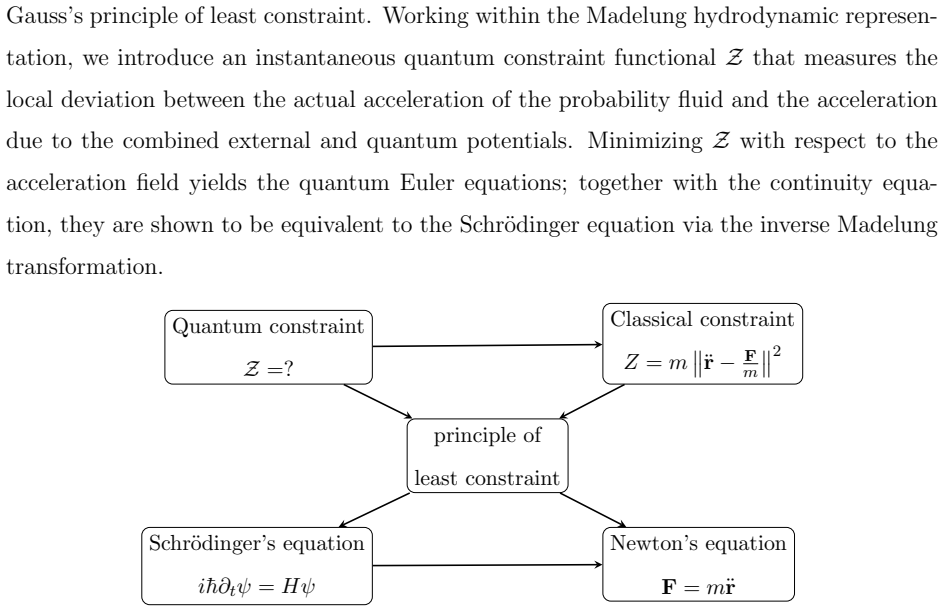
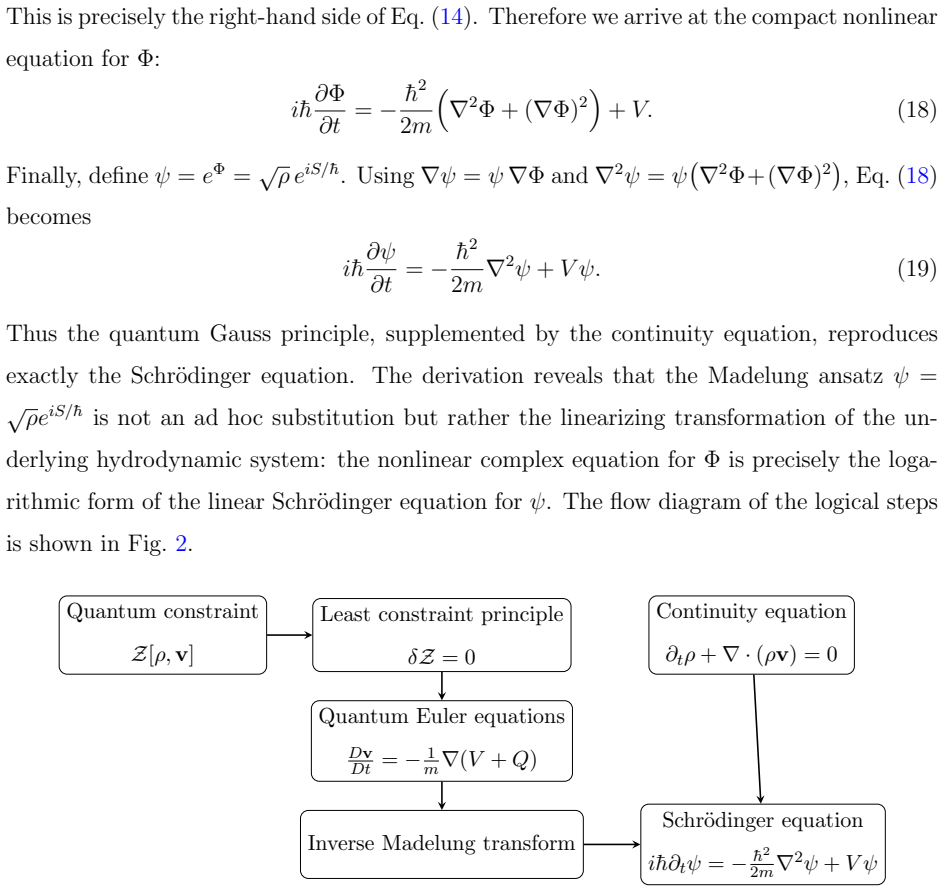
We formulate a variational principle for non-relativistic quantum mechanics inspired by Gauss's principle of least constraint. We define a quantum constraint functional as the probability-weighted square deviation between the actual motion and the unconstrained motion that would arise from external forces alone. In this functional, the quantum potential plays the role of an intrinsic constraint that modifies the acceleration. Minimizing this quantum constraint functional with respect to the acceleration field yields the quantum Euler equations, which together with the continuity equation are equivalent to the Schrödinger equation. The principle is instantaneous and provides a differential, l
What carries the argument
The quantum constraint functional, which measures the probability-weighted square deviation of actual acceleration from the acceleration produced by external forces alone, with the quantum potential acting as the modifying constraint force.
If this is right
- The approach supplies a unified treatment of geometric constraints that is technically more economical than standard global variational formulations.
- Velocity-dependent dissipative forces can be incorporated directly without requiring a global action principle.
- Quantum evolution receives an instantaneous, differential characterization rather than an integral one.
- The equivalence to the Schrödinger equation holds when the quantum Euler equations are combined with the continuity equation.
- The formulation opens indicated applications to a range of quantum phenomena involving constraints or dissipation.
Where Pith is reading between the lines
- Numerical schemes that minimize the constraint functional at each time step could serve as an alternative to traditional wave-function propagation methods.
- The same least-constraint construction may extend naturally to many-body or open quantum systems where classical-style constraints appear.
- Direct comparison of the acceleration fields obtained from this minimization versus standard hydrodynamic formulations would test computational efficiency for constrained problems.
Load-bearing premise
The quantum potential can legitimately be treated as an intrinsic constraint force that modifies acceleration in a manner directly analogous to classical constraints, so that variational minimization governs the dynamics.
What would settle it
Direct numerical minimization of the defined quantum constraint functional for a simple system such as a free particle or harmonic oscillator fails to reproduce the known time evolution given by the Schrödinger equation.
Figures
read the original abstract
We formulate a variational principle for non-relativistic quantum mechanics inspired by Gauss's principle of least constraint. We define a quantum constraint functional as the probability-weighted square deviation between the actual motion and the unconstrained motion that would arise from external forces alone. In this functional, the quantum potential plays the role of an intrinsic constraint that modifies the acceleration. Minimizing this quantum constraint functional with respect to the acceleration field yields the quantum Euler equations, which together with the continuity equation are equivalent to the Schr\"{o}dinger equation. The principle is instantaneous and provides a differential characterization of quantum evolution. We demonstrate that this formulation is not a mere rewriting of existing dynamics: it provides a unified and technically economical treatment of geometric constraints and velocity-dependent dissipative forces, neither of which admits a straightforward global variational formulation. Potential applications to a broad range of quantum phenomena are also indicated.
Editorial analysis
A structured set of objections, weighed in public.
Referee Report
Summary. The manuscript proposes a variational principle for non-relativistic quantum mechanics inspired by Gauss's principle of least constraint. It defines a quantum constraint functional as the probability-weighted squared deviation between actual motion (under external forces plus an intrinsic quantum constraint) and unconstrained motion. The quantum potential is assigned the role of modifying the acceleration within this functional. Minimizing the functional with respect to the acceleration field is asserted to yield the quantum Euler equations; together with the continuity equation these are claimed to be equivalent to the Schrödinger equation. The approach is presented as instantaneous, differential, and capable of unifying geometric constraints with velocity-dependent dissipation in a single framework.
Significance. If the central derivation is non-circular and the quantum potential is introduced independently of the target dynamics, the work would supply a novel classical-mechanics-inspired variational characterization of quantum evolution. It could offer a technically economical route to systems with constraints or dissipation that lack straightforward global variational principles, and the instantaneous formulation might prove useful for numerical or interpretive purposes. The manuscript correctly notes that standard quantum mechanics does not admit such a direct least-constraint treatment, so a successful independent justification would constitute a genuine conceptual advance.
major comments (2)
- [Abstract and formulation of the quantum constraint functional] Abstract and definition of the quantum constraint functional: the quantum potential is introduced as the term that 'modifies the acceleration' inside the functional, yet its explicit form Q = −(ℏ²/2m)(∇²√ρ/√ρ) is the standard expression obtained from the Madelung transformation of the Schrödinger equation. If this expression is inserted prior to minimization, the subsequent variation recovers the known quantum Euler (Madelung) equations by construction rather than from an independent principle. The manuscript must show explicitly how the functional can be written without presupposing this form of Q or the final dynamics.
- [Abstract and derivation of quantum Euler equations] Claim of equivalence (abstract): the text asserts that minimization 'yields the quantum Euler equations, which together with the continuity equation are equivalent to the Schrödinger equation,' but supplies neither the explicit functional derivative with respect to the acceleration field nor a verification that the resulting force term matches the quantum force without circular insertion of Q. A step-by-step calculation (including the variation δ/δa and the identification of the probability-weighted term) is required to substantiate the central claim.
minor comments (2)
- [Abstract] The abstract states that the formulation 'provides a unified and technically economical treatment' of constraints and dissipation, yet does not indicate where in the manuscript these applications are demonstrated or compared with existing approaches.
- [Notation and definitions] Notation for the acceleration field a(x,t) and its relation to the velocity field v = ∇S/m should be introduced with a clear definition before the functional is written, to make the variational procedure unambiguous.
Simulated Author's Rebuttal
We are grateful to the referee for the detailed and insightful comments on our manuscript. The points raised highlight areas where the presentation can be strengthened to better demonstrate the independence of the proposed variational principle. We will make the suggested revisions to provide explicit calculations and clarifications.
read point-by-point responses
-
Referee: Abstract and definition of the quantum constraint functional: the quantum potential is introduced as the term that 'modifies the acceleration' inside the functional, yet its explicit form Q = −(ℏ²/2m)(∇²√ρ/√ρ) is the standard expression obtained from the Madelung transformation of the Schrödinger equation. If this expression is inserted prior to minimization, the subsequent variation recovers the known quantum Euler (Madelung) equations by construction rather than from an independent principle. The manuscript must show explicitly how the functional can be written without presupposing this form of Q or the final dynamics.
Authors: We agree that the current presentation may give the impression of circularity by directly inserting the standard form of the quantum potential. In the revised manuscript, we will first formulate the quantum constraint functional using a general intrinsic constraint acceleration term that modifies the motion, without specifying its form. We will then perform the minimization with respect to the acceleration field and show that this leads to the quantum Euler equations, where the constraint term is identified with the gradient of the quantum potential. The explicit form of Q will be introduced subsequently as the specific constraint that reproduces the known quantum dynamics, motivated independently by the requirement to incorporate quantum effects into the hydrodynamic description. This structure ensures the variational principle is applied independently, with the form of Q serving as the definition of the quantum constraint rather than being derived from the Schrödinger equation within the variation itself. We will add this stepwise presentation to the formulation section. revision: yes
-
Referee: Claim of equivalence (abstract): the text asserts that minimization 'yields the quantum Euler equations, which together with the continuity equation are equivalent to the Schrödinger equation,' but supplies neither the explicit functional derivative with respect to the acceleration field nor a verification that the resulting force term matches the quantum force without circular insertion of Q. A step-by-step calculation (including the variation δ/δa and the identification of the probability-weighted term) is required to substantiate the central claim.
Authors: We will revise the manuscript to include a detailed, step-by-step derivation of the minimization process. Specifically, we will compute the functional derivative of the quantum constraint functional with respect to the acceleration field a, demonstrating that the stationarity condition δJ/δa = 0 directly yields the quantum Euler equation a = F_ext/m - (1/m) ∇Q, where the probability weighting arises naturally from the functional definition. This calculation will be presented without presupposing the final form of the equations, showing explicitly how the variation identifies the effective force term. Combined with the continuity equation, this establishes the equivalence to the Schrödinger equation via the Madelung transformation in reverse. The revised text will contain the full variation, including all intermediate steps and the role of the probability density ρ. revision: yes
Circularity Check
Quantum potential (from Madelung/Schrödinger) inserted into constraint functional before minimization recovers the same equations
specific steps
-
self definitional
[Abstract (definition of quantum constraint functional)]
"We define a quantum constraint functional as the probability-weighted square deviation between the actual motion and the unconstrained motion that would arise from external forces alone. In this functional, the quantum potential plays the role of an intrinsic constraint that modifies the acceleration. Minimizing this quantum constraint functional with respect to the acceleration field yields the quantum Euler equations, which together with the continuity equation are equivalent to the Schrödinger equation."
The functional is constructed by inserting the conventional Q = −(ℏ²/2m)(∇²√ρ/√ρ) (derived from Schrödinger via Madelung) as the 'intrinsic constraint'. The subsequent minimization step therefore recovers the known quantum Euler/Madelung equations by definition rather than from an independent first-principles variational principle.
full rationale
The paper defines the quantum constraint functional using the standard quantum potential Q (known to be obtained by substituting the polar ansatz into the Schrödinger equation and separating real/imaginary parts). Minimizing this functional w.r.t. acceleration then yields the quantum Euler equations, which are asserted equivalent to Schrödinger. This reduces the central claim to a tautology by construction unless Q is justified independently of the target dynamics, which the provided text does not demonstrate. The abstract's phrasing confirms the definitional step is load-bearing.
Axiom & Free-Parameter Ledger
axioms (2)
- domain assumption The quantum potential functions as an intrinsic constraint that modifies acceleration exactly as classical constraints do.
- ad hoc to paper Minimizing the defined functional with respect to the acceleration field produces the correct quantum dynamics.
invented entities (2)
-
Quantum constraint functional
no independent evidence
-
Quantum Euler equations
no independent evidence
Reference graph
Works this paper leans on
-
[1]
Feynman.Space-Time Approach to Non-Relativistic Quantum Mechanics.Reviews of Modern Physics,1948
R.P. Feynman, Space-time approach to non-relativistic quantum mechanics, Rev. Mod. Phys. 20 (1948) 367–387.https://doi.org/10.1103/RevModPhys.20.367
-
[2]
A. Rojo, A. Bloch, The Principle of Least Action: History and Physics, Cambridge University Press, Cambridge, 2018
work page 2018
-
[3]
Kostin, On the Schr¨ odinger–Langevin equation, J
M.D. Kostin, On the Schr¨ odinger–Langevin equation, J. Chem. Phys. 57 (1972) 3589–3591. https://doi.org/10.1063/1.1678812
-
[4]
L. ´A. Gergely, On Hamiltonian formulations of the Schr¨ odinger system, Ann. Phys. 298 (2002) 394–402.https://doi.org/10.1006/aphy.2002.6262
-
[5]
P.A.M. Dirac, Generalized Hamiltonian dynamics, Can. J. Math. 2 (1950) 129–148.https: //doi.org/10.4153/CJM-1950-012-1
-
[6]
Gauss, ¨Uber ein neues allgemeines Grundgesetz der Mechanik, J
C.F. Gauss, ¨Uber ein neues allgemeines Grundgesetz der Mechanik, J. Reine Angew. Math. 4 (1829) 232–235
-
[7]
H. Hertz, Die Prinzipien der Mechanik in neuem Zusammenhange dargestellt (1894); English translation: The Principles of Mechanics Presented in a New Form, Dover, New York, 1956
work page 1956
-
[8]
A suggested interpretation of the quan- tum theory in terms of ”hidden” variables
D. Bohm, A suggested interpretation of the quantum theory in terms of “hidden” variables, I and II, Phys. Rev. 85 (1952) 166–179; 180–193.https://doi.org/10.1103/PhysRev.85.166 https://doi.org/10.1103/PhysRev.85.180. 14
-
[9]
da Costa, Quantum mechanics of a constrained particle, Phys
R.C.T. da Costa, Quantum mechanics of a constrained particle, Phys. Rev. A 23 (1981) 1982– 1987.https://doi.org/10.1103/PhysRevA.23.1982
-
[10]
da Costa, Constraints in quantum mechanics, Phys
R.C.T. da Costa, Constraints in quantum mechanics, Phys. Rev. A 25 (1982) 2893–2900. https://doi.org/10.1103/PhysRevA.25.2893. 15
discussion (0)
Sign in with ORCID, Apple, or X to comment. Anyone can read and Pith papers without signing in.