Third-order intrinsic anomalous Hall effect as a transport fingerprint of altermagnets
Pith reviewed 2026-05-07 11:02 UTC · model grok-4.3
The pith
The third-order intrinsic anomalous Hall effect serves as a transport fingerprint for altermagnets once spin-orbit coupling is included.
A machine-rendered reading of the paper's core claim, the machinery that carries it, and where it could break.
Core claim
Based on spin-group symmetry analysis, the third-order IAHE is generically allowed in the ten spin Laue groups relevant to altermagnets when spin-orbit coupling is taken into account. By combining these symmetry constraints with the anomalous velocity induced by the second-order Berry curvature, a resonant third-order IAHE arises near the altermagnetic band crossings at generic momenta in both the Lieb-lattice altermagnet and the experimentally realized altermagnet V2Se2O. The Berry curvature quadrupole, encoded in the second-order Berry curvature and activated by finite SOC, is identified as the microscopic quantum geometric origin of this resonance. This establishes the third-order IAHE as
What carries the argument
The Berry curvature quadrupole from the second-order Berry curvature under spin-orbit coupling, which supplies the anomalous velocity for the third-order response in symmetry-allowed altermagnetic systems.
If this is right
- The third-order IAHE distinguishes altermagnets from ferromagnets and PT-symmetric antiferromagnets in transport measurements.
- Resonant signals appear near altermagnetic band crossings at generic momenta.
- The effect occurs in both model systems such as the Lieb lattice and real materials such as V2Se2O.
- It completes the hierarchy of intrinsic anomalous Hall effects across collinear quantum magnets.
Where Pith is reading between the lines
- This response could enable purely electrical detection of altermagnetic order in devices without applied magnetic fields.
- Higher-order nonlinear Hall effects may appear in other classes of symmetry-broken magnets once similar symmetry and geometric analyses are applied.
- Strain or doping could shift the band crossings to tune the resonance frequency or strength for practical sensors.
Load-bearing premise
That the second-order Berry curvature produces an anomalous velocity which, when combined with the symmetry-allowed third-order response, yields a measurable resonant effect at generic momenta once spin-orbit coupling is included.
What would settle it
Transport measurements on V2Se2O showing no resonant peak in the third-order Hall conductivity near the predicted altermagnetic band crossings would falsify the resonance mechanism.
Figures


read the original abstract
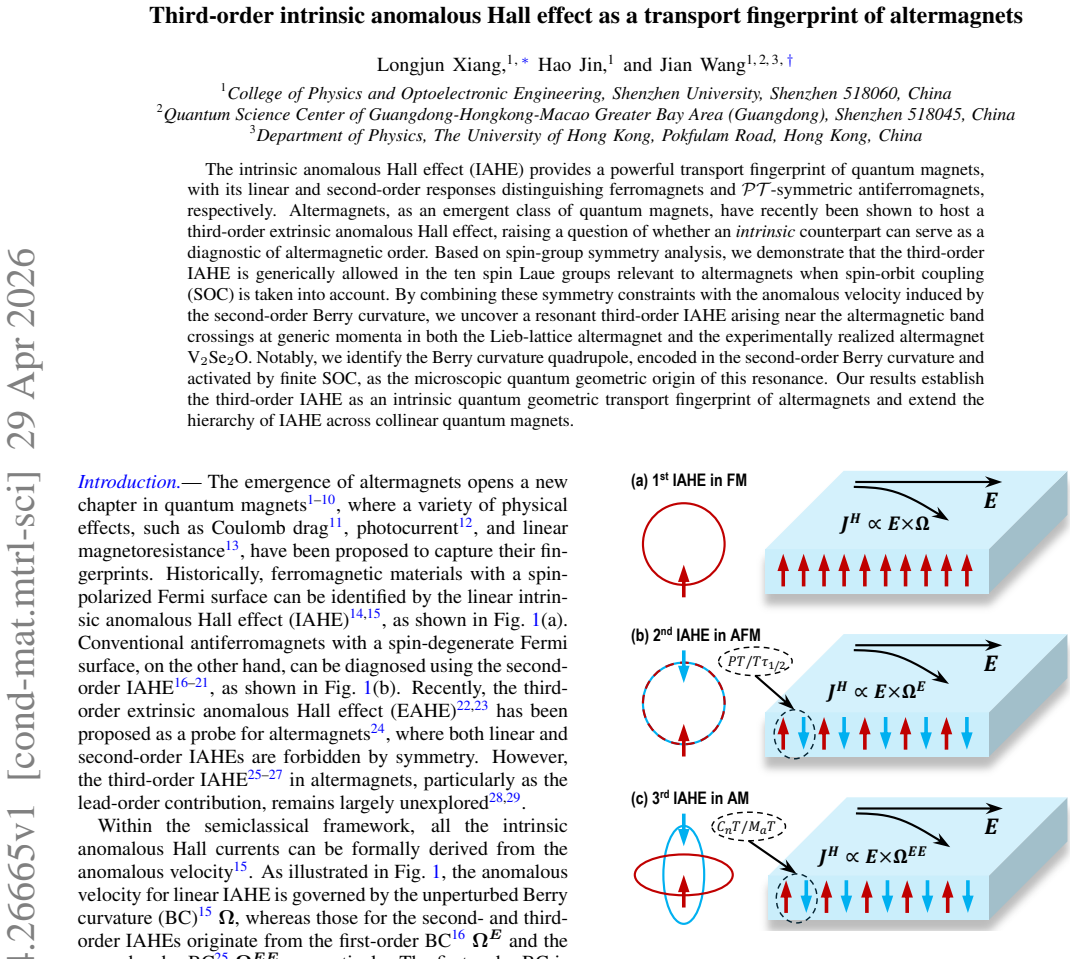
The intrinsic anomalous Hall effect (IAHE) provides a powerful transport fingerprint of quantum magnets, with its linear and second-order responses distinguishing ferromagnets and $\mathcal{P}\mathcal{T}$-symmetric antiferromagnets, respectively. Altermagnets, as an emergent class of quantum magnets, have recently been shown to host a third-order extrinsic anomalous Hall effect, raising a question of whether an \textit{intrinsic} counterpart can serve as a diagnostic of altermagnetic order. Based on spin-group symmetry analysis, we demonstrate that the third-order IAHE is generically allowed in the ten spin Laue groups relevant to altermagnets when spin-orbit coupling (SOC) is taken into account. By combining these symmetry constraints with the anomalous velocity induced by the second-order Berry curvature, we uncover a resonant third-order IAHE arising near the altermagnetic band crossings at generic momenta in both the Lieb-lattice altermagnet and the experimentally realized altermagnet V$_2$Se$_2$O. Notably, we identify the Berry curvature quadrupole, encoded in the second-order Berry curvature and activated by finite SOC, as the microscopic quantum geometric origin of this resonance. Our results establish the third-order IAHE as an intrinsic quantum geometric transport fingerprint of altermagnets and extend the hierarchy of IAHE across collinear quantum magnets.
Editorial analysis
A structured set of objections, weighed in public.
Referee Report
Summary. The manuscript claims that spin-group symmetry analysis shows the third-order intrinsic anomalous Hall effect (IAHE) is generically allowed in the ten spin Laue groups relevant to altermagnets once spin-orbit coupling (SOC) is included. Combining this permission with the anomalous velocity from second-order Berry curvature, the authors identify a resonant third-order IAHE near altermagnetic band crossings at generic momenta in both a Lieb-lattice model and the material V2Se2O, with the Berry curvature quadrupole as the quantum-geometric origin. This positions the third-order IAHE as an intrinsic transport fingerprint distinguishing altermagnets within the hierarchy of collinear quantum magnets.
Significance. If the central claims hold, the work supplies a new intrinsic, quantum-geometric diagnostic for altermagnetic order that complements existing linear and second-order IAHE distinctions for ferromagnets and PT-symmetric antiferromagnets. The explicit linkage of symmetry-allowed tensor components to a resonant response driven by the Berry curvature quadrupole, together with concrete calculations on both a lattice model and an experimentally realized compound, provides a falsifiable prediction that could guide nonlinear transport experiments.
major comments (2)
- [Symmetry analysis] § on spin-group symmetry analysis (near the statement that third-order IAHE is 'generically allowed in the ten spin Laue groups when SOC is taken into account'): the claim that the relevant components of the third-order conductivity tensor remain symmetry-allowed once SOC is included is load-bearing for the entire argument. SOC explicitly entangles spin and orbital degrees of freedom and reduces the symmetry from spin groups to the appropriate magnetic point or space group. The manuscript must demonstrate, either by explicit enumeration of allowed tensor components under the SOC-reduced group or by a side-by-side comparison, that the third-order IAHE terms survive this reduction; otherwise the 'generically allowed' statement and the subsequent resonance construction do not follow.
- [Model calculations] Model calculations section (Lieb lattice and V2Se2O results): the reported resonance is attributed to the combination of symmetry-allowed third-order terms with the anomalous velocity from second-order Berry curvature. The manuscript should explicitly show which tensor components are activated, their scaling with SOC strength, and confirmation that the resonance vanishes when the symmetry-allowed channels are artificially suppressed. Without this decomposition the link between the symmetry analysis and the numerical resonance remains indirect.
minor comments (2)
- [Abstract and introduction] The abstract and introduction would benefit from a brief, explicit list or table of the ten spin Laue groups under consideration.
- [Notation] Notation for the third-order response tensor (e.g., σ_ijk or its nonlinear generalization) should be defined once and used consistently; currently the transition between linear, second-order, and third-order conductivities can be confusing on first reading.
Simulated Author's Rebuttal
We thank the referee for the careful reading and constructive comments, which help clarify key aspects of our symmetry analysis and numerical results. We address each major comment point by point below and will revise the manuscript to incorporate the suggested improvements.
read point-by-point responses
-
Referee: [Symmetry analysis] § on spin-group symmetry analysis (near the statement that third-order IAHE is 'generically allowed in the ten spin Laue groups when SOC is taken into account'): the claim that the relevant components of the third-order conductivity tensor remain symmetry-allowed once SOC is included is load-bearing for the entire argument. SOC explicitly entangles spin and orbital degrees of freedom and reduces the symmetry from spin groups to the appropriate magnetic point or space group. The manuscript must demonstrate, either by explicit enumeration of allowed tensor components under the SOC-reduced group or by a side-by-side comparison, that the third-order IAHE terms survive this reduction; otherwise the 'generically allowed' statement and the subsequent resonance construction do not follow.
Authors: We agree that an explicit demonstration is required to confirm the third-order IAHE tensor components survive the symmetry reduction from spin groups to magnetic point groups upon including SOC. In the revised manuscript we will add a side-by-side comparison of the allowed components under the ten spin Laue groups (without SOC) versus the corresponding magnetic point groups (with SOC). This enumeration will show that the relevant third-order conductivity tensor elements enabling the IAHE remain symmetry-allowed for altermagnets, thereby supporting the generic allowance statement and the subsequent resonance analysis. revision: yes
-
Referee: [Model calculations] Model calculations section (Lieb lattice and V2Se2O results): the reported resonance is attributed to the combination of symmetry-allowed third-order terms with the anomalous velocity from second-order Berry curvature. The manuscript should explicitly show which tensor components are activated, their scaling with SOC strength, and confirmation that the resonance vanishes when the symmetry-allowed channels are artificially suppressed. Without this decomposition the link between the symmetry analysis and the numerical resonance remains indirect.
Authors: We acknowledge that the numerical results would benefit from a more explicit decomposition linking the symmetry-allowed terms to the observed resonance. In the revised version we will identify the specific activated tensor components in both the Lieb-lattice model and V2Se2O calculations. We will also report the scaling of the third-order IAHE with SOC strength and include supplementary calculations in which the symmetry-allowed channels are suppressed (by zeroing relevant Berry curvature quadrupole contributions or modifying the Hamiltonian to eliminate the permitted terms while retaining other symmetries). These additions will directly confirm that the resonance originates from the symmetry-allowed third-order IAHE and strengthen the connection to the symmetry analysis. revision: yes
Circularity Check
No significant circularity; symmetry analysis and quantum geometry are independent of fitted inputs
full rationale
The derivation begins with spin-group symmetry analysis applied to the ten Laue groups for altermagnets, determining allowed third-order IAHE tensor components once SOC is included. These constraints are then combined with the standard anomalous velocity from second-order Berry curvature to identify a resonance near generic-momentum band crossings. Model calculations on the Lieb lattice and V2Se2O serve as explicit realizations rather than tautological fits. No equation reduces a claimed prediction to a parameter fitted from the target data, no load-bearing step collapses to a self-citation chain, and the central result does not rename a known empirical pattern. The chain remains self-contained against external group-theoretic and quantum-geometric benchmarks.
Axiom & Free-Parameter Ledger
axioms (2)
- domain assumption Spin-group symmetry analysis determines allowed higher-order Hall responses in altermagnets
- domain assumption Anomalous velocity is induced by the second-order Berry curvature
Reference graph
Works this paper leans on
-
[1]
L. S mejkal, R. Gonz\'alez-Hern\'andez, T. Jungwirth, and J. Sinova, Crystal time-reversal symmetry breaking and spontaneous Hall effect in collinear antiferromagnets, Sci. Adv. 6, eaaz8809 (2020) https://doi.org/10.1126/sciadv.aaz8809
-
[2]
L. S mejkal, J. Sinova, and T. Jungwirth, Beyond Conventional Ferromagnetism and Antiferromagnetism: A Phase with Nonrelativistic Spin and Crystal Rotation Symmetry, Phys. Rev. X 12, 031042 (2022) https://doi.org/10.1103/PhysRevX.12.031042
-
[3]
L. S mejkal, J. Sinova, and T. Jungwirth, Emerging Research Landscape of Altermagnetism, Phys. Rev. X 12, 040501 (2022) https://doi.org/10.1103/PhysRevX.12.040501
-
[4]
L. Bai, W. Feng, S. Liu, L. S mejkal, Y. Mokrousov, and Y. Yao, Altermagnetism: Exploring New Frontiers in Magnetism and Spintronics, Adv. Funct. Mater. 34, 2409327 (2024) https://doi.org/10.1002/adfm.202409327
-
[5]
C. Wu, K. Sun, E. Fradkin, and S. C. Zhang, Fermi liquid instabilities in the spin channel, Phys. Rev. B 75, 115103 (2007) https://doi.org/10.1103/PhysRevB.75.115103
-
[6]
Momentum- dependent spin splitting by collinear antiferromagnetic ordering,
S. Hayami, Y. Yanagi, and H. Kusunose, Momentum-Dependent Spin Splitting by Collinear Antiferromagnetic Ordering, J. Phys. Soc. Jpn. 88, 123702 (2019) https://doi.org/10.7566/JPSJ.88.123702
-
[7]
L. Yuan, Z. Wang, J. Luo, E. I. Rashba, and A. Zunger, Giant momentum-dependent spin splitting in centrosymmetric low- Z antiferromagnets, Phys. Rev. B 102, 014422 (2020) https://doi.org/10.1103/PhysRevB.102.014422
-
[8]
H. Ma, M. Hu, N. Li, J. Liu, W. Yao, J. Jia, and J. Liu, Multifunctional antiferromagnetic materials with giant piezomagnetism and noncollinear spin current, Nat. Commun. 12, 2846 (2021) https://doi.org/10.1038/s41467-021-23127-7
-
[9]
Mazin, Editorial: Altermagnetism—A New Punch Line of Fundamental Magnetism.Phys
I. Mazin, Editorial: Altermagnetism—A New Punch Line of Fundamental Magnetism, Phys. Rev. X 12, 040002 (2022) https://doi.org/10.1103/PhysRevX.12.040002
-
[10]
C. Song, H. Bai, Z. Zhou, L. Han, H. Reichlova, J. H. Dil, J. Liu, X. Chen, and F. Pan, Altermagnets as a new class of functional materials, Nat. Rev. Mater. 10, 473 (2025) https://doi.org/10.1038/s41578-025-00779-1
-
[11]
H. Lin, S. Zhang, H. Lu, and X. C. Xie, Coulomb Drag in Altermagnets, Phys. Rev. Lett. 134, 136301 (2025) https://doi.org/10.1103/PhysRevLett.134.136301
-
[12]
X. Jiang, U. Jeong, S. Sato, D. Shin, K. Yabana, B. Yan, and N. Park, Nonlinear Photocurrent as a Hallmark of Altermagnet, ACS Nano 19, 23620 (2025) https://doi.org/10.1021/acsnano.5c01421
-
[13]
K. Das and B. Yan, Linear Magnetoresistance as a Probe of the N\'eel Vector in Altermagnets with Vanishing Anomalous Hall Effect, Preprint at https://doi.org/10.48550/arXiv.2603.12692 https://doi.org/10.48550/arXiv.2603.12692
-
[14]
N. Nagaosa, J. Sinova, S. Onoda, A. H. MacDonald, and N. P. Ong, Anomalous Hall effect, Rev. Mod. Phys. 82, 1539 (2010) https://doi.org/10.1103/RevModPhys.82.1539
-
[15]
D. Xiao, M.-C. Chang, and Q. Niu, Berry phase effects on electronic properties, Rev. Mod. Phys. 82, 1959 (2010). https://doi.org/10.1103/RevModPhys.82.1959
-
[16]
Y. Gao, S. Y. A. Yang, and Q. Niu, Field Induced Positional Shift of Bloch Electrons and Its Dynamical Implications, https://doi.org/10.1103/PhysRevLett.112.166601 Phys. Rev. Lett. 112, 166601 (2014)
-
[17]
C. Wang, Y. Gao, and D. Xiao, Intrinsic nonlinear Hall effect in antiferromagnetic tetragonal CuMnAs, https://doi.org/10.1103/PhysRevLett.127.277201 Phys. Rev. Lett. 127, 277201 (2021)
-
[18]
H. Liu, J. Zhao, Y.-X. Huang, W. Wu, X.-L. Sheng, C. Xiao, and S. Y. A. Yang, Intrinsic second-order anomalous Hall effect and its application in compensated antiferromagnets, https://doi.org/10.1103/PhysRevLett.127.277202 Phys. Rev. Lett. 127, 277202 (2021)
-
[19]
A. Gao, Y.-F. Liu, J.-X. Qiu, B. Ghosh, T. V. Trevisan, Y. Onishi, C. Hu, T. Qian, H.-J. Tien, S.-W. Chen, et al., Quantum metric nonlinear Hall effect in a topological antiferromagnetic heterostructure, https://doi.org/10.1126/science.adf1506 Science 381, 181 (2023)
-
[20]
N. Wang, D. Kaplan, Z. Zhang, T. Holder, N. Cao, A. Wang, X. Zhou, F. Zhou, Z. Jiang, C. Zhang et al., Quantum-metric-induced nonlinear transport in a topological antiferromagnet, https://doi.org/10.1038/s41586-023-06363-3 Nature (London) 621, 487 (2023)
-
[21]
J. Han, T. Uchimura, Y. Araki, J.-Y. Yoon, Y. Takeuchi, Y. Yamane, S. Kanai, J. Ieda, H. Ohno, and S. Fukami, Room-temperature flexible manipulation of the quantum-metric structure in a topological chiral antiferromagnet, Nat. Phys. 20, 1110 (2024). https://doi.org/10.1038/s41567-024-02476-2
-
[22]
C.-P. Zhang, X.-J. Gao, Y.-M. Xie, H. C. Po, and K. T. Law, Higher-order nonlinear anomalous Hall effects induced by Berry curvature multipoles, Phys. Rev. B 107, 115142 (2023). https://doi.org/10.1103/PhysRevB.107.115142
-
[23]
S. Lai, H. Liu, Z. Zhang, J. Zhao, X. Feng, N. Wang, C. Tang, Y. Liu, K. S. Novoselov, S. A. Yang, and W.-B Gao, Third-order nonlinear Hall effect induced by the Berry-connection polarizability tensor, Nat. Nanotechnol. 16, 869 (2021) https://doi.org/10.1038/s41565-021-00917-0
-
[24]
R. Chu, L. Han, Z. Gong, X. Fu, H. Bai, S. Liang, C. Chen, S-W. Cheong, Y. Zhang, J. Liu, Y. Wang, F. Pan, H. Lu, and C. Song, Third-Order Nonlinear Hall Effect in Altermagnet RuO _2 , Phys. Rev. Lett. 135, 216703 (2025) https://doi.org/10.1103/rv1n-vr4p
-
[25]
L. Xiang, C. Zhang, L. Wang, and J. Wang, Third-order intrinsic anomalous Hall effect with generalized semiclassical theory, Phys. Rev. B 107, 075411 (2023) https://doi.org/10.1103/PhysRevB.107.075411
-
[26]
D. Mandal, S. Sarkar, K. Das, and A. Agarwal, Quantum geometry induced third-order nonlinear transport responses, Phys. Rev. B 110, 195131 (2024) https://doi.org/10.1103/PhysRevB.110.195131
-
[27]
A. K. Dagnino, X. Liu, and T. Neupert, Non-linear transport in multifold semimetals, Preprint at https://doi.org/10.48550/arXiv.2512.08891 https://doi.org/10.48550/arXiv.2512.08891
-
[28]
Y. Fang, J. Cano, and S. A. A. Ghorashi, Quantum geometry induced nonlinear transport in altermagnets, Phys. Rev. Lett. 133, 106701 (2024) https://doi.org/10.1103/PhysRevLett.133.106701
-
[29]
H. Chen, P. Qin, Z. Meng, G. Zhao, K. Chen, C. Xi, X. Wang, L. Liu, Z. Duan, S. Jiang, J. Li, X. Tan, J. Liu, J. Wang, H. Liu, C. Jiang, and Z. Liu, Giant room-temperature third-order electrical transport in a thin-film altermagnet candidate, Nat. Nanotechnol. XXX, XXXX (2026) https://doi.org/10.1038/s41565-026-02159-4
-
[30]
Z. Liu, M. Wei, W. Peng, D. Hou, Y. Gao, and Q. Niu, Multipolar Anisotropy in Anomalous Hall Effect from Spin-Group Symmetry Breaking, Phys. Rev. X 15, 031006 (2025) https://doi.org/10.1103/PhysRevX.15.031006
-
[31]
X. Feng, L. K. Ang, S. A. Yang, C. Xiao, and X. C. Xie, Giant Out-of-Plane Magnetic Orbital Torque of Altermagnets from Spin-Group Symmetry Breaking, Preprint at https://doi.org/10.48550/arXiv.2602.19076 https://doi.org/10.48550/arXiv.2602.19076
-
[32]
B. Brekke, A. Brataas, and A. Sudb , Two-dimensional altermagnets: Superconductivity in a minimal microscopic model, Phys. Rev. B 108, 224421 (2023) https://doi.org/10.1103/PhysRevB.108.224421
-
[33]
D. S. Antonenko, R. M. Fernandes, and J. W. F. Venderbos, Mirror Chern Bands and Weyl Nodal Loops in Altermagnets, Phys. Rev. Lett. 134, 096703 (2025) https://doi.org/10.1103/PhysRevLett.134.096703
-
[34]
X. Cheng, Y. Gao, J. Peng, and J. Liu, Realistic tight-binding model for V2Se2O-family altermagnets, Preprint at https://doi.org/10.48550/arXiv.2602.09465 https://doi.org/10.48550/arXiv.2602.09465
-
[35]
F. Zhang, X. Cheng, Z. Yin, C. Liu, L. Deng, Y. Qiao, Z. Shi, S. Zhang, J. Lin, Z. Liu, M. Ye, Y. Huang, X. Meng, C. Zhang, T. Okuda, K. Shimada, S. Cui, Y. Zhao, G.-H. Cao, S. Qiao, J. Liu, and C. Chen, Crystal-symmetry-paired spin–valley locking in a layered room-temperature metallic altermagnet candidate, Nat. Phys. 21, 760 (2025) https://doi.org/10.10...
-
[36]
Jiang et al., A metallic room-temperature d- wave altermagnet, Nat
B. Jiang, M. Hu, J. Bai, Z. Song, C. Mu, G. Qu, W. Li, W. Zhu, H. Pi, Z. Wei, Y.-J. Sun, Y. Huang, X. Zheng, Y. Peng, L. He, S. Li, J. Luo, Z. Li, G. Chen, H. Li, H. Weng, and T. Qian, A metallic room-temperature d-wave altermagnet, Nat. Phys. 21, 754 (2025) https://doi.org/10.1038/s41567-025-02822-y
-
[37]
Q. Hu, X. Cheng, Q. Duan, Y. Hu, B. Jiang, Y. Xiao, Y. Li, M. Pan, L. Deng, C. Liu, G. Cao, Z. Liu, M. Ye, S. Qiao, Z. Liu, Z. Sun, A. Gao, Y. Huang, R. Zhong, J. Liu, B. Lv, and H. Ding, Observation of spin--valley locked nodal lines in a quasi-2D altermagnet, Preprint at arXiv:2601.02883 (2026) https://doi.org/10.48550/arXiv.2601.02883
-
[38]
D. E. Parker, T. Morimoto, J. Orenstein, and J. E. Moore, Diagrammatic approach to nonlinear optical response with application to Weyl semimetals, Phys. Rev. B 99, 045121 (2019) https://doi.org/10.1103/PhysRevB.99.045121
-
[39]
S. Sankar, R. Liu, C.-P. Zhang, Q.-F. Li, C. Chen, X.-J. Gao, J. Zheng, Y.-H. Lin, K. Qian, R.-P. Yu, X. Zhang, Z. Y. Meng, K. T. Law, Q. Shao, and B. J\" a ck, Experimental evidence for a Berry curvature quadrupole in an antiferromagnet, Phys. Rev. X 14, 021046 (2024) https://doi.org/10.1103/PhysRevX.14.021046
-
[40]
Quantum geometric map of magnetotransport
L. Xiang, J. Jia, F. Xu, and J. Wang, Classification of electromagnetic responses by quantum geometry, Preprint at https://doi.org/10.48550/arXiv.2510.02661 https://doi.org/10.48550/arXiv.2510.02661
work page internal anchor Pith review Pith/arXiv arXiv doi:10.48550/arxiv.2510.02661
-
[41]
J. Jia, L. Xiang, Z. Qiao, and J. Wang, Equivalence of semiclassical and response theories for second-order nonlinear ac Hall effects, Phys. Rev. B 110, 245406 (2024). https://doi.org/10.1103/PhysRevB.110.245406
-
[42]
A. M. Cook, B. M. Fregoso, F. de Juan, S. Coh, and J. E. Moore, Design principles for shift current, Nat. Commun. 8, 14176 (2017) https://doi.org/10.1038/ncomms14176
-
[43]
Note that the T -even third-order EAHE, arising from the quantum metric quadrupole BCQ4, QMQ1, QMQ2 , can be distinguished from the intrinsic one in experiments and will not be discussed in this work
-
[44]
H. Li, C. Zhang, C. Zhou, C. Ma, X. Lei, Z. Jin, H. He, B. Li, K. T. Law, and J. Wang, Quantum geometry quadrupole-induced third-order nonlinear transport in antiferromagnetic topological insulator MnBi _2 Te _4 , Nat. Commun. 15, 7779 (2024). https://doi.org/10.1038/s41467-024-52206-8
-
[45]
X. Liu, A. Wang, D. Li, T. Zhao, X. Liao, and Z. M. Liao, Giant Third-Order Nonlinearity Induced by the Quantum Metric Quadrupole in Few-Layer WTe _2 , Phys. Rev. Lett. 134, 026305 (2025). https://doi.org/10.1103/PhysRevLett.134.026305
-
[46]
In a moderately dirty altermagnetic metal with alter2024, alter2026 10^ -14 s , we find that ^ (0) _ abcd / ^ (2) _ abcd 40 with a light doping 10^ -2 eV
By dimensional analysis, we find ^ (0) _ abcd / ^ (2) _ abcd ^2/( )^2 , where is the chemical potential controlled by the doping. In a moderately dirty altermagnetic metal with alter2024, alter2026 10^ -14 s , we find that ^ (0) _ abcd / ^ (2) _ abcd 40 with a light doping 10^ -2 eV
-
[47]
Mehraeen, Quantum Response Theory and Momentum-Space Gravity, Phys
M. Mehraeen, Quantum Response Theory and Momentum-Space Gravity, Phys. Rev. Lett. 135, 156302 (2025) https://doi.org/10.1103/t6nt-qzws
-
[48]
Note that both _ abcd ^ (0) and _ abc are spinless
-
[49]
Without the assumption of N j and N E , the spin point group ^26/^2m can support the elements ^ (0) _ yzxx and ^ (0) _ yzxy while the spin point group ^2/^2m^2m^1m can support the elements ^ (0) _ yzxx =- ^ (0) _ zyxy =- ^ (0) _ zxxy in presence of SOC
-
[50]
T. Berlijn, P. C. Snijders, O. Delaire, H.-D. Zhou, T. A. Maier, H.-B. Cao, S.-X. Chi, M. Matsuda, and Y. Wang, Itinerant Antiferromagnetism in RuO _2 , Phys. Rev. Lett. 118, 077201 (2017) https://doi.org/10.1103/PhysRevLett.118.077201
-
[51]
Z. H. Zhu, J. Strempfer, R. R. Rao, C. A. Occhialini, J. Pelliciari, Y. Choi, T. Kawaguchi, H. You, J. F. Mitchell, Y. Shao-Horn, and R. Comin, Anomalous Antiferromagnetism in Metallic RuO _2 Determined by Resonant X-ray Scattering, Phys. Rev. Lett. 122, 017202 (2019) https://doi.org/10.1103/PhysRevLett.122.017202
-
[52]
M. Hiraishi, H. Okabe, A. Koda, R. Kadono, T. Muroi, D. Hirai, and Z. Hiroi, Nonmagnetic Ground State in RuO _2 Revealed by Muon Spin Rotation, Phys. Rev. Lett. 132, 166702 (2024) https://doi.org/10.1103/PhysRevLett.132.166702
-
[53]
P. Ke ler, L. Garcia-Gassull, A. Suter, T. Prokscha, Z. Salman, D. Khalyavin, P. Manuel, F. Orlandi, I. I. Mazin, R. Valent\'i, and S. Moser, Absence of magnetic order in RuO _2 : insights from SR spectroscopy and neutron diffraction, npj Spintronics 2, 50 (2024) https://doi.org/10.1038/s41535-024-00550-4
-
[54]
(12) Ortiz, R.; Strutyński, K.; Melle-Franco, M
S. Reimers, L. Odenbreit, L. S mejkal, V. N. Strocov, P. Constantinou, A. B. Hellenes, R. Jaeschke Ubiergo, W. H. Campos, V. K. Bharadwaj, A. Chakraborty, T. Denneulin, W. Shi, R. E. Dunin-Borkowski, S. Das, M. Kläui, J. Sinova, and M. Jourdan, Direct observation of altermagnetic band splitting in CrSb thin films, Nat. Commun. 15, 2116 (2024) https://doi....
-
[55]
J. Ding, Z. Jiang, X. Chen, Z. Tao, Z. Liu, T. Li, J. Liu, J. Sun, J. Cheng et al., Large Band Splitting in g -Wave Altermagnet CrSb, Phys. Rev. Lett. 133, 206401 (2024) https://doi.org/10.1103/PhysRevLett.133.206401
-
[56]
G. Yang, Z. Li, S. Yang, J. Li, H. Zheng, W. Zhu, Z. Pan, Y. Xu, S. Cao, W. Zhao, A. Jana, J. Zhang, M. Ye, Y. Song, L.-H. Hu, L. Yang, J. Fujii, I. Vobornik, M. Shi, H. Yuan, Y. Zhang, Y. Xu, and Y. Liu, Three-dimensional mapping of the altermagnetic spin splitting in CrSb, Nat. Commun. 16, 1442 (2025) https://doi.org/10.1038/s41467-025-56647-7
-
[57]
M. Zeng, M.-Y. Zhu, Y.-P. Zhu, X.-R. Liu, X.-M. Ma, Y.-J. Hao, P. Liu, G. Qu, Y. Yang, Z. Jiang, K. Yamagami, M. Arita, X. Zhang, T.-H. Shao, Y. Dai, K. Shimada, Z. Liu, M. Ye, Y. Huang, Q. Liu, and C. Liu, Observation of Spin Splitting in Room-Temperature Metallic Antiferromagnet CrSb, Adv. Sci. 11, 2406529 (2024) https://doi.org/10.1002/advs.202406529
-
[58]
S. Lee, S. Lee, S. Jung, J. Jung, D. Kim, Y. Lee, B. Seok, J. Kim, B. G. Park, L. S mejkal, C.-J. Kang, and C. Kim, Broken Kramers Degeneracy in Altermagnetic MnTe, Phys. Rev. Lett. 132, 036702 (2024) https://doi.org/10.1103/PhysRevLett.132.036702
-
[59]
J. Krempask\'y et al., Altermagnetic lifting of Kramers spin degeneracy, Nature 626, 517 (2024) https://doi.org/10.1038/s41586-023-06907-7
-
[60]
Osumi,et al., Observation of a giant band splitting in altermagnetic MnTe.Phys
T. Osumi, S. Souma, T. Aoyama, K. Yamauchi, A. Honma, K. Nakayama, T. Takahashi, K. Ohgushi, and T. Sato, Observation of a giant band splitting in altermagnetic MnTe, Phys. Rev. B 109, 115102 (2024) https://doi.org/10.1103/PhysRevB.109.115102
-
[61]
See supplementary Material
discussion (0)
Sign in with ORCID, Apple, or X to comment. Anyone can read and Pith papers without signing in.